Gutting: Should Everyone Vote?

An op-ed piece in The New York Times by Gary Gutting, a professor of philosophy at the University of Notre Dame:

At election time we inevitably hear earnest pleas for everyone to vote. Voter participation is a data point often cited in political studies, along with an assumption that the higher the percentage, the better: 100 percent participation is the goal. But we rarely question this belief, or objectively consider whether everyone who can vote ought to vote.

The author then outlines the problems of mass democracy, including ‘trumpery’, plutocracy and rational ignorance, and attempts to justify voting as an act of participatory solidarity. But he goes on to consider sortition as an alternative:

At least one political philosopher has put forward the radical idea that we could ensure informed voters by employing an “enfranchisement lottery.” Such a lottery would restrict voting to a randomly chosen group of citizens who are provided unbiased in-depth information relevant to an election. We can think of this approach as a matter of modeling our voting on our jury system. We would never accept deciding important and highly publicized trials by a vote of the general public. We think only people fully informed of the facts and relevant arguments put forward in a trial should make such important judgments. Shouldn’t we be at least as careful in deciding who should be president?

Notice that answering yes does not imply the elitist view that only a small minority of citizens are capable of making informed votes. The idea is not that voters are too stupid or biased to access the needed information; it’s just that they don’t have the time and resources to do so. Ideally, we would provide everyone with the relevant knowledge, but that would be impractical, time-consuming and expensive.

Continue reading

Allotted bodies better than referenda

Two new articles argue that allotted bodes are a better democratic tool than referenda. Both criticize the referenda system for asking the public to make uninformed decisions and both invoke the Athenian precedent. There are also some differences for the sharp-eyed reader to pick out.

Simon Threlkeld writes in Truthout:

Let Juries Legislate: Why Citizen Juries Are Better Than the Ballot Initiative for Citizen Lawmaking

Twenty-four US states have the ballot initiative. Unfortunately, the process is heavily skewed in favor of rich interests and unsuitable for making informed decisions. A much better method of citizen lawmaking is needed.

[…]

Classical Athens, often called the birthplace of democracy, sheds light on how citizen lawmaking can be done in an informed, fair and highly democratic way. In Athens, much of the decision-making was done by various juries chosen from the citizens by lottery. This kept a wide range of decisions in the hands of the citizens, prevented elite rule and provided a more informed version of citizen rule than popular vote.

Keith Sutherland writes in openDemocracy:

The Brexit lottery

On June 23, Britain will go to the polls to decide whether or not the country should remain a member of the European Union. David Cameron’s in–out referendum on EU membership is, ostensibly, about finding out what the people want. But there is a better, and more democratic, way.

[…]

Referendums are swayed by irrelevant issues, are “very blunt instruments” and the outcome would be “a lottery”, [Peter Mandelson] said. In a sense, Lord Mandelson is right – the experience of countries like Ireland, where referendums are commonplace, suggests that they are often used to give the government of the day a kicking, rather than deal with the issue at hand. And yet a different kind of lottery could be more representative of public opinion than a referendum vote.
Continue reading

Why Not Choose Members of Congress by Lottery?

Terrill Bouricius, David Schecter, Campbell Wallace, and John Gastil write on Zócalo on KCRW:

We Already Randomly Select Our Juries. Why Not Choose Members of Congress by Lottery?

Conflicts of interest, corruption, and systemic dysfunction are woven through American legislative history, from Tammany Hall in the 1780s to the Savings & Loan crisis of the 1980s and the recent federal government shutdown. One reason is that the electoral system itself often attracts the wrong kind of candidates and rewards unethical campaigning. Gerrymandered district boundaries, voter suppression efforts, and winner-take-all election laws serve to restrict voter choices. People who choose to run for election are too often driven by ego and personal ambition, qualities at odds with the genuine give and take of deliberation. Donald Trump may seem to stand out in this regard, but his character flaws are less distinctive than his willingness to parade them publicly as a kind of perverse populist brand.

So why not random selection instead? Yes, tossing Congress, en masse, out its own front door and refilling the chamber with everyday citizens might seem like a crazy idea. But when asked about this prospect in surveys conducted in 1999 and 2012, Americans place more trust in a randomly-selected body than in Congress.

So what if we took that idea seriously? Could we replace some of our elections with selection by lot, also known as “sortition?”

Sortition, Voting, and Democratic Equality

On another note, a paper of mine just appeared in Critical Review of International Social and Political Philosophy CRISPP). The paper, entitled “Sortition, Voting, and Democratic Equality,” appears in a special issue devoted to “Equal Representation: New Perspectives on Democratic Theory” (volume 19, no. 3, June 2016). The paper can be found here:

http://www.tandfonline.com/doi/full/10.1080/13698230.2016.1144858

Here is the abstract:

In recent years, democrats both inside and outside the academy have begun to reconsider the merits of the age-old practice of sortition, the random selection of political officials. Despite this fact, however, the comparative assessment of the merits of voting and sortition remains in its infancy. This paper will advance this project by treating the problem of assigning public responsibilities as a problem of allocative justice. To treat the problem in this manner is to treat public office as a type of good to which citizens might have various claims. Random selection is the appropriate method for distributing public office when all citizens have equal claims to that office and there is not enough to go around. Universal distribution is more appropriate when all claimants have equal claims to the office and there is enough to go around (as with universal suffrage, for example). Election (or possibly other procedures, such as appointment) makes sense when citizens do not enjoy equal claims to the office and that office is in scarce supply. This approach captures a crucial component of democratic equality. Different understandings of democratic equality lay behind sortition and election. Each might be appropriate under different circumstances, but both place rights-based constraints on the design of a democratic political system.

Paul Cartledge: The case for sortition is persuasive

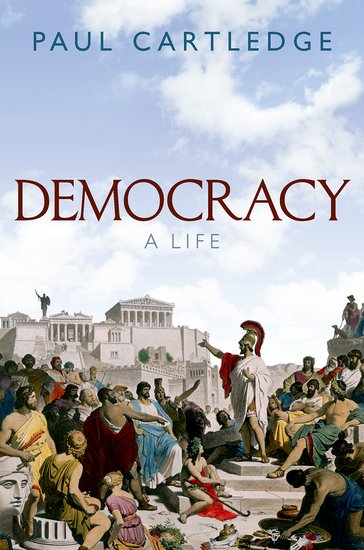
Just read a short piece by Paul Cartledge in which he talks about the history of sortition, a topic treated more extensively in his book Democracy: A Life (Oxford University Press). He even manages to plug my own book, The Luck of the Draw: The Role of Lotteries in Decision Making (also Oxford University Press) along the way. Check it out:

It is quite easy to compile a checklist, perhaps even a decalogue, of differences between their democracy (or rather democracies, as there was no one identikit ancient model) and ours (ditto). And in no respect did they and we differ more than on the issue of sortition, that is, the application of the lottery to the conduct of politics (another Greek invention, both the word and the thing, with – again – the accent to be placed on difference as well as similarity between theirs and ours). We today take the exercise of voting in either general or local elections to be the very quintessence of what it is to do ‘democracy.’ The ancient Greeks took the exact opposite view: elections were elitist and for the nobs, appropriate more for oligarchy (the rule of the few rich) than for democracy (the rule of the masses, most of whom were poor), whereas sortition, the lot, was the peculiarly democratic way of selecting most office-holders and all juror-judges to serve in the People’s jury-courts.
Continue reading

Sortition – Part 2: the book, the AGM, and a strategy

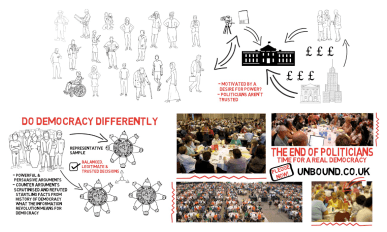
The End of Politicians screeenshotHere’s the latest on the new book on sortition, and two events in London next week: the Citizens’ Parliament strategy meeting, and the Sortition Foundation’s first Annual General Meeting.

Read on for more details on all of the above.

Continue reading

Aftermath of the Irish Election

I recently ran in the Irish general election that was held on Feb. 26th as an Independent (Non-Party) candidate, campaigning on a platform of direct digital democracy.

As some of you may know, this election did not deliver a clear winner or even a clear coalition. A month on, a government has yet to be formed. While some prefer to see this as an argument in favour of the need for stronger government and an end to Independents like me, my view is that it is but one further indictment of the party system. The major parties did badly because they refused (for years) to listen to the people who voted for them, and utterly failed during their campaigns to credibly address any of the mistakes they had made or even to present reasonable solutions for the future. Despite these failures, rather than getting on with the business of governing the country, we are left in limbo waiting to see whether any of them (Fianna Fail, Fine Gael and Sinn Fein) will condescend to form a government with each other. This is a distinct possibility for Fianna Fail and Fine Gael, who between them received nearly 60% of all seats with less than 50% of first-preference votes. The constantly trumpeted line that the public voted for the establishment parties is thus wildly over-stated, and there has definitely been a serious push towards alternative politics.

I definitely noticed this while out canvassing, with most people at least open to the idea of more participatory politics and a surprising number already fairly well-informed about participatory initiatives at home and abroad. Most surprisingly of all, I could knock on people’s doors out of the blue and they would not only answer the door, but read through my literature there and then and really engage with the issues.
Continue reading

Rousseau’s Mistake

A recent article by Hélène Landemore:

Rousseau’s Mistake: Representation and the Myth of Direct Democracy

Abstract: For Rousseau, democracy was direct or it wasn’t. As he famously put it, “the moment a people allows itself to be represented, it is no longer free: it no longer exists. The day you elect representatives is the day you lose your freedom” (Social Contract, III, 15). In other words, representative democracy is no democracy at all. Rousseau isn’t alone in this belief, and today the disappointed of representative government have turned to celebrating anew the virtues of direct democracy as more true to the ideal of popular sovereignty, self-rule, and genuine political equality. This paper defends the thesis that Rousseau was, in fact, mistaken and that there is no salvation to be found in the ideal of direct democracy. If democracy as a political regime is always, in fact, representative, then the interesting question is not: direct or representative democracy? But instead: What kind of representation should we aim for? The paper argues that beyond the familiar electoral model there are at least two other models of representation that present attractive features: the first is based on sortition and the other on self-selection.

Continue reading

Policy and representation

There are two activities that go under the heading “Public Policy”, one that concentrates on political processes, as we do here on this website, and the other that is the focus of university departments of Public Policy and numerous professional associations. The first group (call them PPs) are concerned with political processes of arriving at political decisions, the second (call them PNs) with identifying needs in the community and devising means of satisfying those needs.

The two hardly ever engage with each other. If they did, the PPs would no doubt say to the PNs: you are at best just paternalists, patching up holes in the status quo, arrogating to yourselves decisions about what others need. To which the PNs might reply: you PPs are just entrenching the power of existing adults to suit yourselves. You completely neglect the fact that the young are in no position to understand what lies ahead of them and many disadvantaged people are deprived of the means of understanding what it is that they need to overcome their disabilities. They depend on the ‘paternalistic’ interest of competent professionals to bring about the changes that will open up opportunities for them. With all due respect, you PPs, however benevolent, are not very good at that. Your concern is framed by your own experience and aspirations, drawn from your past, not by any understanding of the potential of the future. You just want to replicate yourselves.

There is a lot more to be said on both sides. I’m an old PP, but one of my daughters, both of whom I greatly admire, is a very successful PN in educational policy. More significantly, there is a lot of empirical evidence that adult representation leads to decisions that favour the old at the expense of the young. Especially as life expectancies increase, we oldies and potential oldies would outvote the young by large margins, if it were a question of deciding policy by voting. Such arguments as these challenge the supremacy of representation as the unique ground of legitimate intervention on behalf of others. I am talking here of debates on policy, not about the right to legislate or administer programs. Status in public debates is not a matter of authorisation of any sort, but of the validity of arguments.
Continue reading

Sortition: the idea, the meeting, and a strategy

[Latest news from the Sortition Foundation blog]

There’s exciting news from the Sortition Foundation:

  • The idea: A new “compelling, inspiring” book on sortition, The End of Politicians, by director and co-founder of the Sortition Foundation, Brett Hennig, is being crowd-funded now by book publisher Unbound: https://unbound.co.uk/books/the-end-of-politicians

The-End-of-Politicians-screeenshot

  • The meeting: The first Sortition Foundation Annual General Meeting will be held at 6pm on Wednesday April 6th in central London. Venue to be confirmed depending on numbers, so please RSVP if you intend to come along.
  • The Strategy: A strategy meeting on how to progress the Citizens’ Parliament campaign (http://www.citizensparliament.uk/) will also be held on Wednesday April 6th from 1-4pm in central London. Exact venue will also depend on numbers, so please RSVP if you want to come along.

Read on for more details on all of the above.

Continue reading