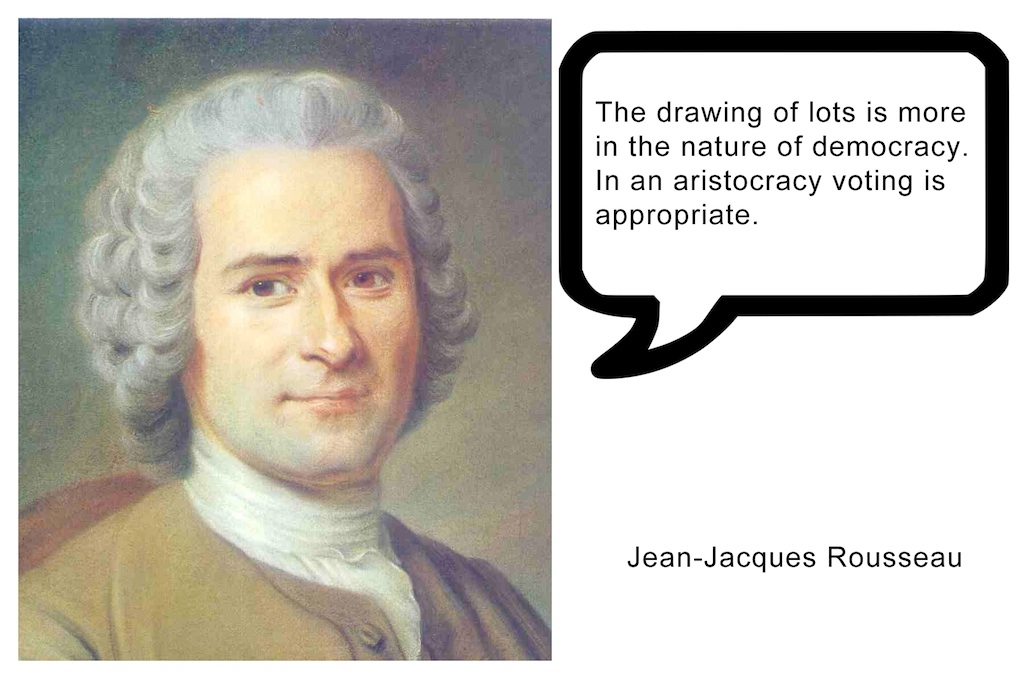
Elections in Israel are in the offing again. Prof. Irad Malkin, a professor of Ancient History in Tel Aviv University and winner of the 2014 Israel Prize for history, againoffers sortition to the readers of the Israeli newspaper Haaretz:
Lottery instead of voting, like in Athens
In these days, in which parties are preparing for elections, especially in view of the increase of the electoral threshold, an exhausting process of political fighting, deals, backstabbing and ideological infighting can be expected. Even if a new party is formed and wins seats in the Knesset, residues of bitterness and animosity that have accumulated during the formation struggle will remain. This problem can be solved – greatly shortening the process and dissolving the conflicts in advance – by adopting a mechanism that was used in ancient Athens, the city that gave us democracy.
In the Athenian democracy people were selected by lottery to most positions in the executive, religious and judicial organization. […] The difference between oligrachy and democracy, say Aristotle, is that oligarchy has elections while democracy has the lottery.
It would be very disappointing to find that the jury principal was fatally flawed, not the sure defence of the rights of the individual against the over-mighty power of the State that we have always believed.
A Grand Jury seems (for us) a superb idea. Following a significant and contested incident a random selection of 23 (?) citizens is summoned to hear the evidence, debate it and decide on a course of action. Rather than stilling protest, in the US the Grand Jury seems to foment it.
So could I ask our US contributors to explain (and I apologise for using this forum for FAQs).
Is a Grand Jury (GJ) as I’ve described it above?
What is wrong with the process that makes its verdicts so un-acceptable?
A new Spanish political party called “Podemos” (“we can”) has seen meteoric growth in public support according to opinion polls. According to some polls, it has now surpassed in popularity the two major Spanish parties.
Its founding manifesto (a somewhat awkward translation here) presents Podemos as an outgrowth of the 2011 “Indignados” protests and the unrepresentative nature of the existing system:
Turning outrage into political change
Just as with other moments in history, we see today a European continent submerged in perplexity. Whilst the majorities look back with nostalgia on the past that is lost, certain powerful minorities, with no criterion other than their own survival, show that enrichment is their flag and impunity their horizon. Never in Europe have there been so many people discontented with their loss of rights, and, at the same time, so few prospects for channeling this outrage through a voting option that excites while at the same time, shows the capacity to represent the majorities under attack and a capacity for committed and efficient administration that makes the best possible options become real. Many find it intolerable that in the greatest crisis in the system since the crash of 1929, those forces that claim to be progressive are at their weakest point, thereby condemning the majorities in our countries to a kind of melancholy that leads to resignation and political depression. [Excerpted from the translation linked above with my touch ups.]
Peter Joneswrites in The Spectator about the differences between the Athenian system the modern electoralist system. Unfortunately, while Jones makes some very valid points, his description of the Athenian system elides its most important democratic institute, sortition, and his reform proposals go down the standard mistaken route of emphasizing mass participation:
The lesson of Athens: to make people care about politics, give them real power
We don’t, as far as the Greeks are concerned, really do politics; we just elect people to do it for us
Voters explain their apathy about politics on the grounds that the politicians do not understand them. No surprise there, an ancient Greek would say, since the electorate does not actually do politics. It simply elects politicians who do, thereby cutting out the voters almost entirely.
But the contrast with 5th and 4th century bc Athens does not simply consist in the fact that all decisions, both political and legal, were made by the Athenian citizen body meeting every week in Assembly. As Pericles’ Funeral Speech (430 bc) famously demonstrates, what is so striking about Athens is that the nature of the world’s first (and last) genuine democracy and the importance of preserving it were the subject of constant public debate.
[W]ho is making the case for our system? If no one, why not? Is it because, like the EU, it needs reform? And if so, how? (Forget the Lords: only Parliament counts.) Consider, for example, the Scots’ referendum. People were actually doing politics then, because they made the decision. Hence the huge turnout. Is there a hint there? After all, every politician applauded. Or was it just crocodile applause? Is it the politicians at fault, not the system?
Is It Time to Take a Chance on Random Representatives?
If you’re looking for an unrepresentative group of Americans, the House of Representatives isn’t a bad place to start. Its members are disproportionately old and white. More than 80 percent of them are men. They spend around four hours per day on the phone, asking people for money. Unlike most other telemarketers, they have a median net worth of almost $900,000. More than a third of them hold law degrees.
Last Tuesday, not much changed. Once again, the American people went to the polls and elected a group of people who, in aggregate, only vaguely resemble the American people.
The problem isn’t new. A representative assembly, John Adams wrote in 1776, “should be in miniature an exact portrait of the people at large.” (By “people,” of course, he meant “white men”). But by the 1780s, when Anti-Federalists challenged the young Constitution, a big part of their concern was that “representation as provided for in the Constitution would be skewed in favor of the most prosperous and prominent classes,” writes the political scholar Bernard Manin.
America proudly sees herself as the leader of the democratic world. Democracy is on the rise around the globe. Forty years ago, think tank Freedom House published its first annual report ranking the world based on democratic freedoms. A mere 40 countries had free elections. Back then, Spain and Portugal were military dictatorships. Today, Freedom House counts 87 nations as “free countries,” a doubling in less than four decades. An additional 60 countries are “partly free,” leaving 48 countries still labeled “not free.”
Good news. However over the same forty years America’s own democracy has been eroded. First politics became a terrible money game with candidates having to spend ridiculous amounts of money to get elected based on sound bite simplifications of all important issues. And ultimately that money game has ended in a stalemate on Capitol Hill where two parties now only agree on one strict rule: If they want “yes” we will certainly and clearly say “no” — no matter the arguments.
Somewhere at the core of the idea of democracy is the notion that the people — or their representatives — get together for a dialogue out of which insight and vision may emerge. Continue reading →
[S]ortition is a form of government based upon the drawing of officials by lottery. It was used in Ancient Greece and is rarely used now. To me, it seems a lot less corruptible than a regular democracy, it seems to me that it represents the people better, by literally selecting by random, rather than certain people picking certain people because he looks cool or “my dad met him”.
If you do it with a large enough pool of people it should represent the larger public well. It works with polling science I dont see why it wouldnt work there.
Most people are incompetent at their chosen profession. Why should we assume that if they are selected randomly they will behave anymore rationally than they do in other areas of their life?
Terry Bouricius and I have published two papers about sortition in an online publication called the Systems Thinking World journal. The first paper (published last year) is about Terry’s model of lawmaking by multiple bodies of randomly selected citizens. The second one (published today) is about a sortition-based model we developed together for accountability of the executive branch. I think both papers would interest people on this blog, and we would welcome comments.
This paper presents an idealized design for a legislative system. The concept of idealized design is explained. The paper critiques two critical (and often taken for granted) features of the legislative branches of most contemporary democratic governments: legislators are chosen by election, and the same bodies perform all legislative and meta-legislative functions, for all laws. Seven problems with these two features are described. A new model of lawmaking is proposed, based on three concepts from ancient Athenian democracy — random selection, dividing legislative functions among multiple bodies, and the use of temporary bodies (like contemporary juries) for final decision making. The benefits of the model are laid out, and likely objections are addressed.
In this paper, the authors continue to build on their proposed model for incorporating randomly selected citizens into the decision-making processes of government. The first article presented a case for the benefits of random selection; proposed a lawmaking process that replaces elected, all-purpose legislatures with multiple, limited-function bodies composed of randomly selected citizens; and identified possible objections to the model (see An Idealized Design for the Legislative Branch of Government, http://stwj.systemswiki.org/?p=1407). In the current article, the authors extend the model to the executive branch, discussing how redesigning the executive branch could improve accountability to the legislature and to the people. The potential for current executive branch designs to negatively affect performance and accountability is used to propose a new model that reduces the power of the executive branch, increases accountability, and has the potential to reduce corruption. The benefits of the model are outlined, and possible objections are addressed.
Filed under: Press, Proposals, Sortition | Comments Off on Two sortition papers published in Systems Thinking World Journal
A ‘lottery’ electoral system could break our malaise
Perhaps it’s time to overhaul our voting system and instigate a form of “lottery” whereby our MPs are elected on the basis of random sampling. It may not be perfect, but neither is our current system, writes Tim Dunlop.
The basic logic of voting is that it is the method by which we determine the will of the people. Free elections are therefore understood to be the cornerstone – the defining characteristic – of democratic governance.
No vote, no democracy is just about a truism.
But what if that’s wrong? What if voting actually hampers democratic governance and is leading to undemocratic outcomes?
What if all the stuff we complain about in regard to our politicians – that they are unrepresentative, that they are out of touch, that they are in the pocket of various vested interests, that all they are really interested in is getting re-elected – what if all those problems are actually a by-product of voting itself?
In fact, Dunlop does a better job of presenting the idea of sortition than van Reybrouk himself. van Raybrouk never quite manages to point out what is wrong with elections. He spins a convoluted story in which elections were supposedly once democratic but are now no longer sufficiently so. This story may provide van Reybrouk with some sort of cover for his anti-electoralist heresy, but it makes his point incoherent. Dunlop, on the other hand, drops this supposedly historical argument and his introductory paragraphs above make the argument for sortition clearly and succinctly.