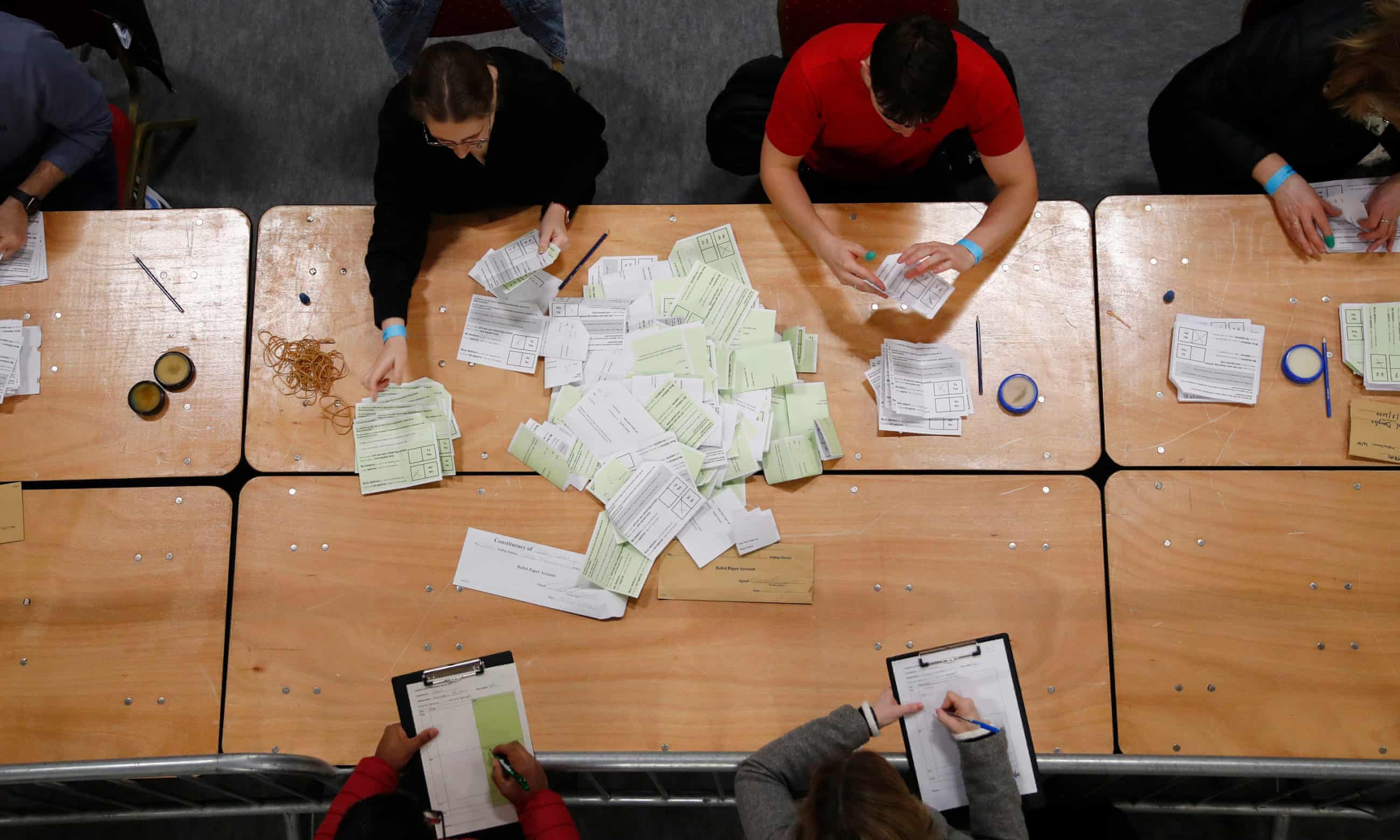
Galloway vs. the British duopoly

George Galloway’s recent landslide win the UK was certainly a rejection of the British duopoly by the Rochdale voters. Despite his obvious loathing of the people put into power by the UK electoral system, and the policies they pursue, Galloway seems to still adhere to Van Reybrouk’s rule – “we despise elected officials, we venerate the elections” – and avoid offering a systemic change that would be more likely to promote different people and different policies.

Nonpartisan Democracy: Extract from a Wikipedia Entry

This variant of democracy should be of interest to persons wanting a less “political” (adversarial) system of government. (A few paragraphs might be quoted in support of demiocracy.) The Wikipedia link is: https://en.wikipedia.org/wiki/Non-partisan_democracy

Nonpartisan democracy (also no-party democracy) is a system of representative government or organization such that universal and periodic elections take place without reference to political parties. Sometimes electioneering and even speaking about candidates may be discouraged, so as not to prejudice others’ decisions or create a contentious atmosphere.

De facto nonpartisan systems are mostly situated in states and regions with small populations, such as in Micronesia, Tuvalu, and Palau, where organizing political parties is seen as unnecessary or impractical.

A direct democracy can be considered nonpartisan since citizens vote on laws themselves rather than electing representatives. Direct democracy can be partisan, however, if factions are given rights or prerogatives that non-members do not have.

Continue reading

Kalypso Nicolaidis proposes a permanent EU citizen assembly

CEPS is “a think tank and forum for debate on EU affairs”, founded in Brussels in 1983. CEPS has a project it calls Ideas Lab whose aim is “to provide a high-level intellectual forum for exchanges concerning the wide range of current and pressing issues faced by the EU”. In this forum, Kalypso Nicolaidis, chair of global Affairs at the New Florence School of transnational governance at the European University Institute in Florence, is proposing to set up a permanent allotted EU citizen assembly.

Nicolaidis writes:

Why Citizens’ Panels haven’t quite cut it…

Continue reading

Demiocracy, Chapter 14b, Postscript: Reasons for Britain & France to Abhor DeMockery

WWI: Even if the analysis below can be disputed or disproved, it illustrates the common sort of situation where, when “the ruler’s imperative”—political survival—is threatened, it will take precedence over the common good.

I reminded my friends of the formidable domestic difficulties which the British regime was facing in 1914, and how [they] made it politically impracticable for it to declare its intentions until after the first gun had been fired.

[“Its intentions”—i.e., to declare war if Germany invaded Belgium; the Germans believed that Britain’s pre-war statements in support of Belgian neutrality were merely pro forma waffle. The Germans were amazed and felt betrayed when Britain entered the war. They thought they should have been clearly warned if Britain had really intended to do this.]

These difficulties were: the impending consolidation of labour into One Big Union; the pressure for home rule in Scotland and Wales, as well as for Ireland; and the pressure for land-value taxation. All these matters were due to come to a head simultaneously in the summer of 1914.

If in July 1914 Sir Edward Grey had served Prince Lichnowsky with a firm notice of the regime’s intentions, it is a hundred to one that the war would have been considerably deferred; but England would have been split up by convulsions far worse than those of the eighteen-forties, and the Liberal regime would be tossed to the dogs. —A.J. Nock, Memoirs of a Superfluous Man, 1943, p. 248.

Continue reading

International Network of Sortition Advocates Presents

Scheming for Democracy

Our deliberative ecosystem has a linguistic blind spot.  In thinking about lottery based democracy, we often leave strategy off the table.  It’s actually the conversation that we should always be having: ABC–Always Be Calculating.  What strategy to use depends on the goal, but whatever your goal, thinking strategically will ease the way.

Let’s talk about how!


Date:

Wednesday, 27 March · 18:00 – 19:00 UTC/GMT

Thursday, 28 March in Australia

Google Meet link: https://meet.google.com/bct-xucx-gep

Or dial: ‪(DK) +45 70 71 41 04‬ PIN: ‪464 474 557‬#  — More phone numbers: https://tel.meet/bct-xucx-gep?pin=1550818843600


About the Speaker: Wayne Liebman, M.D. is an American activist, advocate, and strategist for democratic lotteries and deliberation based in California.  In 2020, he founded Public Access Democracy (PAD) an advocacy group that aims to catalyze the formation of deliberative citizen groups chosen by lot.  PAD provided the impetus for the 2022 City of Petaluma Fairgrounds Citizens’ Assembly. In addition, as a project of PAD in concert with the Berggruen Institute, Healthy Democracy, and other democratic organizations, he co-initiated the Public Democracy LA project with the goal of setting up a citizens’ assembly in Los Angeles by 2026. 


This event is hosted by the International Network of Sortition Advocates (INSA), a network committed to championing sortition across the globe as a transformative approach to political decision-making.

Citizen trust in European government

Eurobarometer data shows that the trust European citizens have for their governments has recovered significantly from the depths of distrust felt in the wake of the 2008 financial crisis. At the bottom, in 2013, only a quarter of European expressed trust in their governments and parliaments. Now the average EU government and parliament enjoy a level of trust of 36% and 39% respectively. These numbers have been fairly steady over the last 5 years and are comparable to the numbers before the crisis.

It seems then this is the European “normal”: those who distrust their government outnumber those who do by a 3 to 2 margin or more. Currently, of the 27 EU countries, there are only 6 countries in which a plurality of citizens trust their governments.

Demiocracy, Chapter 12: Common-man (Demos) Overseers of, and Electorates for, governmental officials

A bal-lottery procedure would, by the use of the public’s self-selected Proxy Electors, put the common man (a.k.a. Everyman) in the catbird seat, where he/she belongs, overseeing, critiquing, recalling, and even electing congresscritters.

This arrangement would resemble the previously described IVE-Proxy oversight of student council representatives in Chapter 9. (IVE = Inner Voice Entity.) Such a commanding-heights IVE could also, like its collegiate counterpart (see Chapter 10), elect some portion of the body it oversees (e.g., a city council or legislature)—say a quarter, as a start.

How would it have the legitimacy to do that? Answer: By referendums and (where necessary) constitutional amendments.

And why should it have such power? Because:

1. Its alternative, DeMockery, has lost much of its legitimacy. It is no longer a popular incarnation of democracy. (For example, see the next Chapter 13 [previously posted on Equality-by-Lot as Is Greece ripe for sortition?], on the Greeks’ disaffection with DeMockery, and the growing menace there of authoritarianism and extremism.) As a result, democracy is being supplanted or threatened by authoritarian or totalitarian regimes and forces. It would be, to put it mildly, “A Bad Thing” if democracy were to shrivel and die. This is the main reason for empowering Demiocracy.

Continue reading

European Citizens’ Energy Efficiency Panel

A three-weekend event convenes 150 allotted EU citizens in Brussels for discussing

how individuals, communities, the public and private sector and others can become more energy efficient in a way that makes the most impact on the climate, economy, jobs, health – and energy bills.

This event, which is billed as “putting citizens at the heart of European policymaking”, is an archetype for how citizen assemblies are being used as an exercise in public relations and a driver for meaningless governance process that serves to generate employment and status for a self-serving political, professional and academic elite. The notion that a body of 150 people can meaningfully generate independent ideas about energy management over 3 weekends is transparently absurd. This is even before questions about whether the purview of energy efficiency even makes sense and how any recommendations produced would be handled by the vast professional political apparatus.

No doubt, though, that events like this would then serve as grist for the citizen assemblies industry and would feed a self-congratulating rhetoric about how “increased involvement of citizen assemblies in our democracies” is leading to a renewal of democracy and is a way to address citizen alienation and cynicism. It is indeed a useful contribution to the money-raising operation of this fledgling industry and to the careers of the experts and academics associated with it.

Ndongo Samba Sylla on the Senegalese exception

Senegal, which “is considered one of West Africa’s more stable democracies and is the only country in the region never to have had a military coup”, has recently been in the news, as its electoralist system is being shaken by the government’s attempt to postpone the upcoming elections.

Back in 2012, the Senegalese economist Ndongo Samba Sylla wrote the following assessment of the situation in Senegal (and elsewhere).

By praising the Senegalese “democratic” model, we are in fact glorifying an oligarchic system based on a legitimacy which, for its effectiveness, is no less artificial. This artificial character derives from the fact that the label “democratic” is conferred more by the certification of established political rating agencies than by an ability to really address the needs of the population. At a time when demagogic flights of fancy regarding the “Senegalese exception” are all the rage on the web, the most needy are quietly suffering in structural poverty which “democracy” will probably never pull them out of.
Continue reading

Demiocracy, Chapter 11: Proxy Electors should also partially choose the elected officials of non-governmental social groups

A similar sort of governance-sharing arrangement—i.e., one that incorporates IVES (Inner Voice Entities) as electors—could and should be adopted by so-called “voluntary”, or non-governmental, social groups that elect officeholders. E.g.,

  • union officials,
  • boards of directors,
  • political-party officials,
  • activist/movement NGOs,
  • charitable-organization functionaries,
  • fraternal association officers,
  • homeowner association officials,
  • co-op-building boards,
  • delegates to professional societies, and
  • some hobbyist and special interest groups.

There isn’t much real bottom-up control of or influence over many of these organizations. Cronyism rules, with new directors and top officials being effectively co-opted by an entrenched leadership clique. The members are mere outsiders and have little sense of what’s really going on inside, in the “executive suite”. So elections amount usually to rubber stamping, maybe with some grousing around the edges.

All the difficulties of democratic government in general are reproduced in the labor union, and in exaggerated forms. It would be as hard for the organized slaves of the United States to get rid of such incompetent leaders … as it would for the whole people to get rid of such mountebanks as Calvin Coolidge. —H.L. Mencken, “The Slave and His Ways”, 1924.

Continue reading