Hello, Kleroterians! Nick Coccoma here from Boston, USA. I’ve been a follower of the blog and member of the sortition movement for several years now, after I discovered the theory and practice in the wake of the 2016 Presidential Election. In the years since, I’ve been a part of The Sortition Foundation and Democracy Without Elections, and published an article on sortition a couple of years ago for the journal New Politics.
Last February I launched my own Substack newsletter, The Similitude, where I cover politics, culture, and religion. I’ve written several posts on sortition, including a recent one entitled “Real Democracy Now: How Americans Can Win Self-Government.” It makes the case for sortition and features original interviews with our own Brett Hennig, Terry Bouricius, and Adam Cronkright. In your kindness, consider subscribing to the newsletter and sharing it in your circles as I seek more readers. I’d love to have the Kleroterians join the conversation. Many thanks for your ongoing work to bring about real democracy in our time!
The proponents of “deliberative democracy” have spent decades dredging a this-but-that argumentative quagmire that has yielded nothing of either theoretical or practical value for democracy. One of the prolific underlying springs of sticky material for the quagmire has been the inherent contradiction between two dicta of “deliberative democracy”: mass participation and deliberation. It is very straightforward that masses cannot deliberate. Meaningful deliberation can occur in groups of at most a few hundreds of people (and even at this scale all-to-all deliberation could occur only under very favorable conditions).
Thus, “deliberative democracy” professionals can develop entire careers stirring, pouring and piling the sands of participation and deliberation without ever managing (or, it could be argued, without ever trying) to build any solid structure. Those of us who would suggestthat both mass participation and deliberation are at best tools for good outcomes, rather than sacrosanct goals, are severely chastised for looking for illegitimate “shortcuts”.
Technology is one of the implements that have been routinely used to stir those sticky sands. Over and over again we have been promised that new information technology would allow democracy to go where it has never gone before. Mass education, remote participation, virtual mass discussions, crowd-sourced documents – these and many other unprecedented tools of democracy would be enabled by innovative technology. The fact that such promises go back to the advent of the radio (and probably much farther back) never discourages the prophets of mass participation from promising that the next technological innovation would be the one that would usher in democratic utopia where millions of voices would be heard by millions of people who all make meaningful – equally meaningful – contributions to decision making.
[Podcat co-host Will] Menaker has said that Chapo is meant to be in “marked contrast to the utterly humorless and bloodless path that leads many people with liberal or leftist proclivities into the trap of living in constant fear of offending some group that you’re not a part of, up to and including the ruling class.”
Sortition (mispronounced as “sortion”) made a brief appearance in episode #662 of the podcast, “The Queen” (about 46 minutes and 30 seconds into the show). Sortition is offered as part of a reform of the U.S. political system in which voting is used to select limited-tenure monarchs among celebrities, while “governing is actually carried out by permanent bureaucracies overseen by a rotating cast of essentially jury duty citizens”. The proposer did not indicate the rotation period of the “national service” but noted that, for that period, service would be considered as a full time job and would be paid accordingly.
This interview for the first edition of the Democracy Creative TV series is an hour and twenty minutes long. The focus is why elections are a poor tool for running a democracy and why civic lotteries would be better. This isn’t the ideal outreach piece because the introduction highlights my leftist political background. But the bulk of the interview is useful analysis for anybody.
The system of peer review tends to favour established names and institutions
By Anjana Ahujaa. The writer is a science commentator.
Star names wield an outsize influence over research, as well as in sport and entertainment. A recent analysis revealed that a research paper written jointly by a Nobel laureate and a novice was rejected by 65 per cent of reviewers when only the novice’s name was made visible as the corresponding author — but by just 23 per cent if the laureate’s name was used instead.
One might argue that “status bias”, also called the Matthew effect, makes for a reasonable short-cut in decision-making, given that prizes are one benchmark of quality.
But findings like these chime with persistent concerns that established names and institutions are unfairly crowding out newer research talent when it comes to publishing papers and winning grants. Now, two UK funding agencies, the British Academy and the Natural Environment Research Council, will try to counter that bias by awarding some of their research grants by lottery. Continue reading →
The International Network of Sortition Advocates will have our next meeting on, Sunday, October 23, 2022, at 19:00 GMT (London) [20:00 Europe, 21:00 Israel, 14:00 EST (2:00 PM), 6:00 AED].
The meeting will be held on our Discord platform. You must register on the app to attend the meeting. Here is your Discord invitation: https://discord.gg/6sgnrphp6w.
Once you have completed registration, to join the meeting:
Navigate to the heading “Talekanaler” on the left side of your screen (it’s before the “Linguistic Regions”)
Click on: “🔊General”
Click on: “Video
*Please note our desire to keep the meetings to a maximum of 1-hour in length.
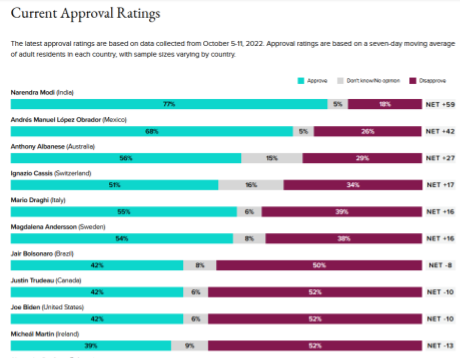
It turns out that a polling company called Morning Consult runs frequent opinion polls in 22 countries measuring the approval ratings of the top elected officials in those countries.
The polls reveal that as of the first week of October 2022, among the 22 officials rated only 6 have positive net rating (approval minus disapproval). Another interesting finding is that the two most highly rated officials are non-Western: India’s Modi, who is often portrayed in the West as being a proto-authoritarian, or at least as a nasty populist, and Mexico’s López Obrador.
Does anyone know of examples of shifts in outlook by participants in sortition?
I’m looking for examples like in the story “The Other Guy and Me” (https://truestoryaward.org/story/51) where sortition participants had major shifts in their viewpoints due to participating in a sortition process. I know people regularly shift their policy positions, but I’m looking more for dramatic examples of shifts in worldview or overall outlooks. If you can provide links with details, that would be much appreciated.
In a recent article Dr. Polyvia Parara made reference to a 2005 book by Mogens Herman Hansen, The Tradition of Ancient Greek Democracy and its Importance for Modern Democracy. It turns out this book is available online.
As always, Hansen is a very useful source of information about democracy in the ancient Greek world. In this book, Hansen focuses less on ancient Greece and more on the connections between ancient Greek democracy and “modern democracy”. Hansen rightly points out that, contrary to what some would have us believe (he cites and quotes Hannah Arendt), there is very little evidence for either institutional or ideological continuity between the two periods.
Hansen focuses first on the ideology.
The classical example that inspired the American and French revolutionaries as well as the English radicals was Rome rather than Greece. Thus, the Founding Fathers who met in Philadelphia in 1787, did not set up a Council of the Areopagos, but a Senate, that, eventually, met on the Capitol. And the French constitution of 1799, designed by Sieyès, had no board of strategoi but a triumvirate of consuls.
The very useful Dutch sortition-focused blog Tegen Verkiezingenreports about a new bachelor’s thesis at Leiden university in the Netherlands titled “Lottery as a democratic instrument?”. The thesis was written by Max Van Duijn, who is the leader of a local political party in the Katwijk municipality named DURF. DURF, which is the biggest party in the municipal council, advocates the application of sortition at the municipal level.
Tegen Verkiezingen provides the following translation of an excerpt from the thesis:
In essence ‘representative democracy’ is not democratic. It’s something fundamentally different. It would be more justified to label it ‘elective aristocracy’. In that sense the contrast between classical and representative democracy is a false one. In fact what we’re talking about is a contrast between democracy (sortition) and aristocracy (elections).



 The proponents of “deliberative democracy” have spent decades

 The very useful Dutch sortition-focused blog Tegen Verkiezingen
  Adam Cronkright
 Ali
Ali Ahmed R. Teleb
 avanderven
 avergne
 Alex Kovner
 azakaras
 Brett Hennig
 campbellwallace
 Simon Threlkeld
 Nick Coccoma
 codyhipskind
 Common Lot Sortitionist
 Conall Boyle
 constitutionalism
 davidschecter
 graytmatter
 gtridimas
 H.J. Hofkirchner
 Hanspeter Rosenlechner
 James Kierstead
 John Burnheim
 jgarry20151
 Jochen Krattenmacher
 johnedwardtaylor
 johnhuang865
 Jonathan Crock
 keithsutherland
 Jacob Richter
 kkoreilly
 lukewhito
 SimonPek
 Nathan El
 Nicholas Gruen
 Owen Shaffer
 Patrick Chalmers
 Paul Gölz
 peterstone
 Pierre-Etienne Vandamme
 pronfeld
 Emil
Emil rcaze
rcaze richwbrown
 Roger Knights
 roslynfuller
 Pierre-Etienne Vandamme
 shaharavin
 tbouricius
 Ted Wachtel
 Joshua Laferriere
 theodorestathis
 towardsautonomyblog
 Wayne Liebman
 Yoram Gat
 Oliver Milne
 Equality by lot