Shareholder democracy using investor assemblies

Luigi Zingales (University of Chicago), Oliver Hart (Harvard University), and Helene E. Landemore (Yale University) write on the Harvard Law School Forum on Corporate Governance.

It is interesting to note how in this context the authors are able to enunciate proposals and arguments that are more systematic and thorough than sortition advocates usually manage to achieve in the context of national or local government.

How should asset managers make decisions in today’s world?

Large asset managers, like Blackrock, Vanguard, and State Street, have been quick to recognize the catch-22 they are in: good old value-maximization in the name of a restrictively understood “fiduciary interest” is no longer cutting it. But in turn any explicitly moralized or political use of their concentrated power puts a political target on their backs and subjects them to public opprobrium. Further, while asset manangers can provide expertise on how many dollars will be lost by pursuing an ethical or environment-friendly strategy, they cannot provide any insights, nor do they have any legitimacy, concerning whether the trade-off is worth it, i.e., whether the moral gains exceed the monetary losses, or whether the moral dimension trumps the financial one altogether.

One obvious way out is to offload the moral and political responsibility for value-values tradeoffs to investors themselves. In 2022, BlackRock launched Voting Choice, a program to transfer the right to cast corporate ballots from asset managers back to investors.

Continue reading

Juries in the political system: surely not?

The British think tank Radix asked me to give an after-dinner speech to a conference of NGOs involved in promoting democracy which I delivered by teleconference.

Almost all democracies mix two approaches: representation by election and representation by sampling. But in modern politics, we’ve sidelined the latter, except in the judicial system. Elections don’t just select representatives; they shape the kind of people who rise to power. The system favours self-promotion, rewards spin, and turns politics into a competition for attention rather than a forum for governing. We assume elections will keep politicians accountable, but in practice, they reinforce a cycle where honesty is a liability and manipulating people takes priority.

Representation by sampling works differently. When people are selected by lottery to deliberate on political issues, they tend to engage with one another in ways that cut through party lines and ideological divides. I explore examples of how this has worked, from ancient Athens to modern citizen assemblies, and outline a proposal: a standing Citizens’ Assembly to sit alongside existing institutions, providing an independent check on government.

This isn’t about replacing elections, but about balancing them with another democratic principle—one we’ve neglected for too long. I mention a documentary on the establishment of the Michigan Independent Citizens’ Redistricting Commission which is here. And you can find the audio here.

Hoping for the fleet to return from Samos

In an impressive demonstration of the power of the electoralist dogma to twist one’s perception, Pierre Silverberg, writing in the Belgian La Libre, shares his belief that the ascent of the second Trump administration has a close historical parallel.

[Original in French, Google translation with a couple of minor touch-ups.]

From Democracy to Oligarchy

The parallels between the oligarchic revolution in Athens in -411 and the current coup d’état in the United States are striking.

In the Oligarchic Revolution, the Athenian elite decides to seize power, put an end to democratic institutions, and ally themselves with the enemy city, Sparta, to maintain their hold on Athens. Sound familiar? The historical parallels between the Oligarchic Revolution of 411 BC and the current coup in the United States are striking.

2036 years apart, both the Athenian oligarchy and the American elite present the individual and political freedoms acquired by the people as clear signs of moral and civilizational decline that must be acted upon. In both cases, the oligarchs present themselves as the only ones capable of straightening out the country and purging the nation of its excesses. And, naturally, in both cases, the oligarchy feels authorized to override the laws and subvert the system to the detriment of the people.

War as a context

These “oligarchic revolutions” also fit into a relatively similar historical context: war. The Peloponnesian War was a conflict that broke out between Athens and Sparta. Ideologically, Athens represented “progressive” Greece: its democracy was complete, each citizen enjoyed unprecedented individual freedom as well as the certainty of being able to actively contribute to the politics of his City. Thanks to its democratic practice of drawing lots, it is estimated that an Athenian citizen had a 70% chance of exercising a political role at least once in his life. Conversely, Sparta had kept its original constitution and represented “conservative” Greece. The City was a “gerontocracy” governed by two kings and a council of elders, the Gerousia. The people had practically no chance of ever exercising political responsibility and literally had to choose their representatives using an “applause-meter”.
Continue reading

Ariely advocates for allotted citizen assemblies

Dan Ariely is a fairly prominent Israeli-American behavioral economist who authored some best-selling popular books (and was also involved in dubious research).

Ynet, the website of the popular Israeli newspaper Yediot Aharonot, has now published an opinion piece by Ariely [Hebrew] in which Ariely proposes allotted citizen assemblies as a way for overcoming divisions in the Israeli public.

Excerpts from the piece [Google translation]:

My proposal for a new Israeli democracy

It already works in the world, why not here? Imagine a situation where one day you receive a letter from the State of Israel. The letter informs you that you have been selected, along with 299 other citizens, to participate in a deep thinking process on one of the biggest problems facing the country. Then, the experts arrive – a variety of voices from all ends of the spectrum

Why is this so important now?

In Israel, the political, social, and values ​​crisis has reached a boiling point. Each side seems convinced that the other is endangering the country. Dialogue has become toxic, and the ability to listen has almost disappeared.

But research shows that if you put people from all groups in a room, give them time to learn about each other and understand the data, they will be able to reach compromises – and, no less importantly, begin to see each other as human beings.

If all you know about your political opponents comes from social media and the belligerent headlines in the media, it’s very easy to think they’re enemies. But when people sit together, really listen, and study the data before forming an opinion – the magic happens. This doesn’t mean that the gaps will disappear, but a process will be created in which people can cooperate and seek common solutions.

Are we ready to think differently about democracy?

I recently met with a German expert who studies citizens’ committees. He told me that there is a widespread perception in representative democracy that once every four years we go to the polls, and that this is what is considered taking civic responsibility. But according to him, the truth is exactly the opposite – going to vote once every four years is not taking responsibility, but giving it up.

A true democracy, he explained, is a situation in which citizens actively participate in public life, frequently and in depth. Not just on social media, not just in protests, but in orderly processes where they can learn, understand and influence. And what’s more – citizen committees are one of the best ways to do this.
Continue reading

Henry George’s analysis of electoralism, with a side note on sortition

From Book X, Chapter IV of Progress and Poverty (1879) by Henry George:

Where there is anything like an equal distribution of wealth—that is to say, where there is general patriotism, virtue, and intelligence—the more democratic the government the better it will be; but where there is gross inequality in the distribution of wealth, the more democratic the government the worse it will be; for, while rotten democracy may not in itself be worse than rotten autocracy, its effects upon national character will be worse. To give the suffrage to tramps, to paupers, to men to whom the chance to labor is a boon, to men who must beg, or steal, or starve, is to invoke destruction. To put political power in the hands of men embittered and degraded by poverty is to tie firebrands to foxes and turn them loose amid the standing corn; it is to put out the eyes of a Samson and to twine his arms around the pillars of national life.

Even the accidents of hereditary succession or of selection by lot, the plan of some of the ancient republics, may sometimes place the wise and just in power; but in a corrupt democracy the tendency is always to give power to the worst. Honesty and patriotism are weighted, and unscrupulousness commands success. The best gravitate to the bottom, the worst float to the top, and the vile will only be ousted by the viler. While as national character must gradually assimilate to the qualities that win power, and consequently respect, that demoralization of opinion goes on which in the long panorama of history we may see over and over again transmuting races of freemen into races of slaves.

International Network of Sortition Advocates Presents

Sortition in Businesses and Organisations

A How-to Guide

In his previous presentation, Ben Redhead, explored how sortition can revolutionize organisations and empower individuals in decision-making processes.  Join Ben, once again, for an interactive deeper dive into the topic that welcomes your specific questions on how to integrate sortition in your own business or organisation.


About the Speaker: We’re honoured to again feature Ben Redhead as our facilitator. As an Associate at Sortition Foundation and Co-Founder of INSA, Ben brings to the table a rich tapestry of experience. His journey as a strategy consultant, facilitator, and project manager has afforded him a unique perspective on the transformative power of sortition. Recently, he launched his own organisation, SORTED, an initiative that aims to merge innovations in democracy and organisational development. Ben’s insights aren’t just limited to offline platforms; he passionately shares his expertise and observations through his blog, also named “SORTED.”


Date: Wednesday, 5 March 2025

Time: 6:00 – 7:00 PM UTC [19:00-20:00 Europe/Copenhagen]

Location: OnlineRegistration on Eventbrite

FREE – Reserve your spot now!


INSA is a volunteer organisation aimed at connecting pro-sortition academics, advocates, and activists around the world, to share resources & tactics and advance the theoretical understanding and practice of sortition. 

www.INSA.site

You are also invited to join our Discord server at

https://discord.gg/6sgnrphp6w

The French School of Athens builds a kleroterion

Kathimerini reports about a project of the French School of Athens involving building a full size marble reconstruction of an Athenian kleroterion:

It is made of marble and weighs about 300 kilos. It is 1.20 meters tall, but on its wooden base it’s the height of a tall adult. And while it looks like an inscribed column, if you get close up, you’ll find that it has many rows of slots in a vertical and horizontal arrangement. What are they for? To receive wooden tiles with the names of citizens who, through a special process, will be selected for public office, or not, at least until their luck is tested again.

It is a faithful copy of an ancient kleroterion, a randomization device similar to the one that the Athenians of the 5th and especially the 4th century BC used to select citizens to be lawmakers, state officials and jury members.

“The best method of democratic selection was to draw lots,” archaeologist and historian Veronique Chankowski, director of the French School of Athens, who coordinated the construction and study of the ancient lottery device, tells Kathimerini. “A person was selected not because they belonged to a specific family or social network, nor because they were rich. This machine chose them.”

Making Sortition Accountable

The typical sortition advocate looks at the theory of electoral accountable and state, well, electoral accountability is so bad it might as well not even be there. But that doesn’t let sortition off the hook. Even if electoral accountability is terrible, that doesn’t mean that lottocratic accountability is good.

Imagine a particularly corrupt society. Random selection rotates the citizens in. These citizens understand what lottery gives them, and they use their power to pay themselves exhorbitant salaries. Or they take bribes from patrons wishing to change legislation.

Even with multi-body sortition, given sufficient coordination between the multiple bodies, all participants could conspire to be corrupt and reward themselves across every panel and assembly.

Of course this is true with elections. Elected officials occasionally conspire to reward themselves across various checked and balanced institutions. If these elected officials are sufficiently discrete, then the voters are none the wiser and cannot apply appropriate electoral feedback.

I imagine a very coarse button that voters could press to hold lottocrats accountable, a sort of nuclear option similar to the practice of banishment.

Every year, voters could have an opportunity to punish a runaway lottocracy.

A referendum shall be held every year and ask, “Should the lottocrats be punished?”

  1. Should the lottocrats serving right now be punished?
  2. Should the lottocrats that served 1 year ago be punished?
  3. Should the lottocrats that served 2 years ago be punished?
  4. Should the lottocrats that served 3 years ago be punished?
  5. Should the lottocrats that served 4 years ago be punished?
Continue reading

Ordinary people vs. explanations

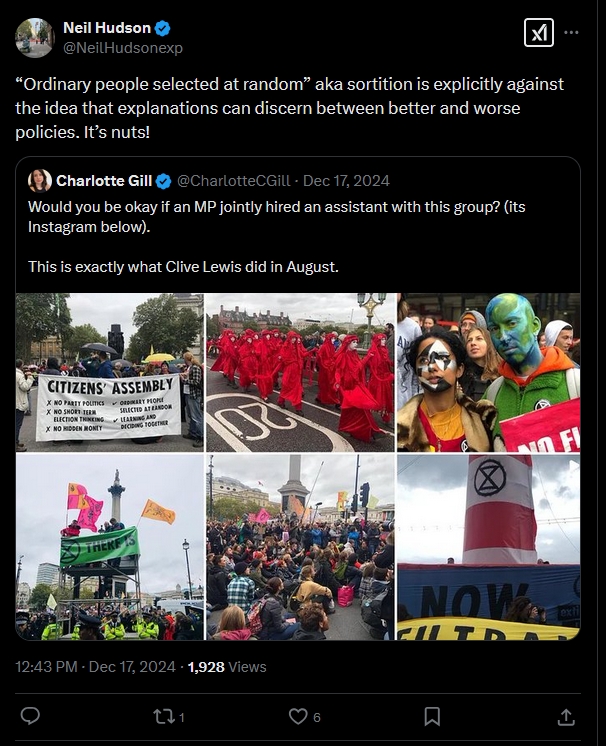
Responding to a recent discussion regarding Roger Hallam and Extinction Rebelion, commenters emphasized the need to distance “ourselves” from such extremists, potentially “manipulated by malign actors”. An X post from December had this to say:

“Ordinary people selected at random” aka sortition is explicitly against the idea that explanations can discern between better and worse policies. It’s nuts!

The New Republic: There’s little doubt that sortition beats election hands down

Roger Hallam, “a co-founder and strategic mastermind of the civil resistance groups Extinction Rebellion (often called XR) and Just Stop Oil”, and who is also serving “five years in prison for ‘conspiracy to cause a public nuisance'” is the protagonist of a supportive article in The New Republic. The article makes a very sympathetic presentation of Hallam’s anti-electoral and pro-sortition ideas:

Hallam calls our current moment a “pre-revolutionary period.” Such eras have arisen throughout history—if never on such a grand scale—and they unfold according to a distinct logic. One of the first casualties is moderation. “The center does not hold,” Hallam said. “You saw this before the Nazis, you saw it before the Bolsheviks, and you’re seeing it at the moment in slow motion in Western democracies.” It’s easy to miss the signs, because “the center still has institutional power,” he added. “In other words, like it’s a zombie space. It’s dead, but it hasn’t yet been pushed over by the new.”

Under such conditions, wrenching paradigm shifts are inevitable. The only question, Hallam suggested, is whether we submit to authoritarianism, as many Americans seem all too eager to do, or embrace a genuinely pro-social revolutionary alternative. While it would have been comforting to hit the snooze button with four more years of Biden-style liberalism—a sound approach in simpler times—when survival hangs in the balance, there are distinct advantages to being awake.

The centerpiece of Hallam’s plan is a radical reinvention of democracy aimed at turning elections into a historical relic. Continue reading