


An article in Liberation by Salvador Juan, professor of sociology at the university of Caen and researcher at the Center for Study of Risks and Vulnerabilities. Original in French.
The Climate Convention: Technocratic illusions and pseudo-direct democracy
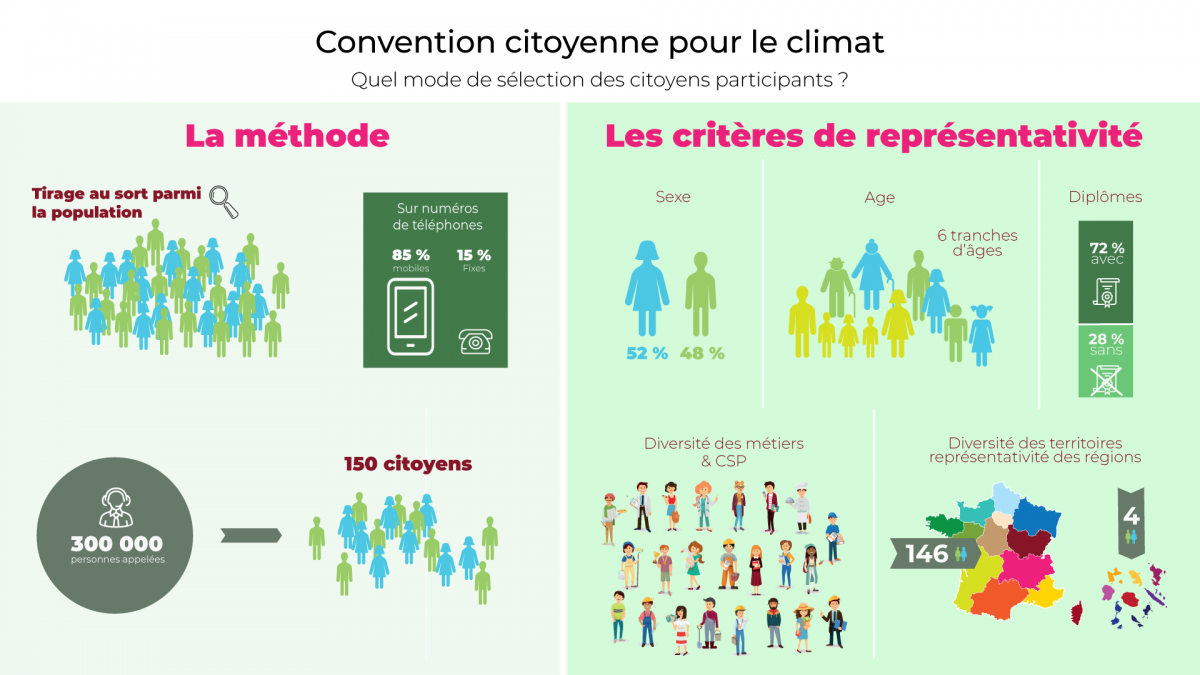
How are the 150 citizens who are supposed to embody the people as they face the climatic challenge supposed to reach reasoned conclusions after a few weekends of work whereas expert researchers spend years in order to understand the complexities of energetic and ecological issues?
If there is a useful concept for defining what the government is doing, it is that of technocracy. Being neither right-wing nor left-wing but promoting progress and growth, technocracy is defined by the identification of the general interest with that of the powerful organizations which manage it – the electronuclear generators, the petrochemical conglomerates, the high speed trains or the industrial agriculture of the 1970’s.
Another characteristic of this new (at the historical scale) power, in which the great state bodies are surpassed by private ones, is the requirement for legitimization by the creation of social demand and of popular support for its products. As opposed to classical economic theories, according to which supply adapts to demand, this power implies the fashioning of daily life according to the products of an industry which is unconcerned with the ecological or health consequences of its activities as long as it can make a profit, either economic or symbolic, related to its image.
Finally the last important characteristic of this new power is contempt for intermediary bodies – associations or unions. It is a quasi-royalist and popular fantasy of a direct relation between a central authority and a mass of atomised citizens, a notion whose dangers for democracy were already described by Tocqueville.[1]
Continue reading
Filed under: Academia, Press, Sortition | Tagged: Convention pour le climat | 31 Comments »

 Adam Cronkright
 Ali
Ali Ahmed R. Teleb
 avanderven
 avergne
 Alex Kovner
 azakaras
 Brett Hennig
 campbellwallace
 Simon Threlkeld
 Nick Coccoma
 codyhipskind
 Common Lot Sortitionist
 Conall Boyle
 constitutionalism
 davidschecter
 graytmatter
 gtridimas
 H.J. Hofkirchner
 Hanspeter Rosenlechner
 John Burnheim
 jgarry20151
 Jochen Krattenmacher
 johnedwardtaylor
 johnhuang865
 Jonathan Crock
 keithsutherland
 Jacob Richter
 kkoreilly
 lukewhito
 SimonPek
 Nathan El
 Nicholas Gruen
 Owen Shaffer
 Patrick Chalmers
 Paul Gölz
 peterstone
 Pierre-Etienne Vandamme
 pronfeld
 Emil
Emil rcaze
rcaze richwbrown
 Roger Knights
 roslynfuller
 Pierre-Etienne Vandamme
 shaharavin
 tbouricius
 Ted Wachtel
 Joshua Laferriere
 theodorestathis
 towardsautonomyblog
 Wayne Liebman
 Yoram Gat
 Oliver Milne
 Equality by lot