Posted on November 3, 2012 by Yoram Gat
The primary negative effect of the electoral system is the obverse of its ostensible function. This effect is what Bernard Manin called “the principle of distinction” – the delegation of political power to people whose situation and outlook is significantly different from those of the population at large. As a result of this difference, the political elite serves interests that are different from, and often antithetical to, those of the average voter.
However, the electoral system is often presented by academic advocates and by electoral activists and politicians as providing a value to society above and beyond its function for selecting government officials. It supposedly encourages meaningful popular participation in government through voting, informed discussion, organized activism in electoral campaigns and awareness of the importance of compromise and coalition building. In fact, the electoral system encourages none of those patterns – on the contrary: it is antithetical to them. This is due to several characteristics of the electoral system that do not follow from the principle of distinction.
1. Politics as competition The electoral system is a mechanism in which groups compete for power. Allocation of power through competition has several related effects:
Continue reading →
Filed under: Academia, Elections, Participation, Sortition | Leave a comment »
Posted on October 31, 2012 by keithsutherland
The last Paris sortition meeting was devoted to Bernard Manin’s argument that sortition was replaced by preference election on account of the natural right theory of consent. I challenged Manin on this with an argument based on Fishkin’s claim that the decision process of an allotted assembly modelled on a Deliberative Poll would be a proxy for the informed consent of all citizens. During the report presented to the recent Dublin meeting Peter Stone returned to this point by arguing, with Bentham, that the whole social contract theory of consent was just nonsense on stilts.
Peter recently referred me to Hanna Pitkin’s two-part paper on Obligation and Consent. The paper is hard work, but could be boiled down into just two claims:
Continue reading →
Filed under: Academia, Elections, Sortition, Theory | 51 Comments »
Posted on October 29, 2012 by peterstone
Scott Wentland (Longwood University) and I are working on a paper in which we explore the idea of randomly assigning legislators to districts when they come up for reelection. The working paper has received some attention at the Washington Post‘s blog: Would Congress work better if legislators were randomly assigned?
Kudos to Scott for his well-thought-out words to the press. We hope to have a revised version ready before the year is out. When it’s done, we’ll let you know.
Filed under: Elections, Press, Proposals | 2 Comments »
Posted on October 28, 2012 by Conall Boyle
Describing what a lottery can contribute to the process of choosing.
Sanitization, Arrationality or should it be called Super-Humanity?
Whatever it is used for, a lottery does something for the process. Sanitizing is Stone’s description; Arrationality is Dowlen’s.
I do not disagree with either definition, but feel that both are a bit lacking.
Sanitization implies a clean-up, removal of contaminating elements, but leaves open the question: Cleansed of what?
Arrationality, besides being a neologism, hence not easily understood, might also even be taken to mean some kind of crazy departure which abandons the only human attribute that truly sets us above the animals – the ability to use our brains to think about things.
So either incomplete or liable to be mis-understood; can I come up with something better?
Continue reading →
0.000000
0.000000
Filed under: Distribution by lot, Religion, Theory | 15 Comments »
Posted on October 6, 2012 by Yoram Gat
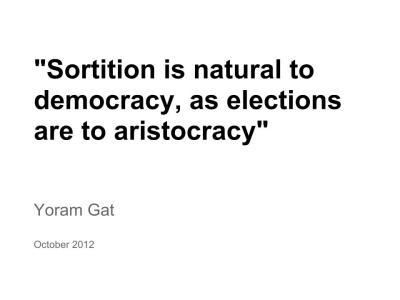
An introductory presentation about sortition for a talk I’ll be giving to a general audience. Comments are welcome.
Filed under: Sortition | 52 Comments »
Posted on September 29, 2012 by peterstone
Watched a TED talk this evening featuring a Stanford Business School Professor. (We’ve never met.) He presented a study suggesting that people might have more difficulty with certain types of tasks if they are presented with a difficult choice in advance than if the choice is made for them–even if the choice is made for them randomly. The argument isn’t completely clear to me, but that’s par for the course for TED. The talk is here–
Baba Shiv: Sometimes it’s good to give up the driver’s seat
Filed under: Experiments, Theory | Leave a comment »
Posted on September 29, 2012 by keithsutherland
The theme for the (UK) 2013 PSA conference (Cardiff, 25-27 March) is The Party’s Over. Oliver Dowlen is organising a sortition panel under the auspices of the PSA specialist group on deliberative and participatory democracy. The deadline is tight (abstracts need to go to Stephen Elstub, the group convenor by October 5), so anyone interested please contact ollydowlen@yahoo.com
Filed under: Academia, Ballot measures, Participation | 1 Comment »
Posted on September 19, 2012 by keithsutherland
Has anyone come across this new book by Arthur Robbins:
At a time when people around the world are rising up to demand self-determination and Americans are locked in debate about the role of government in society, PARADISE LOST, PARADISE REGAINED: The True Meaning of Democracy offers a fresh look at what democratic governance really means.
The story begins in ancient Athens and then turns to Rome and the Italian City States. Democracy in the United States, prior to the signing of the Constitution, is explored in detail. There is a section devoted to the effects of war on emergent democracy in the Middle Ages and in France at the time of the Revolution. The book concludes with a review of recent experiments in democracy, especially in India and Latin America.
Early Americans have much to teach us. We study some of the essays, letters, and articles written by the Anti-Federalists, those who were opposed to ratification of the Constitution. They were articulate and impassioned on the subject of democracy. They understood the nature of political power and of those who would abuse it.
Continue reading →
Filed under: Athens, Books, History, Initiatives, Participation | 2 Comments »
Posted on September 18, 2012 by Yoram Gat
September 17 was marked as the anniversary of the Occupy Wall Street movement. While the dismissal of the movement as a spent force by its opponents including corporate mass media is only to be expected, it seems that the feeling that this movement has reached the limits of what can be achieved with its past tactics is shared by sympathetic observers.
Matt Taylor at The Daily Beast offers an analysis that is to a large extent an establishment point-of-view, but makes some valid points as well:
As Occupy Wall Street protesters geared up to mark their first anniversary in Manhattan on Monday, they found themselves operating almost alone, without much of the outside support from celebrities, labor unions, and other progressive groups and leaders that had helped to create a palpable sense of momentum last fall.
[…]
But it would appear that, some tepid local union supporters in the city notwithstanding, the broader progressive coalition—including organized labor—is sitting this one [the anniversary] out, having seen the Occupy movement descend into internal squabbling in recent months over how, and whether, to engage the political system directly.
Continue reading →
Filed under: Participation, Press, Sortition | 12 Comments »
Posted on September 6, 2012 by Yoram Gat
An interview with Etienne Chouard in Ragemag magazine (translation by Google Translate, with my touch-ups):
Is sortition the future of democracy?
Sortition is not the future of democracy, it is inseparable from democracy; it is a much stronger link than a chronological phase: there is no democracy without sortition.
Chouard also considers the popular initiative mechanism as a major democratic component (mistakenly, in my opinion):
What is a popular initiative referendum?
PIR (or CIR: Citizen-initiated referenda) is the institution that guarantees the people that it is possible, on the people’s initiative at any time, to regain control of the legislative process and components. It is central. The popular initiative referendum exists in a few countries in the world: in Italy, half of the United States, Venezuela and Austria, for example. In France, in 2008, the parliament, by government orders, revised the constitution to establish what they fraudulently called (I weigh my words) a “popular initiative referendum.” Just read Article 11 to find that this is a referendum on parliamentary initiative. Our so-called “representatives” so openly mock us. We do not have a democracy: we have a plutocracy.
Filed under: Press, Sortition | 126 Comments »


 Adam Cronkright
 Ali
Ali Ahmed R. Teleb
 avanderven
 avergne
 Alex Kovner
 azakaras
 Brett Hennig
 campbellwallace
 Simon Threlkeld
 Nick Coccoma
 codyhipskind
 Common Lot Sortitionist
 Conall Boyle
 constitutionalism
 davidschecter
 graytmatter
 gtridimas
 H.J. Hofkirchner
 Hanspeter Rosenlechner
 James Kierstead
 John Burnheim
 jgarry20151
 Jochen Krattenmacher
 johnedwardtaylor
 johnhuang865
 Jonathan Crock
 keithsutherland
 Jacob Richter
 kkoreilly
 lukewhito
 SimonPek
 Nathan El
 Nicholas Gruen
 Owen Shaffer
 Patrick Chalmers
 Paul Gölz
 peterstone
 Pierre-Etienne Vandamme
 pronfeld
 Emil
Emil rcaze
rcaze richwbrown
 Roger Knights
 roslynfuller
 Pierre-Etienne Vandamme
 shaharavin
 tbouricius
 Ted Wachtel
 Joshua Laferriere
 theodorestathis
 towardsautonomyblog
 Wayne Liebman
 Yoram Gat
 Oliver Milne
 Equality by lot