Sortition discussion at Occupy Democracy: Inequality and Representation

The Sortition Foundation will be holding a discussion on sortition at Occupy Democracyod-february-flyer: Inequality and Representation this weekend.

When: 4pm, Saturday 14th February

Where: Parliament Square, London

More info: Occupy Democracy 14-15 February Programme

Facebook: https://www.facebook.com/events/1530502423894273/

Come along, invite your friends!

“There is no data to show that uninformed voters make worse decisions than informed voters.”

As Time magazine reports, low voter turnouts worry some people:

In Los Angeles, as in many cities, voter turnout for local elections tends to be pathetic. In 2013, only 16% of registered voters weighed in on an election that would help determine the city council, mayor, school board, and a potential tax increase. In other words, 84% of registered voters didn’t bother to vote. And the number of potential voters is much higher, of course, since plenty of eligible voters aren’t registered.

Continue reading

Down with Elections! Part 6: conclusion

DOWN WITH ELECTIONS!

Part 1 Part 2 Part 3 Part 4 Part 5 Part 6

PART 6

The Mandate

One of the justifications claimed for elections is that they are the only mechanism by which the citizens give a mandate to those who govern them. “We can’t just leave choosing our representatives to chance. When we vote, we give the winning candidate a mandate.”

But who actually gives this mandate? Surely not those who vote against the winners. And not those who don’t vote, for whatever reason. So it must be those who vote for the winning candidates? Suppose you vote in an electorate where your candidate wins by a handsome margin. If you hadn’t voted at all, he would still have won. If you had voted for another candidate, once again, he would still have won. In short, your vote made no difference at all. How then can you say that you have had even the tiniest part in giving that candidate a mandate?

Only if the other voters are so divided between candidates that your vote is the deciding one, can you be said to have made a difference, and then, of course, you are in a sense a “dictator”, as the political scientists put it when speaking of this problem. In saying this, I’ve assumed a winner-takes-all, first past the post system. Is the situation different in a proportional or a preferential system? Not really. Most of the time, your vote makes no difference at all. And the statement that “we can’t leave choosing our representatives to chance” – as though chance plays no part in elections – is just laughable.

Overheard in a pub in Godelpus:

(Yes, the names have been changed to protect the guilty.)

Two men sat down at the next table.

“I didn’t catch what you were saying about a mandate” said one.

His friend took a deep swig of beer before replying. “It brings back painful memories”, he said, slowly. “I don’t know if you remember when Harry Bolt got elected?”

“That was that very close election, wasn’t it?”
Continue reading

Morena has selected its pool for sortition of congressional candidates

The Informador reports:

Morena chooses three thousand applicants to draw nominations
Party leader Marti Batres says district assemblies concluded without incident

MEXICO CITY (01/FEB/2015) The leader of the National Regeneration Movement party (Morena), Marti Batres, said that on Sunday 300 district assemblies concluded “without incident” the selection of three thousand applicants for the 200 slots of candidates for multi-member district deputies.

Among those elected, five men and five women from each of the 300 constituencies, there are housewives, students, professionals, retirees, workers, merchants, scholars, indigenous people and peasants, said Batres.

All those will participate in the February 23rd allotment process (sortition) for nominating candidates to multi-member electoral districts, Morena’s method to select its candidates.

More about Morena’s sortition process here.

Down with Elections! Part 5

DOWN WITH ELECTIONS!

Part 1 Part 2 Part 3 Part 4 Part 5 Part 6

PART 5

The “Loose-Leaf” Approach

I have touched on the fact that elected politicians may become “locked into” a bad policy. (see §20 above) It is not simply a question of damage to the ego, or the embarrassment of publicly changing their stance after several TV or newspaper interviews. There may be the inertia of a whole political and publicity machine brought into being to push a policy which was once thought to be important for gaining office, and which later turns out to be doubtful or disastrous. (Examples include climate change denial, the “war on drugs”, and the search for weapons of mass destruction in Iraq.)

Changing policy means that the whole team of bullocks: tame journalists and editorialists, other politicians of the same party, public relations staff, and grass-roots party members have to change direction as well. A large part of the public may need to be convinced, not only of the need for the change, but also of the politicians’ sincerity in advocating first one policy, then another. Some sources of party finance may dry up overnight and other sources may have to be found. To make the change, some heads may have to roll, and there will not be many volunteers to rush in to make the sacrifice. All this is risky politically, and time-consuming.

An Assembly chosen by lot will not suffer from these disadvantages, of course. Members will be quite free to change their minds, and in any case, with a secret ballot, there is no need for anyone else even to be aware of a change of mind. This will permit errors of judgement to be quickly corrected, and policies which are no longer desirable because of changed circumstances to be altered.
Continue reading

Down with Elections! Part 4

DOWN WITH ELECTIONS!

Part 1 Part 2 Part 3 Part 4 Part 5 Part 6

PART 4

Theoretical Considerations and Explanations

Athens

Proponents of sortition usually refer to the fact that it was used in Athens, and sometimes use the Athenian constitution as a yardstick for comparing other proposals. There is no attempt here to reproduce or imitate the Athenian democracy, which had several features which would now be considered objectionable, among which are:

  1. The exclusion of the majority of persons living under the control of the government from any say in that government. One can argue about the relative numbers of adult male citizens, adult female citizens, metics (metoikoi, foreigners living and working in Athens) children of citizens, and slaves, but clearly the adult male citizens were a small minority of those affected by the laws which they alone could vote on. Amongst adult male citizens, the Athenian constitution was eminently democratic, amongst those who were subject to its laws, it was oligarchic.
  2. The lack of separation of justice and legislature.
  3. Ostracism. It was not necessary to commit a crime to be ostracised and exiled, merely to be feared.
  4. Dokimasia. This was an examination, not to determine whether a citizen was competent, but whether he was eligible for office, and if so, whether his political views were offensive (usually meaning that he had oligarchic sympathies).
  5. Continue reading

Down with Elections! Part 3

DOWN WITH ELECTIONS!

Part 1 Part 2 Part 3 Part 4 Part 5 Part 6

PART 3

Examples of the Legislation in Action

How might all this work in practice? Let us consider some examples.

Example 1: The Passage of a Proposal by a Private Citizen

Suppose Bill Brown decides that Watchamacallit Bay is over-fished. He writes a letter to the Assembly:

Dear Sirs and Madams,

Watchamacallit Bay is hopelessly overfished, when I was a kid there was fish everywhere, now its DEAD!!! Theres no fish left!

Fishing should be banned in Watchamacallit Bay.

Yours etc, Bill Brown

He receives a reply in warm, friendly, bureaucratic style from the Proposals Committee:

Dear Sir/Madam,

Re: Proposal to ban fishing in Watchamacallit Bay.

The Proposals Committee has received your proposal, and thanks you for it.

Proposal Number: 2050/456789 (please quote this reference in correspondence)

Status of proposal: Pending. (You will be informed of changes to the status.)

Current Regulations in force concerning this matter, or which may be affected:
Continue reading

Sortition Foundation: a new campaign for government by sortition

Last week a new campaign was launched to demand government by sortition.

sortition-definition2

Its aim is to promote sortition and build a movement demanding the replacement of elections with sortition.

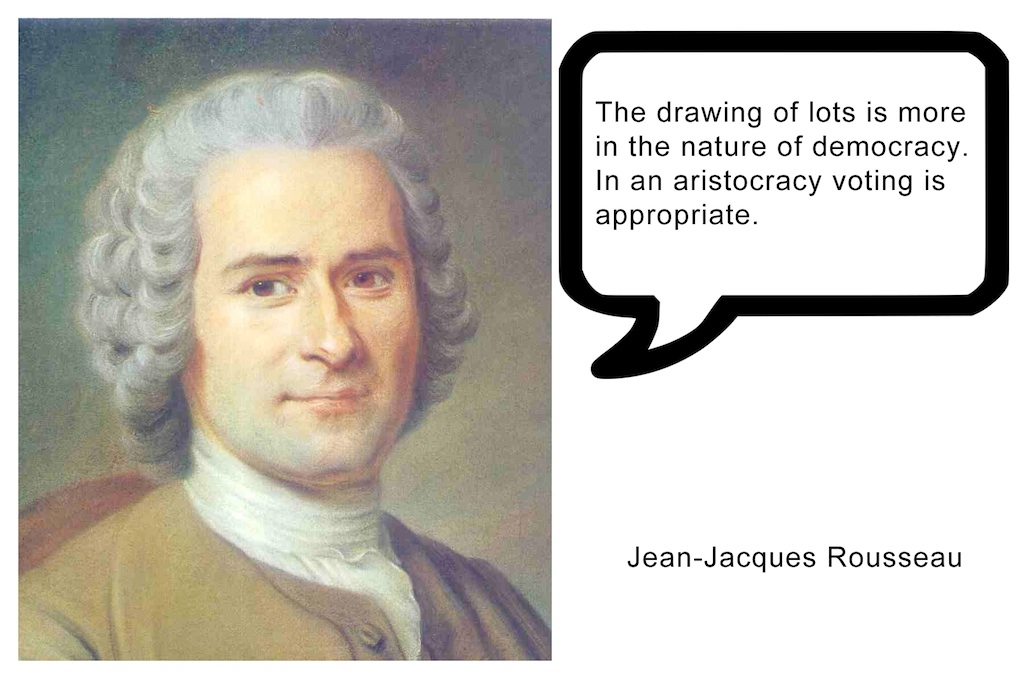
rousseau-1024

To support or promote it, visit http://www.sortitionfoundation.org/, like it on Facebook: https://www.facebook.com/SortitionFoundation or follow it on Twitter @SortitionNow

For more information, or to give feedback or offer to help, please use
the contact page: http://www.sortitionfoundation.org/contact

[Editor’s note: this post was modified after posting as the group changed its name]

New Democratic Seeds / Gentils Virus Manifesto

The Chouardists are at it, this time with a new site (in five languages) calling for an allotted constitutional assembly. They explain their project in six “chapters” that you can see along with a visitor count on the left margin. Here is the main page followed by the first part. They have also included what appears to be an endless number of videos of Chouard and some other resources.

It is the explicit proposal which should rally the millions of citizens whose political impotency is programmed in the constitution.

Because it is not the role of the people in power to write the rules of their own power

“We want a democratic Constitutional Assembly, therefore randomly drawn.”

By reading the 6 chapters of this website, you will understand that if you want to change anything in the mechanisms of our current society, you will have to make this message your one and only claim: from its application the rest will follow. To understand the strength of this message, please take a few minutes to read through the six chapters of the website, they are very short.
Continue reading

It’s the magic of elections