Citizen trust in European government

Eurobarometer data shows that the trust European citizens have for their governments has recovered significantly from the depths of distrust felt in the wake of the 2008 financial crisis. At the bottom, in 2013, only a quarter of European expressed trust in their governments and parliaments. Now the average EU government and parliament enjoy a level of trust of 36% and 39% respectively. These numbers have been fairly steady over the last 5 years and are comparable to the numbers before the crisis.

It seems then this is the European “normal”: those who distrust their government outnumber those who do by a 3 to 2 margin or more. Currently, of the 27 EU countries, there are only 6 countries in which a plurality of citizens trust their governments.

Demiocracy, Chapter 12: Common-man (Demos) Overseers of, and Electorates for, governmental officials

A bal-lottery procedure would, by the use of the public’s self-selected Proxy Electors, put the common man (a.k.a. Everyman) in the catbird seat, where he/she belongs, overseeing, critiquing, recalling, and even electing congresscritters.

This arrangement would resemble the previously described IVE-Proxy oversight of student council representatives in Chapter 9. (IVE = Inner Voice Entity.) Such a commanding-heights IVE could also, like its collegiate counterpart (see Chapter 10), elect some portion of the body it oversees (e.g., a city council or legislature)—say a quarter, as a start.

How would it have the legitimacy to do that? Answer: By referendums and (where necessary) constitutional amendments.

And why should it have such power? Because:

1. Its alternative, DeMockery, has lost much of its legitimacy. It is no longer a popular incarnation of democracy. (For example, see the next Chapter 13 [previously posted on Equality-by-Lot as Is Greece ripe for sortition?], on the Greeks’ disaffection with DeMockery, and the growing menace there of authoritarianism and extremism.) As a result, democracy is being supplanted or threatened by authoritarian or totalitarian regimes and forces. It would be, to put it mildly, “A Bad Thing” if democracy were to shrivel and die. This is the main reason for empowering Demiocracy.

Continue reading

European Citizens’ Energy Efficiency Panel

A three-weekend event convenes 150 allotted EU citizens in Brussels for discussing

how individuals, communities, the public and private sector and others can become more energy efficient in a way that makes the most impact on the climate, economy, jobs, health – and energy bills.

This event, which is billed as “putting citizens at the heart of European policymaking”, is an archetype for how citizen assemblies are being used as an exercise in public relations and a driver for meaningless governance process that serves to generate employment and status for a self-serving political, professional and academic elite. The notion that a body of 150 people can meaningfully generate independent ideas about energy management over 3 weekends is transparently absurd. This is even before questions about whether the purview of energy efficiency even makes sense and how any recommendations produced would be handled by the vast professional political apparatus.

No doubt, though, that events like this would then serve as grist for the citizen assemblies industry and would feed a self-congratulating rhetoric about how “increased involvement of citizen assemblies in our democracies” is leading to a renewal of democracy and is a way to address citizen alienation and cynicism. It is indeed a useful contribution to the money-raising operation of this fledgling industry and to the careers of the experts and academics associated with it.

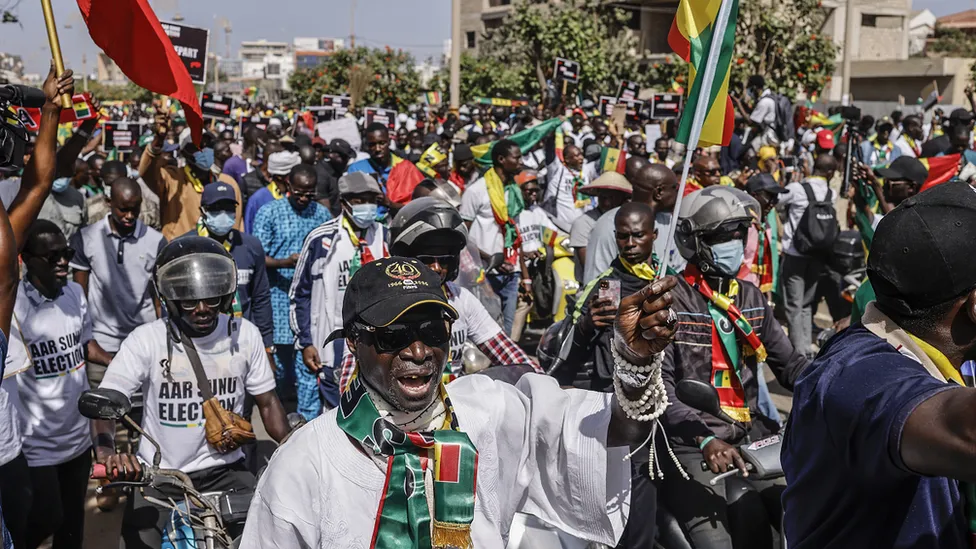
Ndongo Samba Sylla on the Senegalese exception

Senegal, which “is considered one of West Africa’s more stable democracies and is the only country in the region never to have had a military coup”, has recently been in the news, as its electoralist system is being shaken by the government’s attempt to postpone the upcoming elections.

Back in 2012, the Senegalese economist Ndongo Samba Sylla wrote the following assessment of the situation in Senegal (and elsewhere).

By praising the Senegalese “democratic” model, we are in fact glorifying an oligarchic system based on a legitimacy which, for its effectiveness, is no less artificial. This artificial character derives from the fact that the label “democratic” is conferred more by the certification of established political rating agencies than by an ability to really address the needs of the population. At a time when demagogic flights of fancy regarding the “Senegalese exception” are all the rage on the web, the most needy are quietly suffering in structural poverty which “democracy” will probably never pull them out of.
Continue reading

Demiocracy, Chapter 11: Proxy Electors should also partially choose the elected officials of non-governmental social groups

A similar sort of governance-sharing arrangement—i.e., one that incorporates IVES (Inner Voice Entities) as electors—could and should be adopted by so-called “voluntary”, or non-governmental, social groups that elect officeholders. E.g.,

  • union officials,
  • boards of directors,
  • political-party officials,
  • activist/movement NGOs,
  • charitable-organization functionaries,
  • fraternal association officers,
  • homeowner association officials,
  • co-op-building boards,
  • delegates to professional societies, and
  • some hobbyist and special interest groups.

There isn’t much real bottom-up control of or influence over many of these organizations. Cronyism rules, with new directors and top officials being effectively co-opted by an entrenched leadership clique. The members are mere outsiders and have little sense of what’s really going on inside, in the “executive suite”. So elections amount usually to rubber stamping, maybe with some grousing around the edges.

All the difficulties of democratic government in general are reproduced in the labor union, and in exaggerated forms. It would be as hard for the organized slaves of the United States to get rid of such incompetent leaders … as it would for the whole people to get rid of such mountebanks as Calvin Coolidge. —H.L. Mencken, “The Slave and His Ways”, 1924.

Continue reading

Demiocracy, Chapters 9 & 10: Student Councils 

Chapter 9: IVE-Proxies should be Overseers of nongovernmental elected bodies too: e.g., of Student Councils

IVEs might also be employed by social groups that (unlike the ones under Chapters 7 and 8) do elect representatives. They would be supplementary overseers of the electees—guardians of the guardians, in other words.

Let’s start with student councils. In most high schools and colleges the student body is so large that few students know any candidate personally. All they know is how the candidates present themselves in their speeches, campaign posters, and position papers—if they even pay attention to those. (“Student apathy” is common: in one student council election at the U. of Washington only 15% participated.)

Continue reading

A citizen lottery for leadership, a real democracy

Carlos Acuña an attorney from El Centro, California, writes in the Calexico Chronicle:

The upcoming national elections later this fall, not to mention the upcoming recall in … gulp, Calexico, bring to mind the legend of Faust. For those unfamiliar with the name a Medieval legend revolves around a man, Faust, who made a deal with the devil. Faust, in exchange for knowledge and the hedonistic life, offered his soul to the devil. The devil gladly agreed. The devil had vacancies to fill, that sort of thing; hell has no homeless; all are welcome.

Faust was not alone. Your garden-variety political candidate pretty much brings Faust to mind. Political office seekers tend to be a self-selecting lot; unlike the ancient Greek system of sortition — reflected in our modern jury system — where citizens got selected at random to represent the population at large in the halls of leadership and political decision-making. Those hungry for power jockey for position; sadly, those who want it most, deserve it least. The Greeks knew it, 2,300 years ago … Hence, their citizen lottery for leadership, real democracy. A side effect from that: the Greeks not knowing who among them would be picked, made sure everyone got a first-rate education, including ethics …
Continue reading

Rolling the Dice on Democracy

A new short video discussing sortition lays out the standard discourse around sortition. In doing so, despite the video’s tone that seems rather sympathetic to sortition, it echos the arguments against sortition made by supporters of elections rather naively. Similar arguments were made by elitists throughout the ages, going back at least 2,500 years to Socrates, when they argued against any democratic mechanism. When people argue for the maintenance of their privilege, they always claim that they do so for the general benefit. We are quick to dismiss such claims when they come from our ideological enemies, e.g., advocates of monarchy, theocracy, and most notably from those who argue for the system used in the People’s Republic of China. Shouldn’t this skepticism be applied to those defending elections as well?

Demiocracy, Chapter 8: Employees need Inner Voice Entities

American employees usually lack a voice. Three-quarters of them aren’t represented by a union. As for the rest, unions here typically disclaim a willingness to help management improve its likability and operations.

It is essential in the trade union view that they should not be compromised by having a share in management. —H.R.G. Greaves, Democratic Participation and Public Enterprise, 1964.

Employees often suffer from the slings and arrows of outrageous managers—Dilbert’s pointy-haired boss is a notorious example.

So employees would benefit from having a proxy entity that is able complain to a higher-level manager; and, that failing, as it often might, to the board of directors and/or shareholders; and that failing, to the media and/or the internet.

Management would benefit too, by being able to float trial balloons within IVEs, thereby fine-tuning new policies and averting blunders.

The interests of the owners (stockholders) are not necessarily aligned with those of management. A “managerial revolution” long ago wrested effective control from the owners …

… things in a private economic enterprise are quite similar: the real “sovereign,” the assembled shareholders, is just as little influential in the business management as is a “people” ruled by expert officials. —Max Weber, Politics as a Vocation, 1919.

… and management has often put its own petty interests first. The long-term viability of firms has suffered as a result.

Continue reading