McCrae: Citizens’ assemblies: rubber stamping for the Net Zero regime

In 2024 The Conservative Woman magazine had two articles on the issue of citizen assemblies. A column writer was opposed to the idea and presented the standard right wing objections (basically, these are just tools by the government to promote its unpopular lefty agenda). However, a piece by a citizen who took part in an assembly was very balanced and interesting.

TCW now adds another column to this topic, echoing the ideas of the first 2024 column.

As faith in government and institutions declines, citizens’ assemblies are pushed as the solution to the perceived democratic deficit. According to the UK parliament website, ‘a citizens’ assembly is a group of people who are brought together to learn about and discuss an issue or issues, and reach conclusions about what they think should happen.’ Defined in such benign, layperson’s language, what could possibly go wrong?

The House of Commons contracted three organisations (Involve, Sortition Foundation and mySociety) to run Climate Assembly UK on its behalf. According to the Sortition website, this is the process (quoted verbatim):

  1. Select a broadly representative bunch of people by lottery.
  2. Bring them together in an assembly, typically at small tables or groups, and let everyone have their say.
  3. Have those most knowledgeable about, or affected by, the issue address the assembly, bringing in diverse viewpoints and proposals.
  4. Get the participants to discuss, listen and talk to each other – and give reasons for their opinions.
  5. Decide! On what is the best way forward.

Call me a cynic, but I suspect manipulation at each of these stages. Continue reading

National & International Change

I am looking for folks who support the sortition + deliberation movement in general but want to put a stronger focus on making changes at the national and international level. I don’t want to restart the debate on which way is best – from the top or from grassroots. I simply want to find like-minded people. Send an email to dshaffer@lander.edu if interested.

Glenn Greenwald on democracy in the United States

Glenn Greenwald is a former constitutional and civil rights lawyer and a prominent independent journalist, most famous for breaking the Snowden revelations about U.S. government surveillance.

In a recent segment on his show, Greenwald takes U.S. vice president J.D. Vance to task for claiming that U.S. supreme court is subverting the “democratic” will of the U.S. voters to deport all illegal residents from the country (as expressed in the election of Donald Trump to president) by putting up legal barriers to some deportation efforts implemented by the Trump administration. Greenwald rightly points out that Vance’s claim is obviously manipulative. The U.S. system has from the outset, deliberately and explicitly, set up various restrictions on what elected officials can do, and in particular legal challenges to executive policies have always been used, including, of course, by Republicans, to block popular policies.

When presented this way, all of this is the standard grist for the liberal mill. Politicians pretend to be concerned about the anti-majoritarian nature of mechanisms that they like to utilize in their favor when it suits them. “We”, good liberals who stand for civil rights and the rule of law, should be grateful that such mechanisms exist whether or not we support deporting illegal residents. Such mechanisms make sure that government is not despotic and that majorities do not oppress minorities. Specifically, a proper procedure for deporting illegal residents is already in place and is not in any way obstructed by the courts. We should all insist that this procedure is followed whether or not a majority of the voters wish to and thus it is good that the U.S. has anti-majoritarian procedures in place.
Continue reading

Listen up, ruling elites: It’s not enough to be for the people, you must be with the people

Clearly, “by the people” is a non-starter, so Nathan Gardels advises those readers of Noema magazine who are members of the benevolent, if a bit misguided, elites that if they wish to stem the rise of the authoritarian strongmen they better be “with” the people.
The rigid polarization that has gripped our societies and eroded trust in each other and in governing institutions feeds the appeal of authoritarian strongmen. Poised as tribunes of the people, they promise to lay down the law (rather than be constrained by it) […]

The embryonic forms of this next step in democratic innovation, such as citizens’ assemblies or virtual platforms for bringing the public together and listening at scale, have so far been mostly advisory to the powers-that-be, with no guarantee that citizen input will have a binding impact on legislation or policy formation. That is beginning to change.

[This takes us] a step closer to government “with” the people instead of just “for” the people […]

Continue reading

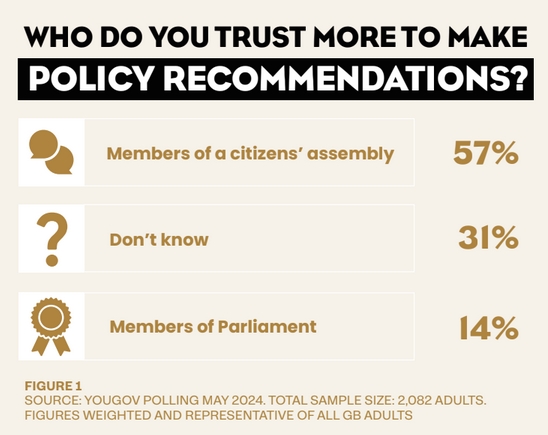
UK citizens trust citizen assemblies 4 times more than MPs

Findings from a 2024 poll appearing in a paper by Sortition Foundation.

Choosing by lot and the politics without titles

Yavor Tarinski

The man who wears the shoe knows best that it pinches and where it pinches. ~John Dewey [1]

One of the main pillars of contemporary oligarchies worldwide is the institution of elections. Every leader and government, regardless of how liberal or authoritarian, claims its ascendance to power through some kind of electoral process. Elections are considered as “the democratic means” per se – if a system is based on elections, then it supposedly is a “democracy”.

The supporters of this view see in electoral processes a means of sustaining popular sovereignty, while avoiding what they see as a danger of popular self-rule – i.e., rule by the incompetent. But as philosopher Jacques Rancière underlines, there is an “evil at once much more serious and much more probable than a government full of incompetents: government comprised of a certain competence, that of individuals skilled at taking power through cunning.”[2]

Electoral processes tend to nurture antagonism and competitiveness, rather than cooperation and dialogue. They give way to a certain anthropological type – the power-hungry political demagogue. Rather than concerned with resolving public issues and problems, it focuses on “winning” elections. The very essence of politics is radically altered in elections-based systems – with their content being emptied of any substantial deliberatory essence and replaced with a lifestylish approach that focuses on candidates – their ways of life, the tricks they pull on each other, etc.

Ultimately, the main agenda that drives the action of the electoral anthropological type is that of opinion polls. Candidates must learn what and when to say things that will be liked by the largest amount of people, so that they can get ahead in the race. The result is a type of craft where electoral competitors outbid each other, play dirty, and resort to all sort of tricks in order to win. This becomes the main occupation of people involved in electoral competitions for office. Because of this political scientist James S. Fishkin suggests:

Candidates do not wish to win the argument on the merits as much as they wish to win the election. If they can do so by distorting or manipulating the argument successfully, many of them are likely to do so. Representatives elected through such processes are looking ahead to the next election while in office.[3]

Continue reading

Just sortition, communitarian deliberation

A new paper by Nicole Curato, Amiltone Luís, Melisa Ross, and Lucas Veloso in Environmental Science & Policy includes field work eliciting comments from people in Zambezia, Mozambique regarding their views on sortition in the context of the allotted Climate Assembly on the Climate and Ecological Emergency.

Just sortition, communitarian deliberation: Two proposals for grounded climate assemblies

Abstract

Sortition or recruiting randomly selected everyday citizens is a core feature of climate assemblies. Sortition, the argument goes, enforces the principle of inclusiveness, as everyone has a fair shot at getting invited to the climate assembly. This form of recruitment, however, faces criticism. It challenges traditional structures of representation and decision-making where elders, religious leaders, elected representatives, and community organisers typically give voice to the ideas and grievances of everyday people. For some, sortition valorises the atomised individual who can speak their mind in a forum, without any mechanism for the individual to reconnect their deliberative experience to the wider community. In this article, we draw on the experience of the province of Zambezia in Mozambique as one randomly selected Assembly Member took part in the world’s first Climate Assembly on the Climate and Ecological Emergency. Based on in-depth interviews, focus group discussions, and feedback sessions with local organisations in Zambezia, we offer practical insight on how sortition can deepen community connection and maximise the impact of climate assemblies in delivering practical outcomes for climate change adaptation. Using grounded normative theory, our study demonstrates how sortition can promote justice by elevating the voices of those most impacted by climate change. We also demonstrate why a communitarian approach to citizen assemblies enhances accountability and shared learning and empowers members to translate global deliberations into local actions.

One useful contribution of this article is a summary of the arguments for and against sortition that the authors drew from the literature.
Continue reading