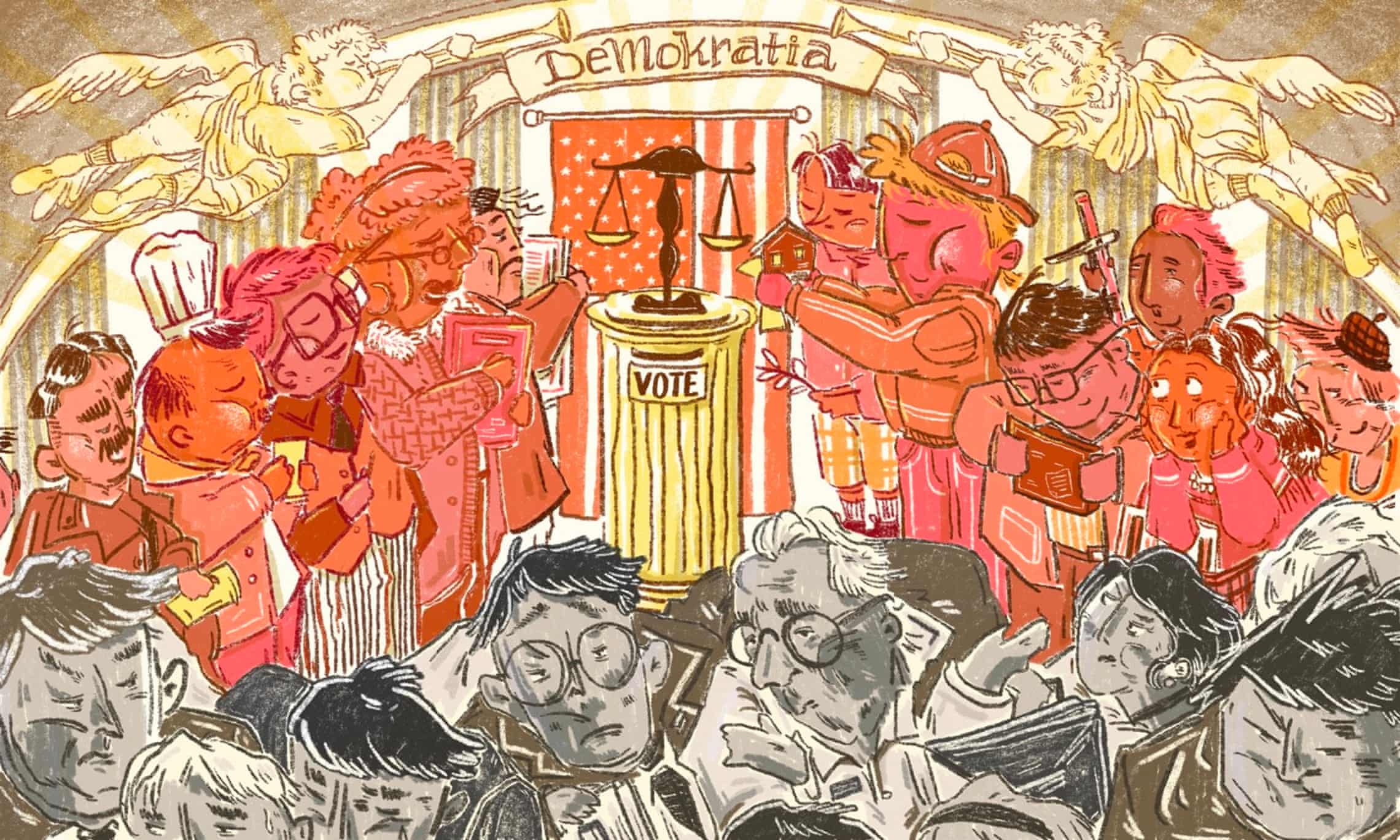
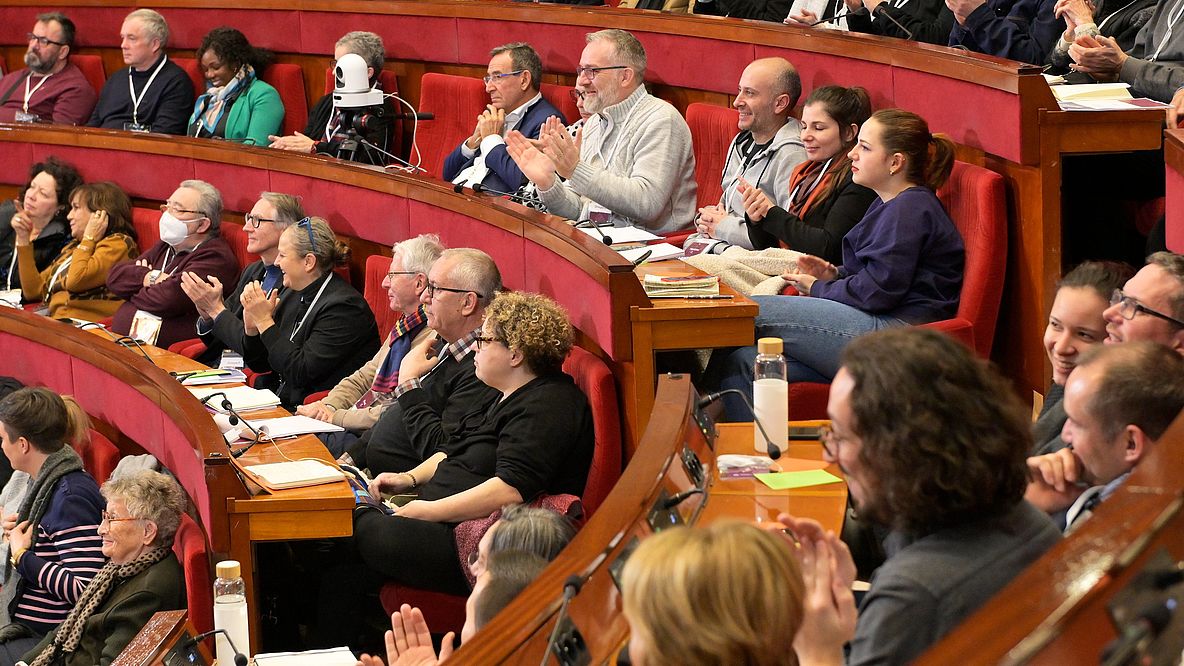
Annabelle Lever, researcher at Cevipof and professor of political philosophy at Sciences Po, writes in The Conversation about the lengths into which the organizers of allotted bodies have to go in order to overcome “cultural imperialism” and give the disadvantaged a voice.
Creating a citizens’ assembly that truly reflects society as a whole isn’t so simple, however. In particular, only a very small percentage of those invited to participate actually agree to do so.
To create an assembly that is more descriptively representative of the population – or one that looks more like us – several approaches are used. One is to have an initial phase of unweighted selection followed by a second phase that uses weighted lotteries. Another is to use stratified sampling or forms of stratification from the beginning.
Because citizen assemblies are very small compared to the population as a whole – France’s Convention for the Climate was made up of just 150 people – the descriptively representative character of the assembly can occur on only a few dimensions. Organisers must therefore decide what population characteristics the assembly should embody and in what proportion. Randomisation thus does not preclude difficult moral, political and scientific choices about the assembly to be constructed, any more than it precludes voluntariness or self-selection.
The use of weighted lotteries means that individuals will not have a formally equal chance to be selected to it – nor, of course, a substantively equal one. Assemblies created by stratified random selection offer a much wider set of opportunities to serve than is typical of other deliberative bodies. It is thus important to remember that even when a randomly selected assembly “looks like us”, everyone will not have had the same chance to be selected to it, nor to take up the invitation if they want to.
[D]emocratic equality does not require that deliberative bodies be composed of social groups in proportion to their share of the population. Continue reading →
SWI swissinfo.ch interviews Su Yun Woo, who is studying processes for citizen participation in decision making in China. Somewhat confusingly, the interview seems to be asserting two conflicting claims. On the one hand it is pointed out that the “citizen participation” processes in China are essentially the same as those in the West and have the same objectives. At the same time it is explaining that, obviously, things in “democracies” are very different as the authoritarian regimes lack “any overarching democratic conviction”.
SWI: How do these participatory budgeting processes [in China] work?
S.Y.W.: The authorities invite the local population to get involved in decision-making on a part of the budget. A group of citizens will come together to form a panel to discuss how to spend money on a project that serves the community – for instance, a library or a communal garden. Wenling’s participatory budget is well known, whereas the example of Chengdu has been less well studied.
In Wenling, citizens are selected through a lottery system. In Chengdu, the participants are volunteers. This explains why mainly older people took part there, since they have more time. In Wenling, random selection works as the participants get paid – just as they do in Switzerland for projects of this kind. They receive the equivalent of CHF7 ($7) and a free lunch for taking part. In Wenling, participatory processes are now an integral part of local budget policy-making.
SWI: So the participants do not have to be Communist Party members?
S.Y.W.: No, they are ordinary citizens. There is no denying, however, that there can be official interference in participatory projects. I was told about some party officials who were supposed to go door to door and ask people their opinions, but instead they just filled out the forms themselves.
SWI: How would you describe the discussion culture during participatory budget debates?
S.Y.W.: Some participants are very vocal in expressing their opinions, while others stay quiet and prefer to take a back seat.
SWI: This sounds rather like participatory budgeting elsewhere. Continue reading →
The recent LTE challenging elections in the U.S. is justified, but his reasons aren’t exclusive. According to Pew, the U.S. still ranks 31st in voter turnout compared to 49 other peer countries. Why?
Now, money can buy most elections, thanks to the Supreme Court ruling in Citizens United. And the two-party duopoly maintains overwhelming control of political power (and the money). At the same time, a plurality of voting-age persons, 41%, consider themselves Independent. Yet we, de facto, can only choose from candidates picked by powerful politicians.
Let’s fix the broken system. Let’s start talking about an evolutionary change to sortition – choosing House members by lottery, which would significantly reduce the power of political parties, remove considerable money from elections, and allow we, the people, instead of politicians, to be our representatives. Teachers, auto-mechanics, doctors, and homemakers can and should be representing us in Congress, not professional politicians.
A reader of the blog wrote asking whether readers of Equality by Lot have ideas about how a transition toward a system in which sortition plays an important role could be achieved.
The reader, who is an Iranian expat, is specifically interested in the case of Iran, which she describes as follows:
There are no political parties in Iran, though there are some syndicates of workers, teachers, …
There are some opposition groups out of Iran, but those who are well-known and are professional politicians, are just promoting their own interests, I think.
The majority of people who are against the regime are still passive as they don’t know what would happen next. They need an image of the future of Iran.
There is so much violence from regime devotees because they are also afraid of the future. Maybe the idea of sortition can soothe them too.
With the appropriate modifications, however, the description applies also to many (possibly all) other countries, specifically including those with the Western-style elections-based systems. Therefore any ideas may very well be relevant for effecting a change in many societies.
The questions then are:
How can a revolution create a deliberative democracy and sortition? What would be a realistic scenario or plan for that? What can international agents/actors, people like you, do to make it possible? Is there any international organization that can help at least us, Iranians who live out of Iran, to have a “citizen assembly based on sortition”, to practice democracy and peer-to-peer conversation between us and to create a feasible image of how could be the democracy like in Iran of future?
And, again, I believe the answers in the context of Iran would not be very different from the answers in other contexts. Sortition activists of all countries should consider these questions in the contexts of their own societies and government systems.
Dr. Anjum Altaf is an economist and Dean of Social Sciences at the Lahore University of Management Sciences. The following are excerpts from an article Altaf recently published in the Pakistani newspaper Dawn.
THE big question Pakistanis must ask is how to get out of this disarray. By now, no one can deny that the country is in a huge mess, which is getting worse by the day. And it is getting worse because of the quality of its rulers. They are interested in nothing beyond their own interests; their only concern, while the country drowns and burns, is who will get to appoint the most important man who, they will then complain, does not allow them to do what needs to be done.
At this stage of terminal decline, there is no possibility of a normal recovery because of the state of the rot and the capability deficit to address it. Only radical solutions offer hope. Ideally, one would hope that the quarrelling rulers would realise the gravity of the catastrophe that threatens everyone and arrive at a consensual response, but that is extremely unlikely. In its absence, only popular demand can force their hand and save the country.
It is no longer possible to revert back to monarchy (though note how intelligently that has been employed in Malaysia) and dictatorship has time and again made things much worse. There is no alternative to popular rule, but we can certainly have a system where governance is truly by the people. There is a model for such an alternative called ‘sortition’, in which legislators are selected by lottery from the larger pool of adult citizens.
In ancient Athens, sortition was the method for appointing political officials and was deemed the principal characteristic of democracy by ensuring that all eligible citizens had an equal chance of holding public office. Unhealthy factionalism, the buying and selling of electables, and populist posturing is eliminated when assemblies are chosen by lottery. These representatives can then engage the experts they need for formulating policies.
This proposal is bound to be met with incredulity and scepticism. I can only point out that even today, in common-law systems, sortition is used to select prospective jurors who have a say over life-and-death decisions. Today, it is a life and death instance for Pakistan, and citizens need to take their governance in their own hands. There is no way they can do a worse job than the motley bunch of uncaring electables and strongmen to whom they have handed over their destiny.
Any extension of the status quo will reduce Pakistan to rubble. By the time the music stops, the lights will be out and there will be nothing to eat next year.
In a paper in The Yale Law Journal, Bernadette Meyler, professor of law at Stanford, makes the case for having sortition as part of the American democratic (sic) system. In the abstract she writes that she aims at
highlighting the ways in which the Constitution celebrates aspects of democracy that do not fit neatly within the model of majoritarian elections. Focusing in particular on the jury system, the protections for petition and assembly, and the references to the general welfare, this Response opens space for nonelectoral democratic defenses of the administrative state, including agonism.
In the article itself Meyler writes:
While democracy today is often seen as synonymous with majoritarian elections, that was not always the case. Another form of democracy, practiced in ancient Athens and elsewhere, entailed selecting officials by lot, or sortition.32 Although the U.S. Constitution never explicitly mentions this procedure, it was not foreign to the Founders, who arguably incorporated it into our constitutional scheme through the jury. Sortition represents a significant democratic alternative to the mechanism of election, and systems that rely on sortition tend to emphasize different aspects of democracy than those implementing majoritarianism.
[S]election by lot could permit an equal distribution of the “probability of achieving power” and “could promote equality in the distribution of offices.”
Meyler wonders why the U.S. revolutionaries did not consider introducing sortition into the system they were designing, and with Bernard Manin suggests that this has to do with their reliance on the idea of consent. (See here for why this idea is not convincing.) Continue reading →
Tyler Brown from Reading, Pennsylvania, writes the following in a letter to The Reading Eagle:
Your Oct. 23 editorial (“Be prepared when casting votes this fall”) claims that it’s time to get ready to make an informed vote. But being informed makes no difference. A candidate’s decision to run for office is disqualifying in itself.
People do not run for office for altruistic reasons, they run because they are power hungry ne’er-do-wells seeking to leech off productive members of society. Even the most blameless person would be corrupted by our dirty, money-laden election process.
The simplest fix would be to make a non-vote count as a vote for sortition. Consider that in 2020 there were about 255 million U.S. citizens. Roughly 81 million voted for Joe Biden and 74 million for Donald Trump. Another 5 million voted for someone else, bringing the total to about 160 million.
Therefore about 95 million citizens did not vote at all. Why should their voice not count? They all saw the candidates, considered all options and decided not to vote. Biden was about 14 million votes short. In such a case the office should be filled by random draw much like jury duty.
If a candidate cannot even win a plurality of their constituents, then what real claim can they possibly have to hold office? The very inventors of democracy, the Athenians, considered sortition to be the test of a democracy. They considered voting to be oligarchic.
I’d much rather entrust the future of our country to randomly chosen citizens rather than partisan politicians.
In a response, Daniel Jamar writes:
How could sortition ever happen when the only people that would benefit is the general population? Lawyers and politicians make the rules and it would largely put them out of business.
Kline has just published an article calling for replacing elections with sortition.
Winston Churchill said: “Democracy is the worst form of government — except for all the others that have been tried.”
For many of us, this “least worst” argument is getting pretty threadbare, particularly as we watch our democracy sliding further from its defining principles every year.
We know this is due to the rise of the professional politician, whose aim is to promote their own advancement to the exclusion of all else. And to achieve that personal advancement, they have to promote the interests of, essentially, a cadre of multinationals plus Rupert Murdoch. And a few other second-division players like big oil, the unions, lesser Murdoch “lookalikes” and a handful of assorted billionaires. Continue reading →
Many people in the world, yes, they go and vote and choose their government, but their material conditions are not being improved. And in the end, people want to live a better life.
Borrell followed this admission in the inefficacy of elections in achieving the most fundamental political goals with the following bromide:
We have to explain what are the links between political freedom and a better life. […] Our fight is to try to explain that democracy, freedom, political freedom is not something that can be exchanged by economic prosperity or social cohesion. Both things have to go together.
Borrell, however, fails to explain what those supposed links between elections and prosperity are. In fact, as he admits, in reality those links do not exist. It is Borrell himself who tells his audience that “many people” vote without having their conditions improved and that the Chinese system provides prosperity without elections. Moreover, despite Borrell’s assertions to the contrary, the situation of having elections on the one hand and stagnation or deterioration of the quality of life of the average person on the other hand is the norm in the West as well, and indeed worldwide. Thus Borrell’s unreflective faith in the links between elections and prosperity is due purely to his own blindness and to him belonging to an insular elite whose status is justified by the electoralist ideology.
The proponents of “deliberative democracy” have spent decades dredging a this-but-that argumentative quagmire that has yielded nothing of either theoretical or practical value for democracy. One of the prolific underlying springs of sticky material for the quagmire has been the inherent contradiction between two dicta of “deliberative democracy”: mass participation and deliberation. It is very straightforward that masses cannot deliberate. Meaningful deliberation can occur in groups of at most a few hundreds of people (and even at this scale all-to-all deliberation could occur only under very favorable conditions).
Thus, “deliberative democracy” professionals can develop entire careers stirring, pouring and piling the sands of participation and deliberation without ever managing (or, it could be argued, without ever trying) to build any solid structure. Those of us who would suggestthat both mass participation and deliberation are at best tools for good outcomes, rather than sacrosanct goals, are severely chastised for looking for illegitimate “shortcuts”.
Technology is one of the implements that have been routinely used to stir those sticky sands. Over and over again we have been promised that new information technology would allow democracy to go where it has never gone before. Mass education, remote participation, virtual mass discussions, crowd-sourced documents – these and many other unprecedented tools of democracy would be enabled by innovative technology. The fact that such promises go back to the advent of the radio (and probably much farther back) never discourages the prophets of mass participation from promising that the next technological innovation would be the one that would usher in democratic utopia where millions of voices would be heard by millions of people who all make meaningful – equally meaningful – contributions to decision making.