Posted on May 17, 2021 by Yoram Gat
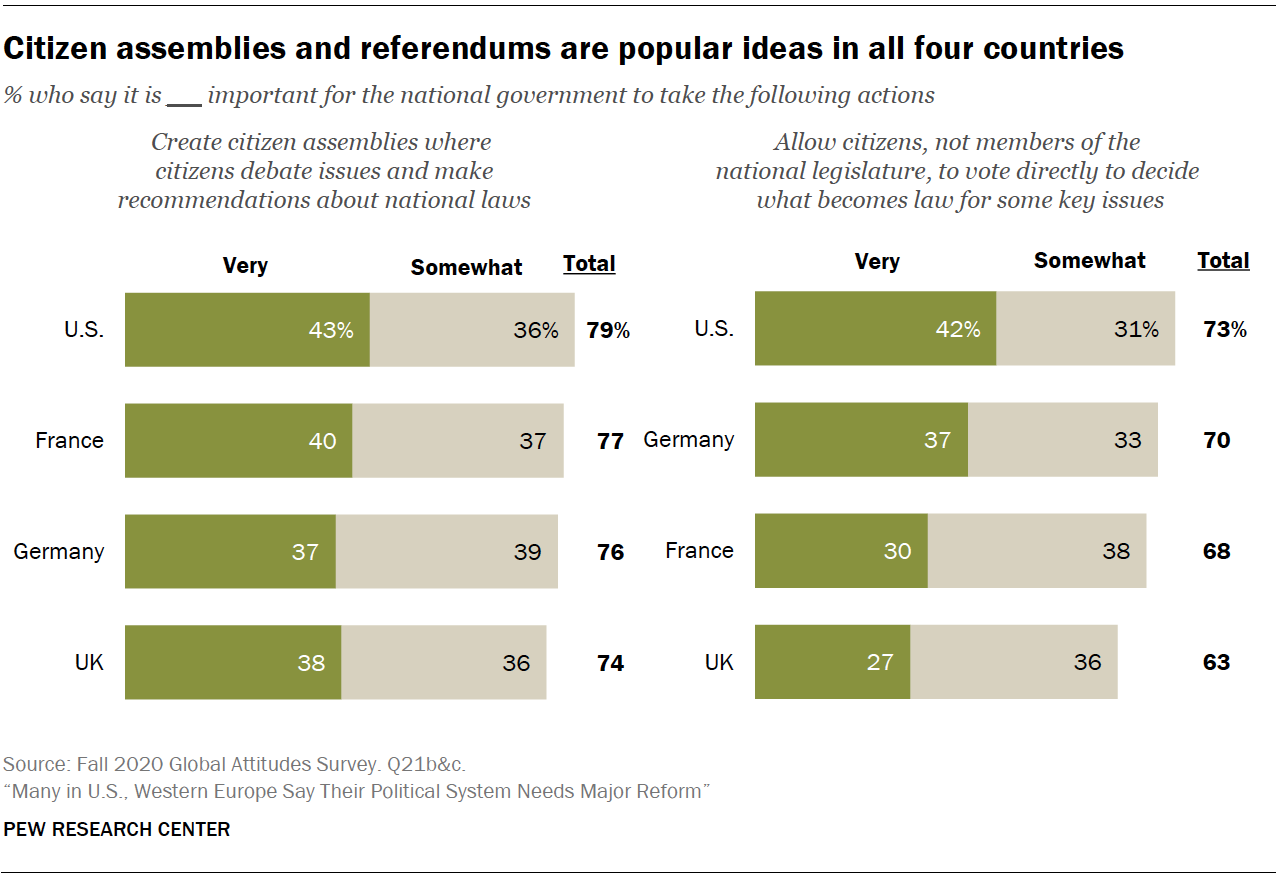
A Pew Research poll conducted in November and December 2020 asked people in France, the U.S., the U.K. and Germany about their attitudes toward the political systems in their countries. As usual, there was a lot of dissatisfaction. It turns out for example that in France and the U.S. about 20% of those polled think that the political system in their country “needs to be completely reformed”.
Interestingly, the poll had a question about “citizen assemblies”.
In all four countries, there is considerable interest in political reforms that would potentially allow ordinary citizens to have more power over policymaking. Citizen assemblies, or forums where citizens chosen at random debate issues of national importance and make recommendations about what should be done, are overwhelmingly popular. Around three-quarters or more in each country say it is very or somewhat important for the national government to create citizen assemblies. About four-in-ten say it’s very important.
Surprisingly, in my opinion, support for such advisory bodies is somewhat higher in all countries than support for binding referenda.
(Thanks Paul Gölz.)
Filed under: Initiatives, Opinion polling, Proposals, Sortition | 3 Comments »
Posted on May 16, 2021 by Yoram Gat
This continues the review of Landemore’s treatment of objections to “open democracy” which makes up the last chapter of her book.
3. Tyranny of the majority
“For some readers”, Landemore says (p. 199),
the undemocratic, or at least counter-majoritarian, aspects of electoral, liberal democracy (aka representative democracy) are intended and desirable features, not problems to be solved.
Those readers
fear that promoting a purer democratic regime against electoral democracies risks undoing the minority rights protections built into the liberal core of the latter.
Landemore sees such fears as “legitimate”, but argues that
it is also entirely possible that, by starting with a liberal rather than a democratic framework, the founders of our modern “democracies” have turned the screw too tightly on the elements of popular rule that they have also tried to incorporate (while compounding that mistake by locking the design and throwing away the key with almost impossible-to-revise constitutional entrenchments. (p. 200)
Josiah Ober is then credited with a “recent attempt at drawing a clearer distinction between democracy and liberalism” and approvingly described as having “thus begun to challenge the view that the tradition of political liberalism, and consequently representative government as its central emanation, is the only ideology or historic system that can protect at least certain individual rights and freedoms.” “Pre-liberal, non-representative democracy” – Landemore reassures her readers – “was not all that unstable or even as terribly ‘illiberal’ on the substance […] as is often feared.”
Continue reading →
Filed under: Academia, Athens, Books, Elections, History, Sortition, Theory | Leave a comment »
Posted on May 15, 2021 by Yoram Gat

Alpa Shah is Professor of Anthropology at London School of Economics and Political Science, London, UK, where she also leads a research theme at the International Inequalities Institute. Her most recent book is Nightmarch: Among India’s Revolutionary Guerrillas (Hurst, 2018).
Shah has an article in a special issue of Development and Change journal titled “What if We Selected our Leaders by Lottery? Democracy by Sortition, Liberal Elections and Communist Revolutionaries”.
Abstract:
What if we selected our leaders by lottery? Zooming out from the mud huts of indigenous communities in the forested hills of eastern India, this article compares three different models of leadership and democracy: liberal electoral democracy; Marxist‐Leninist Maoist democracy; and democracy by sortition — the random selection of rotating leaders. The significance of sortition is introduced into discussions of democracy in India (showing connections with practices in Nepal and China) as part of a broader attempt to make scholarship on South Asia more democratic. The author also re‐reads ideals of leadership among indigenous people, showing that we need a theoretical and practical vision arguing not for societies without leaders but for societies in which everyone may be a leader. In India, this compels us to push back against the critique of its indigenous communities for not producing leaders and enables a profound re‐reading of the history of subaltern anti‐colonial rebellions. The final aim of the article is to highlight the virtues of the potential of sortition in creating democratic society globally. How we think about democracy and leadership is thus turned on its head to provide a new vision for the future.
Continue reading →
Filed under: Academia, Elections, History, Sortition | 2 Comments »
Posted on May 10, 2021 by Yoram Gat
 An op-ed by Joe Mathews in The Mercury News.
We need a new way to govern the internet, here’s how to do it
Joe Mathews, May 7, 2021
Today’s methods for governing the internet do not constitute a coherent system, much less a democratic one. Instead, internet governance is a contest for power between the most powerful tech companies, who put their shareholders first, and national governments, which prioritize their own political interests.
In this contest, both sides create the pretense of democracy. Facebook, based in Menlo Park, has created its own “independent oversight” board of global experts, though it’s unelected and chosen by Facebook. The European Union touts its tougher regulation of privacy and the internet — but those regulators are also unelected, and impose their rules on people far from Europe.
Which is why the internet needs a democratic government that operates beyond the reach of tech companies or national government. Such a system must be both local — to allow people to govern the internet where they live — and transnational, just like the internet itself.
I’d suggest that the internet’s democratic government combine multiple forms of democratic governance.
The center of such a government should be a citizens’ assembly — a tool used around the world to get democratic verdicts that are independent of elites. This citizens’ assembly would consist of 1,000 people who, together, would be representative by age, gender and national origin of the global community of internet users. They would not be elected individually, but rather chosen via randomized processes that use sortition (or drawing lots).
The assembly would be supplemented by an online platform that allowed people to report problems, make suggestions, or even petition for proposals that could be voted upon in a global referendum by internet users everywhere. The models for such a platform include Rousseau, the controversial online environment through which Italy’s Five Star Movement governed itself for a time, and Decide Madrid, the online participatory framework that has spread from the Spanish capital to more than 100 cities worldwide.
National governments and tech companies would try desperately to influence this government, but they would not be in charge of it. And each citizens’ assembly would dissolve after two or three years — making it harder for the powerful to lobby it.
Filed under: Press, Proposals, Sortition | 1 Comment »
Posted on May 10, 2021 by Yoram Gat
 An interview with Jane Mansbridge in the Harvard Gazette.
GAZETTE: How might we get citizens who are so polarized to listen to one another?
MANSBRIDGE: One proven practice is the technique of citizens’ assemblies or deliberative polls. These are groups of citizens drawn randomly, through a democratic lottery, from a particular population. It could be an entire country, a state, a city, or even a neighborhood, from which you bring together a group of citizens to talk about an issue that is of concern to their community. For this technique to be successful, the group has to be random, meaning that you have to have good representation from everyone, not just the white retirees who don’t have much to do and would love to come to this sort of thing. To get a random group, you ought to able to pay the participants because you want to be able to get the poor, the less educated, and people who, for one reason or another, would not give up a weekend otherwise to come together with other citizens to deliberate about some major issue.
GAZETTE: Have you participated in a citizens’ assembly? What was it like?
Continue reading →
Filed under: Academia, Applications, Athens, Deliberation, Elections, History, Press, Sortition | 1 Comment »
Posted on May 7, 2021 by Yoram Gat
 Reddit user subheight640 has a post presenting an uncompromising argument in favor of sortition:
Why randomly choosing people to serve in government may be the best way to select our politicians
So I’m a huge advocate of something known as sortition, where people are randomly selected to serve in a legislature. Unfortunately the typical gut reaction against sortition is bewilderment and skepticism. How could we possibly trust ignorant, stupid, normal people to become our leaders?
Democracy by Lottery
Imagine a Congress that actually looks like America. It’s filled with nurses, farmers, engineers, waitresses, teachers, accountants, pastors, soldiers, stay-at-home-parents, and retirees. They are conservatives, liberals, and moderates from all parts of the country and all walks of life.
Continue reading →
Filed under: Academia, Applications, Athens, Books, Elections, History, Proposals, Sortition | Leave a comment »
Posted on May 4, 2021 by Yoram Gat
In the final chapter of her book, Hélène Landemore addresses a few potential objections to her proposals. I’ll skip over the objections regarding ways in which the Icelandic setup (which supposedly serves as an example where an “open” process functioned well) is atypical of other political situations (e.g., because Iceland is supposedly small or homogeneous). These are not of much interest both because they lack any real merit and because the Icelandic setup is not a particularly good example of a democratic process to begin with. The remaining objections are fairly well known and are generic enough to be aimed at any democratic, counter-electoral proposals rather than specifically at Landemore’s:
- Incompetence of unelected decision-makers,
- Manipulation of the unelected decision-makers by unelected professionals,
- Illiberal policies may be supported by a majority,
- Systemic unaccountability,
- Demands on the time of the citizens.
Most of these objections have been discussed repeatedly on this blog in one way or another. (In particular, all of these objections have been addressed briefly in the series of 4 posts titled “Short refutations of common objections to sortition”.) The comments here relate to how Landemore responds to these objections.
1. Incompetence of unelected decision-makers
Landemore puts this objection as follows:
[G]iven the increasing complexity of the world, it is irrational to want to increase the level of openness to ordinary citizens of our central political institutions. In the face of increasing complexity, what we need is increased specialization and division of labor, not putting amateurs in charge (p. 191).
Landemore offers two answers to this argument. The first is that experts should be used as advisors to the amateurs. The second is response the “competence through diversity” argument. But the first argument gets no more than a single paragraph, while the several pages that make the rest of the section offer highlights of the “vast empirical literature” that shows that “political processes and bodies that involve ordinary citizens […] actually outperform processes and bodies that include only experts” (p. 192).
Continue reading →
Filed under: Academia, Books, Elections, Sortition, Theory | 4 Comments »
Posted on May 2, 2021 by Yoram Gat

Dennis Merritt, a resident of Shelburne Falls, writes in the Greenfield Reporter (keeping Franklin County informed since 1792!):
Judith Truesdell’s letter on immigration reform [“Illegal immigration”, April 24] made me think more about a friend of mine’s opinions on citizens’ assemblies, a form of sortition.
What’s sortition? It turns out the Athenian Greek democracy did not elect representatives. Instead they were chosen at random from the population. That’s sortition.
For some, the very fact that we elect our representatives is at the core of the problems with our government today. They argue that if Congress were made up of randomly selected individuals, who are demographically representative of the country, rotating through fixed terms, then a lot more would get done, and get done better.
Why? Because the representatives would focus on the issues, not the visibility of the issue and how it affects their fundraising and chances for re-election.
That’s clearly not going to happen any time soon, but there is a variation on the idea that is happening in places and could happen on a national level. It’s called citizens’ assemblies.
A citizens’ assembly is a group of randomly selected, demographically representative individuals brought together to address one particular issue, hopefully to make law, but at least to make recommendations. These could be relatively large groups. They would take input from various stake holders and experts. After making their decision, they would disband.
Continue reading →
Filed under: Elections, Juries, Press, Sortition | 2 Comments »
Posted on April 26, 2021 by Yoram Gat
Nicolas Pirsoul, Policy Analyst and Research Assistant, and Maria Armoudian, Lecturer, Politics & International Relations, both at the University of Auckland, write:
While the primary industry sector undeniably plays a key role in New Zealand’s economy (5-7% of GDP for agriculture), its true contribution might look quite different if environmental impacts – and freshwater quality in particular – were taken into account.
Currently, New Zealand taxpayers shoulder the heavy cost of lax oversight and regulation of freshwater. While the public is aware of the issue of freshwater quality, arguably there is less awareness of the democratic deficit contributing to the problem.
In a liberal representative democracy such as New Zealand’s, political decisions result from elections. The three-yearly electoral cycle, however, tends to encourage symbolic politics geared towards winning votes rather than generating long-term solutions to complex problems like freshwater quality.
In 2017, for example, Labour campaigned on cleaning up our waterways. Its eventual plan, “Essential Freshwater: Healthy Water, Fairly Allocated“, appeared promising but is ambiguous and short on detail or substance. Some of the promised reforms have since been delayed.
Elections won’t help
With no real mechanism for public participation beyond the next general election or non-binding public consultation and submission processes, New Zealanders are left largely powerless.
Continue reading →
Filed under: Academia, Elections, Press, Sortition | Tagged: environment, New Zealand | Leave a comment »
Posted on April 20, 2021 by Yoram Gat
Chapter 7 of Open Democracy presents Hélène Landemore’s assessment of the constitution-writing process in Iceland that took place following the 2008 financial crisis. Landemore describes this process as “the first domino of the classic electoral democracy model to fall toward a more open democracy model at a national level”. This seems to me to be a highly over-optimistic assessment of the significance of the process. First, this process was a dud, its outcomes being eventually dismissed by the Icelandic parliament. But more importantly, this was conceived from the outset as a one-off process, not a fundamental change for how things are done. Furthermore, this one-off process dealt in very abstract subjects – phrasing articles of a constitution. By construction it was clear that would not be able to serve as template for the workings of anything like a sortition-based policy making body. The idea of radical democratization (by abolishing elections or at least creating a sortition-based co-equal chamber) was never on the agenda. Thus, the entire discussion in the chapter – and below in this post – should be understood in this light. This was not a momentous occasion whose outcomes did or could have affected how politics is done. The analysis is therefore mostly a theoretical exercise. (A detailed analysis of the workings of the French CCC – which dealt with setting practical policy – could be much more instructive in this sense.)
With this diminished significance, even a radically democratic process would hardly justify the notion that it would serve as a “first domino”. However, as the analysis below indicates, the process itself is far from living up to an aspiration as serving, if not as a template or a model of a democratic process, then at least as an inspiration. Landemore’s celebratory tone is wholly unwaranted.
As Landemore describes the Icelandic process, it had three innovative “open” aspects: the National Forum – an allotted body that met for one day and “established the main viewpoints and points of emphasis of the public concerning the organization of the country’s government and its constitution”, the assembly of amateurs – a body elected from among candidates that were not incumbent professional politicians and which was to draft a proposal for the constitution, and the crowdsourcing phase – an online platform on which the assembly of amateurs would post drafts of the constitution to which the public could post feedback comments on the platform itself or on social media platforms.
Continue reading →
Filed under: Academia, Applications, Books, Deliberation, Sortition | Leave a comment »


 Adam Cronkright
 Ali
Ali Ahmed R. Teleb
 avanderven
 avergne
 Alex Kovner
 azakaras
 Brett Hennig
 campbellwallace
 Simon Threlkeld
 Nick Coccoma
 codyhipskind
 Common Lot Sortitionist
 Conall Boyle
 constitutionalism
 davidschecter
 graytmatter
 gtridimas
 H.J. Hofkirchner
 Hanspeter Rosenlechner
 James Kierstead
 John Burnheim
 jgarry20151
 Jochen Krattenmacher
 johnedwardtaylor
 johnhuang865
 Jonathan Crock
 keithsutherland
 Jacob Richter
 kkoreilly
 lukewhito
 SimonPek
 Nathan El
 Nicholas Gruen
 Owen Shaffer
 Patrick Chalmers
 Paul Gölz
 peterstone
 Pierre-Etienne Vandamme
 pronfeld
 Emil
Emil rcaze
rcaze richwbrown
 Roger Knights
 roslynfuller
 Pierre-Etienne Vandamme
 shaharavin
 tbouricius
 Ted Wachtel
 Joshua Laferriere
 theodorestathis
 towardsautonomyblog
 Wayne Liebman
 Yoram Gat
 Oliver Milne
 Equality by lot