“Maybe they expected to have more influence on projects”

An article by Sabrina Nanji in the Toronto Star is an interesting mix between the standard citizen-jury PR and facts that undermine this standard narrative. There is also an appearance by the familiar elite discourse of the struggle of diversity promoting liberalism against conservative white-supremacist ideology.

The story of Toronto’s Planning Review Panel shows one very important aspect (even if a completely foreseeable one) of the surge of sortition in the 21st century: it is being experimented with by established elites for their own purposes (i.e., for its usefulness in buttressing their power) rather than as a tool of democracy.

City of Toronto is looking for your input on urban planning issues

The city is looking for regular folks interested in studying and informing municipal planning policy and projects on the Toronto Planning Review Panel.

Calling all wannabe urban planners and civic champions — Toronto’s planning department wants your advice.

This week 10,000 letters were randomly sent out across the city soliciting regular folks interested in studying and informing municipal planning policy and projects on the Toronto Planning Review Panel, which is wrapping up its first-ever experiment in diverse citizen engagement, to mixed reviews.

Two years after they were recruited, the original 28 panelists will meet for the last time next Saturday and the search is already on for the next batch of volunteers to take up the mantle in January.
Continue reading

The allotment for the convention of La France insoumise has started

La France insoumise (“France Uprising”, FI) is a Left-wing French political party which was founded in 2016. In the 2017 presidential elections its candidate, Jean-Luc Mélenchon, won almost 20% of the votes in the first round and narrowly missed making it to the second round. FI has presented a platform it calls L’Avenir en commun one plank in which is having a constitutional convention where a certain proportion of the delegates would be selected by lot.

FI is now in the process of having its own internal convention “for setting its new objectives, improving its tools and modes of action and specifying its principles of organization.” This process involves allotting delegates to the convention. FI has now announced that it has sent invitations to those allotted:

The first phase of the sortition has taken place. A list of the first 1,200 people has been drawn. Each one of those people has received a registration form. Those women and men who fill out the form before November 13th will participate in the convention. The unclaimed slots will be redistributed in the second phase of the sortition on Friady, November 10th. There is therefore time for you to participate in the allotment if have done so yet.

P.S.: For the curious, here is the script which we used to implement the sortition.

“The flag should be held by a student who has achieved and not randomly”

It was reported in August that a lottery is going to be used in Greece to distribute the distinction of carrying the flag. This decision is now being taken to court:

A group of parents wants the state’s highest administrative court, the Council of State, to overturn a decision by the ruling Radical Left SYRIZA for flagbearers in school parades to be chosen by lottery and not to the best student as had been the custom.

SYRIZA doesn’t believe in excellence in education nor standards for university admissions but the parents who protested said the flag should be held by a student who has achieved and not randomly.

Education Minister Costas Gavroglou issued the lottery scheme but the parents said it is unconstitutional and was driven by ideology and not merit, nor by popular demand or social necessity. He said the lottery makes the process fairer even if it excludes top students for their work.

The random selection of “an Afghan boy” as flag bearer made him the victim of violence:
Continue reading

Arturo Íñiguez: On the meaning of the word ‘democracy’

Arturo Íñiguez, an occasional contributor to Equality-by-Lot, recently published a rather beautiful essay touching upon sortition which weaves together history, linguistics and political philosophy (English, French, Spanish). Well worth reading in its entirety even for people familiar with the idea of sortition, here is an excerpt from the essay:

[R]epresentative regimes can be either aristocratic, if they rely on election, or democratic if they rely on sortition.

According to my experience, a lot of people, when exposed to these truths, will react in complete denial. But the fact is that this has been completely trivial knowledge for political scientists for most of recorded history: from Plato and Aristotle to Montesquieu and Rousseau, in the mid XVIIIth century, all of them wrote the same: elections are aristocratic and sortition is democratic. How come, then, that we have been so thoroughly indoctrinated as to believe the exact opposite of something that was crystal-clear for the greatest human thinkers?

Well, the change began in the late XVIIIth century, when the rich bourgeois in France and North America decided that they would be better off in the future by breaking free from the existing monarchic regime (which after all had not been so bad with them, or they wouldn’t had got so rich in the first place). Needless to say that sharing any power with the poor masses was always completely out the question. The masses would be used to fight the royal armies and then abused into thinking the the victory was also theirs. Both the Founding Fathers and the French revolutionaries were adamant in opposing democracy. Suffice to read what they said and wrote to understand that democracy was for them a very bad and ugly word.

But calling their elective system aristocracy, which would have been the logical thing to do following the philosophical tradition we have just mentioned, was also a no-go. Was not the aristocracy the despised enemy recently destroyed? And at the end they had to settle for a word like ‘republic’, an empty signifier which can mean anything you want it to mean.

A lively discussion followed the essay in the comments and Arturo exhibited the proper democratic mindset and engaged in conversation with some of the commenters. Here, for exmaple, is one comment by a reader and Arturo’s reply:
Continue reading

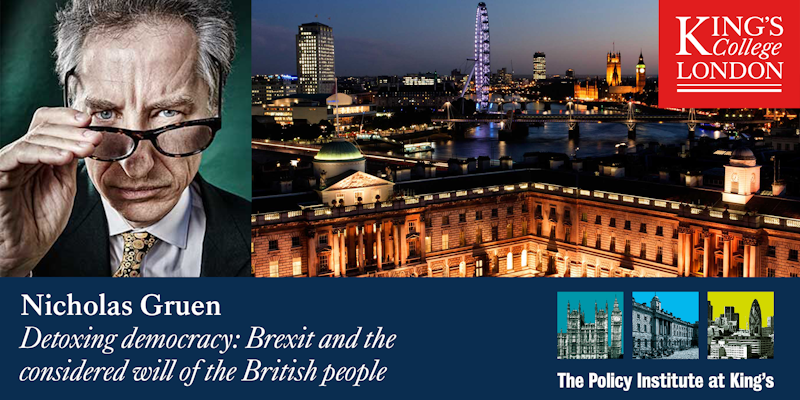
Detoxing democracy: Brexit and the considered will of the British people

Nicholas Gruen is an economist, entrepreneur and commentator who has been described by former Australian member of the House of Representatives Lindsay James Tanner as “Australia’s foremost public intellectual”.

On Nov. 6th, Gruen will be giving a talk at King’s College London titled “Detoxing democracy: Brexit and the considered will of the British people”.

Abstract:

Though material conditions played their part, the degradation of politics now so evident in the shock and awe of Brexit and Trump also reflect the way in which elections orient politics around political combat, rather than deliberation and problem solving. Yet Britain could use the ancient Athenian idea of selection by lot – choosing a cross-section of the public to deliberate together to complement elections – to turn its slow-motion crisis into the rebirth of democracy, moving it from government according to the will of the people, and towards the richer, safer notion of government according to the considered will of the people.

An outline of the argument: Detoxing Brexit by detoxing democracy.

Britain’s governing class is now engineering a tragedy that arose from a piece of political improvisation gone horribly wrong. Yet there’s a principled way of handling the situation.
Continue reading

The other point of view of the debate at La Croix

The French newspaper La Croix has recently published two pieces under the title “Of what use is the senate?”. A translation of one of those pieces is here. Below is a translation of the opposing view.

Jean-Philippe Derosier: “The senate is in the DNA of our institutions”

Jean-Philippe Derosier is a professor of public law at Lille 2 university and the author of the blog “The constitution decoded”.

Personally, I do not dispute the utility of the senate, even if some changes could surely be considered. There are three reasons for the utility of a second chamber. First of all, a logical reason. The parliament represents the nation, and the nation is the people but also something else. The people are represented by the assembly and other thing, in our system, is the regions (territories). In countries which made the choice of bicameralism, this other thing can be different, for example in England the history of the British nobility is incarnated in the House of Lords, or the civil society in Ireland.

The second reason is biological: there are always more ideas in two heads than in one and the second chamber completes the role of the first through a permanent dialog instituted between the two assemblies.
Continue reading

Debate at La Croix: Of what use is the senate?

La Croix has recently had an interview with Loïc Blondiaux about the idea of an allotted senate. A few days later, La Croix published two more pieces on this subject, one supporting the idea and one opposing it, under the title “Of what use is the senate?”.

Here is a translation of the ‘in-favor’ side of the debate. A translation of the ‘against’ side will be published in the upcoming days.

Fatou Tall : “The time has come for a citizen senate”.

Fatou Tall is a lawyer and a member of the Citizen senate collective.

What is useful is the bicameralism which divides Parliament into two distinct chambers. Within this framework we consider the way to respond to what appears to be currently a real emergency: revitalising our democracy, “radicalizing democracy”, to use the words of the constitutional scholar Dominique Rousseau. The senate seems to be the appropriate tool for introducing a citizen assembly and the mechanism of sortition at a time when many are questioning the appointment of senators via indirect elections. The idea is therefore to make the senate a chamber of allotted citizens which would be charged with co-creation of the law in concert with the National assembly, as is now the case.
Continue reading

Loïc Blondiaux on a citizen senate


A France Insoumise rally at the Place de la République in Paris, July 3rd 2017, Thomas Samson/AFP

La Croix has a short interview with Loïc Blondiaux on the idea of a “citizen senate”. Original in French here. My translation, corrections welcome.

What could a citizen senate look like?

Compiled by Béatrice Bouniol, Sept. 22nd, 2017

On the eve of the senate elections, Loïc Blondiaux, professor of political science specializing in participative democracy, discusses the idea of citizen senate and the questions it raises.

La Croix: Why does this idea of a “citizen senate” come up in political debates?

Loïc Blondiaux: The idea of a citizen senate indicates two major developments. First, the return to consciousness of the idea of sortition, which was suppressed for centuries. More and more political players and thinkers are considering the possibility of using it in different ways: citizen juries in a more-or-less ad-hoc setting, citizen assemblies aimed toward an institution change or a new sortition-based institution. Secondly, we witness today an increase in proposals that aim to modify the workings of government bodies, to open them more toward civil society and toward discussion with citizens.
Continue reading

Ranciere: What times are we living in?, part 3 of 3

What to save from the drifting French political system? The philosopher Jacques Ranciere was the guest of Aude Lancelin in “The war of ideas” of June 20th, 2017. Here is the transcript of this interview. Parts 1 and 2 of the translation are here and here. [My translation, corrections welcome. -YG]
05. The question today is that of rethinking forms of organization, ways of being together for the long term, outside of the electoral forces.

Aude Lancelin: Your book is also a severe blow to those who today are pinning their hopes on the famous cortège de tête: the group of young people who clash with the police after the demonstrations. You have some ironic words on this subject. For you it is primarily a varnish of radicality which is applied to quite traditional demonstrations. The political meaning of all that and its future are not at all assured in your eyes. Do I misinterpret your thinking?

Jacques Ranciere: First thing: the cortège de tête is not simply the professional revolutionaries who think that it is necessary to radicalize the struggle and who radicalize the struggle by breaking shop windows. There are also people who think that breaking windows is the time of assembly of people who come from different horizons, who come from the political struggle or who come from delinquency in the suburbs, and who suddenly discover themselves. That is a way of gathering people that is classic anarchist or revolutionary politics, and suddenly the people that the movement appeals to and who are involved, who arrive with their own actions, their own revolt or their own ways, are coming first from the world of delinquency rather than from the world of politics. The cortège de tête are not simply people with a specific strategy. Another thing that I am trying to say is that the violent actions of the cortège de tête are also symbolic and not any more strategic in fact than the assemblies of the Nuit debout. Because, in fact, what is it that they are really doing? They take aim at symbolic targets; an ATM, a shop window, a nice car… But that is not at all a strategic action. There is this idea that it is necessary to radicalize, to create an irreversible situation. In my experience, that is not irreversible. It is not that some actions create an irreversible situation. I don’t think that existing conditions create a great realignment. Basically, the question is knowing how to manage this interaction between gathering the greatest number and striking the enemy. But what does “striking the enemy” mean? I don’t really know. I think that in the so-called “radical” thinking, there is always a double logic. On the one hand, the logic of confrontation (“we are going to confront them and it is through the confrontation that we rattle the enemy”) and at the same time a logic of desertion (“if we secede the system will collapse”). In the texts of the Comité invisible there is always this double logic. I think that neither of those two logics is really proven. But I am not trying to give lessons, I am just responding to the questions.
Continue reading

Kofi Annan endorses sortition

In a speech titled “The Crisis of Democracy” given to the 2017 Athens Democracy Forum, former Secretary-General of the United Nations Kofi Annan has endorsed the use of sortition as a tool for “mak[ing] our democracies more inclusive”. Tucked between two other pieces of advice, to harness new technologies and management techniques in order to make our democracies more effective and to champion democracy against its enemies who are spending billions to undermine it, both in practice and through misinformation, Annan says:

[W]e need to tackle inequality, both economic and political. As I have said, increasing inequality is one of the drivers of resentment, especially since economic equality leads to political inequalities as well, as several studies have confirmed. There is a growing perception that the priorities of the extremely wealthy take precedence over the well-being of the middle class thanks to campaign contributions and lobbying. At the other end of the spectrum, the poor and minorities are, or at least feel, excluded from the political system. Governments must respond by redistributing fairly the benefits of globalisation by restricting tax avoidance and evasion schemes, and most importantly, discouraging tax havens. Fortunately, democracy is one of the only systems in which the concerns of the majority can overturn the interests of the wealthy if the majority harnesses the mechanisms at their disposal. But this demands more participation, not less.

This means that we need to make our democracies more inclusive. This requires bold and innovative reforms to bring in the young, the poor and minorities into the political system. An interesting idea put forward by one of your speakers this week, Mr. Reybrouk, would be to reintroduce the ancient Greek practice of selecting parliaments by lot instead of election. In other words, parliamentarians would no longer be nominated by political parties, but chosen at random for a limited term, in the way many jury systems work. This would prevent the formation of self-serving and self-perpetuating political classes disconnected from their electorates.