Belgiorno-Nettis: “[The government] has stopped listening”

Luca Belgiorno-Nettis, the founder of newDemocracy Foundation, which designed and oversaw the nuclear dump citizen jury process for the South Australian government, has an article in the Sydney Morning Herald in the aftermath of the jury’s decision to reject the proposed dump. Belgiorno-Nettis softly criticizes SA Premier Jay Weatherill’s newly-announced intention to have a referendum on the dump:

From the time the royal commission report was handed down earlier this year, the South Australian government has been trying to listen, very carefully, to its community.

But now it has stopped listening, even after the citizen jury concluded their deliberations. A referendum has now been floated as a way to finally determine the question; never mind the most recent lessons from the Brexit experience. The jury tried to find common ground. A referendum won’t.

Continue reading

Will the Australian citizen jury process survive the nuclear dump decision?

The SA jury on the nuclear dump proposal has handed out its report eliciting significant press coverage and a flurry of reactions. The Online Opinion reports:

Where to now, for Premier Weatherill’s nuclear dream?

On November 6th, to the surprise of all, South Australia’s Nuclear Citizens Jury came up with a report that overwhelmingly rejected the government’s plan for importing and storing high level nuclear waste. Over four days of witness hearings, and deliberations, the 350 members of the jury were tasked with producing an answer to this question:

Under what circumstances, if any, could South Australia pursue the opportunity to store and dispose of nuclear waste from other countries?

The jury’s answer:

Under no circumstances should South Australia pursue opportunity to store and dispose of nuclear waste from other countries for reasons of consent, economics, trust and safety.

But while the Online Opinion is worried about nuclear dreams, another dream is just as much in jeopardy: the dream of Citizen Juries. It seems very likely that Weatherill has promoted the CJ idea because he believed it would be useful for his political agenda, of which the nuclear dump was a part. It seems very likely that those who offered Weatherill the idea, some of whom got to run the process, implied that this would indeed be the case. It also seems likely that other elected politicians have been watching this process with some interest in order to determine to what extent CJs could be used as a tool in their own political box.

In the wake of this outcome, the academics and the political operatives and entrepreneurs would have to go back to the drawing board. They will have to work hard to explain to the politicians how they will re-engineer CJs to guarantee that such unwelcome outcomes will not re-occur.

Antoine Bevort: Chouard and democracy: an intellectual and political fraud

The following is my translation of a recent article Antoine Bevort in the online French publication Mediapart. Like Tommy Lasserre’s Sortition in politics – the false good idea, which appeared in Mediapart two years ago, the article is a critique of Chouard and his proposals. Bevort makes some similar points, but, unlike Lasserre, doesn’t focus solely on sortition, and when he does discuss sortition he often deals with implementation details rather than with the principle itself to which he is not wholly hostile. Bevort also relies much less than Lasserre on canned Leftist rhetoric. As a result of those differences more of his punches land on target.

Chouard and democracy: an intellectual and political fraud
29 June 2016 Antoine Bevort

Étienne Chouard presents himself as the scholar of “real” democracy. His proposal of allotting of a constitutional assembly is however a fraud. It incorporates general principles which can be embraced, at least in part, but rests on largely specious argumentation, eventually leading to a strange and dogmatic conception of democracy.

Chouard considers himself the guru of “real” democracy. He feels he has found the “cause of causes” of the political crisis (“the political disempowerment of the citizens”) and proposes as a solution the allotment of a constitutional assembly. In his analyses, Chouard invokes general principles which can be embraced at least in part, but advances mainly through theoretical and historical shortcuts, simplifications or even misinterpretations, and through blunt claims and assertions. His dogmatic propositions are based on largely specious argumentation and lead eventually to a strange philosophy of democracy.

In order to deconstruct this rhetoric of mystification, we use a conference video available online[i], a text on the Gentils Virus website whose contents are very similar to those of the conference, as well as on the wiki of this organization, and particularly on the constitution drafted by Chouard. We first discuss his analysis of the existing political system, his claims that “we are not living in a democracy yet” and that “an electoral system is not a democracy”. Then we examine his conception of the “true democracy”, and his proposal of drawing by lot a constitutional assembly. We conclude with the mode of action which Chouard, the Gentils Virus (GV) and Les Citoyens Constituants (LCC), two organizations which promote his ideas, are pursuing.
Continue reading

“A little bit manipulated”

The Adelaide news website InDaily has a report by Bension Siebert about discontent in the ranks of South Australia’s citizens’ jury on nuclear waste storage:

Some members of the 350-person jury have told InDaily they voted for a group of witnesses to present information about nuclear waste storage but the facilitator of the process, DemocracyCo, subsequently invited additional witnesses without explicit jury consent.

DemocracyCo concedes it did add further witnesses after a voting process, but says that is “standard practise” in citizens’ juries.

Juror Brett Aylen, an architect, told InDaily: “I do feel like I’m being a little bit manipulated by the process.” He said DemocracyCo facilitators were surprised by the jury’s witness selections and wanted to “balance it up by adding in some of the more pro-nuclear witnesses”. “They seemed a bit surprised at our selections,” he said. “If they had have declared that position in advance [that more witnesses may be added] it would have been more acceptable.”

Continue reading

Workshop on sortition for the Canadian parliament at the CSDC

The Centre for the Study of Democratic Citizenship (CSDC) at the department of Political Science of McGill University is holding a workshop under the title “Representation, Bicameralism, and Sortition: With Application to the Canadian Senate” on December 9.

This workshop will bring together social scientists and philosophers with two aims: critically to evaluate our theoretical and empirical knowledge of the relative merits and defects of using sortition to select representatives to the second legislative chamber of bicameral representative democracies like Canada; and to contribute to public debate in Canada about Senate reform by evaluating the desirability of reconstituting the Senate as a randomly selected Citizen Assembly.

Papers will be presented by Equality-by-Lot contributors Peter Stone and Alex Guerrero, as well as by McGill professor Arash Abizadeh. It turns out that Prof. Abizadeh gave a seminar on “Democracy, Representation, and Sortition” in the 2016 winter semester.

Foa and Mounk: The democratic disconnect

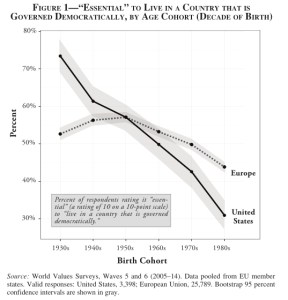
A paper in the Journal of Democracy by Roberto Stefan Foa and Yascha Mounk explores trends in the tremendously valuable World Values Survey database.

Drawing on data from Waves 3 through 6 of the World Values Surveys (1995–2014), we look at four important types of measures that are clear indicators of regime legitimacy as opposed to government legitimacy: citizens’ express support for the system as a whole; the degree to which they support key institutions of liberal democracy, such as civil rights; their willingness to advance their political causes within the existing political system; and their openness to authoritarian alternatives such as military rule.

What we find is deeply concerning. Citizens in a number of supposedly consolidated democracies in North America and Western Europe have not only grown more critical of their political leaders. Rather, they have also become more cynical about the value of democracy as a political system, less hopeful that anything they do might influence public policy, and more willing to express support for authoritarian alternatives. The crisis of democratic legitimacy extends across a much wider set of indicators than previously appreciated.

Continue reading

Senior French politicians propose allotted institutions

Back in June Arnaud Montebourg, who had served as Minister of the Economy in the years 2012-2014 and who is considered a potential presidential candidate in 2017, proposed, among other reforms of the French system aiming to “rebuild the trust” between the French people their political class, to have the Senate re-purposed to serve as a supervisory body and have its members selected by lot:

Could not the Senate, instead of being an end-of-the-career institution, be an allotted assembly, without legislative power because it is not representative, but with a supervisory role?

[My translation here and below.]

Now Emmanuel Macron, Montebourg’s successor as Minister of the Economy and possibly a presidential candidate in 2017 as well, has his own proposal for creating an allotted supervisory body:

The creation of a citizens’ commission

Each year, the president of the Republic has to appear before a citizens’ commission to be held to account, possibly supported by the Court of Audit. The former minister envisages the possibility of using allotment. This would allow the recreation of a little “political hygiene” in the system. For creating a democratic debate “which does not exist today”.

Graham Smith: The problem with politicians and democracy…

I would complete the headline of Alex Sakalis’s interview with Graham Smith on openDemocracy with “… is that they are mutually exclusive” (at least if by “politicians” it is meant “elected politicians”). Smith, however, strikes a more tentative note:

Citizens’ priorities are not necessarily the same as those of their political representatives. […] What is clear is that citizens are willing and able to deliberate on complex and contested political issues. The question is whether they will be listened to by local and national political leaders. The evidence is not promising.
Continue reading

Democracy talk – Episode 4

Patrick and I discuss the upcoming U.S. elections, diminishing candidate favorability, electoral crisis, the principle of distinction and other matters.

“[W]e usually end up where we need to be.”

Hillary Clinton, from the recent Wikileaks release:

You just have to sort of figure out how to — getting back to that word, “balance” — how to balance the public and the private efforts that are necessary to be successful, politically, and that’s not just a comment about today. That, I think, has probably been true for all of our history, and if you saw the Spielberg movie, Lincoln, and how he was maneuvering and working to get the 13th Amendment passed, and he called one of my favorite predecessors, Secretary Seward, who had been the governor and senator from New York, ran against Lincoln for president, and he told Seward, I need your help to get this done. And Seward called some of his lobbyist friends who knew how to make a deal, and they just kept going at it. I mean, politics is like sausage being made. It is unsavory, and it always has been that way, but we usually end up where we need to be. But if everybody’s watching, you know, all of the back room discussions and the deals, you know, then people get a little nervous, to say the least. So, you need both a public and a private position. And finally, I think — I believe in evidence-based decision making. I want to know what the facts are. I mean, it’s like when you guys go into some kind of a deal, you know, are you going to do that development or not, are you going to do that renovation or not, you know, you look at the numbers. You try to figure out what’s going to work and what’s not going to work. [Clinton Speech For National Multi-Housing Council, 4/24/13]