A Dutchman offers sortition to the Scots

Dr Jasper Kenter, an ecological ­economist at the Scottish Association for Marine Science and Honorary Fellow of the University of Edinburgh, writes in The Scotsman:

Being Dutch, Westminster politics and ­elections horrify me. […] In Holland, […] [c]oalition agreements mean ­ministers can get on with their jobs without being threatened by reshuffles. They are even expected to have expertise relevant to their post.

Yet, proportional representation faces the same issues as first past the post: policies in the long-term interest of society are hard to sell because of short-term impacts. This is exacerbated by the commercial and political interests of media, with power to sway opinion by triggering fear, anger and envy, deluding people into thinking the extraordinary is more ­common.

For example, air pollution leads to 40,000 deaths a year, far more than terrorism and homicide. Addressing this would require policy overhauls and investment opposed by ­powerful lobbies, so we stick our heads in the sand.

Another example: preserving healthy ecosystems is the most important thing we can do for future generations – but the UK’s environment department has had more severe cuts than any other, with barely anyone noticing.

There is a solution: replace MPs with randomly selected citizens called up for parliamentary duty, a ­system called sortition. Imagine ­parliament being a true reflection of the public, with mothers and teachers thinking through education and childcare, health workers influencing how to run and fund the NHS. MPs would be ­independent of wealthy donors and no need to be popular, so would be better at making difficult decisions.

They would be supported by an office providing independent expertise, like the current Parliamentary Office for Science and Technology. By changing a third of MPs at a time, experience could be passed on.

In Scotland, there is an ideal opportunity to try sortition: Holyrood does not have a ­second chamber and, regardless of Indyref2, will receive more powers after Brexit, so arguably needs one.

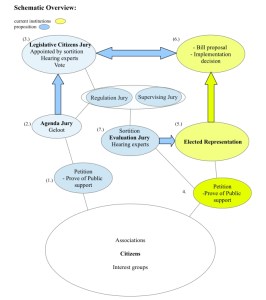
Sortition as a direct democratic system to appoint a real citizens representation, also called “citizen jury“

INTRODUCTION

According to historical sources our political system was developed AGAINST democracy (sovereignty of the people). An “Electoral Aristocracy” was installed (18 century). Nevertheless, this can be seen as a positive evolution compared with ruling by inheritance.

Later on some “democratic” elements were installed, for instance “free” or so called “democratic” elections with universal suffrage, the equality principle, freedom of speech, freedom of organisation, free press, … but some of them were weakened or eliminated afterwards.

But a “democratic element” is not yet a “democracy”. Freedom of organisation may be a “democratic element”, without it a democracy can not exists, on his own it is no democracy. This way “free elections”, to appoint a governor for instance, can be a democratic element but on his own it is by no means a democracy.
Continue reading

Participation Toolkit

A book named “Participatory methods toolkit: a practitioner’s manual” was published in 2005 by the King Baudouin Foundation and the Flemish Institute for Science and Technology Assessment (viWTA).

This toolkit has a “citizens jury” part that may be of interest to us.

Page 21:

4) Participants

Recruitment

In some methods, the participants are supposed to be representative of the population at large. However, this may be unrealistic to achieve perfectly in practice. Purchasing random sampling phone numbers may prove financially unviable.

In this case, the advisory committee and project management will need to establish recruitment criteria and decide on another method, such as newspaper advertising. In newspaper recruitment, panellists are somewhat self-selected because they have to initially respond to an advertisement. In any method of recruitment an element of bias is introduced at the selection stage by the preferences of the selection committee. Recruitment is usually done three to four months prior to the first activity.
Continue reading

The Paradox of Democratic Selection: Is Sortition Better than Voting?

Book chapter just uploaded to academia.edu by Anthoula Malkopoulou

Sortition, or the selection of political officers by lot, has its antecedent in the direct democratic tradition of ancient Athens. Its transfer into a modern context of representative democracy poses rightful scepticism not only about the practical difficulties, but more so about the theoretical inconsistencies that arise. Modern systems of political representation are based on the aristocratic idea of ‘government by the best’, who are to be selected through a competitive call for candidates (Manin 1997). Sortition, on the other hand, replaces this aristocratic criterion of competition and evaluative election with the democratic mechanics of direct and equal distribution of political office by chance. Hence, the very expression ‘democratic (s)election’ includes a paradoxical contradiction in terms, between the democratic concept of equal access to public office and the aristocratic idea of government by the (s)elected best. My aim in this chapter is to shed some light on this contradiction by critically discussing the benefits and pitfalls of using sortition today, comparing it throughout the chapter with voting and the general effects of electoral representation.

Full text

New Law Requiring Deliberative Poll Process for Constitutional Amendment in Mongolia

Here is an email from today (May 3, 2017) from James Fishkin to the National Coalition for Dialogue & Deliberation (NCDD) listserv:

Dear all: I am just off the plane from Mongolia where a national Deliberative Poll considered several proposed elements of a constitutional amendment, as now required by law. National random sample of 669 deliberated a whole weekend and produced results, now with the parliament. Here is a pre-event press report and video:

http://news.stanford.edu/2017/05/02/collaboration-stanford-leads-mongolian-parliament-passing-law-public-opinion-polling/

This development raises interesting possibilities for how citizen deliberation can be institutionalized. Hope you will find it of interest. More information will appear on the http://cdd.stanford.edu web site when available.  Best regards to the NCDD list. Jim Fishkin

Of particular interest, the above-linked press release announces:

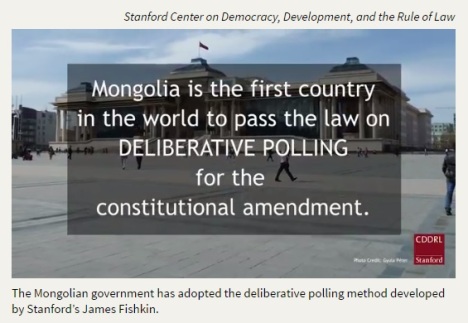
The Mongolian government recently passed a law requiring that an immersive research method that analyzes public opinion developed by Stanford’s James Fishkin be conducted before its constitution could be amended. According to Fishkin, who devised the process called deliberative polling almost 30 years ago, it marks the first time that a country has incorporated the process into its law. … The measure was supported and passed into law on Feb. 9.

Fishkin.jpg

See also: http://www.news.mn/r/328704.

Strictly Eating Chances: You can’t eat chances? Oh yes you can!

I say this despite David Wasserman’s snide comment on the claims made by us lottery enthusiasts. We would say that where there are more qualified applicants than places available, a lottery’s the thing. Some will then win a place — “eat”— but everyone will benefit by having had the chance of winning.

But what is the value of a chance when you win nothing? Rationally we should conclude that the value of nothing is zilch, zero, nada.

In another swipe at advocates of lotteries for sharing Wasserman comments:

if it makes sense to treat an expectation as a good, it also makes sense to ask whether the value of that good increases the longer it is held by the recipient.

It’s nice to see a bit of sarcasm from a philosopher whose main concern is medical ethics!

Instead, I’d like to take up Wasserman’s challenge, and propose that your ‘expectation’ — your ticket to the lottery — can indeed be made more valuable by spinning out the process.

Take for example the way the TV hit show Strictly Come Dancing (in the US it’s called Dancing With the Stars) operates. They start with a dozen or so stars. Each week they dance competitively, and by a complex process one star is eliminated. Over the next weeks the process is repeated, one ‘loser’ every week until there are three left. It is then decided by a Grand Finale.

I take it as axiomatic the producers know how to give the public good entertainment value. That’s show business!
Continue reading

“Representation Against Democracy: Jacques Rancière on the French Presidential Elections”

From an interview with Jacques Rancière on the French Presidential Elections (translated from the original in French):

How would you organise collective life without representatives? By drawing lots — a measure you supported in your 2005 book Hatred of Democracy?

We should distinguish between delegation and representation. In a democracy, logically enough some people will carry out certain activities on other people’s behalf. But the delegate plays her role only once, which is not true of representatives. Drawing lots was once the normal democratic way of designating delegates, based on the principle that everyone was equally capable. I proposed bringing it back in order to reverse the drive toward professionalisation. But that is no simple recipe, any more than non-renewable mandates are. These tools are only of interest if they are in the hands of a vast popular movement. Democracy does not exist without these pressures emerging from outside the system, pressures that shake up the institutions of the state — like the “squares movements” did recently. Democracy presupposes that institutions autonomous of state structures and state agendas are able to make these egalitarian moments last.

Notes on McGill Sortition Workshop

Here are some brief notes on a workshop on sortition held at McGill University.

“Representation, Bicameralism, and Sortition: With Application to the Canadian Senate”

McGill Sortition Workshop: Randomly Selecting the Canadian Senate

I had the pleasure of attending a fascinating one-day workshop on sortition and replacing the unelected Canadian Senate with a randomly selected Citizen Assembly that was held on December 9, 2016, at McGill University in Montreal, Canada. Peter Stone (Political Science, Trinity College Dublin), Alex Guerrero (Philosophy, Rutgers), and Arash Abizadeh (Political Science, McGill) each presented papers on sortition in separate sessions.

In advance of the workshop, Abizadeh did a radio interview (at 21:10) on Ottawa Today with Mark Sutcliffe. Sutcliffe seemed very receptive to the idea of replacing the Canadian Senate with a randomly selected Citizen Assembly. Abizadeh also published an article in the Montreal Gazette in advance of the event.

This event was a timely opportunity to inject sortition theory and practice into current discussion of reforming the unelected Canadian Senate. Canadian Senator Paul Massicotte participated in the public forum and wrote a diatribe—“A randomly selected Canadian Senate would be a disaster”—against sortition following the workshop. Yoram Gat in his post on this insightfully commented on how exceptional such a response is: “It is an indication of the precarious position of the Canadian Senate with its non-electoral appointment procedure that the Senator feels that the proposal to appoint the Senate using sortition requires a refutation. It is a feeling that, as far as I am aware, no elected member of parliament has ever shared in modern times.”
Continue reading

Participatory and Deliberative Democracy: Sortition and Democratic Representation

An upcoming session in the Political Studies Association’s Annual International Conference 2017:

Participatory and Deliberative Democracy: Sortition and Democratic Representation

Room: Executive Room B
Time Slot: Wednesday 12th April 11:00 – 12:30

Panel Chair: Dr John Boswell (University of Southampton)
Panel Members:

  • Mr Keith Sutherland (University of Exeter)
  • Dr Brett Hennig (Sortition Foundation)
  • Dr Peter Stone (Trinity College Dublin)
  • Mr Dimitri Courant (University of Lausanne & University Paris 8)

We are witnessing something of a revival in support for sortition, with the idea popularised in particular in David Van Reybrouck’s recent Against Elections: The Case for Democracy. Although the debate around the use of sortition has typically been tied to discussion of mini-publics, this panel seeks to look more broadly at its relationship to democratic theory and democratic practice more broadly conceived. It brings together proponents and sceptics, normative theorists and those whose work is more applied, for a contemporary, lively and varied debate on this age-old topic.

Papers:

Science funding is a gamble so let’s give out money by lottery

Perhaps your life, like that of many of my friends and relatives, has been improved by propranolol – a beta-blocker that reduces the effects of stress hormones, and that’s used to treat conditions such as high blood pressure, chest pain, an uneven heartbeat and migraines. It’s considered one of the most important pharmaceutical breakthroughs of the 20th century.

Thank goodness, then, that the United States in the 1940s didn’t have the same attitude to science funding that it does today. If it had, you could expect to see seven experts sitting around a table, trying to assign a score to an unorthodox grant proposal to study the function of adrenaline in the body. ‘If I have properly understood the author’s intent, then this mechanism has already been settled, surely,’ a senior physician might say. A lone physiologist mounts a defence, but the pharmacologists in the room are dismissive, with one who remarks that the mathematics ‘look cumbrous and inconvenient’. So the pathbreaking research of the late Raymond Ahlquist, a professor at the Medical College of Georgia who laid the foundations for the discovery of propranolol, could easily end up with low marks, and his theories would never see the light of day.

Science is expensive, and since we can’t fund every scientist, we need some way of deciding whose research deserves a chance. So, how do we pick? At the moment, expert reviewers spend a lot of time allocating grant money by trying to identify the best work. But the truth is that they’re not very good at it, and that the process is a huge waste of time. It would be better to do away with the search for excellence, and to fund science by lottery.
Continue reading