


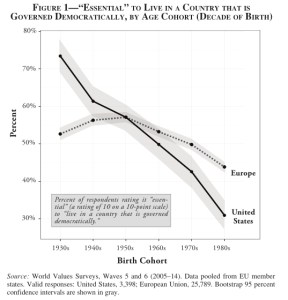
A paper in the Journal of Democracy by Roberto Stefan Foa and Yascha Mounk explores trends in the tremendously valuable World Values Survey database.
Drawing on data from Waves 3 through 6 of the World Values Surveys (1995–2014), we look at four important types of measures that are clear indicators of regime legitimacy as opposed to government legitimacy: citizens’ express support for the system as a whole; the degree to which they support key institutions of liberal democracy, such as civil rights; their willingness to advance their political causes within the existing political system; and their openness to authoritarian alternatives such as military rule.
What we find is deeply concerning. Citizens in a number of supposedly consolidated democracies in North America and Western Europe have not only grown more critical of their political leaders. Rather, they have also become more cynical about the value of democracy as a political system, less hopeful that anything they do might influence public policy, and more willing to express support for authoritarian alternatives. The crisis of democratic legitimacy extends across a much wider set of indicators than previously appreciated.
Filed under: Academia, Elections, History, Opinion polling, Press | 3 Comments »

 Let us start from a finding that is at first surprising. We possess no detailed record of an electoral campaign in Athens – despite it being history’s first democracy! There are multiple reasons for this: first, elections may not have necessarily been important events, being considered an aristocratic selection mechanism, being the opposite of the more egalitarian mechanism of sortition. Most importantly, when elections were held – when selecting generals, for example – they were most often if not unanimous then at least less-contentious: because it was never for selecting a single individual, a bitterly competitive affair, but a board of ten magistrates, which made the competition not as harsh.



 Adam Cronkright
 Ali
Ali Ahmed R. Teleb
 avanderven
 avergne
 Alex Kovner
 azakaras
 Brett Hennig
 campbellwallace
 Simon Threlkeld
 Nick Coccoma
 codyhipskind
 Common Lot Sortitionist
 Conall Boyle
 constitutionalism
 davidschecter
 graytmatter
 gtridimas
 H.J. Hofkirchner
 Hanspeter Rosenlechner
 John Burnheim
 jgarry20151
 Jochen Krattenmacher
 johnedwardtaylor
 johnhuang865
 Jonathan Crock
 keithsutherland
 Jacob Richter
 kkoreilly
 lukewhito
 SimonPek
 Nathan El
 Nicholas Gruen
 Owen Shaffer
 Patrick Chalmers
 Paul Gölz
 peterstone
 Pierre-Etienne Vandamme
 pronfeld
 Emil
Emil rcaze
rcaze richwbrown
 Roger Knights
 roslynfuller
 Pierre-Etienne Vandamme
 shaharavin
 tbouricius
 Ted Wachtel
 Joshua Laferriere
 theodorestathis
 towardsautonomyblog
 Wayne Liebman
 Yoram Gat
 Oliver Milne
 Equality by lot