Distinguishing characteristics, positively valued?

In a 2007 interview, Bernard Manin explains to Hélène Landemore his theory of the principle of distinction (my translation):

[E]lites play in effect an important role in a representative government. This is so because elections necessariliy select individuals who possess uncommon characteristics which are positively valued by the voters. A candidate who is not distinguished by certain traits that are judged favorably cannot win an electoral competition. That said, the electoral method does not determine which specific distinguishing characteristics positive judgment are those which would get candidates elected. These characteristics are determined by the preferences of the voters, that is, by ordinary citizens. The voters choose the distinguishing qualities which they want to find in their representatives. The qualities could consist of a number of things, including an exceptional ability to express and disseminate a certain political opinion. Even in this case, we are still dealing with elites, in the sense these people who are exceptionally capable of defending an opinion possess a talent that most of the people who share the opinion do not. This is the meaning I attach to the term “elites”.

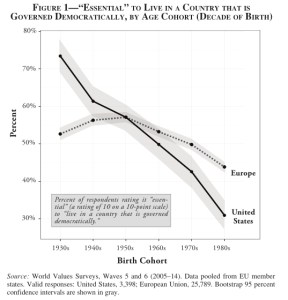
Manin’s claim that the distinguishing characteristics of the elected must be valued positively by the voters, or else they would not be able to win the elections, is empirically refuted by the case of the 2016 presidential elections in the US. In this case, both candidates are disliked by a plurality of the voters, have negative favorability numbers and have a majority of their “supporters” state that they are voting against their opponents rather than for them.

“Limiting who can vote”

Ripples from Van Reybrouck’s book made it across the Atlantic and into the Washington Post where Dutch professors of political science Eric Schliesser and Tom Van Der Meer see fit to discuss his proposals for using sortition together with a proposal to “disenfranchise the ignorant to slant political rule toward experts”. They write:

Both [proposals] limit who can vote and seek to stimulate apolitical and rational decision-making:

1) Representatives by lottery. Belgian author and cultural historian David Van Reybrouck suggests abolishing elections and appointing representatives by lottery instead. Van Reybrouck’s proposal extends the principle of sortition — how juries are appointed — to the legislature: Randomly selected citizens would reach the optimal decision via deliberation, supposedly without a need to be bothered with politicking. When their term is up, they go home.

2) Experts as representatives. Philosopher Jason Brennan at Georgetown University suggests disenfranchising the ignorant to slant political rule toward experts. His proposal recently received favorable discussion in The Washington Post. Inspired by Plato, the rule by properly trained experts, or epistocracy, would prevent politicians from being easily swayed by moneyed interests and demagogues.

Continue reading

Why Citizen Juries should decide Canada’s Voting Method and Election Rules


A brief by Simon Threlkeld to Canadian House of Commons Electoral Reform Committee, July 26, 2016, briefly explains why election rules, including those setting out the voting method, should be decided by jury, not by politicians or a referendum, and how such a jury approach to democratically deciding election rules could work.

4. Were there no good democratic alternative to politicians deciding the election rules, then perhaps we would be stuck with that very flawed approach. However, there is an excellent and highly democratic way to decide the rules, namely by using citizen juries, or as they can also be called, minipublics or citizens’ assemblies.

(In his brief to the Committee Dennis Pilon has some interesting things to say about referendums and how electoral reform in Canada has long been blocked by the self-interest of politicians. All of the briefs the Committee has posted so far at their website are good, it seems to me. Mine is so far as I know the only one they have received recommending that election rules be decided by citizen juries.)

Roslyn Fuller educates Andrew Sullivan

It used to be a mainstream, respectable occupation to theorize about the horrors of popular rule. Socrates and other Athenian aristocrats have been upfront about the fact that the average person should not be trusted with power. This clear-headedness and frankness has been maintained over many centuries. The water began to muddy as the aristocrats were being challenged by the up-and-coming bourgeoisie. Now there had to be some rational criteria explaining why it was not the aristocrats who should be holding power. Talk about natural aristocracy became fashionable, but outright rejection of democracy was still part of the mainstream discourse.

Then, in the 19th century, the term “democracy” was rehabilitated and the ideological water became so thick it was impossible to know where one was heading. In the middle of the 20th century Schumpeter and the elite theorists tried to clear the water by explicitly redefining the term not to refer to popular power after all but simply to a competition between elites for popular vote.

This moment of clarity passed when the 1970’s saw the ideological victory of the Civil Rights movement. At that point popular rule became the only defensible meaning of “democracy”, and since then theorists are in the unpleasant situation of having to reconcile an oligarchical practice with a democratic ideology.

This brief history is presented as an introduction to a recent exchange between Andrew Sullivan, a British author, editor, blogger, conservative political commentator, former editor of The New Republic, and the author or editor of six books, and prof. Roslyn Fuller, an Irish academic, legal expert, columnist, electoral candidate, author of the book Beasts and Gods, and an Equality-by-Lot contributor.
Continue reading

Somin: Sortition won’t solve political ignorance

jpeg-of-cover-final-version-e1464367107681

Ilya Somin, Professor of Law at George Mason University, is the author of the book Democracy and Political Ignorance: Why Smaller Government is Smarter. Somin opens an opinion piece in the Washington Post thus:

Widespread political ignorance is a serious problem for modern democracy. In recent years, many scholars have argued that we can overcome it by relying on “sortition”: delegating various political decisions to jury-like bodies selected at random from the general population. In this post, I explain why such proposals are unlikely to succeed.

Before going into the substance of Somin’s arguments about sortition, it is important to realize that ignorance is actually only the second most important problem with the current system, the first being the difficulty of mass scale agenda setting. More details here. The emphasis on ignorance rather than agenda setting is typical of the “rational choice” line of political argument which ignores the complexity of organization largely for ideological reasons. That said, the ability of decision makers to become informed about their subject matters is important and worth discussing. Some of the considerations that are discussed below apply also to the matter of agenda setting.

Continue reading

Cartledge: Crypto-oligarchy

Paul Cartledge is continuing his assault on the modern conventions about democracy:

To an ancient Greek democrat (of any stripe), all our modern democratic systems would count as “oligarchy”. By that I mean the rule of and by – if not necessarily or expressly for – the few, as opposed to the power or control of the people, or the many (demo-kratia).

That is the case even if – and indeed because – the few happen to be elected to serve by (all) the people. For in ancient Greece elections were considered to be in themselves oligarchic. They systematically favoured the few and, more particularly, the few extremely rich citizens – or “oligarchs”

[…T]here are a number of ancient democratic notions and techniques that do seem highly attractive: the use of sortition, for instance – a random method of polling by lottery that aimed to produce a representative sample of elected officials. Or the practice of ostracism – which allowed the population to nominate a candidate who had to go into exile for 10 years, thus ending their political career.

And comparison, or rather contrast, of our democracies with those of ancient Greece does serve to highlight what’s been called creeping crypto-oligarchy in our own very different (representative, not direct) democratic systems.
Continue reading

Literature-related question

Hi everyone,

I’m wondering whether any readers have insights about books and/or articles which build on/critique John Burheim’s path-breaking and overarching model of demarchy, and/or apply demarchy to non-government organizations such as corporations or unions. I’m conducting some research in this space and haven’t been able to find too much work specifically on demarchy in published work (but have found a lot about specific uses of random selection). Any and all suggestions would be much appreciated. Thanks!

Frijters: Against sortition

Paul Frijters is a Professor of Economics at the University of Queensland and an Adjunct Professor at the Australian National University’s Research School of Social Sciences.

Frijters has written a post titled “Would sortition help against corruption?” in which he lays out his thinking about “what is likely to happen to the problem of special interests in Australia in two different scenarios: if we’d select our MPs randomly, or if we’d decide on mayor policies via citizen juries.”

Frijters’s concluding paragraphs:

I used to be quite charmed of the idea of citizen juries for policies and even for deciding on who would be in parliament. It sounded so democratic, such an elegant solution to the problem of special interest groups worming their way into our democratic institutions. It seemed like a magic solution for hard problems.

On reflection though, I find myself on the side of Edmund Burke and Socrates, who both denounced the idea as silly and unworkable. I agree with them: it is hard to see what use small random groups of citizens would be for policy-making in modern Western institutions.

An interesting discussion follows the post, with several discussants who seem to be aware of the idea and who seem to have given it some thought.

Book Review: Democracy: A Life

I seem to be reviewing a lot of books lately, including this review of Paul Cartledge’s Democracy: A Life in the Los Angeles Review of Books (cited in a previous post by Peter Stone). While the book covers what will be familiar ground for many here, the author also charts how the idea of ‘people power’ has been treated over the centuries that have elapsed since Athenian democracy. As such, I feel that he (intentionally or unintentionally) made an important contribution to challenging the negative perception that we have of citizen participation by explaining how this view developed over time. Another one to order for the library!

Cartledge goes to some effort to show how later [post-Athens] historians and statesmen were anxious to portray Greek democracy as a horrible mistake, the unworkable aspiration of starry-eyed dreamers that was preprogrammed to end in chaos. Under the onslaught of these propagandists, the vast majority of whom never experienced Athenian democracy — and indeed were often born several hundred years after it ceased to exist — the idea of political equality came to be regarded as a myth, the notion of the collective people holding power a danger to be shunned, suppressed, and preferably forgotten.

The truth was that democracy was a dangerous idea — to the kings, emperors, and high clergy who controlled information in the centuries after it ceased to be a living form of government. As the author puts it, while these autocrats held sway throughout the Middle Ages, the very idea of democracy was “on life-support.” And while things may have improved since, modern democracy is, in Cartledge’s view, not in much better shape — off the machine perhaps, but still staggering around the hospital ward, clutching at bits of furniture, and trying to remember what had happened to bring it there in the first place.

Arash Abizadeh: Take electoral reform away from politicians and let citizens decide

David Schecter wrote to point out an article in the Canadian Globe and Mail by Arash Abizadeh, a professor of political science at McGill University:

Take electoral reform away from politicians and let citizens decide

Prime Minister Justin Trudeau campaigned on a promise to change the way we elect Parliament. Here’s the problem: letting politicians who won the last election decide future election rules is like letting the team who won the last playoff game decide rules for the next game. There’s an obvious conflict of interest. Electoral rules determine who forms government, and different rules favour different parties.

[…]

One solution is a referendum. But the Liberals have ruled this out. Maybe they’re right to do so. Referenda are expensive, few Canadians care much about electoral reform, and fewer still will cuddle up with a treatise on voting systems this Sunday evening. A referendum might be a big waste of money in which few vote and fewer still care to learn about the pros and cons of alternative electoral systems.

But without a referendum, how could electoral reform be legitimized? We need a manifestly fair procedure – a neutral body, unbeholden to politicians, that will reasonably evaluate the alternatives.

Fortunately, political scientists have a solution that fits the bill – a randomly selected citizen assembly. The idea is this: randomly select a few thousand Canadians, ask if they are willing to serve, and, from those saying yes, randomly select 100 to 200 to serve on an assembly empowered to determine federal election rules.
Continue reading