Posted on October 23, 2015 by peterstone
Hello All,
I’m giving a talk in Istanbul next week entitled “Is Sortition Part of Our Democratic Future?” The talk will be part of an event entitled “A Pilot Meeting for the Democracies of the Future Conference,” which will be taking place as part of the 14th Istanbul Biennial. There’s not a lot of information posted yet about the event, unfortunately, but the following page is available:
http://14b.iksv.org/event.asp?id=63
Filed under: Academia, Sortition | Leave a comment »
Posted on October 22, 2015 by tbouricius
I have been working with a number of sortition academics to organize the sortition element of an international conference being hosted by the Library of Alexandria in Egypt starting December 9, 2015. Presenters will include many names familiar to sortition activists including John Gastil (U.S.A.), David van Reybrouck (Belgium) and Janette Hartz-Karp (Australia). The first two days of the conference will be addressing the “deficit of democracy” in the modern world and introduce participants to such alternative democratic reforms as sortition, participatory budgeting and varieties of direct democracy. The third day will be largely devoted to sortition and mini-publics. The Library anticipates having around 200 attendees (about half from the Arab world), and can accommodate a small number of additional people who have special interest in sortition. If you would like to attend the conference (paying your own way) please get in contact with me, so I can forward your information to the Library staff. Email me at terrybour(at)gmail.com.
Filed under: Academia, Sortition | 3 Comments »
Posted on October 16, 2015 by Yoram Gat
Simon Threlkeld is a former Toronto lawyer (law degree from Osgoode Hall Law School), holds an MA in philosophy (University of Toronto), and writes about democracy. In 1998 he published an article in the academic journal Social Policy titled “A blueprint for democratic law-making: Give citizen juries the final say” whose abstract is below.
17 years later, Threlkeld is still a committed advocate for sortition, and has two recent pieces in the Canadian press advocating the use of sortition in order to democratize the Canadian government and media. In both cases Threlkeld is not proposing to use sortition to select office holders, but rather to use sortition to select committees that would appoint the office holders.
In September Threlkeld proposed in the National Post to have the Canadian Senate members appointed by randomly selected juries:
Simon Threlkeld: Select senators by jury
 Continue reading →
Filed under: Academia, Juries, Press, Proposals | 61 Comments »
Posted on October 13, 2015 by keithsutherland
I’ve just finished reading Daniela Cammack’s PhD thesis (one chapter was presented recently here by Peter Stone) and would warmly recommend it — it’s mercifully short and extremely readable (available to download on the Harvard website). Chapter 3: The Most Democratic Branch? The Assembly vs. the Courts is of particular interest as it seeks to overturn the view that a) the assembly was the primary institution of Athenian democracy and b) the fourth-century reforms were conservative in nature. Cammack’s interpretation supports Yoram and Terry’s view that the switch in emphasis to randomly-selected institutions was in order to enhance the rule of the demos, rather than being a juridical a check on popular sovereignty (the view of Hansen, Ostwald, Sealey [and myself]). The courts (both legislative and juridical) were much less open to manipulation by elites as a) speech rights were restricted to litigants and persons elected by the assembly, b) isegoria was balanced by the use of a water clock and c) secret voting meant that it was harder to intimidate citizens into voting in any way other than by their considered judgment (aided by the higher minimum age and need to swear the dikastic oath). She provides several examples of assembly decisions that were heavily influenced by factional and elite domination
Continue reading →
Filed under: Academia, Athens, Distribution by lot, History, Juries, Sortition | 83 Comments »
Posted on October 6, 2015 by Conall Boyle
An excellent article in the Irish Times:
Unthinkable: Should college places be awarded by lottery?
Using a lottery is preferable to distributing goods based on ‘bad reasons’, argues political scientist Peter Stone.

Dr Peter Stone of TCD’s political science department believes there’s scope for greater use of lotteries in society as a way of keeping “bad reasons” out of decision-making. Rather than seeing lotteries as a failure of imagination, he argues that those who dismiss lotteries can “have the failure of imagination because they think there must be a good reason for distinguishing [between options], even though we haven’t found it yet”.
School admissions are a “classic case” where lotteries are preferable, he says, and he extends the argument to third-level admission. Criticising the recent CAO reforms, which try to minimise random selection in the points race, he provides today’s idea: “Not only should we not be reducing the amount of random selection [in college admissions], we should be letting more in.”
Filed under: Academia, Applications, Distribution by lot | Leave a comment »
Posted on October 2, 2015 by peterstone
I just wanted to recommend a working paper by Daniela Cammack entitled “Deliberation in Classical Athens: Not Talking, But Thinking (and Voting).” It’s available online here. It’s not directly about sortition, but it deals with a number of themes discussed on this blog. The paper argues that the Athenians maintained a careful distinction between the function of presenting arguments and the function of evaluating those arguments, and assigned the latter, but not the former, to the assembly. This distinction, Cammack argues, is conflated by those who use the term “deliberation” for both functions.
I found this passage particularly relevant to contemporary politics:
In Athens, then, as in modern democracies, an overwhelming majority of non-speaking voters attempted to control a minority of prominent political actors who took primary responsibility for advocating and carrying policies. The key difference between Athenian and modern democracy was not that all or even many Athenians took part in political discussion, but first, that large samples of ordinary citizens had the opportunity to vote on every political decision, and second, that the barriers to becoming politically influential were relatively low, while the risks associated with this position were high. This is the reverse of the situation today, where a high barrier to entry as a politician–largely financial–is combined with a low risk of losing one’s position once established. To be sure, one can fail to be reelected, but this pales in comparison to the mechanisms of accountability available in Athens, such as routine annual audits (euthynai) covering both moral and financial issues. In many modern systems, by contrast, a feedback loop is set up in which corruption becomes endemic, since the high costs of running for election are in large part met by supporters whose opportunity to shape policy then becomes significantly greater than that of ordinary voters, with very little way for those ordinary voters to hold the politician in question to account, either before or after the next election.
Worth a look.
Filed under: Academia, Athens, History, Participation | 12 Comments »
Posted on September 28, 2015 by Ahmed R. Teleb

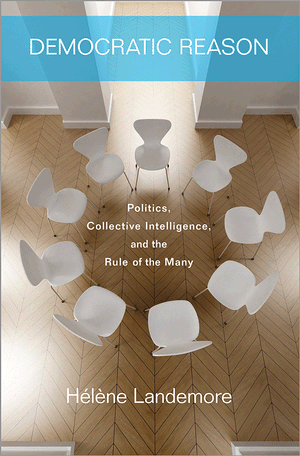
Hélène Landemore’s book Democratic Reason won the 2015 Spitz Prize for work in democratic theory.
That makes the second Spitz (for outstanding work in democratic theory) to a Sortinista in three years, following John McCormick’s Machiavellian Democracy in 2013.
Filed under: Academia, Books, Sortition | Comments Off on News: Democratic Reason wins 2015 Spitz Prize for work in democratic theory
Posted on September 22, 2015 by Yoram Gat
Ray Fisman, a Boston University economist, and Daniel Markovits from Yale Law School write in Slate about “The distributional preferences of an elite”, a study they recently published in Science magazine. In the final paragraphs they say:
Elites’ preferences matter. The American elite overwhelmingly dominates both campaign finance and political lobbying, and American policymakers themselves come overwhelmingly from elite circles—the powerbroker Yale Law alumni mentioned above represent just the tip of a vast iceberg.
Our results thus shine a revealing light on American politics and policy. They suggest that the policy response to rising economic inequality lags so far behind the preferences of ordinary Americans for the simple reason that the elites who make policy—regardless of political party—just don’t care much about equality. Hemingway’s illusory but widely shared view that the only thing that separates the rich from the rest is their money thus disguises a central pathology of American public life. When American government undemocratically underdelivers economic equality, the cause is less party than caste.
Democracy gives the mass of citizens a path for protest when the gap between ordinary views and a closed rank of elite opinion grows too great. The populist insurgencies that increasingly dominate the contests to select both the Republican and Democratic candidates in the upcoming presidential election show the protest path in action. Elites—in both parties—remain baffled by Donald Trump and Bernie Sanders’ appeal; and they prayerfully insist that both campaigns will soon fade away. Our study suggests a different interpretation, however. These bipartisan disruptions of elite political control are no flash in the pan, or flings born of summer silliness. They are early skirmishes in a coming class war.
Filed under: Academia, Elections, Experiments, Press | 5 Comments »
Posted on September 7, 2015 by Yoram Gat
The corrupting effects of “money in politics” – campaign finance and lobbying – are a frequent target for political reform. The underlying idea for this agenda seems to be that elected officials promote particular interests because they expect monetary reward, either as contribution for their re-election campaigns or, through some other channel, to their personal pockets.
Lawrence Lessig, law professor at Harvard, has now announced a presidential campaign that he presents as being based solely on the notion of tackling the corrupting influence of money in politics. Lessig seems to believe that a wide consensus among US voters can be created around this issue and that this issue would be compelling enough for voters to de-prioritize other issues to support this one since – as Lessig presents things – the issue of money in politics is preliminary to all other issues because until it is dealt with the corrupting influence of money makes progress on other issues unfeasible.
Lessig’s presents three items in his reform agenda. Two of those items – changing the way electoral districts are created, and reducing obstacles to voting – are commonplace electoral reform items and seem not to have much to do with money in particular. The third item is about pouring more money into electoral campaign – either by using public-funded matching or by using campaign funds vouchers. Those are presumably supposed to decrease the corrupting influence of money because the additional campaign funds are not a-priori unequally distributed.
Lessig seems to believe that with his activism and with this campaign he is striking at the root of the problem of modern politics. There are several reasons to infer that he is misguided.
Continue reading →
Filed under: Academia, Elections, Press, Proposals | Tagged: campaign finance, Lawrence Lessig | Leave a comment »
Posted on August 13, 2015 by Common Lot Sortitionist
“Lottery Voting: A Thought Experiment” is a 1995 article by Akhil Reed Amar, perhaps the most influential Constitutional Law theorist in the US.
In the article Amar proposes using the lottery to determine representation only after a standard election campaign has determined the percentage of support each candidate has received.
In this case then, the ‘statistical representation’ (which he champions) would be only of those citizens willing to go through the process of standing for election.
This is much less representative — and less attractive to me — than eliminating campaigning altogether… and using only two parameters to enter the lot: 1.) registration for it, indicating a willingness to serve if chosen; 2.) a simple civics test (such as the Naturalization Test in the U.S.).
Filed under: Academia, Elections, Proposals, Sortition | Tagged: Akhil Reed Amar | 35 Comments »


 Adam Cronkright
 Ali
Ali Ahmed R. Teleb
 avanderven
 avergne
 Alex Kovner
 azakaras
 Brett Hennig
 campbellwallace
 Simon Threlkeld
 Nick Coccoma
 codyhipskind
 Common Lot Sortitionist
 Conall Boyle
 constitutionalism
 davidschecter
 graytmatter
 gtridimas
 H.J. Hofkirchner
 Hanspeter Rosenlechner
 John Burnheim
 jgarry20151
 Jochen Krattenmacher
 johnedwardtaylor
 johnhuang865
 Jonathan Crock
 keithsutherland
 Jacob Richter
 kkoreilly
 lukewhito
 SimonPek
 Nathan El
 Nicholas Gruen
 Owen Shaffer
 Patrick Chalmers
 Paul Gölz
 peterstone
 Pierre-Etienne Vandamme
 pronfeld
 Emil
Emil rcaze
rcaze richwbrown
 Roger Knights
 roslynfuller
 Pierre-Etienne Vandamme
 shaharavin
 tbouricius
 Ted Wachtel
 Joshua Laferriere
 theodorestathis
 towardsautonomyblog
 Wayne Liebman
 Yoram Gat
 Oliver Milne
 Equality by lot