Talking Democracy on Talking History

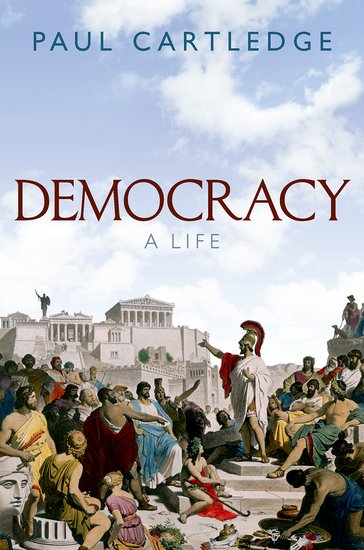
I recently appeared on the Irish Radio show “Talking History.” I was part of a discussion of democracy with Paul Cartledge, the esteemed classicist; Roslyn Fuller, whose work has been discussed on this blog; and Iain Walker, from New Democracy in Australia. Much discussion of Athens and sortition. The show can be heard here:

https://www.newstalk.com/Is-democracy-the-best-we-have

The Demarchy Manifesto

71157100257740l

Many kleroterians are bound to be disappointed in my new book The Demarchy Manifesto, due to be release from Imprint Academic on March 1, because it makes no proposals for replacing voting in favour of sortition in existing institutions, but only in the new voluntary institutions I propose. I believe it is necessary to start this way, since it is extremely difficult to persuade people to give up their vote, but they are prepared to consider sortition where it gives them access to a chance of participating that they do not at present have. This is just an instance of a general pattern in the way that the presentation of options makes a great difference to the evaluations people make of alternatives. You might like to look at this article in the US edition of The Conversation for February 6.

The book suggests that we can snatch the initiative in discussing and formulating public policy from the political parties and produce proposals that they have to accept on pain of voter backlash. I think that there is just a chance that my proposals would consolidate the middle ground whereas the existing procedures encourage the extremes. More fundamentally I aim to move attention from “who gets what” to the sort of public goods that we all can take pride in.

An excerpt from the Introduction to the book:

What I call ‘demarchy’ is primarily a process of transferring the initiative in formulating policy options from political parties to councils representative of the people most directly affected by those policies. The task of those councils would be to distil from public discussion the most acceptable policy in a particular matter. It would be up to voters to insist that the politicians heed them. There is no question of constitutional change, no new parties or new laws, no call for a mass conversion of opinion, but a suggestion about how to initiate a change in accepted practice, starting with actions that may seem of little significance in the big picture, but are still justified by their specific purposes. My focus is on how policy is produced and adopted. I am not concerned with questions about the philosophical basis of state power, or human rights, or crime and punishment. The precise forms these things take in practice are a matter of conventions, which I do not propose to challenge. There is already much debate about these matters. I am concerned about what I see as a more important, but neglected, question.

I begin by concentrating on how to establish some new practices and initiatives in policy formation, empowering those most affected to take the initiative in formulating what they want. It is no advantage to have a choice of products if none of those on offer meets your requirements. The best situation is to be able to say exactly what you want and commission specialists to supply it. Or is that analogy anachronistic and inappropriate in the era of mass production and distribution? I try to analyse our unique problems. My ultimate aim is to transform our political culture. I intend to show how different practices of policy formation are appropriate to different problems at every level from the local to the global and how they might come to be accepted.
Continue reading

Democratising Deliberation: Parliamentarism, Deliberative Democracy and Lotteries

This article [PDF], by Anthoula Malkopoulou, is a commentary on the work of political theorist Kari Palonen on parliamentarianism. In response to recent scepticism, Palonen’s support for the ‘classical paradigm of elected Members of Parliament looks outdated and insufficiently responsive to the challenge of rising inequalities’:

On one hand, sceptics point to the inherent aristocratic or elitist character of elections, embodied in the perceived superiority of representatives compared to the represented (Manin 1997, 134–149). This is sustained not only by century-long anarchist polemics against bourgeois parliamentary democracy, or populist shaming of political corruption, but also by legitimate i.e. republican concerns about election engineering or illegitimate political lobbying. On the other hand, many scholars are worried by the growing social inequalities enabled by the predominance of economic liberalism since the 1980s (Rosanvallon 2013). These are often exacerbated by corresponding inequalities in political influence that further benefit the wealthy and socially advantaged classes (Hill 2013; Malkopoulou 2014). In this respect, legitimising the current system of parliamentary government and providing its apology sounds far too elitist and self-defeating.
In response to such scepticism, Kari has showed some interest in opening his parliamentary model of deliberation to new modes of inclusion . . . his ideal-typical democratic innovations include the practice of rotation, election of singular representatives who are not linked to political parties, and recently, support for the random choice of representatives (Palonen 2014, 345). This turn is linked to the dissociation of random selection from Habermasian consensus and its support by klerotarians as a device that is independent of the process of deliberation (Stone, Delannoi and Dowlen 2013).

Continue reading

Populism and Kleristocracy

A recent exchange on this forum included the following claims:

TA: The early Populists have been much misunderstood and caricatured, including by Hofstadter. If “populist” is to be defined non-arbitrarily, its meaning is a leader whose policy positions for the most part agree with those of the vast majority of the population. Bernie Sanders is a populist, Trump is not.

TB: I’ve been a personal friend and political ally of Sanders for over 40 years, and I agree that the “populist” label fits Sanders based on the historic use of the term dating back to the People’s Party. However, I think the term has been so over-used (and misused) by the mass media that it isn’t particularly useful any more. Any independent-minded politician, whether a leftist charismatic visionary, a demagogue, or proto-fascist is assigned the label.

According to Cas Mudde, most people use populism as a Kampfbegriff (battle cry) to defame a political opponent. The term is in fact just as applicable to politicians and political parties on the left and the right, Trump and Sanders, Front National and Podemos. In an article for Open Democracy Mudde claims that

populism is best defined as a thin-centered ideology that considers society to be ultimately separated into two homogeneous and antagonistic groups, ‘the pure people’ and ‘the corrupt elite’, and which argues that politics should be an expression of the volonté general (general will) of the people.

Continue reading

The Paradox of Democratic Selection: Is Sortition Better than Voting?

A draft book chapter by Anthoula Malkopoulou:

Sortition, or the selection of political officers by lot, has its antecedent in the direct democratic tradition of ancient Athens. Its transfer into a modern context of representative democracy poses rightful scepticism not only about the practical difficulties, but more so about the theoretical inconsistencies that arise. Modern systems of political representation are based on the aristocratic idea of ‘government by the best’, who are to be selected through a competitive call for candidates (Manin 1997). Sortition, on the other hand, replaces this aristocratic criterion of competition and evaluative election with the democratic mechanics of direct and equal distribution of political office by chance. Hence, the very expression ‘democratic (s)election’ includes a paradoxical contradiction in terms, between the democratic concept of equal access to public office and the aristocratic idea of government by the (s)elected best.

My aim in this chapter is to shed some light into this contradiction by critically discussing the benefits and pitfalls of using sortition today, comparing it throughout the chapter with voting and the general effects of electoral representation. More specifically, my arguments are divided in four sections. I begin by addressing the reasons that drive klerotarians away from electoral representation (1). Next, I consider alternative modes of political ‘outsourcing’, such as the inclusion of civil society actors or the use of quotas (2). I continue by discussing the democratic legitimacy of sortition by dividing the subject in two questions: (a) political equality and (b) political participation (3). Last, I focus on the type of political representation that the lot produces, viewed from the perspectives of descriptiveness, authorization and accountability (4). In conclusion, I suggest that lotteries may offer valuable improvement to current practices of democratic selection, but only if special measures are taken to compensate for the limitations they entail.

Full text (uncorrected draft: not for citation).

Sortition Introduction for 21st Century Democracy Conference in Alexandria, Egypt

The Way Forward – by Terry Bouricius

This is the original full draft of an introductory presentation intended to prepare participants of the 21st Century Democracy conference hosted by the Library of Alexandria for the subsequent day’s sessions largely focused on sortition. Due to earlier panels running overtime, this full speech was never presented, and only a few key points were made in an introduction the next day. Note that some underlining and ALL CAPS appear as emphasis aids for reading the speech aloud.

Discussions about the problems of democracy tend to focus on the problems of the elections.

A fundamental point that needs to be understood is that elections are not the same thing as democracy, and are at best one tool for approaching the democratic ideal. Clearly, a system of free and fair elections is a vast improvement over a dictatorship or one-party state. But the ideal of democracy goes far deeper.

The democratic ideal can be summed up as government of, by and for the people. But modern democracies all have government BY a political class that is distinctly different than the people (mostly male, older, wealthier, better educated, etc.)… and whether that government is truly FOR the people is always a matter of debate.

John Adams, one of the founders of the United States wrote in 1776 that a legislature “should be in miniature an exact portrait of the people at large. It should think, feel, reason and act like them.”

The ideal of democracy is that the government should make the same decisions that the people as a whole would make IF they could all have the time, motivation, information, attention, expert advice, access to conflicting points of view, fact-checking of faulty assumptions, and good facilitation. Obviously it is impossible to have all of the people do this on even one issue, let alone the vast number of public policy decisions made every year. But we know exactly how to achieve this ideal by combining the principles of scientific sampling to select a statistically accurate representative mini-public, with good decision-making procedures. The random selection of public officials like this is known as “sortition.”

This would be government BY the ordinary people, rather than by a political class with only the CONSENT of the people.
Continue reading

Sortition and 21st Century Democracy

Sortition and 21st Century Democracy

David Schecter’s presentation at the “Democracy for the 21st Century” conference, Library of Alexandria, Egypt, December 11, 2015

This conference began with a quote from John Kennedy – “the great enemy of truth is not the lie, but the myth.” I believe that the great enemy of truth about democracy is the myth that there is only one democratic way to choose representatives — through elections.

As Dr. Ismail Serageldin suggested, we have been confusing one means of choosing — elections — with democracy itself. And as Dr. George Ishak said, “In the 21st century, we should find new ways to select representatives.” Sortition is one of those ways. Actually, it is not a new way, it’s a very old way. It was used more than elections in ancient Athens, and people wrote about it here in Alexandria 2,000 years ago.

My colleagues, Terrill Bouricius and Oliver Dowlen, have described specific proposals for incorporating sortition into political system design. I would to talk about a whole set of proposals, and a menu of options.

I have been researching proposals like these, and I have also co-authored one. I have found 18 such proposals so far, and I have had the pleasure of corresponding with the authors. They come from Australia, Denmark, France, Germany, Greece, Ireland, South Africa, the U.K., and the U.S. Together, they represent many new possibilities for democracy.

My talk will have three parts. First, I am going to review the rationale for the use of sortition and “mini-publics” – that is, representative samples of the public. I am also going to respond to some common objections to this idea. Second, I am going to describe a menu of options for incorporating mini-publics into political systems. Third, I am going to pose some important questions that have not yet been addressed within these proposals.
Continue reading

2015 review – sortition-related events

This is a review of notable sortition-related events of the year 2015.

Brett Hennig wrote to mention citizens’ assembly pilots and the Irish constitutional assembly which led to the marriage equality vote.

In my mind the two most notable sortition-related events of 2015 were:

  • In Mexico, the Morena party allotted of some of its congressional candidates among the party rank-and-file. This was covered on Equality-by-Lot here (English version), here and here.
  • Leading Belgian politicians from various parties proposed changing the selection method of the Belgian upper house to sortition. This is the most high-profile proposal of its kind of the modern age.

Continuing the trend of previous years, those developments happened in the non-English speaking world. However, they are a reflection of a wide-spread disillusionment with elections – a sentiment that is as common in the English-speaking world as it is outside of it.

In the US this sentiment found an electoral outlet in the surprise strength of the campaigns of two presidential candidates which are perceived as being outside of the electoral establishment – Donald Trump and Bernie Sanders. This fact was observed in a relatively well-noticed academic paper in Science journal by Fisman and Markovits about the way class affects policy choices. The authors drew from their work some conclusions that come close to an indictment of the electoral method.

Prinz and Garry: Democracy is due for an overhaul – could lawmaking-by-jury be the answer?

In an article in The Conversation, Janosch Prinz and John Garry, both from Queen’s University Belfast, advocate for legislation by ad-hoc allotted bodies.

They start off by recounting a standard list of instances of electoral disfunction:

Many will agree that, in practice, democracy leaves a lot to be desired. The system often falls short of its ideals: whether it’s the US congress causing a total government shutdown; Australian prime ministers being ousted by internal party politics; or the UK’s disproportionate electoral system allocating only one seat to a party which received close to 4m votes.

This misses the point. None of these examples is an indication of a problem inherent in elections. The problem with electoralist systems is not that they don’t function but that they function in favor of electoral elites and their allies rather than for the average person.
Continue reading

Dahl: After the Revolution

I’ve been re-reading Robert Dahl’s 1990 book and a section struck me as particularly relevant to some of the debate on this forum:

Perhaps the greatest error in thinking about democratic authority is to believe that ideas about democracy and authority are simple and must lead to simple prescriptions. . . . if you think there are simple prescriptions, then we cannot hope to understand one another. (p.73)

Dahl’s approach, as always, offers a rich combination of historically-informed theoretical analysis, comparative political science and pragmatic policy proposals. From the political theory perspective, he argues that democracy involves a trade-off between personal choice, competence, economy, and the principle of affected interests. Although ‘primary’ (assembly) democracy is generally viewed as the gold standard, considerations of scale mean that other ostensibly non-democratic mechanisms will often lead to a form of democracy that better manages the trade-off than an attempt to approximate the ideal. Polyarchy may well be a poor approximation of ideal democracy but it’s descriptively accurate and a lot better than actual historical alternatives (various forms of oligarchy and dictatorship).

The error of thinking about democracy as a a single form has led to catastrophe in the past; I fear it will lead to disaster in the future.

Dahl’s historical examples include the excesses of the Athenian demokratia, Jacobinism and the attempts to introduce ‘real’ democracy in the former Soviet Union — where the supposed rule of the people’s soviets in effect meant the dictatorship of the leaders of the vanguard party. From the perspective of the future, Dahl spends longer considering sortition (pp. 122-5) than the mere half page in Democracy and Its Critics, but his treatment is cautious — participation by lot should be restricted to selecting advisory councils for elected officials. This is because sovereignty by sortition would contravene principles of personal choice, competence and economy. In coming to this conclusion he ignores the Greek distinction between magistrates and juries and also fails to capitalise on the dual role of polyarchic officials (policy advocacy and judgment), thereby ignoring the potential of sortition in the latter function without undermining his three principles.

P.S. Andre [or any other Rousseau scholar]: Dahl claims (p.139, footnote 10) that Rousseau ‘strongly objects to the selection of representatives by lot’. Is this true? One might well deduce that this was the case, in that he insisted that all citizens should participate in the sovereign assembly, but did he anywhere actually consider sortition for the legislature? Dahl argues that Rousseau’s throwaway suggestion for spatial rotation in Social Contract Ch.XIII (moving the capital alternately from one village to another) was incompatible with his hostility to sortition in the legislative assembly, but to my mind the possibility of spatial rotation would mean that a statistically-representative assembly would not be ruled out as a matter of principle. After all the Greeks did not see any incompatibility between law-making by assembly vote (5th century) and law-making by the vote of an allotted subset (4th century) — the latter was no less democratic than the former.

Reference
Robert A. Dahl, After the Revolution? Authority In a Good Society. Revised edition (1990), Yale University Press.