Double Review: ‘Against Democracy’ and ‘Against Elections’

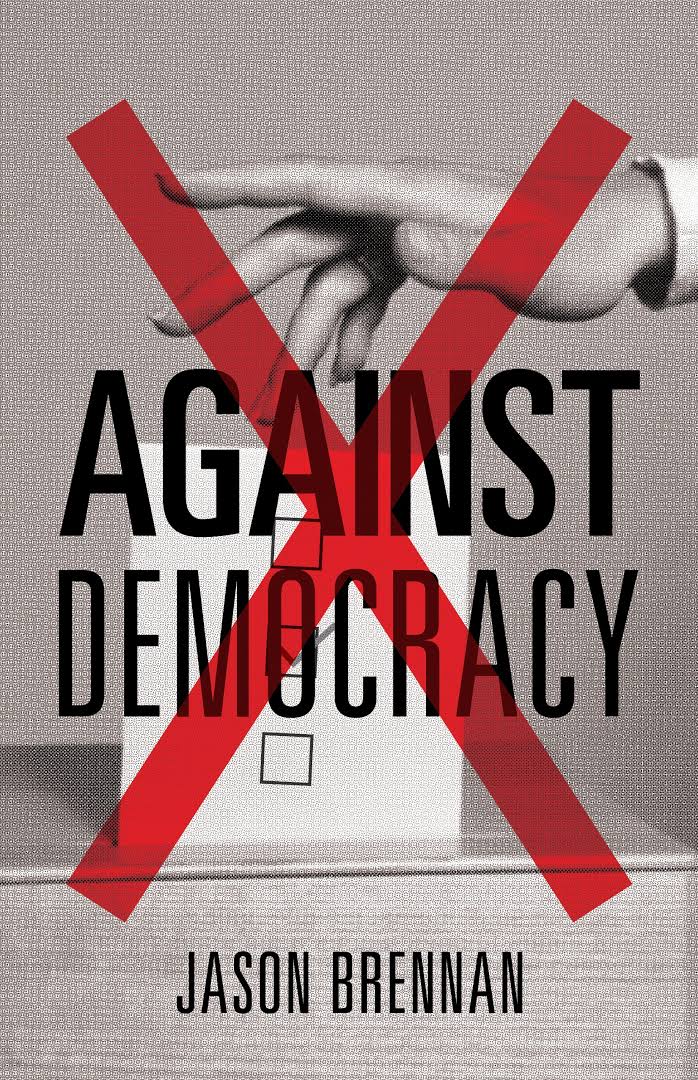
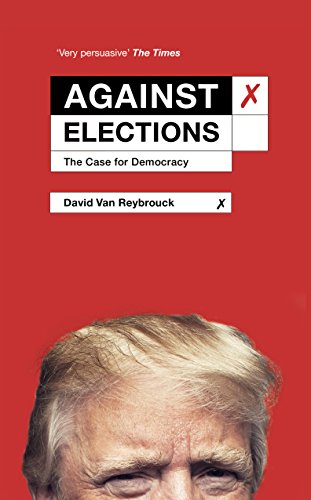
I recently reviewed two books ‘Against Democracy’ by Jason Brennan and ‘Against Elections’ by David van Reybrouck for the Los Angeles Review of Books. I wouldn’t say that I loved either book, but I did give Terry a shout-out in the review :-)

“Against Democracy” and “Against Elections”: Where Do We Go From Here?

AS THE UNITED STATES APPROACHES a most divisive presidential election, it is hardly surprising to see an upsurge in literature proposing to diagnose and cure the ailments of modern politics.

Against Democracy and Against Elections both fall into this category. Despite their provocative titles, they each present detailed plans regarding what they are for rather than focusing solely on what they are against. This willingness to explore alternative politics is a clear strength of both books and what sets them apart in a market clogged with tomes that tend to be heavier on rants than original thinking.
Crowdfunding Anthony Barnett’s WHAT NEXT: Britain after Brexit

unboundAnthony Barnett’s new book WHAT NEXT: Britain after Brexit is available for pre-order on Unbound. He writes:

Dear Fellow Kleroterians!

Thank you for permitting me to join you on this blog. I’m writing with a shameless request, but in this post-Brexit world being polite and submissive and deferential in a British way seems to be for the birds. Towards the end of the last century I wrote a paper suggesting that a section of the upper chamber should be selected by lot. Peter Carty got in touch with me, as he had been writing a paper on similar lines. We developed it into a publication for Demos, then directed by Ian Christie, published in 1998. Ten years later we turned it into a book, The Athenian Option: radical reform of the House of Lords, published by Imprint.

There was a moment I’ll never forget – which we write about in the book. In order to put replacing the Lords into the long grass, Tony Blair created a Royal Commission in 1999 to take evidence across the country. Because our Demos paper had caused a stir we were invited to give evidence. On the way into the session I found myself in a small lift with one of its senior members, Douglas Hurd, at that point Baron Hurd of Westwell. He had been close to Edward Heath, had been Foreign Secretary under John Major, who he had failed to beat for the Tory leadership. A grandee, I think, was the term at the time. the very opposite of the kind of regular person who would have been chosen had the Commission been selected by lot.
Continue reading

“Limiting who can vote”

Ripples from Van Reybrouck’s book made it across the Atlantic and into the Washington Post where Dutch professors of political science Eric Schliesser and Tom Van Der Meer see fit to discuss his proposals for using sortition together with a proposal to “disenfranchise the ignorant to slant political rule toward experts”. They write:

Both [proposals] limit who can vote and seek to stimulate apolitical and rational decision-making:

1) Representatives by lottery. Belgian author and cultural historian David Van Reybrouck suggests abolishing elections and appointing representatives by lottery instead. Van Reybrouck’s proposal extends the principle of sortition — how juries are appointed — to the legislature: Randomly selected citizens would reach the optimal decision via deliberation, supposedly without a need to be bothered with politicking. When their term is up, they go home.

2) Experts as representatives. Philosopher Jason Brennan at Georgetown University suggests disenfranchising the ignorant to slant political rule toward experts. His proposal recently received favorable discussion in The Washington Post. Inspired by Plato, the rule by properly trained experts, or epistocracy, would prevent politicians from being easily swayed by moneyed interests and demagogues.

Continue reading

Van Reybrouck’s Against Elections, in English

An English translation of David Van Reybrouck’s book Against Elections was recently published. The book is blurbed by, among others, J. M. Coetzee, the South African novelist who was the recipient of the 2003 Nobel Prize in Literature:

Choosing our rulers by popular vote has failed to deliver true democratic government: that seems to be the verdict of history unfolding before our eyes. Cogently and persuasively, David Van Reybrouck pleads for a return to selection by lot, and outlines a range of well thought out plans for how sortitive democracy might be implemented. With the popular media and the political parties fiercely opposed to it, sortitive democracy will not find it easy to win acceptance. Nonetheless, it may well be an idea whose time has come.

With attention from such a luminary it is not surprising that the book was reviewed in several elite media outlets. As Coetzee predicts, the reception is quite cold. The warmest one is Andrew Anthony’s lukewarm response in The Guardian. Anthony concludes:

[W]hen, say, a sortition of the public recommends an expensive transport system that doesn’t work out or cuts a defence system that is later needed, […] where and how is that frustration registered? You can’t vote out the public. One job that elected politicians fulfil is as democratic punchbags. It’s not edifying or necessarily productive, but it may be essential.

Perhaps sortition or partial sortition could be applied in very specific cases. But we also need to look at reviving elections and renewing our belief in them. They remain a vital part of the democratic process. Not its only part, to be sure, but they are an all too rare example of mass engagement. Let’s not vote them out just yet.

Continue reading

Roslyn Fuller educates Andrew Sullivan

It used to be a mainstream, respectable occupation to theorize about the horrors of popular rule. Socrates and other Athenian aristocrats have been upfront about the fact that the average person should not be trusted with power. This clear-headedness and frankness has been maintained over many centuries. The water began to muddy as the aristocrats were being challenged by the up-and-coming bourgeoisie. Now there had to be some rational criteria explaining why it was not the aristocrats who should be holding power. Talk about natural aristocracy became fashionable, but outright rejection of democracy was still part of the mainstream discourse.

Then, in the 19th century, the term “democracy” was rehabilitated and the ideological water became so thick it was impossible to know where one was heading. In the middle of the 20th century Schumpeter and the elite theorists tried to clear the water by explicitly redefining the term not to refer to popular power after all but simply to a competition between elites for popular vote.

This moment of clarity passed when the 1970’s saw the ideological victory of the Civil Rights movement. At that point popular rule became the only defensible meaning of “democracy”, and since then theorists are in the unpleasant situation of having to reconcile an oligarchical practice with a democratic ideology.

This brief history is presented as an introduction to a recent exchange between Andrew Sullivan, a British author, editor, blogger, conservative political commentator, former editor of The New Republic, and the author or editor of six books, and prof. Roslyn Fuller, an Irish academic, legal expert, columnist, electoral candidate, author of the book Beasts and Gods, and an Equality-by-Lot contributor.
Continue reading

Somin: Sortition won’t solve political ignorance

jpeg-of-cover-final-version-e1464367107681

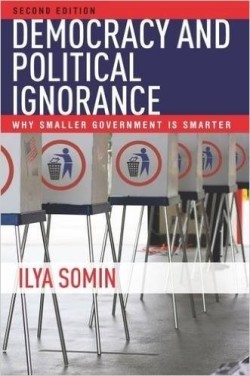
Ilya Somin, Professor of Law at George Mason University, is the author of the book Democracy and Political Ignorance: Why Smaller Government is Smarter. Somin opens an opinion piece in the Washington Post thus:

Widespread political ignorance is a serious problem for modern democracy. In recent years, many scholars have argued that we can overcome it by relying on “sortition”: delegating various political decisions to jury-like bodies selected at random from the general population. In this post, I explain why such proposals are unlikely to succeed.

Before going into the substance of Somin’s arguments about sortition, it is important to realize that ignorance is actually only the second most important problem with the current system, the first being the difficulty of mass scale agenda setting. More details here. The emphasis on ignorance rather than agenda setting is typical of the “rational choice” line of political argument which ignores the complexity of organization largely for ideological reasons. That said, the ability of decision makers to become informed about their subject matters is important and worth discussing. Some of the considerations that are discussed below apply also to the matter of agenda setting.

Continue reading

Democracy Talk, Episode 2

In this episode Patrick Chalmers and Yoram Gat talk about Patrick’s inside view of establishment journalism. Patrick presents his analysis of the roots of the problems with journalism and their connection to the problems of our systems of government.

Patrick’s book – Fraudcast News – How Bad Journalism Supports Our Bogus Democracies – can be found online here: http://fraudcastnews.net.

Literature-related question

Hi everyone,

I’m wondering whether any readers have insights about books and/or articles which build on/critique John Burheim’s path-breaking and overarching model of demarchy, and/or apply demarchy to non-government organizations such as corporations or unions. I’m conducting some research in this space and haven’t been able to find too much work specifically on demarchy in published work (but have found a lot about specific uses of random selection). Any and all suggestions would be much appreciated. Thanks!

Book Review: Democracy: A Life

I seem to be reviewing a lot of books lately, including this review of Paul Cartledge’s Democracy: A Life in the Los Angeles Review of Books (cited in a previous post by Peter Stone). While the book covers what will be familiar ground for many here, the author also charts how the idea of ‘people power’ has been treated over the centuries that have elapsed since Athenian democracy. As such, I feel that he (intentionally or unintentionally) made an important contribution to challenging the negative perception that we have of citizen participation by explaining how this view developed over time. Another one to order for the library!

Cartledge goes to some effort to show how later [post-Athens] historians and statesmen were anxious to portray Greek democracy as a horrible mistake, the unworkable aspiration of starry-eyed dreamers that was preprogrammed to end in chaos. Under the onslaught of these propagandists, the vast majority of whom never experienced Athenian democracy — and indeed were often born several hundred years after it ceased to exist — the idea of political equality came to be regarded as a myth, the notion of the collective people holding power a danger to be shunned, suppressed, and preferably forgotten.

The truth was that democracy was a dangerous idea — to the kings, emperors, and high clergy who controlled information in the centuries after it ceased to be a living form of government. As the author puts it, while these autocrats held sway throughout the Middle Ages, the very idea of democracy was “on life-support.” And while things may have improved since, modern democracy is, in Cartledge’s view, not in much better shape — off the machine perhaps, but still staggering around the hospital ward, clutching at bits of furniture, and trying to remember what had happened to bring it there in the first place.

Democracy Talk, Episode 1

Patrick Chalmers and I are aiming to turn this into an ongoing video series. Any comments are welcome.