Posted on October 2, 2015 by Yoram Gat
The St. Louis Post Dispatch reports:
Global movement towards representative legislatures
St. Louis, Missouri, 18 October: A world-wide movement towards establishing legislative bodies that are fully representative finds expression in the staged reading of “Our Common Lot” by David Grant. The short play is written for an international conference, “Democracy for the 21st Century,” to be held in December at the Library of Alexandria, Egypt.
In the play, Marisa, Alma, Sami, and Ali live in a city embroiled in conflict and violence — the Regime, the Opposition, the Opposition to the Opposition. When the fighting stops, they ask themselves: What is the best way to move forward? “Our Common Lot” argues for choosing legislators in the way that the first democracy did – by random lot, known as ‘sortition.’
In the original Athenian democracy, sortition was regarded as a principal characteristic of democracy. Most recently the city of Melbourne, Australia has used a random sample of citizens to determine its ten-year financial plan. Two-thirds of the recent Irish Constitutional Convention was composed of sortitionally-chosen citizens.
The reading of “Our Common Lot” is its world premiere. The ensemble includes Adam Flores, Carl Overly, Jr., Erin Roberts, and Jacqueline Thompson.
Continue reading →
Filed under: Action, Books, Fiction, Press, Sortition | 1 Comment »
Posted on September 28, 2015 by Ahmed R. Teleb

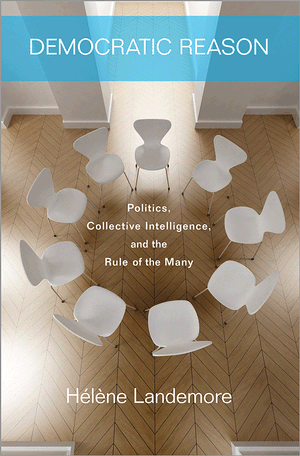
Hélène Landemore’s book Democratic Reason won the 2015 Spitz Prize for work in democratic theory.
That makes the second Spitz (for outstanding work in democratic theory) to a Sortinista in three years, following John McCormick’s Machiavellian Democracy in 2013.
Filed under: Academia, Books, Sortition | Comments Off on News: Democratic Reason wins 2015 Spitz Prize for work in democratic theory
Posted on September 19, 2015 by Yoram Gat
This topic came up recently. Here is the most thorough discussion of this matter in the primary sources that I am aware of. Aristotle is describing here (Politics, 1317a-1318a) what he considers as the conventional wisdom of his time:
And for this inquiry we must take into view all the features that are popular and that are thought to go with democracies; for it comes about from combinations of these that the kinds of democracy are formed, and that there are different democracies and more than one sort. In fact there are two causes for there being several kinds of democracy, first the one stated before, the fact that the populations are different (for we find one multitude engaged in agriculture and another consisting of handicraftsmen and day-laborers, and when the first of these is added to the second and again the third to both of them it not only makes a difference in that the quality of the democracy becomes better or worse but also by its becoming different in kind); and the second cause is the one about which we now speak. For the institutions that go with democracies and seem to be appropriate to this form of constitution make the democracies different by their combinations; for one form of democracy will be accompanied by fewer, another by more, and another by all of them. And it is serviceable to ascertain each of them both for the purpose of instituting whichever of these kinds of democracy one happens to wish and for the purpose of amending existing ones. For people setting up constitutions seek to collect together all the features appropriate to their fundamental principle, but in so doing they make a mistake, as has been said before in the passage dealing with the causes of the destruction and the preservation of constitutions. And now let us state the postulates, the ethical characters and the aims of the various forms of democracy.
Continue reading →
Filed under: Athens, Books, Elections, History, Participation, Sortition | 57 Comments »
Posted on August 26, 2015 by campbellwallace

My book “DOWN WITH ELECTIONS!” will be available as an e-book on Amazon and Smashwords from 1st September for the princely sum of 99c US or equivalent. It’s a revised and corrected version of the articles published earlier on this forum.
The links are:
Smashwords (epub, most ebook readers), Amazon (mobi – Kindle).
Readers of this forum can have it free from my Dropbox account. It would be nice if you post a comment on Amazon or Smashwords. (Thanks)
Dropbox links:
epub, mobi, HTML, PDF, ODT, DOC.
Filed under: Books, Sortition | 2 Comments »
Posted on May 18, 2015 by Common Lot Sortitionist

A new book by Shaazke Beyerle, Curtailing Corruption: People Power for Accountability and Justice, describes grassroots efforts around the world to fight corruption.
In one of the cases described a randomly chosen group of regular citizens in Korea served as a ‘citizen jury’ that confirmed results of an investigation into political corruption. The outcome of this ‘people power’ campaign was that over 50% (58 out of 112) of the politicians identified as corrupt dropped out of the race, and of the blacklisted candidates who did run, 68% (59 out of 86) were defeated.
Filed under: Applications, Books, Juries, Sortition | Tagged: Korea | Leave a comment »
Posted on May 13, 2015 by Yoram Gat
Manuel Arriaga‘s Foreign Policy magazine article is a well-aimed, much needed corrective to the techno-progressivist formula of popular political theory:
Democracy Does Not Live by Tech Alone
Democracy is in crisis — and more apps won’t save it. Instead, bring decision-making back to the people.
Enthusiasm for reforming our democracies has been gaining momentum. From the pages of FP to the colorful criticisms of comedian Russell Brand, it is evident that a long-overdue public conversation on this topic is finally getting started.
There is no lack of proposals. For example, in their recent FP piece, John Boik and colleagues focus on decentralized, emergent, tech-driven solutions such as participatory budgeting, local currency systems, and open government. They are confident that such innovations have a good chance of “spreading virally” and bringing about major change. Internet-based solutions, in particular, have captured our collective imagination. From Pia Mancini’s blockbuster TED presentation to New Scientist‘s recent coverage of “digital democracy,” we’re eager to believe that smartphone apps and novel online platforms hold the key to reinventing our way of governance. This seems only natural: after all, the same technologies have already radically reconfigured large swaths of our daily lives.
To put it bluntly, I believe that focusing on innovations of this sort is a dangerous distraction. Continue reading →
Filed under: Athens, Books, History, Participation, Sortition | Tagged: Manuel Arriaga, technology | 1 Comment »
Posted on January 10, 2015 by Yoram Gat
Claudia Chwalisz writes in 3am magazine:

Representative democracy today seems to be at an impasse. Low voter turnout, falling party membership, plummeting trust in politicians, the fierce rise of populist parties. These trends, together with political fragmentation, disengagement among young generations, and backlash against the political elite who have failed to govern responsibly, highlight democracy’s dilemma. Though much has been written about this democratic crisis, less has been proposed in terms of solutions. Belgian historian David Van Reybrouck’s recent book, Contre les élections [Against Elections], attempts to fill this gap of ideas. Although it has not yet been translated into English, as is obvious from what I discuss below, his analyses are critically important in the current climate.
Chwalisz’s long article mostly revolves around Van Reybrouk’s book, but also mentions Gilens and Page. She seems to some extent skeptical of Van Reybrouck’s progressivist outlook and ends thusly:
[T]he dilemma of how to get elected elites to relinquish their grip on the seats of power remains unresolved. Perhaps the starting point is to question ourselves: are we, in fact, electoral fundamentalists?
Filed under: Athens, Books, History, Juries, Press, Proposals, Sortition | 4 Comments »
Posted on November 1, 2014 by avanderven
On Sunday, September 29th 2013 in a Dutch TV series named Buitenhof the word Lottocracy (Dutch: lottocracy), although casually, for the first time was used in public in Holland. There was an interview with David Van Reybrouck about his new book ‘Against elections’. Great, that the idea of Lottocracy was mentioned for the first time in the Dutch media. The broadcast can be viewed by clicking below:
http://www.uitzendinggemist.nl/afleveringen/1368517
However, van Reybrouck did not mention in the program nor in his book, that the idea of lottocracy has already been discussed extensively in the book ‘The World Solution for World Problems’, especially in the chapter ‘A Concept for Government’. The book was already published in 1988. The book is available as an electronic book at:
http://www.picarta.nl/
The book can also be read directly on Internet at the address:
http://www.socsci.kun.nl/~advdv/leonbook/leonbook.html
Continue reading →
Filed under: Books, Elections, Sortition | Leave a comment »
Posted on October 24, 2014 by tbouricius
A section of Belgian author David Van Reybrouck’s sortition book, Against Elections has been translated into English and posted online:
Representative democracy is in crisis. Low voter turnout, abstention, falling party membership, and the phenomenal rise of populist parties – these are the symptoms of Democratic Fatigue Syndrome. Considering democratic innovation from classical Athens to present day, it becomes apparent that our democratic institutions haven’t been updated since the late 18th century. How to renew the centralised, hierarchical party system to reflect the horizontal power relationships of the hyper-connected, interactive society of the 21st century? A bi-representative system, combining elections with the democratic principle of sortition, or drawing of lots, could steer democracy into smoother waters.
Continue reading →
Filed under: Books, Elections, Press, Sortition | 1 Comment »
Posted on October 8, 2014 by Yoram Gat
Susan C. Stokes, a professor of political science at Yale university, is the author of a book called Mandates and Democracy: Neoliberalism by Surprise in Latin America.
I find the following excerpts from a chapter called “Explaining policy switches” generally amusing and rather illuminating about the practice of political science (I introduced some light editing to improve readability of the excerpts):
[B]oth qualitative evidence from campaigns and statistical analysis of cross-sectional data offer evidence that fear of losing elections induced politicians to hide their policy intentions.
Yet evidence of this belief structure does not adjudicate between the representative and the rent-seeking model of policy switches. Both kinds of politicians are expected to hide their true intetions to win office. The critical question is, Did they dissimulate and switch because they thought efficiency policies were in the best interest of voters or because they found efficiency policies advantageous for themselves, whether or not they would be good for voters?
Continue reading →
Filed under: Academia, Books, Elections, History | 5 Comments »


 Adam Cronkright
 Ali
Ali Ahmed R. Teleb
 avanderven
 avergne
 Alex Kovner
 azakaras
 Brett Hennig
 campbellwallace
 Simon Threlkeld
 Nick Coccoma
 codyhipskind
 Common Lot Sortitionist
 Conall Boyle
 constitutionalism
 davidschecter
 graytmatter
 gtridimas
 H.J. Hofkirchner
 Hanspeter Rosenlechner
 John Burnheim
 jgarry20151
 Jochen Krattenmacher
 johnedwardtaylor
 johnhuang865
 Jonathan Crock
 keithsutherland
 Jacob Richter
 kkoreilly
 lukewhito
 SimonPek
 Nathan El
 Nicholas Gruen
 Owen Shaffer
 Patrick Chalmers
 Paul Gölz
 peterstone
 Pierre-Etienne Vandamme
 pronfeld
 Emil
Emil rcaze
rcaze richwbrown
 Roger Knights
 roslynfuller
 Pierre-Etienne Vandamme
 shaharavin
 tbouricius
 Ted Wachtel
 Joshua Laferriere
 theodorestathis
 towardsautonomyblog
 Wayne Liebman
 Yoram Gat
 Oliver Milne
 Equality by lot