


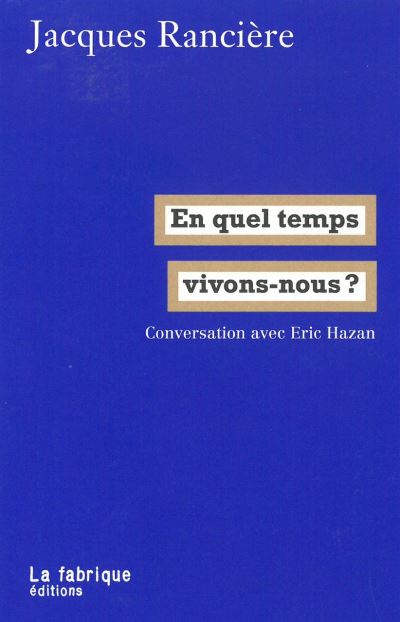
What to save from the drifting French political system? The philosopher Jacques Ranciere was the guest of Aude Lancelin in “The war of ideas” of June 20th, 2017. Here is the transcript of this interview. Parts 1 and 2 of the translation are here and here. [My translation, corrections welcome. -YG]
 05. The question today is that of rethinking forms of organization, ways of being together for the long term, outside of the electoral forces.
Aude Lancelin: Your book is also a severe blow to those who today are pinning their hopes on the famous cortège de tête: the group of young people who clash with the police after the demonstrations. You have some ironic words on this subject. For you it is primarily a varnish of radicality which is applied to quite traditional demonstrations. The political meaning of all that and its future are not at all assured in your eyes. Do I misinterpret your thinking?
Jacques Ranciere: First thing: the cortège de tête is not simply the professional revolutionaries who think that it is necessary to radicalize the struggle and who radicalize the struggle by breaking shop windows. There are also people who think that breaking windows is the time of assembly of people who come from different horizons, who come from the political struggle or who come from delinquency in the suburbs, and who suddenly discover themselves. That is a way of gathering people that is classic anarchist or revolutionary politics, and suddenly the people that the movement appeals to and who are involved, who arrive with their own actions, their own revolt or their own ways, are coming first from the world of delinquency rather than from the world of politics. The cortège de tête are not simply people with a specific strategy. Another thing that I am trying to say is that the violent actions of the cortège de tête are also symbolic and not any more strategic in fact than the assemblies of the Nuit debout. Because, in fact, what is it that they are really doing? They take aim at symbolic targets; an ATM, a shop window, a nice car… But that is not at all a strategic action. There is this idea that it is necessary to radicalize, to create an irreversible situation. In my experience, that is not irreversible. It is not that some actions create an irreversible situation. I don’t think that existing conditions create a great realignment. Basically, the question is knowing how to manage this interaction between gathering the greatest number and striking the enemy. But what does “striking the enemy” mean? I don’t really know. I think that in the so-called “radical” thinking, there is always a double logic. On the one hand, the logic of confrontation (“we are going to confront them and it is through the confrontation that we rattle the enemy”) and at the same time a logic of desertion (“if we secede the system will collapse”). In the texts of the Comité invisible there is always this double logic. I think that neither of those two logics is really proven. But I am not trying to give lessons, I am just responding to the questions.
Continue reading
Filed under: Academia, Books, Elections, History, Participation, Press, Sortition, Theory | 1 Comment »
 Aude Lancelin: Let’s remain with France insoumise and the phenomenon of Mélenchon during the presidential elections. You are very sceptical regarding the figure of a tribune (Mélenchon) who is going to speak in the name of the suffering of the people and champion their cause. This posture is suspect in your view. What is the basis of your criticism?
 Jacques Ranciere: There are several things. First, adopting this posture means also adopting the posture that the system imposes, namely the posture that there is an official political game and that there are the people of the depths who are not represented, or are represented by the extreme right from which they must be separated. It is this idea that the people exist, that there are those who represent the people, that is what de Gaulle pretended to do. I don’t think that this is a democratic idea that makes it possible to mobilize and advance. That is the first point. The second point is that I find it paradoxical to become a candidate of the supreme office of the system saying: if you elect me, here is my program. And at the same time to say: but pay attention, this system is bad and therefore everything is going change. I think there is a fundamental contradiction. You are saying to me that my anti-presidential stance is somewhat paradoxical or difficult to follow. But I think it is still more difficult to follow a stance which on the one hand asks to be vested with the powers of the president of the 5th republic and at the same time says I want to 6th republic and i am going to throw all of this up in the air. It is either one or the other. If we say: it is necessary to throw the 5th republic up in the air, we say: I am here to throw the 5th republic up in the air. Period.
 Aude Lancelin: Jacques Rancière, welcome. I thank you, a great political philosopher, for coming to help us understand what is happening in a democratic country where full power is obtained with the support of less than 11% of the electorate. One of the very cruel lessons of your new book “In what times are we living?”, which is a dialog with the editor Eric Hazan, is that despite the mass abstention, despite the dysfunction of the representative system, someone holds power. Moreover, power becomes more and more oligarchical in our societies, without meeting any serious obstacle. It is not enough to turn our backs on the electoral system for it to collapse by itself. It continues to function without the popular classes, without the left… until when?
 Jacques Ranciere: As I see things, the representative system is made to function with the support of a minority. There is always this confusion between democracy as the power of all and a representative system. The electoral system is made as a conflation of the two but fundamentally the representative system is in its essence an oligarchical system. In the 17th century the representative system was therefore made for a small part of the population that was supposed to be “enlightened”, representative and conscious of the general interests of society, to be able to govern with as few obstacles as possible. At the time of the revolutions of the 19th and 20th centuries a belief in the power of people emerged, which could express itself through the electoral system and representation. Today we realize again that in different ways power is always with a small minority. In the past it was a social class, now it is difficult to say what social class can really govern the country, even if we know what interests the system serves. In consequence, we professionalization occurred which produced an interaction between a left and a right which fundamentally thought and did the same thing. And at the same time, they saw themselves as representatives and called for a non-establishment system or an “anti-system”. That is, the system itself produced its anti-system. What we see with Macron, with En Marche [Macron’s party], is a new and unexpected way in which the system produces its “anti-system”. I mean that the representative system carries within it the potential for several possibilities. There is the Le Pen style alternative, that is the people of the depths who are going to sweep away all the people of the system, and then there is of course the Macron alternative, which is a more subtle form because it replaces the system by the system itself. Fundamentally, what is the great novelty about under the banner of En Marche? These are alliances which are already known in other European countries (Germany, for example), with the difference that the parties keep their autonomy, while keeping the same politics, sometimes as adversaries and sometimes as allies.
 This sortition community may be pleased to hear that a new party employing principles of sortition was recently founded by Austrian Comedian

 On the other hand, I want to emphasise the supreme importance of getting it right in dealing with the dangerous world we have created. I postulate that this goal can only be achieved by a rational process in which any citizen who wishes to do so may take an active part. One takes an active part in a rational process by putting forward considerations for or against a proposal that others can be expected to recognise as having a certain amount of validity. Mere will or gratuitous assertion do not count.
 Adam Cronkright
 Ali
Ali Ahmed R. Teleb
 avanderven
 avergne
 Alex Kovner
 azakaras
 Brett Hennig
 campbellwallace
 Simon Threlkeld
 Nick Coccoma
 codyhipskind
 Common Lot Sortitionist
 Conall Boyle
 constitutionalism
 davidschecter
 graytmatter
 gtridimas
 H.J. Hofkirchner
 Hanspeter Rosenlechner
 John Burnheim
 jgarry20151
 Jochen Krattenmacher
 johnedwardtaylor
 johnhuang865
 Jonathan Crock
 keithsutherland
 Jacob Richter
 kkoreilly
 lukewhito
 SimonPek
 Nathan El
 Nicholas Gruen
 Owen Shaffer
 Patrick Chalmers
 Paul Gölz
 peterstone
 Pierre-Etienne Vandamme
 pronfeld
 Emil
Emil rcaze
rcaze richwbrown
 Roger Knights
 roslynfuller
 Pierre-Etienne Vandamme
 shaharavin
 tbouricius
 Ted Wachtel
 Joshua Laferriere
 theodorestathis
 towardsautonomyblog
 Wayne Liebman
 Yoram Gat
 Oliver Milne
 Equality by lot