


Filed under: Elections, Press, Sortition | Tagged: image | 6 Comments »

Filed under: Elections, Press, Sortition | Tagged: image | 6 Comments »
Owen Shaffer, a retired college professor living in Asheville, NC has an opinion piece in the local Citizen Times. Unlike many sortition advocates, Shaffer is not talking half-measures. He is ready to dispose of elections altogether and replace them with sortition:
Is there a better way to select representative bodies to govern us? Is it possible to remove “politics”, “lobbyist”, and “campaign contribution” from our vocabulary, and still have a democracy? Can we remove the oligarchic underpinnings to our democracy? One only needs to look at history to find the answer. “It is thought to be democratic for the offices to be assigned by lot, for them to be elected would be oligarchic” – Aristotle (Politics, Book 4, Section 1294b)
What changes might happen if the random selection of members of a governing body occurs? It would be more likely that they deliberate issues and not sink into decisions based on political affiliation, posturing, and “sound bite” opportunities. They would be unafraid to make hard choices since they would owe no one any favors nor have an opportunity for re-election. In short, they would be more willing to make the right decisions.
Filed under: Elections, History, Juries, Press, Sortition | 11 Comments »

Ripples from Van Reybrouck’s book made it across the Atlantic and into the Washington Post where Dutch professors of political science Eric Schliesser and Tom Van Der Meer see fit to discuss his proposals for using sortition together with a proposal to “disenfranchise the ignorant to slant political rule toward experts”. They write:
Both [proposals] limit who can vote and seek to stimulate apolitical and rational decision-making:
1) Representatives by lottery. Belgian author and cultural historian David Van Reybrouck suggests abolishing elections and appointing representatives by lottery instead. Van Reybrouck’s proposal extends the principle of sortition — how juries are appointed — to the legislature: Randomly selected citizens would reach the optimal decision via deliberation, supposedly without a need to be bothered with politicking. When their term is up, they go home.
2) Experts as representatives. Philosopher Jason Brennan at Georgetown University suggests disenfranchising the ignorant to slant political rule toward experts. His proposal recently received favorable discussion in The Washington Post. Inspired by Plato, the rule by properly trained experts, or epistocracy, would prevent politicians from being easily swayed by moneyed interests and demagogues.
Filed under: Academia, Books, Elections, Juries, Press, Proposals, Sortition | 131 Comments »
New article by Simon Threlkeld.
Many people think choosing politicians by popular vote is an essential part of democracy. Nevertheless, there is another way to choose politicians that is in important regards far more democratic and much better. That way is for politicians to be chosen by juries of citizens drawn from the public by random selection.
Ideally, politicians would be chosen in a way that is very democratic, well informed, and independent from moneyed interests and billionaires, with political independents being on a level playing field with party nominees, with no portion of the public being underrepresented, and with candidates not being dependent on the media to get a fair hearing. All of these things can be achieved if politicians are chosen by juries.
After briefly explaining the considerable advantages of choosing politicians by jury rather than popular vote, Simon also briefly proposes two ways juries can be used to make popular elections much more democratic.
If politicians continue to be chosen by popular election, despite the problems with that approach, there are two ways juries can be used to make popular elections much more democratic.
Filed under: Elections, Juries, Sortition | Leave a comment »

Simon Threlkeld has a new article in Dissident Voice, proposing that America’s judges be chosen by randomly sampled judicial selection juries.
Judges should not be chosen by popular vote, nor by politicians. Both approaches are undemocratic and deeply flawed, perhaps even absurd … A far better option is for judges to be chosen by juries drawn from the public by random selection.
[…]
The problem with choosing judges by popular election is not that it puts the choice in the hands of the people, but rather that it fails to do so, or does so very badly and inadequately. Fortunately, judicial selection juries provide a remarkably good and informed way for the people to choose judges.
In a democracy the people are the rulers, and are the highest and most legitimate authority, not politicians and political parties, nor the rich interests that fund their electoral victories. For this reason, the judiciary should be chosen by the people, not by politicians. All that is needed is a good informed way for the people to choose judges, something judicial selection juries can provide.
Filed under: Elections, Juries, Press, Sortition | 5 Comments »

A brief by Simon Threlkeld to Canadian House of Commons Electoral Reform Committee, July 26, 2016, briefly explains why election rules, including those setting out the voting method, should be decided by jury, not by politicians or a referendum, and how such a jury approach to democratically deciding election rules could work.
4. Were there no good democratic alternative to politicians deciding the election rules, then perhaps we would be stuck with that very flawed approach. However, there is an excellent and highly democratic way to decide the rules, namely by using citizen juries, or as they can also be called, minipublics or citizens’ assemblies.
(In his brief to the Committee Dennis Pilon has some interesting things to say about referendums and how electoral reform in Canada has long been blocked by the self-interest of politicians. All of the briefs the Committee has posted so far at their website are good, it seems to me. Mine is so far as I know the only one they have received recommending that election rules be decided by citizen juries.)
Filed under: Academia, Action, Elections, Proposals, Sortition | 2 Comments »

Andreas Whittam Smith, founding editor of the Independent, argued recently that ‘a cross-section of society that is informed can act more coherently than an entire society that is uninformed’:
In fact, the jury system, with its random selection of jurors from the local community and their thorough briefing as result of the hearing and challenging of evidence, has often been examined as providing a model for democracy. David Van Reybrouck has just written a book, Against Elections: the Case for Democracy. He argues against what he calls “electoral fundamentalism”, an unshakeable belief in the idea that democracy is inconceivable without elections, and elections are a necessary and fundamental precondition when speaking of democracy.
Whittam Smith read my book A People’s Parliament when it was published in 2008 and wrote to me saying that he agreed with the general thrust of the argument, but he clearly disagrees with the title of Van Reybrouck’s book, as he describes himself as an ‘electoral fundamentalist’. David, of course, does not wish to replace elections with sortition, and this would suggest to me that Kleroterians would be well advised to avoid rhetorical language that might lead to such a conclusion.
Filed under: Elections, Juries, Proposals, Sortition | 20 Comments »

An English translation of David Van Reybrouck’s book Against Elections was recently published. The book is blurbed by, among others, J. M. Coetzee, the South African novelist who was the recipient of the 2003 Nobel Prize in Literature:
Choosing our rulers by popular vote has failed to deliver true democratic government: that seems to be the verdict of history unfolding before our eyes. Cogently and persuasively, David Van Reybrouck pleads for a return to selection by lot, and outlines a range of well thought out plans for how sortitive democracy might be implemented. With the popular media and the political parties fiercely opposed to it, sortitive democracy will not find it easy to win acceptance. Nonetheless, it may well be an idea whose time has come.
With attention from such a luminary it is not surprising that the book was reviewed in several elite media outlets. As Coetzee predicts, the reception is quite cold. The warmest one is Andrew Anthony’s lukewarm response in The Guardian. Anthony concludes:
[W]hen, say, a sortition of the public recommends an expensive transport system that doesn’t work out or cuts a defence system that is later needed, […] where and how is that frustration registered? You can’t vote out the public. One job that elected politicians fulfil is as democratic punchbags. It’s not edifying or necessarily productive, but it may be essential.
Perhaps sortition or partial sortition could be applied in very specific cases. But we also need to look at reviving elections and renewing our belief in them. They remain a vital part of the democratic process. Not its only part, to be sure, but they are an all too rare example of mass engagement. Let’s not vote them out just yet.
Filed under: Books, Elections, Press, Sortition | 7 Comments »
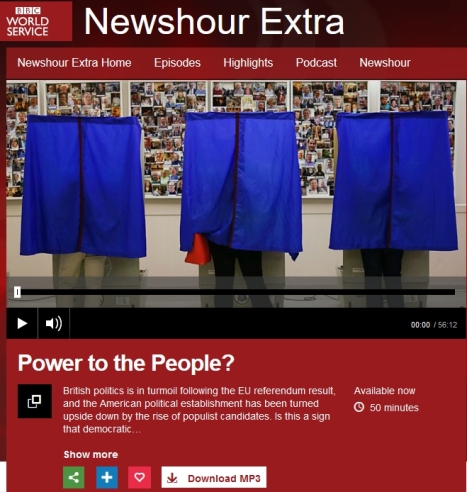
I was invited to speak on News Hour Extra on BBC World Radio last week, along with Baroness Helena Kennedy, William Galston of the Brookings Institution, and Kenyan journalist John Githongo. The show also interviewed Pia Mancini of DemocracyOS. Highlights include me calling the entire Anglo-American establishment a collection of oligarchs, and a brief foray into sortition in the end. There has been a huge backlash against ‘democracy’ in the wake of Brexit, which I personally find highly concerning (although simultaneously completely predictable), so I was very happy to be able to participate in this conversation.
If anyone wants to listen, the podcast is here: http://www.bbc.co.uk/programmes/p0401gd9#play
Filed under: Elections, Press, Sortition | Tagged: audio | 14 Comments »
Filed under: Elections | Tagged: image | Leave a comment »
 Adam Cronkright
 Ali
Ali Ahmed R. Teleb
 avanderven
 avergne
 Alex Kovner
 azakaras
 Brett Hennig
 campbellwallace
 Simon Threlkeld
 Nick Coccoma
 codyhipskind
 Common Lot Sortitionist
 Conall Boyle
 constitutionalism
 davidschecter
 Ethan McCutchen
 graytmatter
 gtridimas
 Henry Tuttle
 H.J. Hofkirchner
 HpR
HpR James Kierstead
 John Burnheim
 jgarry20151
 Jochen Krattenmacher
 johnedwardtaylor
 johnhuang865
 Jonathan Crock
 keithsutherland
 Jacob Richter
 kkoreilly
 lukewhito
 SimonPek
 Nathan El
 Nicholas Gruen
 Owen Shaffer
 Patrick Chalmers
 Paul Gölz
 peterstone
 Pierre-Etienne Vandamme
 pronfeld
 Emil
Emil rcaze
rcaze richwbrown
 Roger Knights
 roslynfuller
 Pierre-Etienne Vandamme
 shaharavin
 tbouricius
 Ted Wachtel
 Joshua Laferriere
 theodorestathis
 towardsautonomyblog
 Wayne Liebman
 Yoram Gat
 Oliver Milne
