

Klirosi sent a couple of election posters they created with the titles “It’s us or them” and “See the future”:
Filed under: Elections, Sortition | Leave a comment »

Klirosi sent a couple of election posters they created with the titles “It’s us or them” and “See the future”:
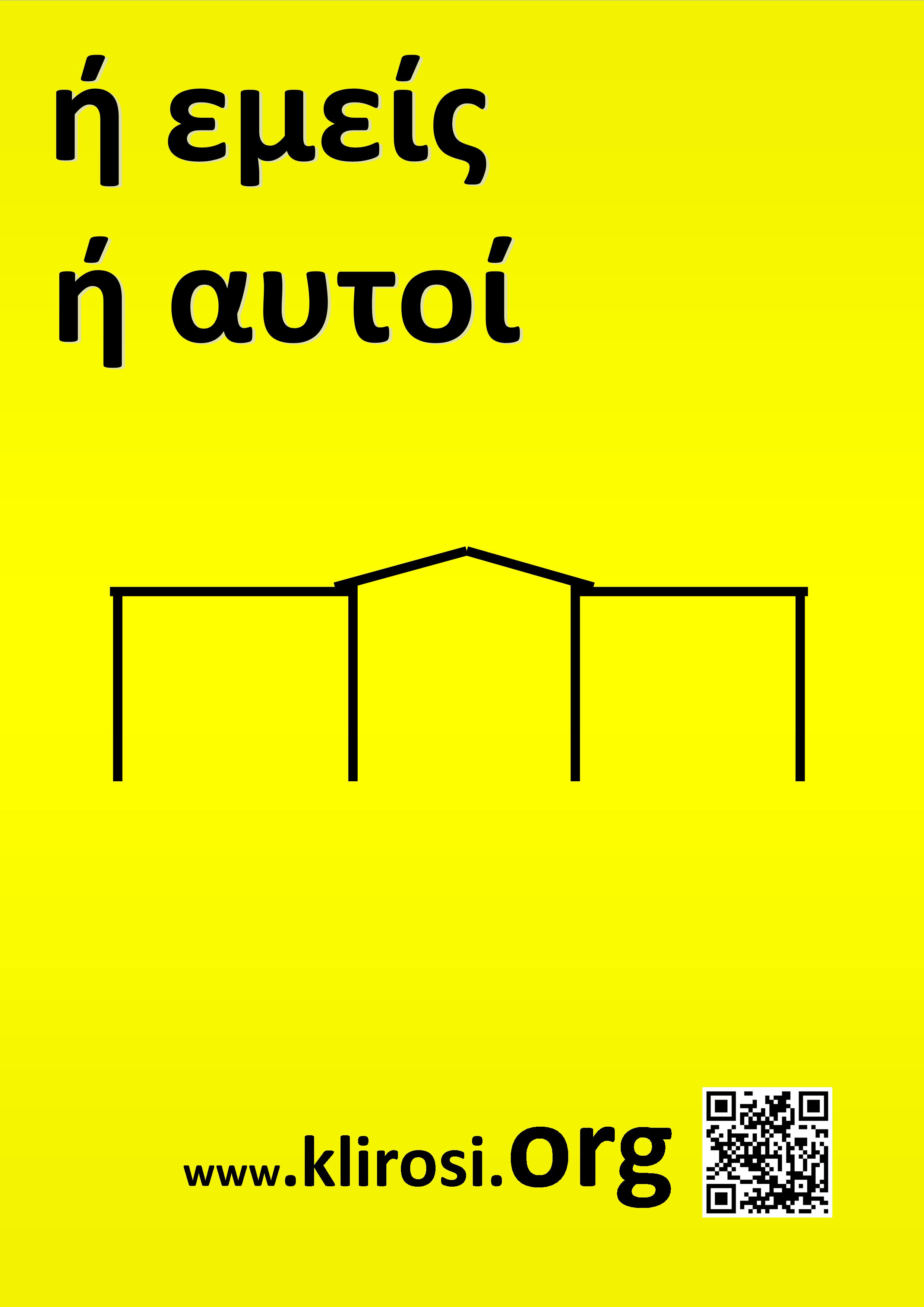

Filed under: Elections, Sortition | Leave a comment »
I spoke to Etienne Chouard for the first time last night. He recommended the following TED talk he did:
It is close-captioned with English subtitles.
He also pointed me to the following talk (again in French) which unfortunately does not yet have subtitles:
I’ve only watched the first talk, and I must say I think he overstates a bit the worthlessness of elections. There is a reason why people like Mugabe resist elections so vehemently–it does offer some checks on arbitrary power. At the very least, they prevent one faction of the powerful from running roughshod over everyone, including other powerful people, and that can provide a measure of protection to everyone else.
Chouard expressed great appreciation for the work of Bernard Manin. I wonder what he thinks of the claim that representative government has both a democratic and an aristocratic side? I hope we will discuss this further with him.
Filed under: Athens, Elections, Sortition | 12 Comments »
A post by Campbell Wallace:
It is universally accepted that free elections guarantee the happiness of a nation.
At a time when men and women risk their lives and die for democracy it may seem indecent, even sacrilegious to criticise it. I do not write in order to mock those who struggle heroically against tyranny. But where is the evidence that the longed-for democratic elections are any better than chance as a method of choosing leaders?
Of course, voting an unwanted leader out of office (when it works!) is much better than bombs, kalashnikovs, or foreign invasions. It is in choosing politicians that the vote fails so miserably. I hardly have to justify this statement: everyone can think of examples of incompetent, corrupt, dishonest – or worse – democratically elected leaders, even though we would not all draw up the same list.
Continue reading
Filed under: Elections, Sortition | 21 Comments »
Matt Hall writes in the openDemocracy website:
‘Britain’s political system is plainly in trouble’ […] One solution that has been growing in support […], is the replacement of elections and politicians with the random selection of ordinary people. […] Too radical say some. Too naive say others. Familiar complaints, but is this really the case? In this article I’d like to provide some counterpoints to the main arguments against sortition.
Continue reading
Filed under: Elections, House of Lords, Sortition | 3 Comments »
Part 1 is here.
Mass politics is the situation in which political decisions are made by a symmetrical aggregation of the actions of a large number of individuals.
The modern electoral system is an example of a mass political system. In this case, the actions of the individuals are (1) whether to run for office, (2) advocacy, and (3) voting. The political decision made is the selection of the officials.
Another example is the “direct democracy” situation – both in its modern “popular initiative” setup or in the ancient “Athenian Assembly” setup. In this case, the individuals can (1) propose legislation, (2) advocate, and (3) vote, and the decision made is the passing of pieces of public policy.
When the agenda is set externally (by the Ephors in Sparta and to some extent by the Boule in Athens, or by the elected legislature in Oregon System referenda), then the individual actions are limited to advocacy and voting. In some cases (e.g., the Spartan assembly) advocacy by individuals is also explicitly excluded from the process.
Due to the symmetry of its decision making process, mass politics has superficial similarity to democracy – a political system in which political power is distributed equally among the members – since both terms describe situations of equality. The difference is that mass politics is defined in terms of formal equality while democracy is defined in terms of equality of actual political power.
Continue reading
Filed under: Athens, Elections, Participation, Sortition | 14 Comments »
The third sortition conference will take place on May 24-25 at CEVIPOF, Science-Po, Paris. Programme:
Gil Delannoi, Update on the research programme
Bernard Manin, Principles of Representative Government revisited
Keith Sutherland, The triumph of election: Natural right or wrong?
Andrei Poama, Virtues and limits of judicial luck: Reasons for randomising the choice of jurors and verdicts
I’d greatly appreciate advance feedback on my own paper which challenges Manin’s central argument as to why sortition hasn’t been considered as a candidate for representative government.
Filed under: Distribution by lot, Elections, History, Juries, Sortition | 3 Comments »
Clive Aslet writes in the Mail Online:
[E]ven the Conservatives back a largely elected chamber. They have to; democracy is the only show in town. But leaving aside the constitutional impasse that would ensue once an elected upper house started to throw its weight around, who would really want it? Our elected politicians are not exactly revered. In fact they’re reviled. The last thing we need is more of them. We need a different type of animal in the Lords – experts, great legal brains — but not appointees of the prime minister, thank you very much. It’s a conundrum. Everyone who thinks about it comes up with a different answer.
If David Cameron really believed in the Big Society, he would advocate true democratic involvement: appointment by lot. It could work like the jury system. Ordinary people serve a term as scrutineers of parliamentary legislation. You could be sure they would bring a lot more practical experience to the table than their oppos in the Commons.
Otherwise the only way forward I can see is for the Lords to revert to their origins. There are far too many Lords for the chamber to accommodate; let them fight it out.
Filed under: Elections, House of Lords, Press, Sortition | 1 Comment »
The reformist idea of “direct democracy” is a recurring theme among critics of the dominant modern elections-based system of government. However, “direct democratic” systems, when considered as systems for representing popular interests, suffer from much the same problems that afflict elections-based systems.
The standard description of the Athenian democracy emphasizes the role of the Assembly. According to this description having thousands of Athenians assemble 40 times a year to discuss and vote on policy decisions was the main democratic mechanism in Athens. This institute, supposedly, distributed political power widely within the group of Athenian citizens. Wikipedia puts it this way:
It [Athens] remains a unique and intriguing experiment in direct democracy, a political system in which the people do not elect representatives to vote on their behalf but vote on legislation and executive bills in their own right.
Filed under: Athens, Elections, History, Initiatives, Participation, Proposals, Sortition | 65 Comments »
John McCormick’s recent book Machiavellian Democracy (Cambridge University Press, 2011) has already attracted some attention on this blog. Interested readers might like to know that the journal The Good Society has published a symposium on it.
Filed under: Elections, History, Sortition | 1 Comment »
Dan Bennett, of the Bristol Radical History Group, presents a description of the Athenian democratic system and proposes a sortition party.
Cheerleaders for parliamentary democracy often hark back semi-legendary ‘golden ages’ as a foundation of the modern electoral process. Do these myths have any basis in reality and what relevance do they have today? Dan Bennett uncovers the hidden history of Athenian popular democracy and proposes a modern alternative.
‘Every Cook Can Govern’: From Athens to the Electoral Lottery – part 1, part 2, part 3.
Filed under: Athens, Elections, Proposals, Sortition | 19 Comments »
 Adam Cronkright
 Ali
Ali Ahmed R. Teleb
 avanderven
 avergne
 Alex Kovner
 azakaras
 Brett Hennig
 campbellwallace
 Simon Threlkeld
 Nick Coccoma
 codyhipskind
 Common Lot Sortitionist
 Conall Boyle
 constitutionalism
 davidschecter
 graytmatter
 gtridimas
 H.J. Hofkirchner
 Hanspeter Rosenlechner
 John Burnheim
 jgarry20151
 Jochen Krattenmacher
 johnedwardtaylor
 johnhuang865
 Jonathan Crock
 keithsutherland
 Jacob Richter
 kkoreilly
 lukewhito
 SimonPek
 Nathan El
 Nicholas Gruen
 Owen Shaffer
 Patrick Chalmers
 Paul Gölz
 peterstone
 Pierre-Etienne Vandamme
 pronfeld
 Emil
Emil rcaze
rcaze richwbrown
 Roger Knights
 roslynfuller
 Pierre-Etienne Vandamme
 shaharavin
 tbouricius
 Ted Wachtel
 Joshua Laferriere
 theodorestathis
 towardsautonomyblog
 Wayne Liebman
 Yoram Gat
 Oliver Milne
 Equality by lot