Sortition advocacy in North Carolina

Owen Shaffer, a retired college professor living in Asheville, NC has an opinion piece in the local Citizen Times. Unlike many sortition advocates, Shaffer is not talking half-measures. He is ready to dispose of elections altogether and replace them with sortition:

Is there a better way to select representative bodies to govern us? Is it possible to remove “politics”, “lobbyist”, and “campaign contribution” from our vocabulary, and still have a democracy? Can we remove the oligarchic underpinnings to our democracy? One only needs to look at history to find the answer. “It is thought to be democratic for the offices to be assigned by lot, for them to be elected would be oligarchic” – Aristotle (Politics, Book 4, Section 1294b)

What changes might happen if the random selection of members of a governing body occurs? It would be more likely that they deliberate issues and not sink into decisions based on political affiliation, posturing, and “sound bite” opportunities. They would be unafraid to make hard choices since they would owe no one any favors nor have an opportunity for re-election. In short, they would be more willing to make the right decisions.

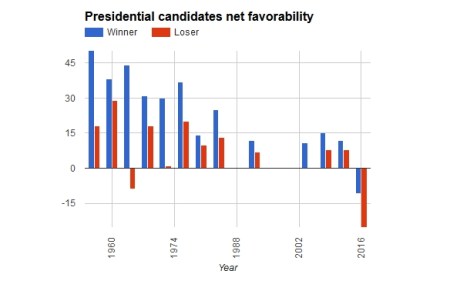
6 decades of decreasing favorability

Gallup has been tracking U.S. presidential candidate favorability ratings for 60 years. It turns out that this year’s candidates have the lowest net favorability (i.e., % favorable minus % unfavorable) ratings observed over those six decades, with, for the first time, both candidates having negative net ratings. Even more interesting, there is a steady trend of decline in favorability over the years.

Roslyn Fuller educates Andrew Sullivan

It used to be a mainstream, respectable occupation to theorize about the horrors of popular rule. Socrates and other Athenian aristocrats have been upfront about the fact that the average person should not be trusted with power. This clear-headedness and frankness has been maintained over many centuries. The water began to muddy as the aristocrats were being challenged by the up-and-coming bourgeoisie. Now there had to be some rational criteria explaining why it was not the aristocrats who should be holding power. Talk about natural aristocracy became fashionable, but outright rejection of democracy was still part of the mainstream discourse.

Then, in the 19th century, the term “democracy” was rehabilitated and the ideological water became so thick it was impossible to know where one was heading. In the middle of the 20th century Schumpeter and the elite theorists tried to clear the water by explicitly redefining the term not to refer to popular power after all but simply to a competition between elites for popular vote.

This moment of clarity passed when the 1970’s saw the ideological victory of the Civil Rights movement. At that point popular rule became the only defensible meaning of “democracy”, and since then theorists are in the unpleasant situation of having to reconcile an oligarchical practice with a democratic ideology.

This brief history is presented as an introduction to a recent exchange between Andrew Sullivan, a British author, editor, blogger, conservative political commentator, former editor of The New Republic, and the author or editor of six books, and prof. Roslyn Fuller, an Irish academic, legal expert, columnist, electoral candidate, author of the book Beasts and Gods, and an Equality-by-Lot contributor.
Continue reading

Griffiths: Seven potential problems with sortition

Edmund Griffiths has a post about concerns he has regarding sortition. The post is quite interesting in its originality and in avoiding most of the standard anti-sortition talking points.

Griffiths is generally sympathetic to sortition and starts out with a long list of “well known” advantages of the system. The first few of these are:

it is likelier than any other system to produce representative bodies that are sociologically representative of the people;

• it removes the need for any specific positive discrimination;

• it forces political parties, campaign groups, etc., to address themselves to the public as a whole if they want to have any consistent influence on policy;

• it transforms political representation into a genuine public service, carried out by people who would often not have chosen it: a matter of duty, not ambition[.]

In terms of potential problems, Griffiths is much concerned about the validity of the sampling procedure and raises the questions of both deliberate tampering and non-intentional error as well as the question of whether the public will have faith in the procedure.

Griffiths lists four additional potential problems:
Continue reading

Cartledge: Crypto-oligarchy

Paul Cartledge is continuing his assault on the modern conventions about democracy:

To an ancient Greek democrat (of any stripe), all our modern democratic systems would count as “oligarchy”. By that I mean the rule of and by – if not necessarily or expressly for – the few, as opposed to the power or control of the people, or the many (demo-kratia).

That is the case even if – and indeed because – the few happen to be elected to serve by (all) the people. For in ancient Greece elections were considered to be in themselves oligarchic. They systematically favoured the few and, more particularly, the few extremely rich citizens – or “oligarchs”

[…T]here are a number of ancient democratic notions and techniques that do seem highly attractive: the use of sortition, for instance – a random method of polling by lottery that aimed to produce a representative sample of elected officials. Or the practice of ostracism – which allowed the population to nominate a candidate who had to go into exile for 10 years, thus ending their political career.

And comparison, or rather contrast, of our democracies with those of ancient Greece does serve to highlight what’s been called creeping crypto-oligarchy in our own very different (representative, not direct) democratic systems.
Continue reading

Why Not Choose Members of Congress by Lottery?

Terrill Bouricius, David Schecter, Campbell Wallace, and John Gastil write on Zócalo on KCRW:

We Already Randomly Select Our Juries. Why Not Choose Members of Congress by Lottery?

Conflicts of interest, corruption, and systemic dysfunction are woven through American legislative history, from Tammany Hall in the 1780s to the Savings & Loan crisis of the 1980s and the recent federal government shutdown. One reason is that the electoral system itself often attracts the wrong kind of candidates and rewards unethical campaigning. Gerrymandered district boundaries, voter suppression efforts, and winner-take-all election laws serve to restrict voter choices. People who choose to run for election are too often driven by ego and personal ambition, qualities at odds with the genuine give and take of deliberation. Donald Trump may seem to stand out in this regard, but his character flaws are less distinctive than his willingness to parade them publicly as a kind of perverse populist brand.

So why not random selection instead? Yes, tossing Congress, en masse, out its own front door and refilling the chamber with everyday citizens might seem like a crazy idea. But when asked about this prospect in surveys conducted in 1999 and 2012, Americans place more trust in a randomly-selected body than in Congress.

So what if we took that idea seriously? Could we replace some of our elections with selection by lot, also known as “sortition?”

Paul Cartledge: The case for sortition is persuasive

Just read a short piece by Paul Cartledge in which he talks about the history of sortition, a topic treated more extensively in his book Democracy: A Life (Oxford University Press). He even manages to plug my own book, The Luck of the Draw: The Role of Lotteries in Decision Making (also Oxford University Press) along the way. Check it out:

It is quite easy to compile a checklist, perhaps even a decalogue, of differences between their democracy (or rather democracies, as there was no one identikit ancient model) and ours (ditto). And in no respect did they and we differ more than on the issue of sortition, that is, the application of the lottery to the conduct of politics (another Greek invention, both the word and the thing, with – again – the accent to be placed on difference as well as similarity between theirs and ours). We today take the exercise of voting in either general or local elections to be the very quintessence of what it is to do ‘democracy.’ The ancient Greeks took the exact opposite view: elections were elitist and for the nobs, appropriate more for oligarchy (the rule of the few rich) than for democracy (the rule of the masses, most of whom were poor), whereas sortition, the lot, was the peculiarly democratic way of selecting most office-holders and all juror-judges to serve in the People’s jury-courts.
Continue reading

Rousseau’s Mistake

A recent article by Hélène Landemore:

Rousseau’s Mistake: Representation and the Myth of Direct Democracy

Abstract: For Rousseau, democracy was direct or it wasn’t. As he famously put it, “the moment a people allows itself to be represented, it is no longer free: it no longer exists. The day you elect representatives is the day you lose your freedom” (Social Contract, III, 15). In other words, representative democracy is no democracy at all. Rousseau isn’t alone in this belief, and today the disappointed of representative government have turned to celebrating anew the virtues of direct democracy as more true to the ideal of popular sovereignty, self-rule, and genuine political equality. This paper defends the thesis that Rousseau was, in fact, mistaken and that there is no salvation to be found in the ideal of direct democracy. If democracy as a political regime is always, in fact, representative, then the interesting question is not: direct or representative democracy? But instead: What kind of representation should we aim for? The paper argues that beyond the familiar electoral model there are at least two other models of representation that present attractive features: the first is based on sortition and the other on self-selection.

Continue reading

Book Review: Democracy’s Beginning

Greetings, everyone. Please excuse my long absence, due to – of all things – running in an election. I recently had the pleasure of reviewing ‘Democracy’s Beginning: The Athenian Story’ by Thomas N. Mitchell former Provost of Trinity College, Dublin for the Irish Times:

Alien and fascinating

It is common knowledge that democracy was invented in ancient Athens, but Mitchell explodes the myths of what that democracy was like. In Athens, all citizens had an equal say in public affairs (known as isegoria), staffed enormous citizen juries, were chosen for office by lottery, and were paid to participate in politics. In describing this way of life, Mitchell paints a picture of a society both alien and fascinating, underscoring the vibrancy of this long-lost civilization with a collection of maps and photos in the centre of the book.

His close scholarship shines in documenting the transition of Athens from financially and morally bankrupt oligarchy to emancipated democracy 2,500 years ago. It was not an easy or linear process, and the book tracks the many clashes of ideas and personalities with a commendable attention to detail that beautifully captures the essence of ancient Greek culture and politics.

From Solon’s economic balancing act, through the political reorganisation of Cleisthenes, the assassination of Ephialtes and, finally, Pericles, one of the most respected but sober leaders of the early democracy, Democracy’s Beginning explores this innovative and fearless experiment in “people power”.

Full review here. I would highly recommend the book to anyone interested in Athenian democracy. It is extremely comprehensive and highly readable.

Lasserre: Sortition in politics – the false good idea, part 1

André Sauzeau referred me to a polemic against sortition by Tommy Lasserre. This text is the most elaborate argument against sortition ever written (as far as I am aware) and it is therefore of significant interest to sortition advocates. In view of that, and despite my essentially non-existent French I have undertaken to translate it from the original French to English. The first part of the outcome is below. If your French is better than mine I’d be happy with any corrections.

Sortition in politics – the false good idea

By Tommy Lasserre, September 2014

Immersed in scandals, disconnected from the realities of the majority in society, demonstrating every day their total submission to finance and the dogmas of liberalism, and therefore their complete incapacity to pull us out of the crisis, the political caste today is largely discredited, in France as in the rest of Europe. This is expressed well in record low turnouts and in the rise of false alternatives, but equally, fortunately,, reflection, shared by increasingly significant number of citizens, about the ways to change politics. Suggestions for changing the Republic through a constitutional process, proposals for giving citizens greater control over our elected officials, in particular opening the way for recallability, garner, therefore, significant response on the Web.

Among all the ideas that emerged in the blogosphere or on the social networks, one idea, that could appear absurd keeps appearing frequently: putting the reins of power in the hands of an allotted assembly. It is often mentioned in conversations on Facebook, or in argument between bloggers, the controversial intellectual Étienne Chouard has made it his battle cry and the political party Nouvelle Donne (“New Deal”) even made an argument for this idea during the European elections.
Continue reading