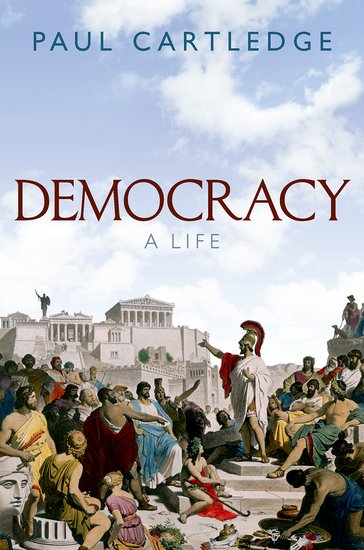
Rethinking Athenian Democracy

I’ve just finished reading Daniela Cammack’s PhD thesis (one chapter was presented recently here by Peter Stone) and would warmly recommend it — it’s mercifully short and extremely readable (available to download on the Harvard website). Chapter 3: The Most Democratic Branch? The Assembly vs. the Courts is of particular interest as it seeks to overturn the view that a) the assembly was the primary institution of Athenian democracy and b) the fourth-century reforms were conservative in nature. Cammack’s interpretation supports Yoram and Terry’s view that the switch in emphasis to randomly-selected institutions was in order to enhance the rule of the demos, rather than being a juridical a check on popular sovereignty (the view of Hansen, Ostwald, Sealey [and myself]). The courts (both legislative and juridical) were much less open to manipulation by elites as a) speech rights were restricted to litigants and persons elected by the assembly, b) isegoria was balanced by the use of a water clock and c) secret voting meant that it was harder to intimidate citizens into voting in any way other than by their considered judgment (aided by the higher minimum age and need to swear the dikastic oath). She provides several examples of assembly decisions that were heavily influenced by factional and elite domination
Continue reading

Voting but not talking

I just wanted to recommend a working paper by Daniela Cammack entitled “Deliberation in Classical Athens: Not Talking, But Thinking (and Voting).” It’s available online here. It’s not directly about sortition, but it deals with a number of themes discussed on this blog. The paper argues that the Athenians maintained a careful distinction between the function of presenting arguments and the function of evaluating those arguments, and assigned the latter, but not the former, to the assembly. This distinction, Cammack argues, is conflated by those who use the term “deliberation” for both functions.

I found this passage particularly relevant to contemporary politics:

In Athens, then, as in modern democracies, an overwhelming majority of non-speaking voters attempted to control a minority of prominent political actors who took primary responsibility for advocating and carrying policies. The key difference between Athenian and modern democracy was not that all or even many Athenians took part in political discussion, but first, that large samples of ordinary citizens had the opportunity to vote on every political decision, and second, that the barriers to becoming politically influential were relatively low, while the risks associated with this position were high. This is the reverse of the situation today, where a high barrier to entry as a politician–largely financial–is combined with a low risk of losing one’s position once established. To be sure, one can fail to be reelected, but this pales in comparison to the mechanisms of accountability available in Athens, such as routine annual audits (euthynai) covering both moral and financial issues. In many modern systems, by contrast, a feedback loop is set up in which corruption becomes endemic, since the high costs of running for election are in large part met by supporters whose opportunity to shape policy then becomes significantly greater than that of ordinary voters, with very little way for those ordinary voters to hold the politician in question to account, either before or after the next election.

Worth a look.

The ancient Greek view on what democracy is

This topic came up recently. Here is the most thorough discussion of this matter in the primary sources that I am aware of. Aristotle is describing here (Politics, 1317a-1318a) what he considers as the conventional wisdom of his time:

And for this inquiry we must take into view all the features that are popular and that are thought to go with democracies; for it comes about from combinations of these that the kinds of democracy are formed, and that there are different democracies and more than one sort. In fact there are two causes for there being several kinds of democracy, first the one stated before, the fact that the populations are different (for we find one multitude engaged in agriculture and another consisting of handicraftsmen and day-laborers, and when the first of these is added to the second and again the third to both of them it not only makes a difference in that the quality of the democracy becomes better or worse but also by its becoming different in kind); and the second cause is the one about which we now speak. For the institutions that go with democracies and seem to be appropriate to this form of constitution make the democracies different by their combinations; for one form of democracy will be accompanied by fewer, another by more, and another by all of them. And it is serviceable to ascertain each of them both for the purpose of instituting whichever of these kinds of democracy one happens to wish and for the purpose of amending existing ones. For people setting up constitutions seek to collect together all the features appropriate to their fundamental principle, but in so doing they make a mistake, as has been said before in the passage dealing with the causes of the destruction and the preservation of constitutions. And now let us state the postulates, the ethical characters and the aims of the various forms of democracy.
Continue reading

Linker: An absolute democracy would assign political offices by lot

Damon Linker’s argument against compulsory voting weaves in Plato and the Socratic argument for aristocracy. His reasoning is an interesting modernization of the classical aristocratic mindset. His point about the contestability of excellence is good, and he makes use of it as a justification of electoralism.

A democracy gives every adult citizen a very small say in who rules. An individual doesn’t have to prove that he’s thoughtful or informed to exercise that right. As Plato argued 2,300 years ago, this makes democratic politics exceedingly peculiar. We don’t take a vote to determine the medical treatments that doctors prescribe, and neither do we ask for a show of hands about how to construct a bridge or a building. And yet we think it’s perfectly reasonable to ask for everyone’s opinion about what policies our country should pursue at home and abroad.

That’s because in politics, unlike in medicine and engineering, the act of determining who does and does not possess knowledge and wisdom is exceedingly contentious. (One might say it’s a political act in itself.) So we solve — or rather, we sidestep — the problem by letting everyone have a say.
Continue reading

Short refutations of common objections to sortition (part 1)

1. It would be madness to appoint public officials by lot. No one would choose a pilot or builder or flutist by lot, nor any other craftsman for work in which mistakes are far less disastrous than mistakes in statecraft.

The problem with this ancient argument against sortition (attributed to Socrates) is that it implicitly assumes that there is some consensus around who should be running the state (those are the pilots, builders or flutists of politics). If there was such consensus politics would be very simple. Politics to a large extent is about identifying whose advice should be taken on which subject. The pretense of elections is that the voters can identify such people. This is a fantasy.

A small group, meeting together and discussing and examining matters in depth, would be able to do a much better job of getting the best advice than the citizens can do as isolated individuals. In fact, most voters already know that – they tend to be very disapproving of elected officials – the very people whom they supposedly selected as being the best suited to handle statecraft.

2. Average people suffer a great many shortcomings (some combination of stupidity, laziness, apathy, greed, selfishness, lack of education, lack of experience, inability to work together with others, etc.).

This dismissive view of the average person is offensive and unsubstantiated by the facts. Continue reading

Arriaga: Democracy Does Not Live by Tech Alone

Manuel Arriaga‘s Foreign Policy magazine article is a well-aimed, much needed corrective to the techno-progressivist formula of popular political theory:

Democracy Does Not Live by Tech Alone

Democracy is in crisis — and more apps won’t save it. Instead, bring decision-making back to the people.

Enthusiasm for reforming our democracies has been gaining momentum. From the pages of FP to the colorful criticisms of comedian Russell Brand, it is evident that a long-overdue public conversation on this topic is finally getting started.

There is no lack of proposals. For example, in their recent FP piece, John Boik and colleagues focus on decentralized, emergent, tech-driven solutions such as participatory budgeting, local currency systems, and open government. They are confident that such innovations have a good chance of “spreading virally” and bringing about major change. Internet-based solutions, in particular, have captured our collective imagination. From Pia Mancini’s blockbuster TED presentation to New Scientist‘s recent coverage of “digital democracy,” we’re eager to believe that smartphone apps and novel online platforms hold the key to reinventing our way of governance. This seems only natural: after all, the same technologies have already radically reconfigured large swaths of our daily lives.

To put it bluntly, I believe that focusing on innovations of this sort is a dangerous distraction. Continue reading

Humor in Article Based on Erroneous Assumption About Athenian Democracy

A rather amusing article in the Onion makes the mistake of assuming that the Athenian democracy was an electoralist system and therefore subject to the same elitist control:

Anthropologists Discover Ancient Greek Super PAC That Helped Shape First Democracy

ATHENS, GREECE—In a finding that provides new insight into the roots of Western civilization, a team of anthropologists from Cambridge University announced Monday the discovery of an ancient Greek super PAC that helped shape the world’s first democracy. “At the same time Cleisthenes first instituted a representative form of government in Athens, it appears that a group of wealthy citizens and merchants created an organization to influence these new voters by bombarding them with around-the-clock political messages,” lead researcher Daniel Rogers said of the early political action committee, named Athenians for a Better City-State, which is said to have received millions of drachmas’ worth of funding in gold, lambs, dates, loaves of bread, and slaves from Athens’ largest and most influential trade groups. “While the committee was prohibited from coordinating directly with candidates seeking public office, AFBCS nevertheless spent astonishing sums on orators hired to stand in the Agora and recite the negative traits of politicians that the super PAC opposed, as well as on writers who were hired to pen slanderous epic poems.”

A 5-minute video lesson about sortition

Melissa Schwartzberg is a professor of Politics at NYU.

Transcription:

What did democracy really mean in Athens? – Melissa Schwartzberg

Hey, congratulations! You just won the lottery. Only the prize isn’t cash or a luxury cruise. It’s a position in your country’s national legislature. And you aren’t the only lucky winner. All of your fellow lawmakers were chosen in the same way.

This might strike you as a strange way to run a government, let alone a democracy. Elections are the epitome of democracy, right? Well, the ancient Athenians, who coined the word, had another view. In fact elections only played a small role in Athenian democracy, with most offices filled by random lottery from a pool of citizen volunteers.
Continue reading

Down with Elections! Part 4

DOWN WITH ELECTIONS!

Part 1 Part 2 Part 3 Part 4 Part 5 Part 6

PART 4

Theoretical Considerations and Explanations

Athens

Proponents of sortition usually refer to the fact that it was used in Athens, and sometimes use the Athenian constitution as a yardstick for comparing other proposals. There is no attempt here to reproduce or imitate the Athenian democracy, which had several features which would now be considered objectionable, among which are:

  1. The exclusion of the majority of persons living under the control of the government from any say in that government. One can argue about the relative numbers of adult male citizens, adult female citizens, metics (metoikoi, foreigners living and working in Athens) children of citizens, and slaves, but clearly the adult male citizens were a small minority of those affected by the laws which they alone could vote on. Amongst adult male citizens, the Athenian constitution was eminently democratic, amongst those who were subject to its laws, it was oligarchic.
  2. The lack of separation of justice and legislature.
  3. Ostracism. It was not necessary to commit a crime to be ostracised and exiled, merely to be feared.
  4. Dokimasia. This was an examination, not to determine whether a citizen was competent, but whether he was eligible for office, and if so, whether his political views were offensive (usually meaning that he had oligarchic sympathies).
  5. Continue reading

Robbins: Democracy: What Would It Be Like?

Arthur D. Robbins writes in the Sri Lanka Guardian:

What would it be like if we really lived in a democracy? These days just about everybody seems to be enjoying the benefits democratic government, that is if you believe government propaganda and you are one of the credulous many who are eager for a sense of well being at any price. But what is usually called democracy is in fact an oligarchy of elected representatives responsible to the business interests who bankrolled their campaign. If people were actually given the opportunity to choose democracy, they might do so, provided they understood what the word actually means. Our one uncontested example is ancient Athens.

Note the difference between “equal speech,” or “political speech,” the right to debate and legislate, and what today we call “free speech,” the prohibition against being denied the right to speak. We could be speaking on a street corner or marching in a protest. “Free speech” says we have the right to do that. It says the right cannot be taken away. “Free speech” has no particular context. We are granted the right to say what we want, provided, it turns out, we do not threaten the governing powers. “Free speech” is a civil right. It is not a political right. It does not give us the right to set national policy. “Equal speech” in ancient Athens did.
Continue reading