A quarter of US voters ready for exploring “alternative forms of government”

A recent poll has found that about 27% of U.S. registered voters support the following statement:

Democracy is no longer a viable system, and America should explore alternative forms of government to ensure stability and progress.

Josine Blok reviews Pope’s The Keys to Democracy

Josine Blok, a historian from Utrecht University, has a review of Maurice Pope’s The Keys to Democracy in H-Soz-Kult. In the last two paragraphs of the review, Blok gives her opinion about the substance of the book:
The quality of the argument is in my view quite uneven. Some of the political analyses and in particular the historical sections suffer from oversimplification, generalisation, and special pleading. For instance: “The political ideals and most of the political practices of Western civilisation go back through Venice and ancient Rome to classical Greece.” (p. 115). No, they don’t, this is simply not true, nor is Pope’s account of how sortition got “lost” in the course of history. On p. 123, Pope contends: “It would be possible […] to define history itself as the story of how experts have been proved wrong. For otherwise […] it would not be history at all, but current practice. […examples in] the history of science. Being history, it is possible to tell which side was wrong.” This view of history is simply bizarre. If Pope resorted to such sweeping statements to help easy reading, I don’t think they are the proper means to that end.

But, making up for such drawbacks, Pope offers excellent observations on deliberation as a crucial ingredient of democracy and on the potential of sortition to prevent oligarchisation (the “law of Michels”), meritocracy and other problematic forms of hierarchy. Sortition enables implementing the equality of citizens and bringing their engagement in policy making about. Importantly, Pope points out that sortition, whenever it is employed, must be rigorous and compulsory to be effective, and allotted bodies must be selected from the whole population (p. 167; complemented by the outstanding comment by Potter in the appendix). He underlines that allotted panels of citizens must have moral authority and real responsibility (to which should be added a transparent system of accountability). Written with an open, engaging style, The Keys to Democracy is set to win a wider audience for its important and pressing message.

The American Academy of Arts and Sciences recommends citizen assemblies

In 2020 the American Academy of Arts and Sciences published the report of its Commission on the Practice of Democratic Citizenship.

The report is a useful example of how the liberal U.S. establishment views the state of the political system and for the kind of ideas it generates for institutional reforms. A set of self-appointed reformers, highly credentialed by the establishment, functions as the tribunes of the people. The report is ostensibly based on “listening sessions” held with various groups in the U.S., but of course the entire exercise is controlled from beginning to end by elite actors and it is completely up to the commission members to select the makeup of the groups “listened to” and to channel their “input” into the a set of recommendations. In fact, regarding the makeup of the groups in the “listening sessions”, the report specifically asserts that “[t]he intent of this strategy was not to collect a statistically representative sample, but to cast a wide net and surface the personal experiences, frustrations, and acts of engagement of a diverse array of Americans”.

The Commission on the Practice of Democratic Citizenship was established in the spring of 2018 at the initiative of then Academy President Jonathan Fanton and Stephen D. Bechtel, Jr., Chair of the S. D. Bechtel, Jr. Foundation. Mr. Bechtel challenged the Academy to consider what it means to be a good citizen in the twenty-first century, and to ask how all of us might obtain the values, knowledge, and skills to become still better citizens. Since 1780, projects that work to bolster American citizens’ understanding of and engagement with the institutions of their government have been a hallmark of the Academy’s work.

The background for the commission’s work is a grim picture of disintegration of social cohesion and distrust in institutions. As is standard practice, the real-world causes of this situation are left unclear. Abstract economic issues like inequality and mobility are mentioned, and it is asserted (citing Gilens and Page) that “[c]ongressional priorities, studies have shown, now align with the preferences of the most affluent”. However, real-life, specific outcomes of those “congressional priorities”, such as food insecurity, lack of medical care, indebtedness, declining life spans, or incarceration rates are not discussed.
Continue reading

A poll finds a plurality of Britons support an allotted House of Lords

A story in the Byline Times.

The Idea to Overhaul the House of Lords that Politicians Aren’t Talking About

YouGov polling suggests strong potential support across the board for a very different chamber to replace the House of Lords

Josiah Mortimer
28 June 2023

There is significant public support for overhauling the House of Lords in a way that is almost never discussed in political debate, according to a newly published poll.

YouGov, commissioned by the Sortition Foundation – a social enterprise which campaigns for greater use of citizens’ assemblies – has shed some new light on public opinion regarding Lords reform.

Typically, the debate is about moving to an elected second chamber – for instance, using a proportional voting system to more fairly reflect how the public vote than under the Commons’ winner-takes-all ‘First Past the Post’ system. Others suggest an ‘indirectly’ elected house, whereby council leaders or regional mayors would fill a new Senate of the Nations and Regions.

The latter idea stems largely out of fears of a directly-elected second chamber simply replicating the House of Commons, or ‘worse’ in their eyes, having more legitimacy and therefore power over MPs.

But the Sortition poll adds another option for the first time: replacing the Lords with a permanent citizens’ assembly made up of ordinary people, reflective of the UK population.

Out of the options presented for the future of the Lords, this was the most popular with 23% of public support. The idea came top among all major party supporters (bar Liberal Democrats, who marginally prefer an elected second chamber).
Continue reading

Sortition in 2022

Equality-by-Lot’s traditional yearly review post.

The most significant piece of sortition-related news for 2021 had been, in my view, the finding that over a quarter of public in four Western European countries – the UK, France, Italy and Germany – supports using allotted bodies to systematically complement the work of parliament. This year, the most significant piece of sortition-related news was the findings of a wider-coverage poll, this time conducted in 15 Western European countries. According to this poll, in all those countries there is fairly strong popular support (~4 in a scale of 0 to 10 on average) for having “a group of randomly-selected citizens make decisions instead of politicians”.

But while popular support for sortition is strong, and while (well justified) concern in elite circles about the declining popularity of the elections-based system persists, it seems to me that 2022 has continued a down-trend in interest in sortition in elite circles, a down-trend that indicates a recovery from the heights of establishment hysteria about the “Crisis of Democracy” following Brexit, the election of Donald Trump and the Gilets Jaunes protest in France. Academics have continued publishing papers and opinions on the pros and cons of sortition (unfortunately often rehashing very well hashed material) but applications of sortition have been fading in prominence since the zenith of the French Citizen Convention for the Climate, and discussion of the idea in mass media has receded as well.

That said, there were certainly many notable pieces of news and opinion written about sortition over the last year. Pieces advocating for sortition and discussions of the subject that were mentioned this year on Equality-by-Lot included items from South Africa, the UK: 1, 2, the US: 1, 2 3, 4, 5, 6, Australia, Malaysia, Texas, US, France, Ireland, Utah, US, California, US, Pakistan, Pennsylvania, US, and Massachusetts, US.

Also this year, an allotted council on climate change in Herefordshire, UK generated a discussion about its cost as well as other aspects. A fairly prominent Australia politician,
Vicotr Kline, wrote a strident article advocating replacing elections with sortition, and an independent candidate for governor of Minnesota, US ran on a sortition-based platform. In the city of Petaluma, California, an allotted Citizens’ Assembly was convened to determine how to use a piece of public property, an assembly to discuss food policy was set up in Switzerland, and in the province of Trento, Italy, a bill was discussed for constituting a citizen assembly for reviewing municipal regulations.

Finally, this year saw the passing of citizen assembly pioneer, Ned Crosby.

Top elected officials are generally unpopular

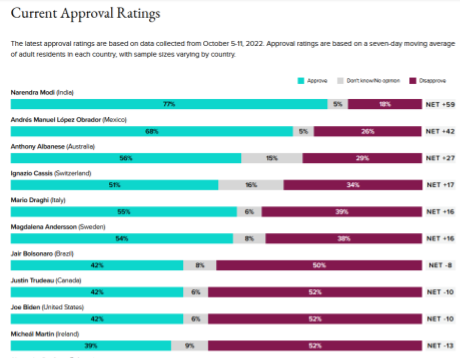
It turns out that a polling company called Morning Consult runs frequent opinion polls in 22 countries measuring the approval ratings of the top elected officials in those countries.

The polls reveal that as of the first week of October 2022, among the 22 officials rated only 6 have positive net rating (approval minus disapproval). Another interesting finding is that the two most highly rated officials are non-Western: India’s Modi, who is often portrayed in the West as being a proto-authoritarian, or at least as a nasty populist, and Mexico’s López Obrador.

Booij: Sortition as the Solution

Below is the Introduction to a Master’s thesis by G.J. Booij, submitted in 2021 at the Tilburg School of Humanities and Digital Sciences of Tilburg University, the Netherlands, titled “Sortition as the Solution: How randomly sampled citizen assemblies can complement the Dutch democracy”. Booij was advised by Prof. Michael Vlerick, author of the 2020 paper “Towards Global Cooperation: The Case for a Deliberative Global Citizens’ Assembly”.

During World War II, Winston Churchill famously stated that “Democracy is the worst form of government, except for all the others.”. Not only does this indicate that, at least in Churchill’s eyes, the current governmental form is flawed, but also that, remarkably, Churchill sees democracy as being synonymous to the elective representative democracy that was present during his life. If this kind of democracy would indeed be the best way to govern a nation, it is logical that many countries have stuck with it. However, if it is actually flawed, as he also claims, it may be wise to investigate alternative forms of government.

In this thesis, I will do just this by investigating alternative (democratic) governmental systems, since democracy is in fact not synonymous to the elective representative democracy that is still present in many Western countries. In particular, I will scrutinize the democratic system of sortition (democracy through citizen assemblies drawn by lot) and I will argue that this system should be used as a complement to the system currently in play in the Netherlands. By doing this, I will build on existing literature regarding sortition (Fishkin, 2011; van Reybrouck, 2016) by presenting a comparative perspective of several (democratic) systems, focusing specifically on the Dutch context. This kind of critical evaluation of the governmental status quo and democratic renewal is now more important than ever, since political trust dropped drastically over the past years – 70% of the Dutch population has indicated they do not have faith in politics (Erasmus University Rotterdam, 2021; NOS, 2021a).
Continue reading

Luebwick: How democratic is democratic innovation?

Patrick Luebwick, Professor of Political Philosophy at the University of Antwerp and Visiting Professor at the University of Ghent, critiques sortition in general and more specifically what may be called “the citizen assembly process”, i.e., the way allotted bodies are being employed nowadays within the existing power structure. Some excerpts are below. [The text seems to be an automatic translation of an original text in French(?) and contains some dubious phrases, which I tried to correct.]
Betting on direct civil democracy is not an innocent game

Belgium jumps on the bandwagon of democratic renewal. The elected representatives of the people increasingly seem to desire direct assistance through the insights and advice of ordinary citizens. There is a project under way in the German-speaking community where commissions drawn up by lot can provide input to Parliament. The federal government has just completed an online citizen survey inviting us to share ideas about the future of Belgium. The Vivaldi government itself also has a bill ready to allow bodies in which citizens selected by lot can engage in dialogue with each other, politicians, experts and civil society to formulate policy recommendations for state reform.

Various arguments are used to support these types of initiatives. Politicians present it as a good sign to increase political participation and citizen participation. Civic democracy as a means of bridging the gap with citizens and promoting democracy. Proponents often assume that citizen paintings drawn by lottery can speed up and improve political decision-making.

[However, the use of sortition relies on the idea that i]f we inform citizens adequately and allow them to reasonably discuss with each other, we can track down the will of the people. This assumption is problematic. First, the outcomes of the allotted body may reflect what citizens see after deliberation about a particular political topic. But the rest of the population may not be convinced. The use of citizens’ committees thus runs counter to the idea that democracy is a form of self-government. After all, the well-thought-out judgments made by allotted citizens do not match what the what the population thinks or wants. Democracy as autonomy is not served by a participatory shortcut that is taken over the heads of the majority of citizens. Rather, the strength of deliberative democracy lies in the attempt to involve the whole of society in political opinion and decision-making, particularly through open debate in the public sphere and through diverse civil society and civil society.
Continue reading

Public support for allotted citizens’ assemblies in Western Europe

A new paper in the European Journal of Political Research (full text) provides data about popular support for allotted citizens’ assemblies in Western Europe. The countries surveyed were: Austria, Belgium, Denmark, Finland, France, Germany, Greece, Italy, Ireland, Netherlands, Norway, Portugal, Spain, Sweden, and the UK.

Public Support for Deliberative Citizens’ Assemblies Selected through Sortition: Evidence from 15 Countries

Jean-Benoit Pilet*, Damien Bol**, Davide Vittori*, and Emilien Paulis*

*Université libre de Bruxelles, Belgium
** King’s College London, United Kingdom

Abstract

As representative democracy is increasingly criticized, a new institution is becoming popular among academics and practitioners: deliberative citizens’ assemblies. To evaluate whether these assemblies can deliver their promise of re-engaging the dissatisfied of representative politics, we explore who supports them and why. We build on a unique survey conducted with representative samples of 15 Western European countries and find, first, that the most supportive respondents are those who are less educated, have a low sense of political competence and an anti-elite sentiment. Thus, support does come from the dissatisfied. Second, we find that this support is for a part ‘outcome contingent’, in the sense that it changes with people’s expectations regarding the policy outcome from deliberative citizens’ assemblies. This second finding nuances the first one and suggests that while deliberative citizens’ assemblies convey some hope to re-engaged disengaged citizens, this is conditioned to the hope of a favourable outcome.

Despite emphasizing the “deliberative” label in the title of the paper, the question measuring support for allotted assemblies makes no mention of this obfuscatory term and instead focuses directly on decision-making power:

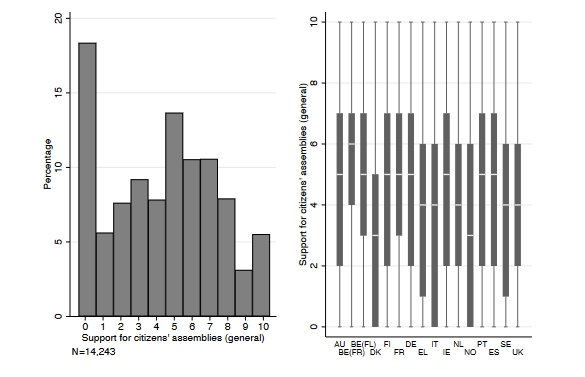
Overall, do you think it is a good idea to let a group of randomly-selected citizens make decisions instead of politicians on a scale going from 0 (very bad idea) to 10 (very good idea)?

The median response was 4.32, which is pretty impressive for such a radical idea. The chart below shows the distribution of responses. It is interesting to note that (if I read the chart correctly) the two countries with the lowest median support for the idea (3/10) are Denmark and Norway – the two Scandinavian countries in the survey. Those countries are among those with the highest level in the Western world of satisfaction with current government.

UK government as seen by UK citizens

A report by the Institute for Public Policy Research (IPPR) in the UK has some new data about the opinions of the UK citizens about their government. The findings, showing low levels of satisfaction and trust in the system, are not surprising, but useful in giving some details and in showing that no significant change in the general negative sentiment has taken place.

Contrary to the supposed polarization, there exist a wide consensus regarding the oligarchical nature of the system. UK citizens across the political spectrum see the voters as having little influence compared to party donors, business, media and lobbyists. There is also a widespread agreement that politicians “do not understand the lives” of typical people and that “democracy in Britain does not serve [their] interests”.


Continue reading