Sortition in the New Yorker, again

For the second time in less than a year, sortition is mentioned in the New Yorker. Last time, it was merely an off-handed comment. This time, sortition is front and center. Nathan Heller’s article is built around an interview with Hélène Landemore. Alexander Guerrero also gets quoted.

Landemore’s ideal is participative, but she seems to be working with a rather loose concept for her proposals:

What distinguishes Landemore’s ideal from other lottocratic models, such as Guerrero’s, is the breadth of her funnel: the goal is to involve as much of the public organically in as many decisions as possible. Her open-democratic process also builds in crowdsourced feedback loops and occasional referendums (direct public votes on choices) so that people who aren’t currently governing don’t feel shut out.

As evidence that open democracy can work in large[…,] culturally diverse societies, Landemore points to France’s Great National Debate—a vast undertaking involving a vibrant online forum, twenty-one citizens’ assemblies, and more than ten thousand public meetings, held in the wake of the gilets jaunes protests, in 2019—and, this year, to the country’s Citizens’ Convention on Climate Change.

Continue reading

Costa Delgado and Moreno Pestaña: Democracy and sortition: Reasons for using randomness

A new book, The Routledge Handbook of Contemporary European Social Movements, has a chapter by Jorge Costa Delgado and José Luis Moreno Pestaña named “Democracy and sortition: Reasons for using randomness”. The authors summarize their chapter as follows:

The use of sortition accompanies the renewal of debates on democracy. In this chapter, following a brief overview of a few general traits pertaining to the political use of sortition, we will study its fundamental contributions on three levels. First of all, we will analyze how random selection can contribute to renewing the debate about the knowledge necessary to participate politically. For that we will develop four logical possibilities following the discussion between Socrates and Protagoras in Plato’s homonymous dialogue, and, subsequently, they will be exemplified through the debate regarding sortition in the Spanish political party Podemos as context for reference. Secondly, we will address the problem of sortition and its double potential to motivate participation and demotivate unwanted behaviour and profiles. In this case, illustrative examples will be taken stemming from the authors’ own ethnographic experience. Lastly, it will be argued that sortition serves to produce a particular moral content within political participation, based on the idea that politics are a civic virtue, essential to the development of human capabilities, that must be stimulated and distributed en masse. This perspective contrasts with logics deeply rooted in activist environments that, often hinder the declared objectives of those who are members of them, specially the alternation, when we think of political participation, between the ideology of the gift and the professional one.

Blok: Sortition and democracy: equality, justice and the challenge of present-day democracy

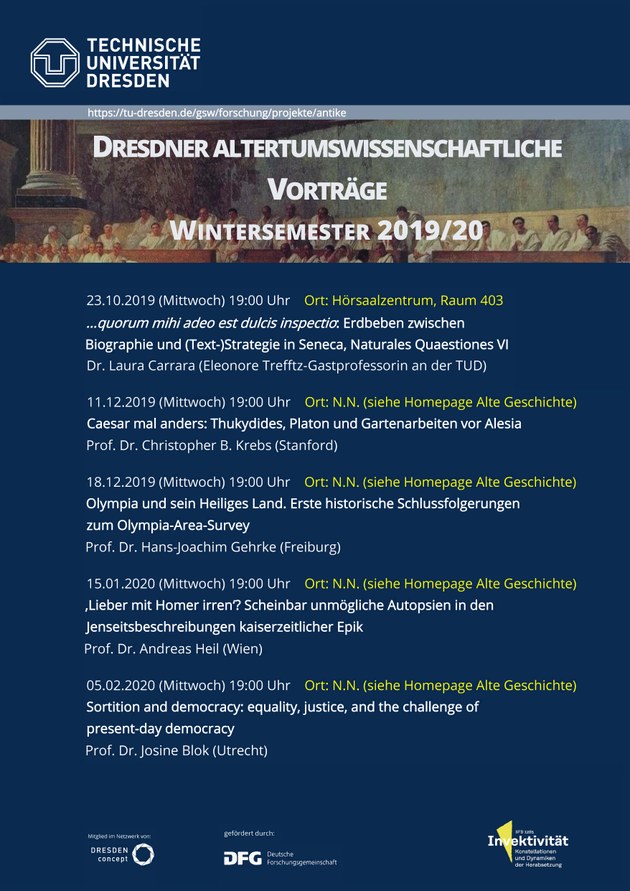
Prof. Josine Blok, a classicist from the University of Utrecht, will be giving a talk titled “Sortition and democracy: equality, justice and the challenge of present-day democracy” at the University of Dresden on Feb 5th, 2020.

It turns out that Blok has been interested in sortition for some time. In 2014 she has published a paper called “Participatory Governance: The Case for Allotment” in the journal Participation. The paper is viewable and downloadable here.

In the paper, Blok hypothesizes that sortition was legitimated in Athens by the custom of using the lottery to allocate shares of inheritances among the heirs. Other parts of her discussion are interesting and original as well.

Democracy without political parties: the case of ancient Athens George Tridimas

Here’s the abstract of a recent article by George Tridimas in the Journal of Institutional Economics:

Democracy without political parties: the case of ancient Athens

Political parties, formal, durable and mass organizations that inform voters on public policy issues, nominate candidates for office and fight elections for the right to govern, are ubiquitous in modern representative democracies but were absent from the direct participatory democracy of ancient Athens. The paper investigates how the political institutions of Athens may explain their absence. The arguments explored include voter homogeneity; the conditions at the start of the democracy, characterized by single constituency configuration of the demos, simple majority voting and lack of organized groups; the irrelevance of holding public office for determining public policy; appointment to public posts through sortition; and voting on single-dimension issues. The paper then discusses how in the absence of parties voters became informed and how political leaders were held accountable by the courts.

I’ve not yet read it. If you want to email me on ngruen at gmail, I might be able to help you out with access to the article.

Citizen Climate Convention: Become a Democratic Assembly!

An open letter to the members of the French Citizen Climate Convention from several mass-action environmental organizations was recently published in Reporterre – a French environmental daily newspaper. [Original in French.]

A Citizen Climate Convention has been convening since October 4 over the course of 6 sessions of three days each until the upcoming January. How to make sure this unprecedented test of collective democracy, which gives 150 allotted citizens the power to deliberate measures for reducing France’s CO2 emissions by at least 40% in 10 years, does not end up as a tool of self-promotion for a government whose real policy for the last two years has been so blatantly anti-environmental that it forces Nicolas Hulot, its very moderate minister of the environment, to resign? That is possible if the allotted rely on their popular legitimacy in order to change the nature and the objective of their upcoming deliberations. It is for this democratic usurpation that we are calling.

What is it that makes you legitimate, more legitimate in any case than the committee that is supposed to “govern” you? It is not that fact that you were allotted according to social-professional or geographic “representivity” criteria defined by the polling institute. This representativity has no democratic value. The fact that an allotted woman is a self-employed resident of Brittany like me does not in any way guarantee that she would faithfully represent my political convictions. It is therefore not the allotment according to social-professional categories which makes you close to your fellow citizens, but rather the fact that you share their situation of democratic dispossession. In these dying days of this deceptive regime of “representative democracy”, we are all reduced to being nothing more than private individuals, deprived of any meaningful political power.
Continue reading

Sortition in German press, Citizens’ Council website

Just a couple of notable discussions of sortition in the German press from the last couple of months.

The first from the Frankfurter Allgemeine in August is entitled: “Can sortition save democracy?” After mentioning that in Germany, like in many other countries, satisfaction with actually existing democracy has been hovering around 50%, it delves somewhat IN DEPTH into the differences between elections and lot. Not surprisingly, it quotes Aristotle that “sortition” is democratic, while elections are aristocratic. And it discusses historical examples beyond Athens, in particular, the familiar mentions of Florence and Venice. It then discusses both the Irish Citizens Assembly, and the Buergerrat Demokratie citizens’ assembly in Germany–mentioning that the President of the Bundestag supports it and will take its recommendations seriously. It then discusses the Buergerrat Demokratie at length.

The second from the Sueddeutsche Zeitung in September, entitled “An experiment to save democracy,” reports on the new Citizens Council, which amounts to a second chamber of Parliament, in East Belgium. It calls it a “world premier,” and allows readers to vote yes/no to the idea of whether citizens should be able to make laws. So far, the yeahs have it. It emphasizes that David van Reybrouk’s book, as well as the G1000, played important roles in bringing the idea of “aleatory democracy” to that part of Belgium.

Speaking of which, this is the website for the new Citizens’ Council in East Belgium.

Sortition has nearly gone mainstream, and the so-called “Neo-Athenian Revolution” is alive and well.

First German National Citizens’ Assembly on DemoPart: the Rise of the “Alloted Citizen”

On September 28 in Leipzig, “Phase 2” of the first ever German citizens’ assembly “Bürgerrat Demokratie” concluded its second and last weekend of deliberation on whether and how to “complete or improve [ergänzen]” Germany’s representative democracy “with elements of direct democracy or citizen participation.” On November 15, a day dubbed “Tag für die Demokratie,” the 160 participants, together with 100s more from the “regional conferences” from Phase 1, will ceremoniously present their recommendations to the President of the Bundestag, Dr Wolfgang Schäuble. I was present in Leipzig on all four days of the assembly as observer along with a few researchers, journalists, and an evaluation team from Goethe University’s “Democracy Innovation” lab. A camera crew filmed the entire event, including the small group discussion at one of the tables. The documentary will be released sometime in 2020.

This was a civil society initiative prompted by the “Grand Coalition” [GroKo] agreement between the SPD and CDU/CSU. Article 13 (pg 136) of that agreement includes a promise to research (via an expert commission) the possibility that “our precious representative parliamentary democracy could be completed with elements of direct democracy or citizen participation.” Nearly two years later, that expert commission has still not even begun to materialize. Seizing the opportunity, a civil society initiative called Mehr Demokratie (more democracy) raised money and organized this even in “four phases” with the help of two institutes that run participatory fora for local and regional governments and organizations: Nexus and Ifok. Of high interest to “sortinistas” will be this brochure about “Losverfahren” (procedure by lot) also handed out to the participants last Saturday at the end of the assembly.
Continue reading

Roslyn Fuller: Don’t be fooled by citizens’ assemblies

Highly recommended post by Roslyn Fuller on UnHerd.com:

I believe that the biggest threat to democracy is the belief among the current societal elite that what they want and what democracy is are the same thing – and that tweaking the rules of the game to get what you want is therefore right, just and somehow unto itself democratic.

This trend that sees democracy as a set of particular decisions, rather than just as a method for making decisions, has been well under way for some time and tends to divide the world between ‘informed’, ‘correct’ decisions, and ‘uninformed’ ‘incorrect’ decisions. ‘Correct’ decisions are automatically democratic; ‘incorrect’ ones are not.

One of the ways that is currently in vogue for ensuring ‘informed’, ‘correct’ decisions is to hold so-called citizens’ assemblies, a democratic ‘innovation’ that many leaders currently feel assured will bring them the results that they want.

This is followed by a nuanced (and sceptical) examination of the use and abuse of randomly-selected citizens’ assemblies, focusing on (wilful) misunderstandings of Irish CAs:

British politicians and intellectuals apparently feel themselves entitled to just blithely repeat these myths as a justification for holding such assemblies on all manner of decisions in Britain.

Sortition in the press

Some recent media items mentioning sortition:

Jack Hunter, a research fellow at think tank IPPR North, writes in PSE proposes to use the Northern Powerhouse to encourage greater social purpose among businesses in the region by having investment directed by an allotted citizen panel.

The Northern Powerhouse was created in Whitehall, but is increasingly something owned and championed by the north’s leaders. Because of this, there is also the opportunity to leverage the strength of the north’s history and culture, to develop a more civic role for businesses.

In a recent report, IPPR North set out how to make this happen. One idea we have put forward is the creation of a Northern Powerhouse Community Fund. We suggested that a pan-northern charitable fund should be set up, funded through a voluntary contribution of 1% of profits from northern businesses in order to help to fund voluntary and community activity in the region. Decisions about investment would be made by a panel of northern citizens, chosen by sortition.

Such a fund would give firms across the north a new opportunity to put their money where their mouth is. At the same time, it could be an opportunity to give people in the north a greater say in where money in their region goes.

Allotted citizen panels are part of Extinction Rebellion’s call to action:
Continue reading

Sortition and democracy. History, instruments, and theories: a special issue of Participations journal

Participations journal’s latest issue is devoted to sortition. This appears to be a treasure trove. The issue, titled “Sortition and democracy. History, instruments, and theories”, has 24 papers comprising over 500 pages. The French text of all papers seems to be allow unrestricted access.

The papers are organized into 5 sections:

  1. The ancient world
  2. The medieval world and the modern world
  3. The Chinese world
  4. The contemporary world
  5. Postface

The authors include familiar names (Sintomer, Demont, Courant) as well as many that I, at least, am not familiar with.

“The contemporary world” section has some papers that seem particularly interesting, e.g., Samuel Hayat’s “The militant trajectory of the reference to Bernard Manin in French activism for sortition” and Julien Talpin’s “Does random selection make democracies more democratic? How deliberative democracy has depoliticized a radical proposal”.

Another intriguing paper is Alexei Daniel Serafín Castro’s “Political representation and the uses of sortition in Mexico: 1808-1857” which discusses a historical application of sortition that I have never heard of before.