Luebwick: How democratic is democratic innovation?

Patrick Luebwick, Professor of Political Philosophy at the University of Antwerp and Visiting Professor at the University of Ghent, critiques sortition in general and more specifically what may be called “the citizen assembly process”, i.e., the way allotted bodies are being employed nowadays within the existing power structure. Some excerpts are below. [The text seems to be an automatic translation of an original text in French(?) and contains some dubious phrases, which I tried to correct.]

Betting on direct civil democracy is not an innocent game

Belgium jumps on the bandwagon of democratic renewal. The elected representatives of the people increasingly seem to desire direct assistance through the insights and advice of ordinary citizens. There is a project under way in the German-speaking community where commissions drawn up by lot can provide input to Parliament. The federal government has just completed an online citizen survey inviting us to share ideas about the future of Belgium. The Vivaldi government itself also has a bill ready to allow bodies in which citizens selected by lot can engage in dialogue with each other, politicians, experts and civil society to formulate policy recommendations for state reform.

Various arguments are used to support these types of initiatives. Politicians present it as a good sign to increase political participation and citizen participation. Civic democracy as a means of bridging the gap with citizens and promoting democracy. Proponents often assume that citizen paintings drawn by lottery can speed up and improve political decision-making.

[However, the use of sortition relies on the idea that i]f we inform citizens adequately and allow them to reasonably discuss with each other, we can track down the will of the people. This assumption is problematic. First, the outcomes of the allotted body may reflect what citizens see after deliberation about a particular political topic. But the rest of the population may not be convinced. The use of citizens’ committees thus runs counter to the idea that democracy is a form of self-government. After all, the well-thought-out judgments made by allotted citizens do not match what the what the population thinks or wants. Democracy as autonomy is not served by a participatory shortcut that is taken over the heads of the majority of citizens. Rather, the strength of deliberative democracy lies in the attempt to involve the whole of society in political opinion and decision-making, particularly through open debate in the public sphere and through diverse civil society and civil society.
Continue reading

Marcel Monin: What about sortition?

Marcel Monin is a doctor of law. He writes the following in the French website AgoraVox.

What about sortition?

The substance and the goals of decisions made – which elude the people, and the conduct of the elites with regards to the people, especially over the last 5 years, lead sometime to doubt that we are still living in a democracy. Who wants government of the people, by the people, for the people, when those same elites are those standing for election?

The considerations made 2,500 years ago regarding the respective merits of sortition and elections and regarding their practice are again in vogue. Some advocate replacing elections with sortition.

Sortition, it appears, has advantages.

From a technical point of view:

  • It eliminates professionalism and thus the the submission of the elected to the internal rules of attaining and maintaining office (with its implications on the elected-electors relationship).
  • It eliminates the dependence before the elections in groups of financial backers who finance the electoral campaigns and which manipulate the voters through the media they own. (See the ideal-type example of this phenomenon with the candidate Macron.)
  • It overcomes the obstable of campaign cost which keeps the poor away from being candidates, somewhat similar to how things were when only the rich had the vote. The presidential elections show this effect in accentuated to an absurd degree.
  • Statistically, humble people would have less of a chance of being under-represented.

However, still from a technical point of view there are disadvantages. Among them are:
Continue reading

Ned Crosby (1936-2022)

Saddened to learn of the death of Ned Crosby, founder of the Jefferson Center and creator of Citizens’ Juries. Crosby was one of the first to envision selection by lot playing an important role in modern democratic politics. I only saw him speak once, and I’m sorry never to have met him.

Further details can be found here: https://www.cndp.us/announcement-on-the-death-of-our-founder-ned-crosby/.

The Minnesota Star Tribune has a full obituary.

RIP, Ned.

A terrible admission of weakness

Lenny Ferretti, a law student at the University of Mons in Belgium, writes the following in the Carte Blanche section of Le Vif:

In Belgium there are elections every five years. There are directly elected assemblies and others, which are elected indirectly. The Senate, which is the second chamber of the Federal Parliament has been elected indirectly since the Sixth Reform of 2014. Today, some tell us that it is useless and that it should be eliminated and replaced by allotted citizens.

First, it is good to recall that the Senate creates bicameralism, that Belgium is a federal state (article 1 of the Constitution), and that no federal state in the world is unicameral.

Sortition is profoundly anti-democratic and would require training for the relevant citizens which would imply additional costs… On the other hand, citizen panels can and should be convened. Their work can guide our elected officials, but we must distinguish consultation from decision-making itself. It is a question of representativity and of legitimacy and hence of democracy.

Such an idea constitutes a terrible admission of weakness on the side of the political system and particularly on the side of the members of parliament. It implies shifting the responsibility onto the citizens of what they should be expecting, and what they have the right to expect: effectiveness, and thus the creation of a decent and secure life, to the extent possible, for their children. If we have elected officials, it is so that they assume the responsibilities that we have vested in them through elections by all!

It is not by proposing original and/or complex ideas such as those described here that the political system is going to bring the citizen back in and produce the expected results. The political system must assume its responsibilities, and address the fact that the nation spirit has been eroding within the political class.

Finding Genius Podcast

I’ve been meaning to post about this, but sadly the end of term proved rather hectic for me. I was interviewed in April about sortition for the Finding Genius podcast. It was a good interview–wish I’d seen the interview with Simon Pek beforehand, as the topic of sortition inside of firms came up. The picture they found of me is ten years old, but I’m not going to complain about that! The podcast can be accessed here: Revolutionizing Democracy – The Benefits Of Sortition and Selected Citizens Councils with Dr. Peter Stone.

1936: For the Random Selection of the Chamber of Deputies

Hugh Pope is a British reporter and author. He is also the son of Maurice Pope, a linguist and a specialist in Classical studies and antiquity. It turns out that when Maurice Pope died in 2019 he left a manuscript which he wrote decades earlier titled “Sortitional Democracy”. Hugh has now undertaken to edit and to publish this manuscript, and it seems that in the process he has become a sortition activist. I certainly hope to read and review the book once it is published later this year.

It seems that, now that he is running in the sortition circles, Pope has met David Van Reybrouk and the latter has informed him about the existence of a book published in 1936 in France called Pour le Tirage au Sort de la Chambre des Députés (For the Random Selection of the Chamber of Deputies). The book was written by an anonymous former French Assembly-member.

This book marks a very early contribution to the modern consideration of sortition. In fact, it is the earliest book-length treatment of sortition in the entire history of political writing, as far as I am aware, if we don’t count Headlam’s Election by lot at Athens, which is mostly historical and its political-ideological aspects are somewhat secondary (and which is also aimed at dismissing sortition rather than considering it seriously).
Continue reading

Public support for allotted citizens’ assemblies in Western Europe

A new paper in the European Journal of Political Research (full text) provides data about popular support for allotted citizens’ assemblies in Western Europe. The countries surveyed were: Austria, Belgium, Denmark, Finland, France, Germany, Greece, Italy, Ireland, Netherlands, Norway, Portugal, Spain, Sweden, and the UK.

Public Support for Deliberative Citizens’ Assemblies Selected through Sortition: Evidence from 15 Countries

Jean-Benoit Pilet*, Damien Bol**, Davide Vittori*, and Emilien Paulis*

*Université libre de Bruxelles, Belgium
** King’s College London, United Kingdom

Abstract

As representative democracy is increasingly criticized, a new institution is becoming popular among academics and practitioners: deliberative citizens’ assemblies. To evaluate whether these assemblies can deliver their promise of re-engaging the dissatisfied of representative politics, we explore who supports them and why. We build on a unique survey conducted with representative samples of 15 Western European countries and find, first, that the most supportive respondents are those who are less educated, have a low sense of political competence and an anti-elite sentiment. Thus, support does come from the dissatisfied. Second, we find that this support is for a part ‘outcome contingent’, in the sense that it changes with people’s expectations regarding the policy outcome from deliberative citizens’ assemblies. This second finding nuances the first one and suggests that while deliberative citizens’ assemblies convey some hope to re-engaged disengaged citizens, this is conditioned to the hope of a favourable outcome.

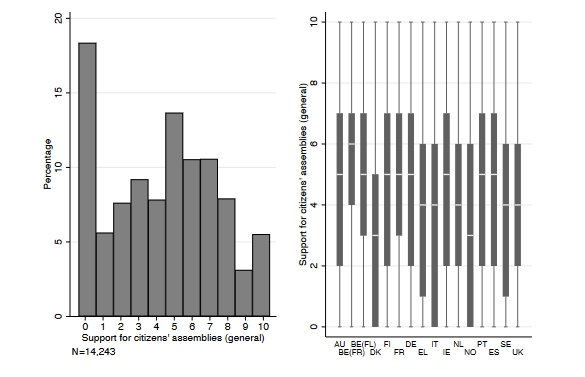
Despite emphasizing the “deliberative” label in the title of the paper, the question measuring support for allotted assemblies makes no mention of this obfuscatory term and instead focuses directly on decision-making power:

Overall, do you think it is a good idea to let a group of randomly-selected citizens make decisions instead of politicians on a scale going from 0 (very bad idea) to 10 (very good idea)?

The median response was 4.32, which is pretty impressive for such a radical idea. The chart below shows the distribution of responses. It is interesting to note that (if I read the chart correctly) the two countries with the lowest median support for the idea (3/10) are Denmark and Norway – the two Scandinavian countries in the survey. Those countries are among those with the highest level in the Western world of satisfaction with current government.

Sortition on VSauce

VSauce is a popular YouTube channel. The channel, which has millions of subscribers, deals with “scientific, psychological, mathematical, and philosophical topics, as well as gaming, technology, popular culture, and other general interest subjects”.

In April 2021 the channel uploaded a 30-minute video called “The Future Of Reasoning”. The video is a bit of grab bag of ideas and topics, but the main message seems to be that in order to deal with global warming the human race (or the West, or the US) needs to improve the way in which it makes decisions, and that this improvement could involve relying on sortition. “Lottocracy” is presented and argued for starting about 26 minutes into the video and Aristotle is quoted about 28 minutes in. According to YouTube, the video has been watched 6.5 million times – quite a nice exposure to the idea of sortition.

Micah Erfan: Texas should try sortition democracy

Micah Erfan is an economics freshman at the University of Houston. He writes at the The Cougar, “the official student-run news organization of the university”. Nicely assertive, Erfan draws a direct link from the oligarchical nature of the elections-based system to the deaths of hundreds of citizens in a climate disaster. This is the kind of things one cannot do after having managed to climb a few rungs of the academic ladder.

Texas democracy is immensely broken. Sortition democracy, a government by random selection, might be the best way to fix it.

The idea is that a simple random sample or stratified sample of the population will provide a group that is far better suited to represent the genuine views of residents than a collection of politicians.

In recent years, Texas has become notorious for its anti-democratic policies. Key among them is the state’s rampant gerrymandering.

Even though roughly 60 percent of residents are nonwhite, in Texas’s new political maps, fifty percent of congressional districts have white majorities.

Texas’s elections also suffer from severe voter suppression and the use of majoritarian first past the post voting, a system that has frequently been deemed by political scientists as one of the least representative.

This democracy deficit has come with real costs. In 2021, the failure of lawmakers to prepare the state power grid for extreme weather cost the state 200 billion dollars and over 700 lives.

A sortition proposal in Malaysia

Datuk Yong Soo Heong writes in the Malaysian newspaper New Straits Times:

[M]any in the political gamesmanship seem to be brimming with confidence on how to bring that winning formula for themselves and their hangers-on. I’m not so sure what they’ve in mind in terms of wealth-creation for the people because I’ve not heard much about this except that they want to return to power.

Therefore, we often find ourselves in a dilemma.

Who do we vote for? Who could be trusted? Which politicians will not abandon their righteous cause? These are tough questions to answer.
Continue reading