Reporterre: The members of the Citizen Climate Convention rebel against Macron, Part 1

An article in Reporterre, original in French.

The members of the Citizen Climate Convention rebel against Macron
November 2, 2020
Gaspard d’Allens

Anger mounts among the members of the Citizen Climate Convention. Left to “face the lobbies” all by themselves, disappointed that many of their proposals have been thrown out or unraveled, some lose their energy, others do battle.

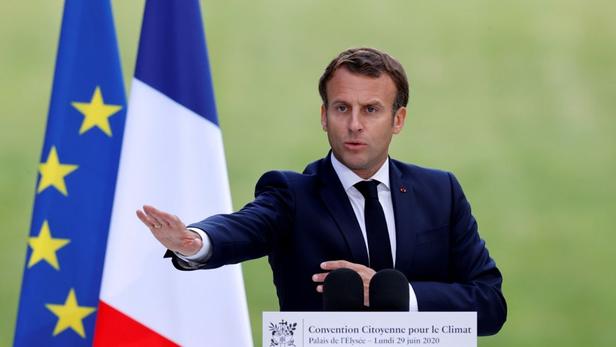
Promises oblige only those who believe them. The same is true for Emmanuel Macron’s commitments. It seems so long ago that the President has talked, with great gusto, in the gardens of the Élysée about the climate crisis and the adoption “without filtering” of 146 out of the 149 measures of the Citizen Climate Convention. “I want to have all your proposals implemented as soon as possible. Let’s go! Let’s act!”, he exclaimed to the sustained applause of the citizens, reburnishing, on the cheap, his environmental credentials.

Four months later, however, the ground covered is limited and motion has nearly stopped. Discussion of the bill handling the proposals of the CCC was postponed to next year instead of being discussed this fall. The idea of a constitutional referendum has disappeared and many proposals were dismissed or watered down. Time is passing and opportunities are lost. The stimulus plan and the financing bill could in fact have included the Convention’s measures but they did not.
Continue reading

Belgiorno-Nettis: There’s a problem with elections

Luca Belgiorno-Nettis, the founder and director of the newDemocracy​ Foundation, takes the opportunity of US elections day to propose sortition to the readers of The Sydney Morning Herald. Belgiorno-Nettis recounts Australia’s historical record of electoralist innovation.

Australia led the world in democratic innovations throughout the 19th century, beginning with the secret ballot, the first independent electoral commission, and then compulsory and preferential voting. […] New Zealand is often heralded as pioneering the vote for women, but it was Australia that also enabled women to stand for office – 20 years ahead of the Kiwis. The American political scientist Louise Overacker wrote in 1952: “No modern democracy has shown greater readiness to experiment than Australia.”

He then offers the adoption of sortition as continuing this trend:

[W]e need to go further. In 2017 the former secretary-general of the United Nations, Kofi Annan, said: “We need to make our democracies more inclusive. This requires bold and innovative reforms to bring the young, the poor and minorities into the political system. An interesting idea would be to reintroduce the ancient Greek practice of selecting parliaments by lot instead of election. In other words, parliamentarians would no longer be nominated by political parties, but chosen at random for a limited term, in the way many jury systems work. This would prevent the formation of self-serving and self-perpetuating political classes disconnected from their electorates.”
Continue reading

Random Selection for the Supreme Court

In an opinion piece in The New York Times, Yale law student Melody Wang lays out an extremely cogent argument for random selection in choosing cases. She emphasizes the power of random selection to prevent corrupt practices, and to focus advocates on directing their arguments to the general good, rather than to specific decision makers.

Claude Sicard: Replacing representative democracy with participative democracy is dangerous, Part 1

A translation of an article from Le Figaro.

Replacing representative democracy with participative democracy is dangerous
Claude Sicard, economist and international consultant
July 6, 2020

Seeing his popularity ratings decline, Emmanuel Macron appeals to the French people for a reform. For this economist, the head of state’s seemingly bright idea is a mistake because making decisions concerning the future of a country requires thorough study and the assistance of experts.

Macron at the Citizen Convention for the Climate at the Élysée, June 29, 2020.

The distance in our country between civil society and the institutions never stops increasing. In every democratic system it is the law that the majority prevails: the dominant fraction imposes its will on the minority, and the electoral moment is decisive for the duration of the mandate of the elected representatives. These principles are increasingly questioned these days. Minorities are increasingly unwilling not to be heard, and moreover they too often observe that the elected do not always have the virtues which they claimed to have during the campaign. Pierre Rosanvallon, a noted researcher of democracy, tells us that we are seeing in our modern democracies the rise of the “people as a judge”. The “monitoring citizen”, he says, is replacing the “voting citizen”. In this way a tendency has developed in our modern societies toward the creation of “counter-democracies”.

CEVIPOF surveys confirm this claim: 70% of the French think that in our country democracy “does not function very well”, and assert that they have no confidence in the ability of members of parliament to address issues that the country is facing. The American political scientist Yascha Mounk, a Harvard professor, writes in his book The People vs. Democracy published in 2018 that “in North America and in Western Europe, a growing number of citizens are turning their backs on democracy: they are feeling that they have less and less influence over political decisions”.
Continue reading

The question of sortition generates a heated debate in the French Senate

The following is a translation of an AFP article.

Reform of the CESE: The question of sortition generates a heated debate in the French Senate
October 15, 2020

Representative democracy vs. participative democracy: the question of the usage of allotment of citizen for participation in public consultations has generated a heated debate in the Senate during the discussion of the proposal for the reform of the Council for the Economy, Society and Environment (CESE).

The organic law bill, adopted by the National Assembly in September was approved on Thursday in first reading by the Senate with 292 votes for (LR, UC, PS, the large majority of RDSE, LIRT) and 50 abstentions (RDPI – mostly the LREM members, CRCE – mostly the communists, EST).

Assembly members and Senators are now going to try to reach an agreed text in a joint committee. If that fails, the National Assembly will have the last word.

During his speech in front of Congress in 2017, President Emmanuel Macron spoke about transforming the CESE, a little-known consultative institution which convenes representatives of employers, of workers’ unions and of NGOs at the Palais d’Iéna, into “a chamber of the future, where all the stakeholders of the nation take part”.

Short of a constitutional reform, the organic law bill aims to breathe new life into this institution in order to respond to strong demand for participative democracy in public opinion. Notably, the bill streamlines petitioning the CESE for it to form an opinion on economic, social and environmental questions raised by the public. The number of required signatures would be reduced from 500,000 to 150,000. The senators have approved this procedure with some reservations.

Moreover, opposing “any legitimization of sortition”, the right-wing Senate majority has removed any possibility for the CESE to organize “public consultations” based on allotment modeled after the Citizen Climate Convention. The removal of this central tool has been debated at length, with the government and the Left failing to reintroduce it through amendments during session.
Continue reading

Ferey: Populism against science: a new political cleavage?, Part 2/2

This is part 2 of a translation of an op-ed by Camille Ferey in BibliObs. Part 1 is here.

Analyzing the legitimate reasons for criticizing science

If the ideological dimension of the cleavage between rationalism and populism has been clarified, there remains a real phenomenon behind it. There exists a mass of untruths (lies and errors) whose effects on humanity are deleterious: climate-skepticism, historical denialism, anti-Darwinism and various kinds of conspiracy theories. But there is a pressing need to analyze the real causes of these untruths rather than to attribute them to the mental dysfunction of idiots: democracy cannot be defended by being anti-democrats.

The foremost of these causes is a political one: the process of scientification of politics and technicalization of democracy. Liberal capitalism largely subordinates collective decisions to mathematical economic models that are presented by a stratum of “experts” that are linked to power as eternal truths. In this way, presenting political choices as scientific ones, a rhetoric that was widely used in the management of the COVID19 pandemic (the decisions, said Edouard Phillipe, are not political, they are scientific), exposes science to skepticism from that point on whenever choices prove to have negative consequences. How can we believe, for example, the irrefutability of economic laws after the 2008 crisis? Dismissing any critical reflection of a technical-scientific vision of politics, immediately branding such reflection as mistrustful and irrational populism, and eliminating from public debate a set of subjects under the pretext that they are matters of science, thus contributes directly to putting science in doubt.

Another cause, this one sociological, can explain the lack of confidence in science. As history and sociology show clearly: no science is neutral in the sense that it may be produced by an observer with no characteristics and no purpose. Science is produced by scientists and if the scientists all belong to the same social class or to the same group, their products will necessarily be affected. And so, the fact that over the centuries scientists were men can explain the great delay in research about feminine sexual organs as well as about certain diseases such a endometriosis, which afflict only women.

If today women are slowly gaining ground in science (even if with much difficulty, for the scientific establishment is barely opening up and renewing itself), this is not happening with regards to the working class due to the length and uncertainty of the path leading to a career in research (being inversely proportional to the ridiculous sums and the small numbers of the scholarships available). Therefore, as science is going to be done by the wealthier classes, it will necessarily to some extent be done for the wealthy. Objectivity and neutrality grow from pluralism and equality. Without those, as the philosopher John Dewey wrote in 1927, “a class of experts is inevitably so removed from common interests that it becomes a class with private interests and private knowledge, which in social matters is no knowledge at all. [The Public And Its Problems, p. 207]”
Continue reading

Today German Bundestag Live Committee Discussion of “Citizen Engagement” via Sortition

With the title, “A New Form of Citizen Participation,” a special subcommittee of the German Parliament [of the Bundestag or popular assembly] convenes a “technical discussion” of experts on October 6 at noon Berlin time on the upcoming citizens’ assembly on “the role of Germany in the world.” It will be live-streamed at http://www.bundestag.de.

“A lot-based Citizens Council will produce a report on Germany’s role in the world. This project will be implemented as an independent undertaking of the More Democracy association [Mehr Demokratie e. V.] under the patronage of the President of the Bundestag,” reads the announcement of the Bundestag.

It continues that this kind of participation has been practiced in Ireland since 2012 as “Citizens’ Assembly.” The ambassador of Ireland will be a special guest of the committee to report on the Irish experience with “citizens’ councils.” [In Germany the term Buergerrat or “citizen council” has come to mean an allotted body of either the size of a panel or an assembly; it seems, the literal translation of assembly has the connotation of an Ekklesia or gathering of all.]

  • Dr. Nicholas O’Brien, Ambassador from Ireland
  • Roman Huber, Executive Director, Mehr Demokratie e. V. [More Democracy]
  • Dr. Siri Hummel, Acting Director, Maecenata Institute for Philanthropy and Civil Society
  • Dr. Ansgar Klein, Managing Policy Director, Federal Network for Citizen Engagement, [Bundesnetzwerk Bürgerschaftliches Engagement (BBE)] Advisory Board of Bürgerrat Demokratie [the organization which organized the CA on democratic reform in 2019]
  • Univ.-Prof. Dr. Roland Lhotta, Helmut-Schmidt-Universität Hamburg, Professor, Political Science, specializing in the German Federal System

https://www.bundestag.de/dokumente/textarchiv/2020/kw41-pa-buergerschaftliches-engagement-793926

More info in English regarding the upcoming CA on Germany’s role in the world: https://deutschlands-rolle.buergerrat.de/english/

Rothchild: “Ancient wisdom” in MI’s new redistricting process

John Rothchild, Professor of Law at Wayne State University, writes approvingly in The Conversation about Michigan’s new allotted electoral redistricting commission. Rather naively, Rothchild seems to believe that democratic redistricting could result in the selection of “representatives who truly reflect [citizens’] political preferences”. Alas, this is more than mere redistricting can deliver, however well done.

How, then, should Michigan’s decision to assign unskilled members of the public the job of drawing nonpartisan election districts be evaluated?

Redistricting is a complex task. Michigan’s Constitution says that the districts must be drawn in compliance with federal law. That includes a requirement that voting districts have roughly the same population. It also requires that the districts “reflect the state’s diverse population and communities of interest,” and “not provide a disproportionate advantage to any political party.”

Dividing the map to meet all of these criteria is not likely to be within the capabilities of a group of randomly selected citizens.

There are several reasons to think that the redistricting commission will nevertheless prove adequate to the task.
Continue reading

Ferey: Populism against science: a new political cleavage?, Part 1

Camille Ferey is a doctoral student at the Université de Paris-Nanterre where she is writing a thesis about theories of participative democracy and democratic social movements. She wrote the following op-ed in BibliObs back in July.

Populism against science: a new political cleavage?

Rarely does science provoke as many hopes and controversies as it has been doing over the last few months.

It is a matter of great importance: upon the progress of science depends the neutralization of a disease that has confined half of humanity, upon its instructions and warnings depend our rights to travel, to meet and to kiss. However, many commentators talk about the threat of “distrust” that undermines the authority of science, if not of the authority of Truth itself, in our democracies. Furthermore, this dominant narrative confounds this phenomenon of skepticism (which is very real) with a different phenomenon, a political one: populism. The political cleavage is then reduced to a binary opposition between reason and populism, and consequently all criticism of scientific and political institutions is ruled out.

Mistrust of science and political non-conformism: a problematic confounding

It is a widely circulated narrative, with its opinion polls, its statistical studies, its indicators and its media talking points: democracies are suffering because of the irrational acceptance by a growing number of citizens of a mass of fake news, alternative truths and conspiracy theories (vaccines are bad for your health, the theory of evolution is a lie, climate change is a hoax). Yet, this narrative never asks whether what is taking place is a rejection of scientific theories, of scientific protocols, of scientists, of institutions of research, of technical applications of science or of its political uses. This vagueness allows to systematically associate this distrust with a specific phenomenon: populism, which is designated willy-nilly as both a cause and an effect of the regime of errors and lies.

The latest CEVIPOF poll on the relations between science and society establishes a correlation between, on the one hand, “an indicator” of mistrust calculated based on questions such as “Do you think that science brings more good than bad, as much good as bad, or more bad than good?”, and, on the other hand, “and indicator of populism”, based on the following questions: “Politicians are generally corrupt? A good political system is one where citizens rather than a government decide what they think is better for the country? Democracy functions best if the representatives are allotted citizens?”. A surprising definition of “populism”, which rather resembles the definition of democracy, or maybe of common sense.
Continue reading

Chumbley: Abolish student government elections now

Robert Chumbley writes in the Tulane Hullabaloo:

Elections are detrimental to the establishment of diversity of thought in any given student government. Cognitive diversity is more important to the success of political leadership than relying solely on demographic diversity, which can potentially foster differences in thinking but does not guarantee it.

When individuals with varying opinions interact, these relationships are more conducive to innovation and the development of problem solving abilities. Given that cognitive diversity and the ensuing boon to collective problem solving should be a higher priority than the maintenance of elections for traditional-ideological purposes, Tulane ought to replace USG elections with sortition, the random selection of individuals for offices.

The reason for that logical jump may not be intuitively obvious, but the fact is that random allotment of political offices promotes cognitive diversity and improves problem solving ability.

Random selection does not produce a mob of unqualified commoners. In truth, those who object to sortition on the basis of “lack of qualification” are effectively dividing the population into commoners and elites, the former of whom deserve to be managed and the latter of whom deserve to manage by virtue of their special “qualifications,” whatever those are alleged to be.
Continue reading