Táíwò: Power over the police

In the context of the recent mass outrage over the murder of George Floyd by a policeman in Minneapolis, Olúfẹ́mi O. Táíwò of the Pan-African Community Action reiterates the proposal made by Max Rameau to enforce citizen control over police via allotted citizen boards.

The core problem with policing and incarceration is the same problem that plagues our whole political system: elite capture. The laws, the regulations, the bailouts, and the wonks who write and evaluate all of the above are all powerfully influenced—if not functionally controlled—by elite political and corporate interests. We cannot put our faith in elected representatives and merely vote our way out of this problem: elections are more dominated by dollars than ever, and grassroots energy around political figures is increasingly shaped by identity politics, which faces its own elite capture problem.

Instead, we need to give power back to the people—directly. Under one specific proposal, offered by the Washington, D.C.–area group Pan-African Community Action (of which I’m a member), communities would be divided into districts, each of which would be empowered to self-determine how to maintain public order. Each district would hold a plebiscite to decide what to do with its current police department, immediately giving the community the direct voting power to abolish, restructure, downsize, or otherwise reconstruct their departments.
Continue reading

Testart on democracy, democratic debate and citizen power, Part 1

Jacques Testart, a prominent French biologist, is a long-time advocate for citizen power, especially as it concerns control of science-related issues. His work in this area stretches back decades. In 2002 Testart co-founded the Association for Citizen Sciences. In a 2017 interview (Le Comptoir, Part 1, Part 2), parts of which are translated below, Testart discusses democracy, public debate, and citizen control of science.

Science, such as economics, could be a carrier of truth because of its neutrality. However, among other examples, the basic axiom of the Work Law forced through, against the opinion of millions of workers affected, rests on a certain “scientific” concept of economics. This law is a good demonstration that this supposed neutrality which economics maintains is in fact such in the eyes of the minority in power alone. When the social contract is under stress, when the decision-makers prefer Capital over the people, it may be necessary to try and consider about how it is put together, in order to be able to improve democracy. Jacques Testart, formerly a research biologist and “father” of the first French test-tube baby, now devotes his time to this goal, notably through the Association for Citizen Sciences. With this in mind, he has recently published “Rêveries d’un chercheur solidaire“, “L’humanitude au pouvoir – Comment les citoyens peuvent décider du bien commun” and “Faire des enfants demain“. We went to meet him. In the first part we discussed the collapse of democracy, in which the flag barriers of Truth are thoroughly involved. The means for making democracy work are discussed in the second part.

Le Comptoir: We hear here and there that democracy is experiencing a “crisis” of representation. Due to the professionalization of politics, the elected are no longer (if they ever were) really representative of their voters, but are rather members of a political-media-financial oligarchy. What do you think?

Testart: That is obvious, yes. The problem is knowing if those who occupy the leadership circles are leaders or representatives. They consider themselves to be leaders because they are elected, and therefore have popular support. But originally, the rules of the game were aimed at – and things must get back to this – them being only representatives. They ability to initiate during their term should be limited by their initial mandate, accounting for unexpected developments. In no case should they be allowed to take decisions that do not conform to the promises for which they were elected. I believe this is a really fundamental point. It is this which dispirits a lot of people, politically, and leads them to abstain. It lead to the rise of the “everything is corrupt” attitude on which the extreme right prospers.

Le Comptoir: May we say that this crisis of representation is also due to an appalling lack of debate regarding issues regarding which there is a consensus among experts in media? I am thinking specifically regarding assisted reproductive technology and the barrage of articles published daily about new “advanced” technologies, presenting all manner of gadgets and announcing “revolutions” to come, from self-driving cars to the bionic prostheses.
Continue reading

Kleroterion 2.0; Our Once and Future Escape Key

This is the third post in a series on Barbara Goodwin’s classic work on sortition Justice by Lottery, University of Chicago Press, Chicago, 1992. The first post is here and the second post is here.

There are mass demonstrations in cities throughout the United States and around the world against racism, sparked by the murder of George Floyd, a Black man in Minneapolis who was recorded being choked to death by a police officer while in custody. Among his last words, “Please, I can’t breathe” are now a slogan repeated and sung around the world, a metaphor for the stifling nature of racialized oppression. Here in Ontario — the Toronto-Niagara Golden Horseshoe region is the most racial and ethnically diverse in the world, a place where immigrants are popular and in Toronto  are actually the majority –there have still been large street demonstrations against deaths-while-in-custody of certain Black and Indigenous people who were suffering from mental illness. Why is it, Toronto activists ask, that money meant to alleviate problems in poor neighbourhoods is directed away from local social workers and towards force, armed police and other arbitrary measures? In the Canadian Parliament, Elizabeth May, leader of the opposition Green Party, summarized a large part of the problem,

She urged an inquiry to weed out white-power groups in Canada and make sure they are not infiltrating police forces. `Because if there is one thing scarier than a white supremacist with a gun, it’s a white supremacist with a gun in uniform.’ (1)

Mr. Floyd’s plea for air resonates so universally because none are guarding the guardians. Clearly, bullies in uniform tasked with enforcing social distancing laws are targeting and persecuting visible minorities, worsening the climate of fear that visible minorities already suffer under. The democratic institutions that depend upon justice, especially but not exclusively the police, to uphold the rule of law are blocking reform and accountability and stifling the very purpose for which they exist, to serve the social good, protect the vulnerable and assure the safety, order and security of everyone, not just the privileged. So, these are the questions of the hour: How can democracies end the perilous insularity of the police? How do we reinstate badly degraded trust in authority? Why is the guardian branch of governance so prone to corruption, bullying and infiltration by sociopaths? How do we end the vicious cycle of escalating violence, reaction and oppression?
Continue reading

Lotteries during Covid-19

Public housing is allocated via lottery in Trinidad and Tobago:

Five hundred applicants from the public housing database moved one step closer to home ownership when they were selected for assessment interviews during the Housing Draw, which was hosted live by the Ministry of Housing and the Trinidad and Tobago Housing Development Corporation (HDC) on Wednesday.

The HDC said the applicants were selected from a database of 180,000.

The National Housing Allocation Policy, which was developed in 2004, and which guides the HDC, is intended to ensure greater equity in the allocation process so that all applicants, once they are eligible for the programme, have an equal opportunity of being randomly selected for the location of their choice.

In addition to modified random draws which account for 60 percent of allocations per community, the Allocation Policy provides for a 25 percent for emergency cases or those recommended by the Minister; 10 percent allocation to members of the protective service and defence force; and 5 percent for the elderly and persons with disabilities.

To be eligible for public housing, applicants must be twenty-one 21 years and over, resident citizens with a combined household income of under $25,000 and must not own any property.

The French citizen convention on the climate: the endgame


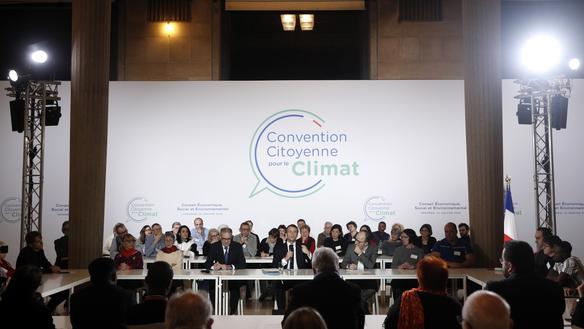
Florent Gougou and Simon Persico write in La Vie des idées about the approaching culmination of the French citizen convention on the climate and how its work should be translated into policy. They find the use of a referendum particularly appealing. Also included in the article is the useful chart above comparing along several dimensions the makeup of the French National Assembly to that of members of the convention (which were selected to reflect the makeup of the French population).

Deciding together: The citizen convention on the climate and the democratic challenge

Now that the citizen convention on the climate is drawing to a close, how should the proposals of the allotted citizen be made into policy within the framework of the a democratic process? What place and shape should a referendum take within the political decision-making?

In the weekend of June 19 to 21, the 150 citizens allotted to the citizen convention on the climate will meet for the last time in order to conclude their work. Two essential points will be on their schedule. The first is finalizing the list of proposals that they will hand to the executive, and more broadly to the French people. The second is choosing the legal mechanisms by which a decision would be made regarding those proposals: executive orders, legislation or through a referendum.
Continue reading

Reginald Walter Macan: early sortition advocate

The February 1892 issue of The Classical Review (vol. 6, No. 1/2) has a review by Reginald Walter Macan of James Wycliffe Headlam’s Election by Lot at Athens which was published the year before.

Macan talks approvingly of Headlam’s analysis of the rationale behind the use of sortition in Athens:

The Lot was used in the Athenian democracy for two main purposes, as Mr. Headlam explains clearly enough: to constitute bodies, that represented the sovran people, or were committees, commissions of the same (p. 161); to secure rotation of office (p. 94) — both these purposes being subordinate to the supreme end, the sovranty of the whole people.

However, in regards to the representation function, Macan is radically reinterpreting Headlam. The “representation” discussed in page 161 of Headlam’s book is that of carrying out technical, apolitical functions which require no judgement and which any Athenian would have performed in the same way.

The inspectors, then, were appointed by the people to act as stewards or bailiffs. The people was the owner of a large business establishment; the inspectors had to do the work of superintendence over the workmen which the owner had not time to do himself. They were a committee of the Assembly, or council, who were appointed by lot because they represented the whole people. The whole of the demos could not go together to the dockyards to see that the new ships which had been ordered were properly built, so they deputed a few of their number to do so, and as a matter of course, as in all such committees, made the appointment by lot.
Continue reading

Buchstein: Democracy and lottery: Revisited

Ten years ago Hubertus Buchstein pinned some high hopes on the application of sortition in government (“Reviving Randomness for Political Rationality”, Constellations 17(3), 2010):

[T]he horizon for further development of randomly selected councils boils down to two options. One can either stay on the beaten path and continue working with the experiments and projects described above with their non-binding status. That would amount to supporting commendable projects instructive about democracy, which admittedly remain mere ornaments of the political system’s routines, projects that participants expect to have little tangible influence, thus engendering the problems of motivation. Or the standing of randomly selected councils could be reinforced; their integration in existing institutional arrangements with a clearly defined and binding set of competencies would form the culminating point of such a reform policy.

There is much to be said for the fact that random selection, if used wisely, could prove a useful complement to the procedures in place until now. And if we have the courage to make such changes, there is reason to believe that judicious integration of components of lotteries in modern democracies can contribute to a reform policy model, relevant beyond nation-states and the example of the EU, for coping with the institutional demands of the spatial transformation of democracy beyond the framework of the nation-state currently on the agenda. Resorting to chance in such a program of policy for democracy is not an expression of resignation or fatalism, but instead of democratic experimentalism striving to increase democracy’s potential for rationality.

A decade later, Buchstein is singing a very different tune (“Democracy and lottery: Revisited”, Constalleations 26(3), 2019). Buchstein now opens his article with some accusations directed toward sortition advocates and with some skeptical questions:
Continue reading

Grandjean: Sortition is apolitical and in-egalitarian

An op-ed in LaLibre.be by Geoffrey Grandjean, teaching fellow at the University of Liège and director of the Institut de la Décision publique. Original in French. Published 03/12/2019.

Forming a citizen assembly using sortition in order to reinvigorate democracy is a fashionable idea. Nevertheless, it appears to me to be erroneous. There are preferable alternatives.

Sortition has come back into fashion. Political representatives, swayed by a series of experts, are now seeing sortition as a way to reinvigorate democracy and maybe, for some, to finally realize the democratic dream through statistical sampling. Instrumental reasoning will win over ideological debates because an allotted assembly – or even a partially allotted assembly – is synonymous with democracy.

However, recourse to sortition as a method for selecting assembly members is profoundly apolitical and in-egalitarian idea. There are three reasons for this.

More than a link of trust

First, behind sortition there are mistaken, and even dangerous, assumptions about the functioning of democracy. On the one hand, in critiquing the existing representative system, the advocates of sortition respond to a sentiment of general distrust by proposing a mechanism that does not rely on trust. The electoral link of trust between represented and representatives is replaced by a probabilistic selection technique of cold calculation. In this regard, in Les @nalyses du CRISP en ligne, Vincent de Coorebyter asserts that the tendency to create citizen parliaments consists of “an abandonment, pure and simple, of sovereignty in favor of an assembly selected without us”.

On the other hand, when we look at the different proposals for allotted assemblies, they are often designed as having short terms. In fact, citizens are convened for a single day, or a week at most. This type of proposal translates to short-termism and the ephemerality, unless the allotted citizens become full-fledged parliamentarians. Taking a public decision takes time, even in our digital societies. Fundamentally, the advocates of sortition drain away, through the procedure of selection of assemblies, what is the heart of political decisions – the depth and intensity of debate of ideas which requires trust and requires time. Therefore, sortition reveals itself as apolitical.
Continue reading

Kerlouan: Macron treats the allotted citizens like children

Philippe Kerlouan writes in Boulevard Voltaire.

Citizen Climate Convention: Macron treats the 150 allotted citizens like children…

One may ask oneself how can 150 citizens, selected by lot in order to create proposals for addressing global warming, be “France in miniature” and represent “all the significant sections of French society”, as the co-president of the governance committee of the Climate Convention asserted they are. One must believe that the allotment was balanced according to some statistical measurements. But nevermind! The Athenian democracy at the time of Pericles designated numerous officials using a lottery. Chance is maybe the most effective way to turn equality for all and social-professional diversity into a democratic system.

We should also have confidence in the people so selected and not consider them second class citizens. As they met on Friday, January 10th for another weekend of work, they were able to pose questions to Emmanuel Macron, who attend in person for the occasion. No doubt he had nothing better to do in these troubled times. One of the participants, quoted by the Le HuffPost, observed that it is “scandalous that he chose this date in order to clown around in front of the Convention whereas he would have done better to take care of the pensions”. But our president must have had his reasons.
Continue reading

Schnapper: Extreme democracy and democratic extremists

Dominique Schnapper is the director of studies at the School for Advanced Studies in the Social Sciences (EHESS) (retired) and a former member of the French Constitutional Council. This is a translation of Schnapper’s articleExtrême et extrémistes de la démocratie” published in April 2019 on the Telos website.

The Gilets Jaunes movement fights under the banner of “real” democracy and it risks contributing to the destruction of the only democratic regime that has ever existed, namely representative democracy.

Democracy always had two dimensions: a democratic one and an aristocratic one. Democratic because the rulers submit to elections by the ruled and are rewarded or punished through the vote.

The dream of direct democracy

The aristocratic dimension was always a source of disagreement. The dream of direct or total democracy has accompanied the history of democracy. But it is today all the more present in the idea that entrusting decision making to others is contradictory to the conception of the sovereign democratic individual doing things himself, and being the source of all legitimacy and competence. He brings his own legitimacy. He feels fully qualified to express himself directly by himself without the intervention of a representative.

Democrats like neither mediation nor distinctions. Every type of distinction – and in particular the distinction between voters and elected – every hierarchy is perceived as discriminatory. The elites are easily denounced as responsible for all our failures. For there the ideas of direct democracy and ideas inspired by direct democracy regain their power. Protesting activists become actors of a “counter-democracy” [Pierre Rosanvallon, La contre démocratie, 2006], they speak about the foundational principles of democracy and the liberation from electoral rhythm in order to exercise daily surveillance on the actions of the rulers.
Continue reading