Van Reybrouck’s Against Elections, in English

An English translation of David Van Reybrouck’s book Against Elections was recently published. The book is blurbed by, among others, J. M. Coetzee, the South African novelist who was the recipient of the 2003 Nobel Prize in Literature:

Choosing our rulers by popular vote has failed to deliver true democratic government: that seems to be the verdict of history unfolding before our eyes. Cogently and persuasively, David Van Reybrouck pleads for a return to selection by lot, and outlines a range of well thought out plans for how sortitive democracy might be implemented. With the popular media and the political parties fiercely opposed to it, sortitive democracy will not find it easy to win acceptance. Nonetheless, it may well be an idea whose time has come.

With attention from such a luminary it is not surprising that the book was reviewed in several elite media outlets. As Coetzee predicts, the reception is quite cold. The warmest one is Andrew Anthony’s lukewarm response in The Guardian. Anthony concludes:

[W]hen, say, a sortition of the public recommends an expensive transport system that doesn’t work out or cuts a defence system that is later needed, […] where and how is that frustration registered? You can’t vote out the public. One job that elected politicians fulfil is as democratic punchbags. It’s not edifying or necessarily productive, but it may be essential.

Perhaps sortition or partial sortition could be applied in very specific cases. But we also need to look at reviving elections and renewing our belief in them. They remain a vital part of the democratic process. Not its only part, to be sure, but they are an all too rare example of mass engagement. Let’s not vote them out just yet.

Continue reading

Sweeney: Imagine an America truly led by the people

George Sweeny, a freelance writer based in Wilmington, writes a rather eloquent piece of sortition advocacy at Delaware Online. Interesting paragraph from the piece:

And one of the best arguments for sortition is simply to look at what our current system has produced. According to Las Vegas oddsmakers, Hillary Clinton has a 3-out-of-4 chance to win the presidency and Donald Trump has a 1-out-of-4 chance. But if we used sortition instead, they would both only have about a 1-in-164,000,000 chance, based on Census estimates of the number of Americans over the age of 35. The numbers speak for themselves and give us the most convincing reason why sortition is clearly the superior system.

More citizen juries in Australia

The newDemocracy foundation has recently been managing the citizen jury process in regards to the South Australia nuclear waste dump proposal. Now it has been hired to manage another citizen jury process – this time in Victoria:

Jay Weatherill has issued an “I told you so” over his oft-criticised Citizens’ Jury model, after it was adopted by the Victorian Government as it seeks to mop up in the wake of its dramatic sacking of the Geelong Council.


Sacked Geelong Mayor Darryn Lyons outside the Victorian Parliament.

The Government in April moved to dismiss the entire council – including colourful mayor and notorious former paparazzo Darryn Lyons and his deputy Bruce Harwood, the father-in-law of former Adelaide star Patrick Dangerfield – after an inquiry found it had become so dysfunctional and riven with internal conflict and a bullying culture that it could no longer govern properly.

Fresh elections won’t take place till October next year, with an administrator overseeing the region in the interim.

But Premier Daniel Andrews has announced the formation of a Citizens’ Jury to help set the parameters of an overhaul of the next council’s governance structure – to be overseen by Sydney-based newDemocracy Foundation, which selected the 50 jurors involved in this month’s Adelaide forum on the merits of a high-level nuclear waste dump.
Continue reading

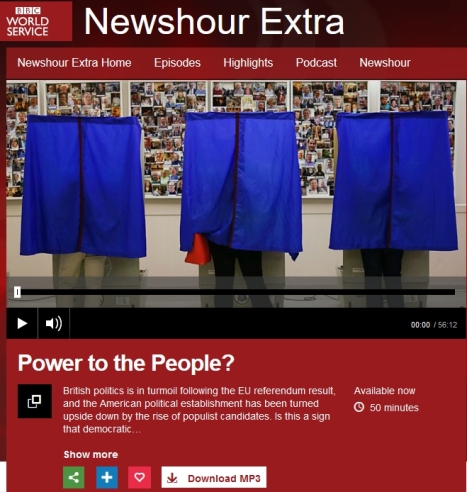
Power to the People? BBC World Radio

nh-pttp

I was invited to speak on News Hour Extra on BBC World Radio last week, along with Baroness Helena Kennedy, William Galston of the Brookings Institution, and Kenyan journalist John Githongo. The show also interviewed Pia Mancini of DemocracyOS. Highlights include me calling the entire Anglo-American establishment a collection of oligarchs, and a brief foray into sortition in the end. There has been a huge backlash against ‘democracy’ in the wake of Brexit, which I personally find highly concerning (although simultaneously completely predictable), so I was very happy to be able to participate in this conversation.

If anyone wants to listen, the podcast is here: http://www.bbc.co.uk/programmes/p0401gd9#play

Van Reybrouck: Why elections are bad for democracy

In the wake of the Brexit referendum David Van Reybrouck takes his “tired democracy” message to the readers of the Guardian:

Brexit is a turning point in the history of western democracy. Never before has such a drastic decision been taken through so primitive a procedure – a one-round referendum based on a simple majority. Never before has the fate of a country – of an entire continent, in fact – been changed by the single swing of such a blunt axe, wielded by disenchanted and poorly informed citizens.

Van Reybrouk now recounts the statistics showing low and falling citizen trust in elected institutions and offers a diagnosis of the problem. Avoiding the mention of any substantive complaints about the policies implemented by those institutions, for Van Reybrouk it is purely a matter of procedure. There is considerable vagueness whether the procedural problem was always there or is a new phenomenon. The risk, if things are not repaired, is that voters will continue to make transparently foolish choices.

In a referendum, we ask people directly what they think when they have not been obliged to think – although they have certainly been bombarded by every conceivable form of manipulation in the months leading up to the vote. But the problem is not confined to referendums: in an election, you may cast your vote, but you are also casting it away for the next few years. […]

Referendums and elections are both arcane instruments of public deliberation. If we refuse to update our democratic technology, we may find the system is beyond repair; 2016 already risks becoming the worst year for democracy since 1933. We may find, even after the folly of Brexit, that Donald Trump wins the American presidency later this year. But this may have less to do with Trump himself, or the oddities of the American political system, than with a dangerous road that all western democracies have taken: reducing democracy to voting.
Continue reading

Roslyn Fuller educates Andrew Sullivan

It used to be a mainstream, respectable occupation to theorize about the horrors of popular rule. Socrates and other Athenian aristocrats have been upfront about the fact that the average person should not be trusted with power. This clear-headedness and frankness has been maintained over many centuries. The water began to muddy as the aristocrats were being challenged by the up-and-coming bourgeoisie. Now there had to be some rational criteria explaining why it was not the aristocrats who should be holding power. Talk about natural aristocracy became fashionable, but outright rejection of democracy was still part of the mainstream discourse.

Then, in the 19th century, the term “democracy” was rehabilitated and the ideological water became so thick it was impossible to know where one was heading. In the middle of the 20th century Schumpeter and the elite theorists tried to clear the water by explicitly redefining the term not to refer to popular power after all but simply to a competition between elites for popular vote.

This moment of clarity passed when the 1970’s saw the ideological victory of the Civil Rights movement. At that point popular rule became the only defensible meaning of “democracy”, and since then theorists are in the unpleasant situation of having to reconcile an oligarchical practice with a democratic ideology.

This brief history is presented as an introduction to a recent exchange between Andrew Sullivan, a British author, editor, blogger, conservative political commentator, former editor of The New Republic, and the author or editor of six books, and prof. Roslyn Fuller, an Irish academic, legal expert, columnist, electoral candidate, author of the book Beasts and Gods, and an Equality-by-Lot contributor.
Continue reading

Somin: Sortition won’t solve political ignorance

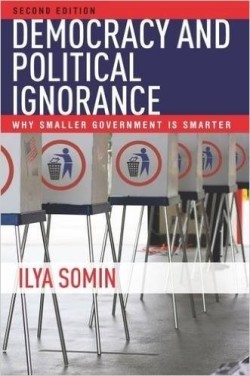
jpeg-of-cover-final-version-e1464367107681

Ilya Somin, Professor of Law at George Mason University, is the author of the book Democracy and Political Ignorance: Why Smaller Government is Smarter. Somin opens an opinion piece in the Washington Post thus:

Widespread political ignorance is a serious problem for modern democracy. In recent years, many scholars have argued that we can overcome it by relying on “sortition”: delegating various political decisions to jury-like bodies selected at random from the general population. In this post, I explain why such proposals are unlikely to succeed.

Before going into the substance of Somin’s arguments about sortition, it is important to realize that ignorance is actually only the second most important problem with the current system, the first being the difficulty of mass scale agenda setting. More details here. The emphasis on ignorance rather than agenda setting is typical of the “rational choice” line of political argument which ignores the complexity of organization largely for ideological reasons. That said, the ability of decision makers to become informed about their subject matters is important and worth discussing. Some of the considerations that are discussed below apply also to the matter of agenda setting.

Continue reading

Threlkeld: Electoral system should be decided by jury, not politicians or referendum

Simon Threlkeld has a new article in the Canadian National Observer advocating against having electoral reform decided by referendum. An excerpt:

Electoral system should be decided by jury, not politicians or referendum

Politicians should not decide the rules under which they are elected, because fair and democratic decision-making requires that those who decide do not have a conflict of interest. All of Canada’s political parties should accept this.

The Conservatives say that whatever electoral system parliament decides on, it needs to be ratified in a national referendum. Rather transparently, what concerns them is not giving the public a say, but rather preserving the status quo which in the 2011 election gave them a majority of the seats with just under 40 per cent of the popular vote.

Rule by the people needs to be well-informed, because only informed views provide a good basis for a decision.

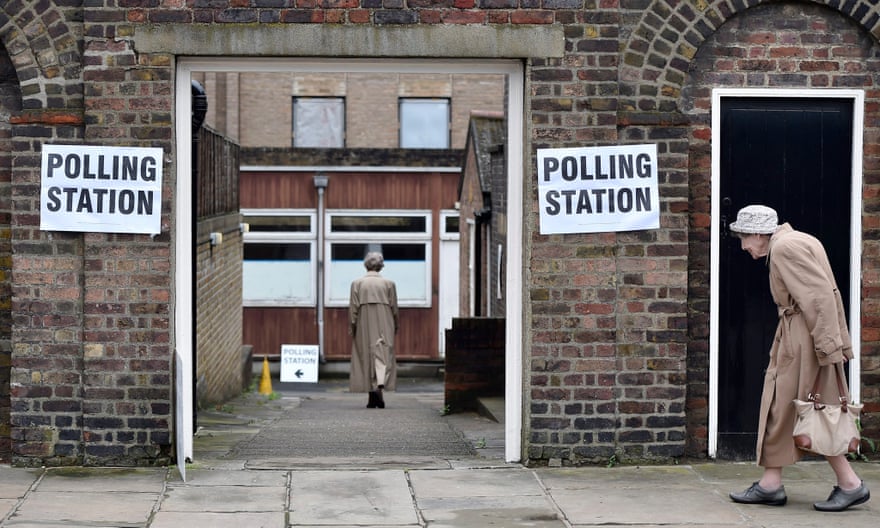
A referendum is highly unsuitable for ensuring an informed decision about Canada’s electoral system. The public would only learn about the option(s) on the ballot voluntarily in their spare time, and most people are not especially interested in learning about electoral systems. In B.C.’s 2005 referendum on a proposed new electoral system, shortly before voting day 66 per cent of those surveyed by Ipsos-Reid said they knew “nothing” or “very little” about the proposal on the ballot. In another survey, over half of those who voted “no” said they did so because they did not feel “knowledgeable.”

Sortition as a business opportunity

In Australia, sortition is a business opportunity:

Combining a shrewd business acumen with a philanthropic social conscience, the SA-based start-up – which formally launched last week – aims to work with governments, business, not-for profits and communities to broaden democratic engagement.

[…]

“It’s really nice to be able to set the boundaries of what’s authentic and inclusive, and what’s not … we’re really only interested in those (clients) that are actually sharing decision-making.”

Even before its official launch, the fledgling company has already made a splash; it managed the recent Citizens’ Jury process that reviewed policy prescriptions for the management of unwanted dogs and cats, and is now engaged with the Premier’s Taskforce on Healthy Kids’ Menus.

But both Lawson and Jenke are confident the long-term success of their venture isn’t predicated on political whim.
Continue reading

Cartledge: Crypto-oligarchy

Paul Cartledge is continuing his assault on the modern conventions about democracy:

To an ancient Greek democrat (of any stripe), all our modern democratic systems would count as “oligarchy”. By that I mean the rule of and by – if not necessarily or expressly for – the few, as opposed to the power or control of the people, or the many (demo-kratia).

That is the case even if – and indeed because – the few happen to be elected to serve by (all) the people. For in ancient Greece elections were considered to be in themselves oligarchic. They systematically favoured the few and, more particularly, the few extremely rich citizens – or “oligarchs”

[…T]here are a number of ancient democratic notions and techniques that do seem highly attractive: the use of sortition, for instance – a random method of polling by lottery that aimed to produce a representative sample of elected officials. Or the practice of ostracism – which allowed the population to nominate a candidate who had to go into exile for 10 years, thus ending their political career.

And comparison, or rather contrast, of our democracies with those of ancient Greece does serve to highlight what’s been called creeping crypto-oligarchy in our own very different (representative, not direct) democratic systems.
Continue reading