McKay: Combining mini publics and multi stage popular votes

The section ‘Combining mini publics and multi stage popular votes’ in Spencer McKay’s new paper ‘Building a better referendum’ presents an interesting overview of several systems where the referendum is combined with mini publics.

Pairing a multi-stage popular vote with a mini-public – a process I refer to as an iterated popular vote (IPV) – may aid in bridging the gap between micro-deliberation and macro-participation. The IPV is an attempt at institutional design inspired by the notion of “designed coupling,” which seeks to “find the optimal strength of linkages between different parts of a deliberative system” (Hendriks, 2016, p. 55).

Two proposals for representative representation

Representative representation: a citizens’ jury appointed by sortition (v 2019.03.11). (For a fuller context, see the paper released by democratie.nu: ‘Sortition as a democratic system for the appointment of a real parliament, also called ‘Citizens’ Jury’).

Introduction

Proposal I: The principle of our proposals is derived from some aspects of the jury in its judicial application. The ‘Legislative Citizens’ Jury’ is only called when necessary and has a short term mandate with the power to make a decision in just one specific case.

During the national elections, voters can allocate a number of additional parliamentary ‘seats’ to a descriptively representative Citizens’ Jury of at least 500 citizens, appointed by sortition[1]. This Legislative Citizens’ Jury will vote, along with the elected parliamentarians, on all bills and proposals for implementing decisions that citizens consider to be of sufficient social importance. A new jury will be summoned for each vote.

Questions and answers

Q1. What does the legislative power look like after summoning a ‘Legislative Citizens’ Jury’?

A1. The Citizens’ Jury presents itself like a ‘party’ in the political structure. The citizen himself determines the balance of power during free elections.


Continue reading

Lottocracy among 5 ideas to upgrade democracy

NJ.com presents “5 ideas to upgrade democracy” by 5 “of America’s leading political philosophers”. One of those is Alexander Guerrero, professor of philosophy at Rutgers University-New Brunswick’s School of Arts and Science, who offers the readers his ‘lottocracy‘:

Maybe America’s problem stems not from the fact that we aren’t picking the right people, but from the fact that we aren’t picking them in the right way.

Maybe — bear with me here — we should get rid of elections. I believe that you — that each of us — has something to offer, and that we can find ways to work together.

I propose we use a new system that uses random selection, rather than elections, to select political representatives.

I call it lottocracy.

For it to work, we must agree that having an elected, generalist legislature has run its course.

We should instead have randomly-chosen citizens selected to serve on single-issue legislatures, each covering specific areas such as immigration, transportation, education, agriculture and so on.

Each of the proposals was evaluated by 3 political scholars from Rutgers’ Eagleton Institute of Politics: Ashley Koning, Elizabeth C. Matto and John Weingart. Here is what they wrote about lottocracy:

Why won’t this work?
Continue reading

New permanent sortition assembly in Belgium

Parliament of the Belgian German-speaking community

The parliament of the German-speaking Belgian community (Ostbelgien, 77.000 inhabitants) – which enjoys some political autonomy in the Belgian federal system – has officially and unanimously decided on February 25 to use sortition on a permanent basis, starting after the next elections in the fall.

Two different institutions will involve sortition. First, a permanent “Citizen council” (Bürgerrat) composed of 24 randomly selected citizens serving for 18 months. This council will have the mission to select topics and set the agenda, each year, for several “Citizen assemblies” (Bürgerversammlungen). These assemblies (maximum 3 per year) will be composed through sortition and age, gender and education quotas. The council will decide both their size (between 25 and 50 citizens) and the duration of their work (e.g. 3 weekends over 3 months).

These assemblies will produce recommendations to the German-speaking Parliament, the latter having the obligation to discuss the proposals (provided that they reach a 4/5 majority support in the citizen assembly) and to justify its decision to follow them or not.

Topics discussed in the citizen assemblies will usually concern the competencies of federated communities (culture, education, scientific research, development aid) but could exceptionally go beyond if the citizen council recommends it. Non-selected citizens can easily propose topics to the council, provided that they gather 100 signatures.

The selection method will be the following: First, a mail will be sent by the local parliament to a large number of randomly selected citizens. Second, a new public random selection will be made among those who responded positively, with quotas and a 17 years old threshold. Interestingly (compared to Ancient Athens), participation will be open to non-Belgian residents.
Continue reading

Instead of the Popular Initiative, let’s try the democracy of chance

François de Closets writes in l’Opinion.

The Gilets Jaunes, the coalition, the opposition, everybody seems to support the Popular Initiative (référendum d’initiative citoyenne, or RIC). This mechanism for popular participation would offer both a renovating reform of our republic and a way out of the crisis. Wouldn’t it, however, be a false solution? Wouldn’t it be embraced more because it is in the air rather than through thorough reflection? Wouldn’t it be masking a real solution? “Let the people speak”, who can object to that? No one, and it is for this reason that we must not give in to moral terrorism.

Popular sovereignty, the foundation of democracy, struggles with the question of the government. Beyond the scale of the city, even beyond that of a village, collective power is no longer operative. Representative democracy must be utilized. Every nation has arrived at this conclusion. That is, popular sovereignty does not mean governing but appointing and recognizing rulers. It also means that the citizens see themselves as being represented by those who speak and act in their name.

Despite this delegation, the people remain the ultimate source of truth, their word being superior to that of their representatives. In particular, their word must be imposed through referendum when it comes to the supreme law: the constitution. Representative democracy is therefore a compromise due to the impossibility of the ideal of direct democracy.

A crutch. In practice the system risks the formation of an enclosed political class which usurps power from the people. Conversely, direct democracy can be used by manipulators who under the pretext of “letting the people speak” impose their point of view on the majority. Real democracy, that of the general will, is therefore a historical construction which must fend off both of those perversions. The RIC should be examined from this perspective.
Continue reading

Pressure for Brexit Citizen’s Assembly increases

Message from Compass:

Only a few weeks ago, many had not even heard of the idea. But now, the use of a Citizens’ Assembly to break the Brexit deadlock is a real possibility.

Compass, working as ever with others, has helped get an answer to Brexit on the political map and found a way to rebuild our broken democracy.

The demand is simple: if Parliament can’t decide, then a representative sample of the people must take over. Chosen by lot and filtered to be representative of class, geography, gender, race and views on Brexit, they would decide between which of the three options on the table to recommend to Parliament: Deal, No Deal or a Second Referendum.

A Brexit Citizens’ Assembly would take ten weeks. During this time it would set up, present the evidence, allow people to deliberate and then recommend a way forward to Parliament. A short extension of Article 50 would be needed. It is doable.

Lisa Nandy and Stella Creasy, now backed by dozens of MPs from across the spectrum, have submitted an amendment for Parliament to set up such as an Assembly.

The amendment is likely to be debated next Tuesday. It’s called ‘Amendment H’.

Whoever your MP is, lobby them – write, email or turn up at a weekend surgery. You are not asking them to take a side on Brexit, just to support a better process to reach an answer.

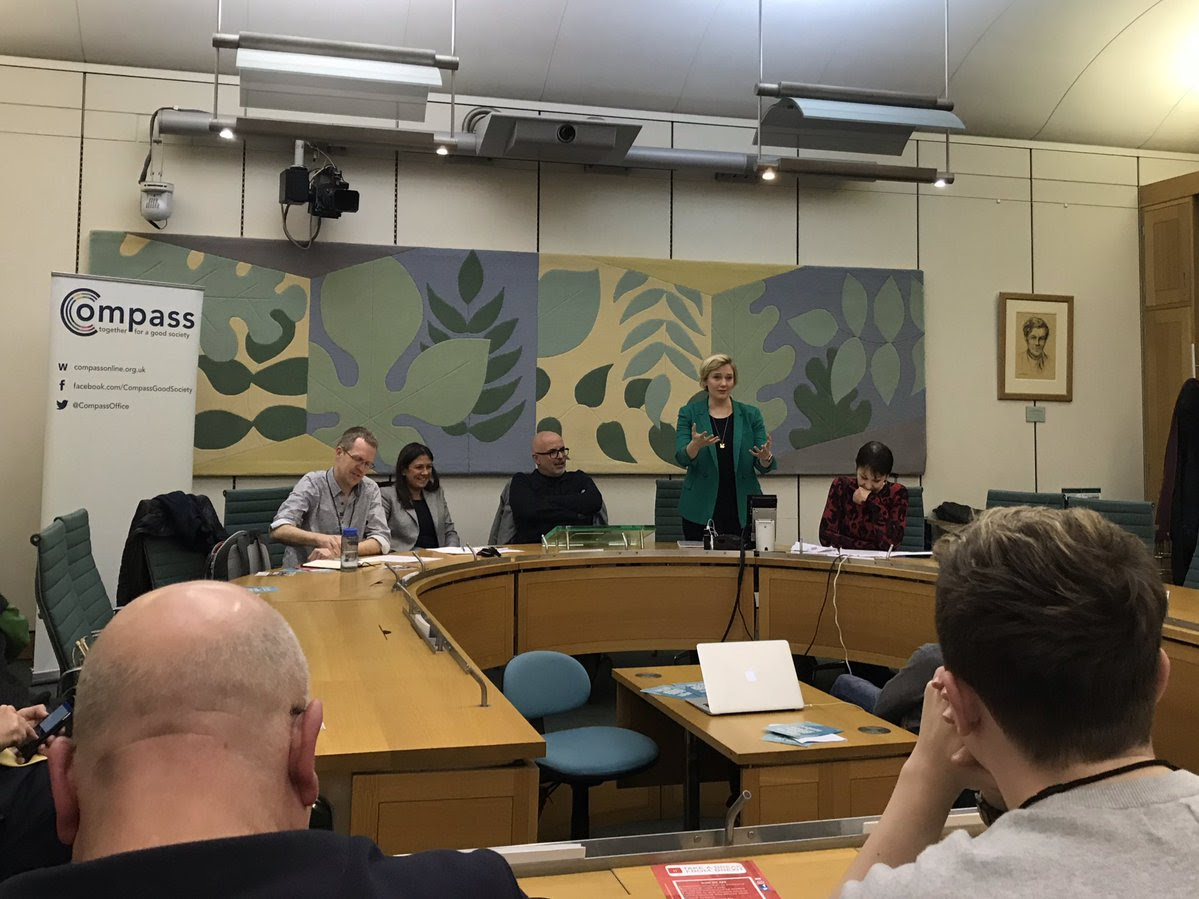
Brexit_event_Ca.jpg

Last night in Westminster, a packed room heard the case for a new politics. In times of crisis we look to the ideas lying around us – the best idea is a Citizens’ Assembly. It is time to get out of the Brexit stalemate and deepen our democracy by trusting the people.

Please do all you can to ensure the country has the option of a Citizens’ Assembly.

Our deepest thanks,

The Compass Team

The Gilets Jaunes: what are the prospects for sortition?

An article in RTL by Laure-Hélène de Vriendt and AFP (original in French, Dec. 29, 2018):

Gilets Jaunes marching in Montmartre

Perspective: Some among the Gilets Jaunes propose using citizen participation via sortition in order to create a list for the European elections.

To be used in “the great debate” by the government, proposed by some “gilets jaunes” for the European elections, citizen participation via sortition is riding high, despite some limits emphasized by researchers.

Its detractors fear a “talk-shop where legitimacy is only up to chance”, undermining the foundations of elections. Its supporters praise “the equality of chance to participate in the debate” which sortition makes possible, a specialist in democratic systems working at the Paris VIII university.

In any case, the method has the support of the government: within the framework of “the great debate”, to be held in January and February as a response to the Gilets Jaunes movement, meetings of a hundred allotted citizens in each region will be held in order to give their opinion on the grievances mounting everywhere in France.

“The idea is to make sure that the Frenchpeople who are not necessarily those most involved in public life and public conversation can give their ideas about the debate and the proposals”, explained PM Édouard Philippe last week in Haute-Vienne.

“A much more diverse representation”
For prof. Loïc Blondiaux, a specialist in those matters in Paris I university, “it is a response to the crisis of representation”. Sortition “guarantees a much more diverse representation” because “if we look at the social makeup of Parliament, there are very few workers and wage earners, as opposed to the Gilets Jaunes and to the future assembly members of the “great debate”, emphasizes the researcher. “The representatives will not speak instead of the citizens but as citizens, it is a different voice”, he asserts.

Until now, civic participation via sortition never went above the local level in France. After an experiment during the summer with a national debate for the 5-year energy plan, it “reaches for the first time the national level, with the demand coming from below”, emphasizes Yves Sintomer.

Although citizens councils and participative budgeting using sorititon already exist in municipalities, he observes, “the only institutionalization of sortition at the national level is in trial juries”, going back to the revolution.
Continue reading

The Guardian view on Brexit: the government has failed – it’s time to go back to the people

According to the lead editorial in today’s Guardian:

We urgently need innovative ways to resolve the referendum vote. Setting up a citizens’ assembly is the first step to break the impasse . . . Britain should pause the article 50 process and put Brexit on hold. Parliament should explicitly reject no-deal. MPs should then open up the debate to the country: first, by establishing a citizens’ assembly to examine the options and issues that face the nation; and second, by giving parliament the right, if it so chooses, to put these alternatives in a referendum this year or next.

It’s worth pointing out that this approach involves a mixture of sortive, elective and plebiscitary elements.

Chouard: An allotted referendum chamber

Etienne Chouard, who has been the most vocal and consistent French advocate for sortition, is having somewhat of a day in the limelight in the context of the Gilets Jaunes protests. Chouard’s other major procedural proposal is the Popular initiative (in french: Referendum d’initiative citoyenne, often referred to as RIC).

A major issue with the popular initiative process, which is practiced in Switzerland and in various US states, is the ballot qualification process. In order to cut down the number of proposals on the ballot to a reasonable number, some hurdle has to be introduced. This hurdle is usually set as the collection of a large number of signatures. This makes qualification resource intensive and thus much easier for elite interests than for the average citizen.

In an interview (original in French), Chouard lays out an interesting alternative:

Chouard: “The RIC makes it possible for a group of people, or for a single person, to pose a question for the whole of the people. One of the first questions to ask ourselves is how many people can legitimately pose a question. In Italy, in Switzerland, it is 100,000, 500,000. It could be a million. It is for us to decide. […] I would say that a single person should be able to pose a question.”

Of course, the immediate consequence of this proposal, unlimited RIC without a minimal quota, is chaos. To handle this issue, the blogger proposes a “referendum chamber” whose members are allotted ordinary citizens, as in the Athenian democracy.

Also worth noting, and commending, the way Chouard affirms his democratic convictions in response to the standard question about the danger that his proposed system would produce bad policy:

I am a democrat. That means that I support the people deciding their destiny themselves and making the most important decisions themselves. At the same time if we are really democrats and honest, then we must expect that from time to time there would be issues, which can be important ones, about which the people would make decisions that would not be the ones we would make.

The full interview (almost an hour) is available as a video.

More sortition in the Guardian

In October, the Guardian published an excerpt from Tim Dunlop’s sortition-advocating book “The Future of Everything”. Today, James Bridle offers the readers of the Guardian to apply sortition to the Brexit issue. (Of course, he is not the first with this idea.)

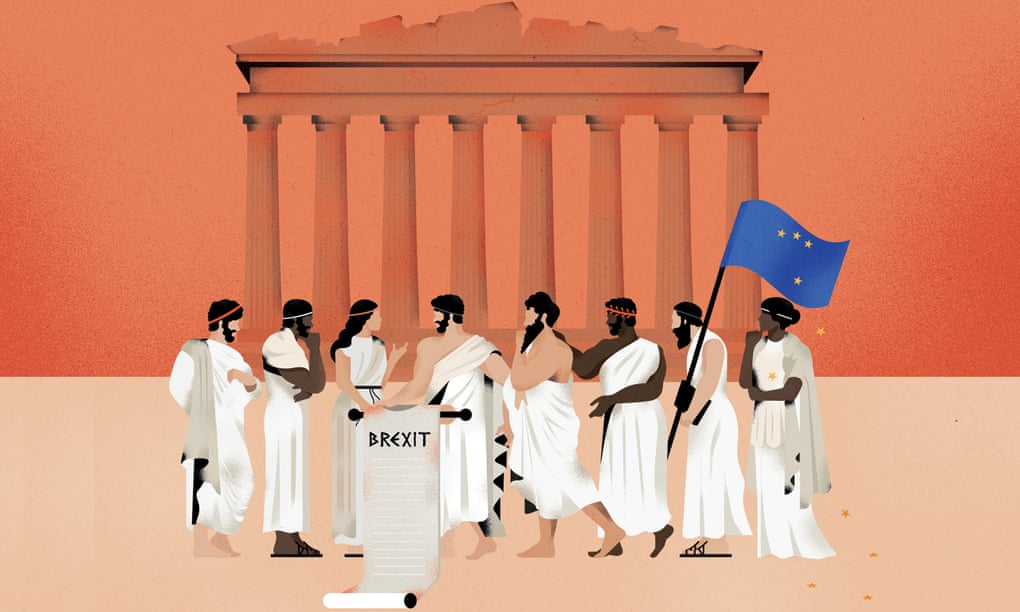
How can we break the Brexit deadlock? Ask ancient Athens
James Bridle

Citizens’ assemblies have their roots in sortition – selecting citizens at random to fill public posts – which was once central to democracy

In the central marketplace of ancient Athens, around 350BC, there stood a machine called the kleroterion. This was a six-foot-high slab of stone that had a series of slots on the front, and a long tube bored down from the top to the base. Those up for selection for the various offices of state would insert metal ID tags, called pinakia, into the slots, and a functionary would pour a bucket of coloured balls, suitably shaken, into the top of the tube. The order in which the balls emerged would determine who took which role, some for the day, some for a year.