


The Swiss news website 24heures has a story about sortition in Switzerland. (Original in French, my translation, corrections welcome.)
And if parliament members were allotted?
Democracy A seminar examines the use of sortition in Switzerland, which some citizens want to implement.
By Caroline Zuercher, 25.10.2017
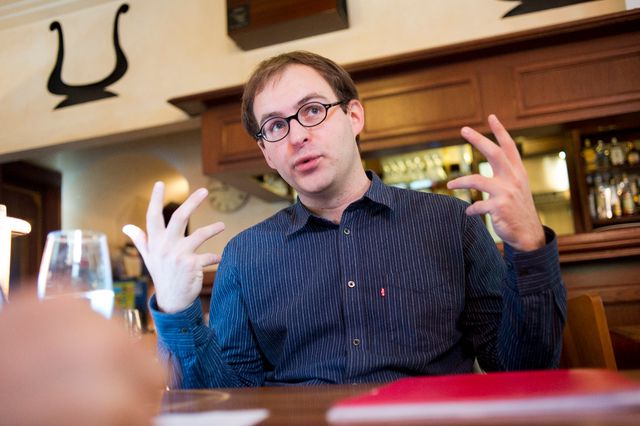 Antoine Chollet, research professor at UNIL. Photo: Marius Affolter
Allotment is useful not only for selecting the winners in lotteries. A group of citizens, Generation Nomination, wants to use it for selecting our people’s representatives in Berne. In time, they place to launch a initiative to this effect. The mechanism is far from being new having already been used in ancient Greece. An international seminar, on Friday and Saturday at the university of Lausanne is examining exactly these experiences in Switzerland and in Europe.
Sortition has been used in various contexts. And it has not always been synonymous with democracy. Antoine Chollet, teaching assistant in the University of Lausanne, gives and example. In the 18th century Berne used it to name bailiffs and other magistrates, but only the members of noble families participated in the allotment. The goal was therefore about all to share power among the powerful.
Switzerland had more democratic experiences as well. Studies supported by the National Swiss fund for scientific research examined cases in Schwytz and in Glaris. “There, the people demanded allotment in order to reduce the corruption of the elites and to enhance the circle of powerful families”, explains the researcher. In Glaris at the end of the 18 century, for example, the deputies were for allotted among the entire body of citizens. With limited success: “Our research shows that it was transformed into a form of lottery. Those who were selected could resell their post: that was the great prize!”
Continue reading
Filed under: Academia, Ballot measures, Elections, Initiatives, Press, Proposals, Sortition | 10 Comments »

 Personally, I do not dispute the utility of the senate, even if some changes could surely be considered. There are three reasons for the utility of a second chamber. First of all, a logical reason. The parliament represents the nation, and the nation is the people but also something else. The people are represented by the assembly and other thing, in our system, is the regions (territories). In countries which made the choice of bicameralism, this other thing can be different, for example in England the history of the British nobility is incarnated in the House of Lords, or the civil society in Ireland.


 The intended outcome of the workshop will be a book whose prospective title is “Legislature by Lot: An Alternative Design for Deliberative Governance”, to be published by
  Aude Lancelin: Jacques Rancière, welcome. I thank you, a great political philosopher, for coming to help us understand what is happening in a democratic country where full power is obtained with the support of less than 11% of the electorate. One of the very cruel lessons of your new book “In what times are we living?”, which is a dialog with the editor Eric Hazan, is that despite the mass abstention, despite the dysfunction of the representative system, someone holds power. Moreover, power becomes more and more oligarchical in our societies, without meeting any serious obstacle. It is not enough to turn our backs on the electoral system for it to collapse by itself. It continues to function without the popular classes, without the left… until when?
 Jacques Ranciere: As I see things, the representative system is made to function with the support of a minority. There is always this confusion between democracy as the power of all and a representative system. The electoral system is made as a conflation of the two but fundamentally the representative system is in its essence an oligarchical system. In the 17th century the representative system was therefore made for a small part of the population that was supposed to be “enlightened”, representative and conscious of the general interests of society, to be able to govern with as few obstacles as possible. At the time of the revolutions of the 19th and 20th centuries a belief in the power of people emerged, which could express itself through the electoral system and representation. Today we realize again that in different ways power is always with a small minority. In the past it was a social class, now it is difficult to say what social class can really govern the country, even if we know what interests the system serves. In consequence, we professionalization occurred which produced an interaction between a left and a right which fundamentally thought and did the same thing. And at the same time, they saw themselves as representatives and called for a non-establishment system or an “anti-system”. That is, the system itself produced its anti-system. What we see with Macron, with En Marche [Macron’s party], is a new and unexpected way in which the system produces its “anti-system”. I mean that the representative system carries within it the potential for several possibilities. There is the Le Pen style alternative, that is the people of the depths who are going to sweep away all the people of the system, and then there is of course the Macron alternative, which is a more subtle form because it replaces the system by the system itself. Fundamentally, what is the great novelty about under the banner of En Marche? These are alliances which are already known in other European countries (Germany, for example), with the difference that the parties keep their autonomy, while keeping the same politics, sometimes as adversaries and sometimes as allies.
 Adam Cronkright
 Ali
Ali Ahmed R. Teleb
 avanderven
 avergne
 Alex Kovner
 azakaras
 Brett Hennig
 campbellwallace
 Simon Threlkeld
 Nick Coccoma
 codyhipskind
 Common Lot Sortitionist
 Conall Boyle
 constitutionalism
 davidschecter
 graytmatter
 gtridimas
 H.J. Hofkirchner
 Hanspeter Rosenlechner
 John Burnheim
 jgarry20151
 Jochen Krattenmacher
 johnedwardtaylor
 johnhuang865
 Jonathan Crock
 keithsutherland
 Jacob Richter
 kkoreilly
 lukewhito
 SimonPek
 Nathan El
 Nicholas Gruen
 Owen Shaffer
 Patrick Chalmers
 Paul Gölz
 peterstone
 Pierre-Etienne Vandamme
 pronfeld
 Emil
Emil rcaze
rcaze richwbrown
 Roger Knights
 roslynfuller
 Pierre-Etienne Vandamme
 shaharavin
 tbouricius
 Ted Wachtel
 Joshua Laferriere
 theodorestathis
 towardsautonomyblog
 Wayne Liebman
 Yoram Gat
 Oliver Milne
 Equality by lot