Japan’s energy future too important to be left to experimental polling method

An opinion piece in The Mainichi:

Yoroku: Japan’s energy future too important to be left to experimental polling method

Once upon a time, in ancient Athens, state policy was decided not by elected representatives, but by a great assembly of all eligible citizens. Five hundred of these citizens were also chosen by lot for the Bouletai, or council, which spent time deliberating the issues facing Athens and drawing up bills for the assembly’s consideration.

In the modern world, a small-scale version of this selection by lot and the group deliberation that was such an important part of Athenian democracy is being resurrected by U.S. academics in the form of deliberative polls.
Continue reading

Popular Sovereignty Network

I attended the first meeting of the Popular Sovereignty Network yesterday at Queen Mary, University of London. The first talk, by Melissa Lane (politics, Princeton) was on Athenian democracy. Professor Lane took issue with the assumption that the Athenian franchise for office-holding was open to all male citizens over 30, drawing attention to the Solonic prohibition on the thetes holding office (as opposed to participating in the assembly and courts). The source for the Solonic prohibition is Aristotle’s Politics, VII 3. Scholars like Hansen and Sinclair claim that by the 4th Century the prohibition had become a ‘dead letter’, but there is no real evidence for this.

Her talk then took an unusual turn when she shifted the focus to the election of (some) officeholders, on the basis of universal (by Athenian standards) suffrage. I questioned her on the number of elected offices and she claimed it was 100 (out of around 700); nevertheless she used this to argue that Athenian democracy was not so different from its modern Schumpeterian form, in which all citizens elect officeholders and then hold them to account.

This was all a little odd (why focus on the minority of elected officials?), and not particularly convincing, so perhaps she was just trying to stir things up. But I did find her contrast between office-holding and assembly/courts to be illuminating. She disputed Hansen’s claim that ‘ruling and being ruled in turn’ referred to rotation in office, claiming that it referred more to the assembly and the courts. Jury service did involve very significant rotation and, with the 4th century innovation of the nomothetai, serious legislative power was involved. Membership of the council was a collegial office, so Aristotle’s remark could have referred to this (Hansen claims that most eligible citizens would have served on the council at least once), but note her earlier comments on the Solonic prohibition.
Continue reading

Nissani: Cheers for Direct Democracy

Dr. Moti Nissani writes in The Dissident Voice:

Revolutionary strategists must ask themselves: How can we best structure our own movement? And: What kind of political framework should we aim for, once we relegate the Banking-Militarist Complex to the dustbin of history? The answer to both questions is the same: genuine (or direct) democracy.

Democracy, for the Greeks who coined the word, meant “power of the people” or “rule of the people.” Perhaps the best-known example of a genuine democracy in a highly-advanced, highly-literate, polity, is Athens and its sister democracies of Ancient Greece. There, all significant political, legal, and judicial decisions were made directly by the people. Democratic Athens went to war if, and only if, the majority so voted; a man was exiled, or condemned to death, if, and only if, his fellow citizens so decreed.

It is a typical reformist treatment of the Athenian system. Sortition is discussed in the context of juries, but its application to political offices is given barely a mention:

The Athenians knew that power-seekers could not be trusted, so they filled many important public offices by lot. Moreover, most office holders maintained their positions for extremely short durations. Athens thereby bypassed, to a certain extent, a key problem in all other extant political systems: The ascendancy of the psychopaths.

Jeremy Clarkson calls for sortition in the House of Lords

And Your Premium Bond Prize is . . . A Seat in the Lords

In his column in the current issue of the Sunday Times, Jeremy Clarkson argues the case for appointing members of the Lords by sortition. Although the piece is written in Clarkson’s customary jocular style, it’s a serious response to Nick Clegg’s proposal for an elected house. Clarkson argues that this will attract ‘the sort of people who you’ll find in any large organisation, the sort who go to a lot of meetings and when there they eat all the biscuits . . . they go on marches but half the time they have no idea what they’re marching for.’ Clarkson refers to these political types as ‘Colins’:

Suffice to say, I have a better idea. It goes like this. Instead of filling a House of Colins with a bunch of biscuit-eating nonentities, who left to their own devices would struggle to wire a plug, we use the computer that’s used to pick premium bond winners to select eight people at random each week from the electoral list. Of course, it would be a nuisance for them to take a week off work . . . but all that will be asked of them is that they have a quick look over the bills being discussed in the House of Commons . . .

Seriously. Who would you rather have doing the job: [hereditary peers] or your mate Jim from the builder’s yard? Quite. We trust randomly selected juries on the important business of a person’s liberty, so why wouldn’t we trust a similar system to apply the checks and balances in government? . . . Certainly I’d rather have a government’s ideas checked by a small, cheap group of ordinary people than by 450 expensive Colins.

Unfortunately the article itself is pay to view.

Klirosi posters

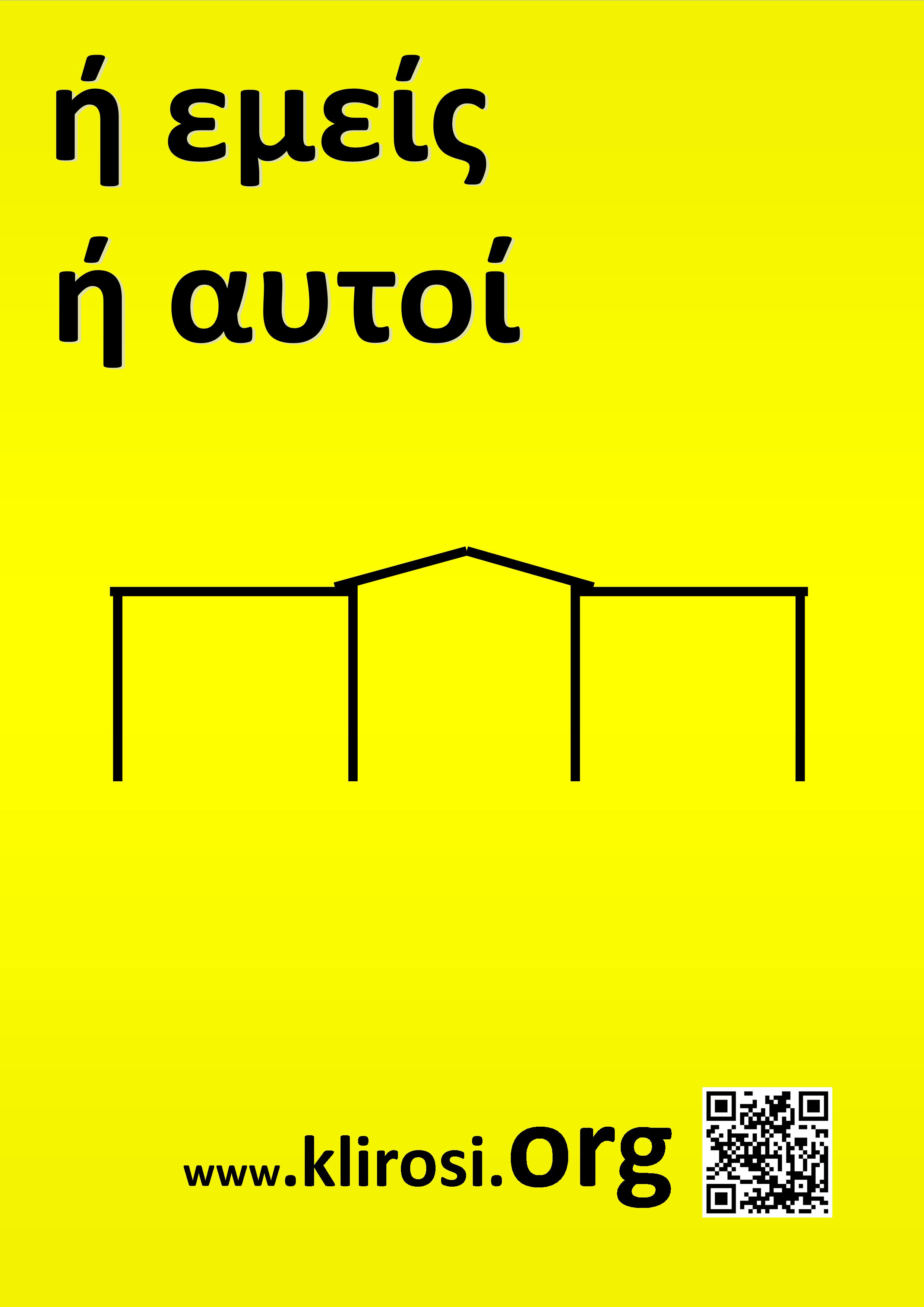
Klirosi sent a couple of election posters they created with the titles “It’s us or them” and “See the future”:

κλήρωση

κλήρωση, Greek for “lottery” or “drawing of lots” (as Google Translate tells me), is a Greek website advocating sortition.

The site presents sortition as follows (Google Translate, with some of my own touch-ups):

The Lottery

We know that you are tired of political parties and politicians. You do not want to see them, let alone hear them: tell you what you want to hear in order to gain power, and then pursue government policies other than those that were voted for.

You wonder what is the reason to vote…

The lottery is a way to finally achieve a truly representative democracy. To solve a problem that is not only Greek, but global. Greece can be talked about everywhere, not a corrupt country, but as a country of innovation, leadership and democracy. An example to follow.

Just do not expect saviors. Just believe in yourself.

Sortition is aimed at regeneration of the democratic political system based on the belief that only democracy can lead to improving the lives, dignity and ολβιότητας[?] of the Greeks. The basic principle of the movement coincides with one of the basic principles of democracy as implemented by Solon, Cleisthenes, Pericles and was described by Thucydides and Aristotle.

The Republic is achieved not solely through elections, but especially through sortition.

Opportunity for easy online activism

David Grant wrote to draw attention to an online proposition and voting exercise at Slate magazine. Readers are asked to propose pieces of reform for the U.S. constitution and to vote for their favorite proposals.

David wrote a proposal titled “Use sortition, not elections, for a Citizen House“.

Browsing around at random, I found a similar proposal: “Select our representatives by lottery“.

Voting for those proposals is an easy way to highlight the idea of sortition. Registration to the site (free and easy) is needed in order to vote. You can vote more than one proposal.

Ordinary citizens? Are you crazy?

Harvard Magazine has an article about Lawrence Lessig’s reform proposals. Lessig has been promoting his proposal for “democracy vouchers”, but it turns out that he has another proposal to make – a Constitutional Convention selected by sortition:

[Lessig] writes: “I recognize that of all the insanity strewn throughout this book, this will strike readers as the most extreme. Ordinary citizens? Are you crazy? Proposing amendments to our Constitution? When two-thirds of Americans can’t even identify what the Bill of Rights is?”

Are Sortitionists sincere?

Do sortitionists really believe their own rhetoric? A Citizen’s Jury will be called using the method of random selection. They then proceed to chew over the issue at hand, and normally decide by voting!

What’s the matter with these guys? Surely the matter should be resolved, either by Unanimity, or failing that by a lottery, weighted by the votes of the CJ?

I was inspired to pose this question after reading a piece about the rise of Majority Voting which is mostly about French and Catholic Church experiences.

The Anglo-juridical Jury (12 citizens drawn at random) used to require unanimity, and still needs 10/12 to convict. Who so?

Iñaki Berazaluce: Por qué es mejor elegir a los diputados al azar

Pluchino et al. are invoked by Iñaki Berazaluce:

350 diputados y 208 senadores, elegidos por sufragio universal cada cuatro años para votar como un solo hombre los designios de sus respectivos partidos. ¿Es esta democracia la mejor posible?, ¿es la única posible? Unos científicos italianos han demostrado que el sistema sería más eficiente si un determinado número de legisladores (no todos, de momento) fueran escogidos al azar entre todos los ciudadanos en lugar de ser elegidos en las urnas.

This article generated some lively discussion on Menéame (noted by Tomaso Mancebo).