A new paper in the European Journal of Political Research (full text) provides data about popular support for allotted citizens’ assemblies in Western Europe. The countries surveyed were: Austria, Belgium, Denmark, Finland, France, Germany, Greece, Italy, Ireland, Netherlands, Norway, Portugal, Spain, Sweden, and the UK.
Public Support for Deliberative Citizens’ Assemblies Selected through Sortition: Evidence from 15 Countries
Jean-Benoit Pilet*, Damien Bol**, Davide Vittori*, and Emilien Paulis*
*Université libre de Bruxelles, Belgium
** King’s College London, United Kingdom
Abstract
As representative democracy is increasingly criticized, a new institution is becoming popular among academics and practitioners: deliberative citizens’ assemblies. To evaluate whether these assemblies can deliver their promise of re-engaging the dissatisfied of representative politics, we explore who supports them and why. We build on a unique survey conducted with representative samples of 15 Western European countries and find, first, that the most supportive respondents are those who are less educated, have a low sense of political competence and an anti-elite sentiment. Thus, support does come from the dissatisfied. Second, we find that this support is for a part ‘outcome contingent’, in the sense that it changes with people’s expectations regarding the policy outcome from deliberative citizens’ assemblies. This second finding nuances the first one and suggests that while deliberative citizens’ assemblies convey some hope to re-engaged disengaged citizens, this is conditioned to the hope of a favourable outcome.
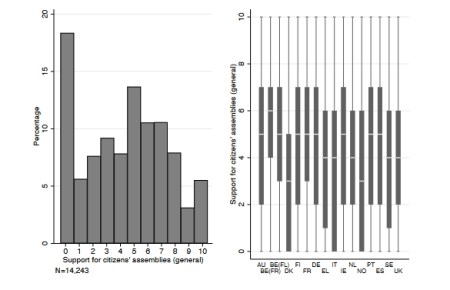
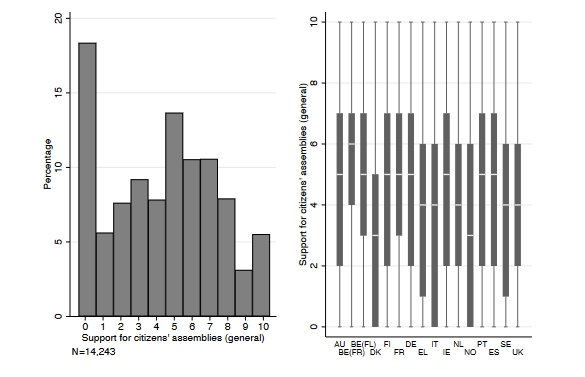
Despite emphasizing the “deliberative” label in the title of the paper, the question measuring support for allotted assemblies makes no mention of this obfuscatory term and instead focuses directly on decision-making power:
Overall, do you think it is a good idea to let a group of randomly-selected citizens make decisions instead of politicians on a scale going from 0 (very bad idea) to 10 (very good idea)?
The median response was 4.32, which is pretty impressive for such a radical idea. The chart below shows the distribution of responses. It is interesting to note that (if I read the chart correctly) the two countries with the lowest median support for the idea (3/10) are Denmark and Norway – the two Scandinavian countries in the survey. Those countries are among those with the highest level in the Western world of satisfaction with current government.
Filed under: Academia, Opinion polling, Press, Sortition | 15 Comments »


 I’ve been meaning to post about this, but sadly the end of term proved rather hectic for me. I was interviewed in April about sortition for the Finding Genius podcast. It was a good interview–wish I’d seen the interview with Simon Pek beforehand, as the topic of sortition inside of firms came up. The picture they found of me is ten years old, but I’m not going to complain about that! The podcast can be accessed here: Revolutionizing Democracy – The Benefits Of Sortition and Selected Citizens Councils with Dr. Peter Stone.



 Micah Erfan is an economics freshman at the University of Houston. He
 Adam Cronkright
 Ali
Ali Ahmed R. Teleb
 avanderven
 avergne
 Alex Kovner
 azakaras
 Brett Hennig
 campbellwallace
 Simon Threlkeld
 Nick Coccoma
 codyhipskind
 Common Lot Sortitionist
 Conall Boyle
 constitutionalism
 davidschecter
 graytmatter
 gtridimas
 H.J. Hofkirchner
 Hanspeter Rosenlechner
 John Burnheim
 jgarry20151
 Jochen Krattenmacher
 johnedwardtaylor
 johnhuang865
 Jonathan Crock
 keithsutherland
 Jacob Richter
 kkoreilly
 lukewhito
 SimonPek
 Nathan El
 Nicholas Gruen
 Owen Shaffer
 Patrick Chalmers
 Paul Gölz
 peterstone
 Pierre-Etienne Vandamme
 pronfeld
 Emil
Emil rcaze
rcaze richwbrown
 Roger Knights
 roslynfuller
 Pierre-Etienne Vandamme
 shaharavin
 tbouricius
 Ted Wachtel
 Joshua Laferriere
 theodorestathis
 towardsautonomyblog
 Wayne Liebman
 Yoram Gat
 Oliver Milne
 Equality by lot