Non-Partisan Sortition Activism: Real Or Imagined?

I’ve recently been urging legislators in my home state of California to write a bill to implement the CIR (Citizens’ Initiative Review) process to make our ballot proposition system more democratic. We have two parties in our state, and generally, one (the majority) has been more receptive to such a bill than the other. This reflects the national situation where one major political party seems at least overtly supportive of democratic reform, whereas the other, not so much. This state of affairs contrasts with polls that show the idea of democratic lotteries to be popular with both conservatives and progressives. Of course we need to be building a cross-ideological grassroots coalition to give democratic lotteries a place in government. But what about the existing political parties holding power? Currently they make the laws. Do we try to work with them or do we ignore them?

Suppose I continue to have no luck with minority party legislators and we get a CIR bill in my state, and suppose it’s entirely supported by the majority party and not the minority party. This is not a hypothetical. There is a real possibility that such a bill could pass the legislature and become law. But is it worth it? Or will a CIR law supported by only one party, even if the majority party, paint the sortition movement as partisan? Is a one-party supported CIR worse than no CIR? Should we not be working with the legislature at all, but rather using the initiative process in our attempts to make change?

Landemore: Open Democracy, part 8

Chapter 6 of Open Democracy presents “institutional principles” of “open democracy” – Landemore’s ideal system. These are aimed to be compared and contrasted with the principles of “assembly democracy” – the Athenian system, and with the principles of “representative democracy” – the present day electoralist system.

“Assembly democracy” and “representative democracy”

The initial section describing the principles of the Athenian system and of the electoralist system presents a rather conventional view of both those systems. The names used for as labels for those systems are themselves more easily attributable to convention than to their descriptive power. The Athenian system is labeled “assembly democracy”, putting the emphasis in that system, following convention, on the assembly. Landemore does mention the “less often remarked upon” equality of “opportunity to participate in the agenda-setting Council of 500”, but this remains a detail rather than a focal point. The electoralist system is labeled “representative democracy” and is presented as having a commitment to “equality” despite the fact that equality not only is far from the reality of this system but was also explicitly denied as a design goal at the outset.

The conventional approach persists throughout the description of those systems. There is the supposed contrast between “constitutionally entrenched” modern individual rights and the lack of those in Athens. It is far from clear that this conventional contrast is more than apologia for the modern system. In terms of either “institutional principles” or ideology it would in fact be hard to show that such a contrast exists. The Spartan sympathizers in Athens, for example, enjoyed freedom of expression and action that are almost unimaginable in modern “democratic” societies.

Another conventional contrast that Landemore adopts is in the attitudes toward the majority principle. Landemore says that majoritarianism was wholly embraced by the Athenians but is embraced with reservations in the modern system, where it is supposedly feared for potential of “tyranny of the majority”. It is true that “representative democracy” is historically ideologically anti-democratic and thus anti-majoritarian. However, this is a vestigial feature of the modern system and in its contemporary form “representative democracy” is ideologically democratic – and thus committed to majority rule – even if it is substantively oligarchical.
Continue reading

The True Representation Pledge

This is the final chapter from my book published last year entitled “True Representation: How Citizens’ Assemblies and Sortition Will Save Democracy.”

What if we were to demand that every candidate for President, Senate and House of Representatives sign a True Representation Pledge? The pledge strategy can be used in any election, in any country, at the national, state, provincial or local level, wherever people want to demonstrate the potential of sortition and citizens’ assemblies, by targeting an important issue that politicians cannot resolve.

In signing the pledge, each candidate would promise, upon being elected to office, that:

  • They would quickly enact legislation to authorize and fund a national (or state, provincial or local) citizens’ assembly to decide an important issue, identified for the pledge.
  • The citizens’ assembly would be conducted with a briefing book prepared to fairly represent the pros and cons of a wide range of views on the chosen issue.
  • Continue reading

Austria’s Climate Jury – A Mixed Effort

Austria has now joined the circle of democratically-minded countries planning a government-sponsored Climate Citizen Jury (“Klima-Bürger*innenrat”) to tackle climate change. This follows a national popular initiative signed by 380.000 citizens of election age. At this stage, the envisaged process and timing is still quite unclear, what little has transpired is a mixed bag of some good and regrettably also some bad.

What is clear is that this mini-public shall consist of 100 random citizens and be “representative” for the general electorate of 6.4 million. Two issues here: the target number is underpowered, for comparison, Austria’s parliament consists of 183 representatives. And seeking “representativeness” in these numbers is a turnoff for those who know about statistical sampling requirements needed for this highly elusive adjective. An unnecessary weakness, the use of the word “representative” is entirely unnecessary when a simply “stratified” jury will serve the democratic purpose perfectly fine.

Clear is that the jury shall be tasked – similar to France – “to discuss and elaborate specific proposals for political measures to reach climate neutrality by 2040”. As I have noted in this forum so often, this fashionable brief is doomed to fail, just as it failed in France. An institution composed of random citizen juries is simply out of its depth with such a broad task and of such complexity. Like in France, well-meant but half-baked proposals will not impress those knowledgeable of consequences or charged to implement them. The elaboration of political proposals should be part of an open innovation competition in which any citizen or organisation is entitled to compete. Only then it is the turn of citizen juries to hear two-sided expert testimony, to judge and select between these, a task to which they are perfectly suited.

For the recruiting plan there is some encouraging information. The ministry’s intention is to recruit these random citizens proactively instead of the problematic oversampling of activists. Proof in point: a hundred of the usual suspects have already knocked at the ministry’s door but were sent away with the promise of some parallel participation process.

Recruiting will be put into the hands of a professional social research institute after a public tender – although rumours have it that SORA Institut will get the contract, anyway. There seems to be awareness of the distortions resulting from low invitation vs. acceptance rates in France.

Whether the future selected institute knows how to ensure the correct stratification for a jury is up in the air. An indicator for methodic accuracy will be that the final jury should seat 6 signatories of the public initiative (380k / 6.4m) and 43 members which see an immediate need to act on climate protection, corresponding to the ex-ante percentage of the general public which do so, according to pollsters.

Nothing is known as of yet about deliberative process design, organisation and moderation.

Finally, the Citizen Jury’s “proposals” will be sent to a committee of national and regional government representatives. There is no information about any commitment or obligation to proceed with the proposals. Sadly, and in light of the unrealistic mission definition, this may be a lesser issue due to the likelihood of failure.

Here is to an article from an Austrian daily newspaper (in German language):

https://www.derstandard.at/story/2000125369666/klimapolitik-als-demokratisches-experiment-parlament-ebnet-weg-fuer-buergerrat

Democratic power, outcomes and ideology

This post continues the inquiry carried out in a few previous posts regarding how democracy can be measured. Thanks to various commenters for the discussions that encouraged further thought on this matter.

Dimensions of democracy

In a democracy, political power is distributed equally among all members. This should probably be considered the definition of democracy. However, there are two additional democratic dimensions: democratic outcomes and democratic ideology. Outcomes are democratic when power is used to serve everybody equally. Democratic ideology states that political power should be distributed equally. This normative statement could be justified either directly or consequentially. The direct justification is that equally distributed political power is the only just political arrangement. The consequential argument is that democratic outcomes are the only just outcomes and that democratic power is the only political arrangement that can deliver democratic outcomes. Presumably often those with democratic commitments believe in both the direct and the consequential arguments. The position that political power must be distributed equally even if this leads to undemocratic outcomes seems questionable. For those who adopt consequential democratic ideology, democratic results are a necessary and sufficient condition for democracy (i.e., for democratic power).

A-priori, there are 8 possible situations regarding the presence or absence of democracy along each of the dimensions of democracy. A wholly undemocratic society lacks all three dimensions: the dominant ideology is not democratic, power is distributed unequally and the outcomes favor some at the expense of others. A fully democratic society has all three dimensions present: the dominant ideology is democratic, power is equally distributed and outcomes serve everybody equally. Partially democratic societies could have some combination of situations along the axes.

As pointed out above, however, to believe that democratic outcomes can exist in a non-democratic society, or that non-democratic outcomes can exist in a democratic society we – as observers – need to adopt a non-democratic stance. Accepting that democratic power is uniquely suited for attaining democratic outcomes implies believing that the settings along those two axes must be aligned.
Continue reading

Landemore: Open Democracy, part 7

Having argued in Chapter 3 that all mass democracy is representative (i.e., cannot be based on mass participation on a basis of equality), Landemore proceeds in chapters 4 and 5 to offer an analysis of representation which aims to determine which mechanisms of representation should be considered as good. The idea, it seems, is to define criteria for good representation that would allow the examination various forms of representation – electoral, allotted, self-selected, “liquid” – and assess their quality. Doing so we will “complicate our understanding of democratic representation” (p. 80) and allow us to overcome the established habit of regarding electoral representation as the only good representation.

All of this may seem like a constructive way to proceed, but in fact it is a framing of the question of government and democracy that is already committed to a set of problematic conventional assumptions. This framework conceives of government as being created through an act of delegation of power by individuals to representatives and thus focuses on the supposed act of delegation as the critical point which needs to be analyzed and rationalized. This leads to a formalistic discussion regarding the notion of representation and regarding formal properties of the mechanism of appointment of representatives. The author then finds herself encumbered by a set of questions to which the answers are often blurry or unsatisfactory. With this formalistic focus, government as an ongoing phenomenon in the world – its policy outcomes, primarily, but in general the role government plays in the world – is sidelined, ignored almost entirely. The result is a morass of “analytical hair-splitting” (Landemore’s own expression, p. 108), which does produce a lot of complication but despite much effort produces little insight.

Landemore follows convention, then, by putting heavy emphasis on the notion of a “representative” – someone (or some group) being recognized as “standing in for” a group (or for another group). This notion which is supposedly fundamental serves no useful purpose in the discussion as far as I can tell. A-priori it is unclear that such a “standing in for” relationship is necessary for government in general or for good government in particular. This is thus a poor starting point. Having started with “representation”, Landemore now spends her effort on defining what democratic representation is (representation that is “characterized by inclusiveness and equality”) and what legitimate representation is (representation that has been “properly authorized”). At the outset neither of these characteristics seem clearly meaningful or useful, and the lengthy discussion that ensues does little to dispel this suspicion. It is also rather surprising that in this theory of representation the matter of deliberation – which was so prominent in previous chapters – plays a very minor role.
Continue reading

Waserman: What the Convention has brought to us is different from what government or Parliament would have produced

Sylvain Waserman is a representative from Bas-Rhin and the vice president of the French National Assembly. He is a member of Macron’s party, LREM. He published the following piece in the French Huffington Post.

The Climate Convention: a democratic innovation or a sign of crisis of the representative system?

The citizen climate convention tests our democratic model. It was born in an atmosphere of general skepticism, or even worse, a certain condescension. We kept hearing that sortition has no democratic legitimacy and that its place is only in the history books under the heading “Ancient Greece”.

Today the situation is quite the opposite: no one doubts anymore the value of the proposals formulated, and the only question is about knowing how those proposals will be implemented and if they are going to be implemented in full.

When the so-called “climate and resilience” bill arrived at the Assembly, numerous deputies expressed irritation and some opined that this signaled another decline in the status of Parliament and a negation of the role of its members.

Following the example of the citizen members of the Convention

Let’s be clear: what the Convention has brought to us is different from what either the government or the Parliament would have produced in a classic legislative process. Surely it is more audacious and truly different. Let’s have the humility to recognize that and the intelligence to see that as a virtue rather than as an affront. The best example is the text for the amendment of the first article of the Constitution. Few among us would have spontaneously proposed the bold formulation adopted by the Convention: “France guarantees the preservation of the environment and of biodiversity, and the struggle against global warming”. The term “guarantee” is vertiginous and could open the door to questions of constitutional priorities, leading to complex issues and giving constitutional judges wide discretion in invalidating laws which would not respect this guarantee. Indeed: Nicolas Hulot, a sincerely committed environmentalist, had proposed constitutional reforms that are judicially less risky and more convenient legalistically, such as “France acts in order to” or “committed to promote”.
Continue reading

Significant support in European countries for citizen assemblies as a complement to parliament

A recent poll finds (p. 129 and on) that the public in France, Germany, the UK and Italy is generally supportive of using allotted bodies to discuss and form opinions regarding various matters, with two thirds of those polled supporting using such bodies to address national-level issues.

Most surprising is the finding that about 30% of those polled support having such bodies used systematically to complement the work of parliament. The fact that there is widespread support for establishing a political power which is independent of the elected bodies is most extraordinary since there is no precedent for such an institution in modern times and since there has been no significant advocacy for such an idea by any established political power.

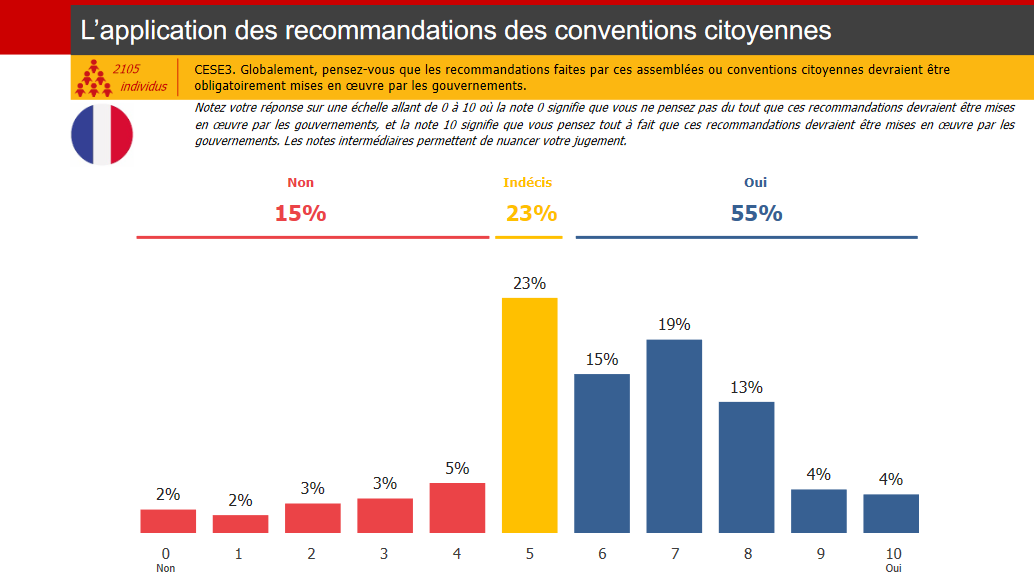
In addition, a large majority of the citizen polled believes that the decisions made by the allotted bodies should be binding: 55% supporting, 23% undecided, and only 15% objecting.

(Thanks to André Sauzeau for pointing out this poll.)

Public Support for Citizens’ Assemblies Selected through Sortition

A new paper explores public opinion in the EU regarding sortition based decision-making bodies. The paper was written by Jean Benoit Pilet, Damien Bol, Emilien Paulis, Davide Vittori and Sophie Panel.

Title: Public Support for Citizens’ Assemblies Selected through Sortition: Survey and Experimental Evidence from 15 Countries

Abstract:
As representative democracies are increasingly criticized, a new institution is becoming popular in academic circles and real-life politics: asking a group of citizens selected by lot to deliberate and formulate policy recommendations on some contentious issues. Although there is much research on the functioning of such citizens’ assemblies, there are only few about how the population perceives them. We explore the sources of citizens’ attitudes towards this institution using a unique representative survey from 15 European countries. We find that those who are less educated, as well as those with a low sense of political competence and an anti-elite sentiment, are more supportive of it. Support thus comes from the ‘enraged’, rather than the ‘engaged’. Further, we use a survey experiment to show that support for citizens’ assemblies increases when respondents know that their fellow citizens share the same opinion as them on some issues.

Democratic lotteries featured in FastCompany

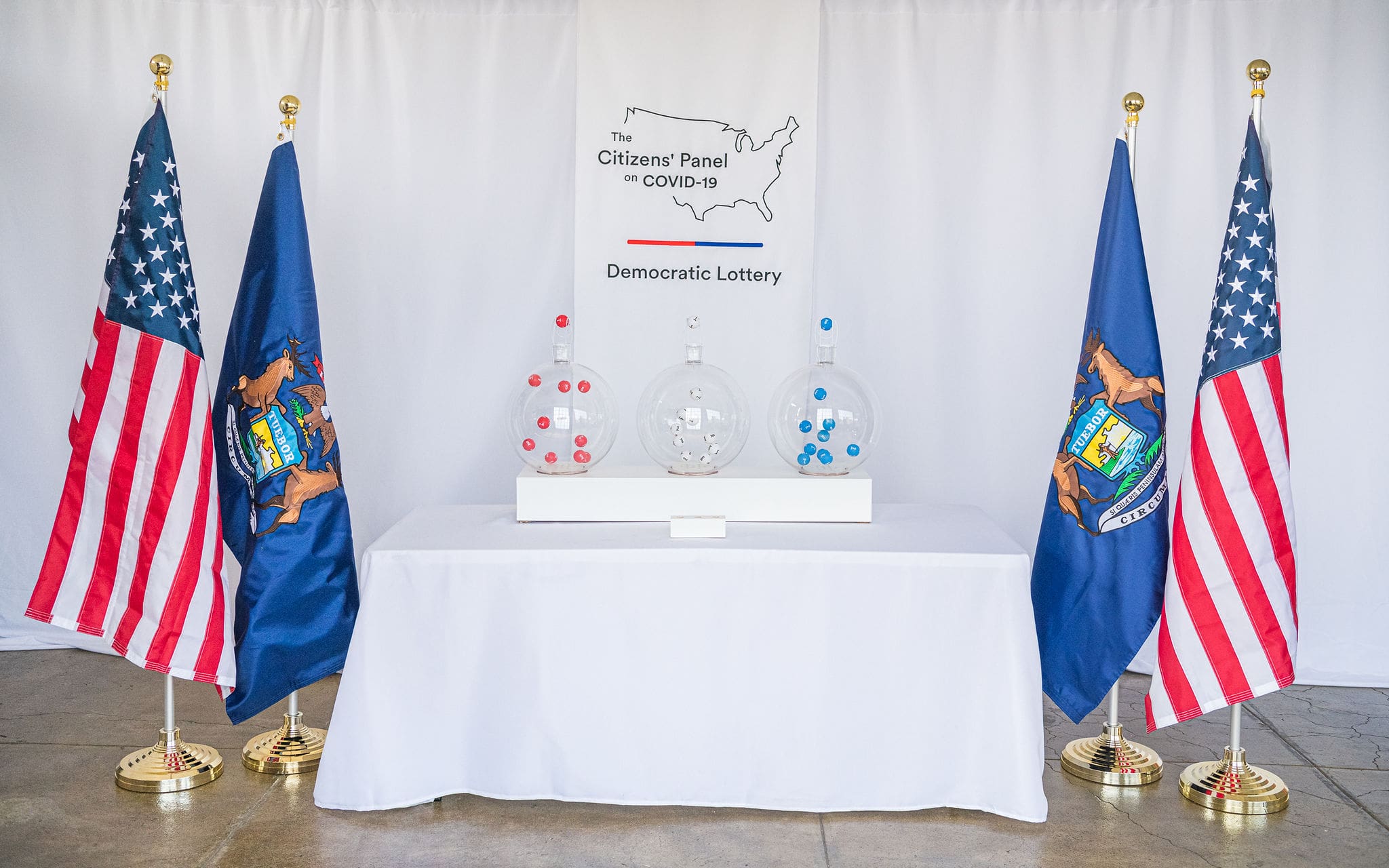
Democratic lotteries and our organization, of by for*, were recently featured in a piece in FastCompany. The article introduces selection of representatives by lottery, the history in Athens, Democracy R&D, and our recent Citizens’ Panel on COVID-19. It will be followed up by a ‘World Changing Ideas’ podcast episode within the next month.

Excerpt below and full article here: What if we replaced elected politicians with randomly selected citizens?

For Cronkright, drawn-out election cycles—filled with stump speeches, attack ads, and super PACs—are dysfunctional. The candidates are often “slick and vicious performers” trained to put on a show and say the right things, who spend most of their time fundraising. “We are awarding power to those who can win, and keep winning, cutthroat popularity contests,” he says. When elected, many politicians are then at the whim of parties, lobbyists, and corporations and don’t have personal incentives to make the right decisions for the average Joe. “To me, they’re the least qualified bunch to represent us,” he adds.

Real representation can only be achieved by putting ordinary people in charge of governing. That means “representatives” should reflect the greater population’s demographics, but also its struggles, fears, hopes, and values. These people would be accountants, waitresses, engineers, business owners, single mothers, and students, who are actually affected by the decisions they make for everyone. “If they sink the ship,” he says, “they, too, are going down.”