Sortition and reform of political institutions

Keith has described me as the Godfather of sortition. Of course, I reject the capital G, which is associated with mafia, but I also reject the strict Christian role in which the godfather promises to see that the godchild is brought up in the True Faith. For me there is no such thing, especially in politics.

Politics is mainly a matter of making and enforcing collective decisions where it is desirable to do so. The decision procedures and enforcement procedures may well differ from context to context. As every engineer knows, a design that will work well on a certain scale will fail miserably and perhaps disastrously on a smaller or larger scale. From my first book on I have always seen sortition as a procedure that depends for its utility on many factors. In that book I argued for it as a way of selecting decision-makers in the decentralised authorities that I hoped might replace most of the functions of the highly centralised modern state.

The structuring of authorities charged with producing or protecting certain public goods has to be designed in relation to the problems that emerge from patterns of social interaction. In that book I singled out a few examples of areas of social activity that might have their own independent regulatory authority. But I had no systematic analysis of the problems of contemporary society. Certainly, if I had one it would now be hopelessly out of date. Humanity now faces major problems of which we were hardly aware a generation ago, some created by, and all changed by the explosion of our capacity to record, store, process, communicate and exploit information, where that misleading word has to cover not just figures and facts, but contracts, threats, promises, suggestions, commands and many other kinds of organisation, interaction and interdependence.

All nations have surrendered control of their currency, their terms of trade, much of their law and even entertainment to supranational bodies and processes. The nation-state as we know it survives as the authority responsible for many of these activities, only because we have not invented authorities capable of regulating them satisfactorily on the required scale, and we need to feel we are doing something about them by the occasional international agreement.
Continue reading

Why worry about equality

We all gain in numerous ways from the fact that we are all different to varying degrees in most respects. Strict equality in any respect can only mean uniformity in that respect. Equality as such is not generally a good thing. Certain varieties of socialist thinking that focus on eliminating inequalities inevitably turn out to be very oppressive. (Marx himself was not guilty in this respect.)

However there are many kinds of inequalities that have very detrimental effects on people’s lives. Some of these are due to natural causes, like many physical disabilities. It is to the credit of the much-maligned “nanny state” that we devote quite a lot of resources to helping people with disabilities to participate in as many areas of social life as possible.

Many other injurious inequalities are socially constructed, sometimes deliberately, but often as an unintended result of activities, some legitimate, others criminal undertaken for other reasons and causes. Some of these are remediable without recourse to compulsion, simply by dissuading the culprits from doing certain things, often just by shaming them. Those so shamed often attempt to deride this as “political correctness”. Obviously it can go too far.

Even those activists who operate principally without invoking political authority sometimes try to have the activities they want to suppress declared illegal, not so much in order to impose legal penalties on their targets as to show their opponents that the nation collectively disapproves of what they do. Obviously, that can help the activists to defend themselves from the imputation of being an idiosyncratic clique. It is a two-edged sword. Concentrating on legality invites the response that nobody has a right to criticise people who are doing what they are legally entitled to do. Usually the sorts of activity in question are mainly matter if intent in acting and notoriously difficult to prosecute. So some egregious offenders escape. Moral matter should as far as possible be left to moral suasion. Continue reading

The practicalities of demarchy

1. In order to be THE voice of public opinion the council advancing that claim would need to be unique and unchallenged. But if anybody can set up a rival council, that is impossible. If anybody takes it seriously, it will be challenged and rivals set up.

Answer. There are two stages in the proposal: a fully open public discussion and the council attempting to draw a practical policy from that discussion.

The public discussion will be unique if the Foundation sponsoring it has adequate resources to publish and render accessible on line every word that anybody thinks relevant to the problem under discussion. If anybody sets up a rival forum, all of its content will be posted on the original site, where it could have been posted at no cost. So if somebody refuses to allow certain material to be posted, they are refusing to offer it for public scrutiny.

How might they justify that refusal?

Perhaps it is copyright, and they demand to be paid for it. In a genuine case, the foundation might agree to pay whatever any other user would pay for it. In some cases a reference to sites on which it has been published might suffice.

In other cases the appeal might be to confidentiality, for example, in the case of survey documents. That sort of confidence protects the identity of contributors to the survey, not its content. When it comes to privacy about the actions of individuals and organisations, such privacy can never be invoked in a way that favours a competing open forum. It has to remain private.

Some may argue that the way in which the problem is described by the foundation in initiating discussion is subtly biased to exclude certain viewpoints. In that case they need to state their case and argue it publicly.

A completely open forum, including full documentation on the proceedings of the foundation, can be reduplicated, but the only point that could have was to try to exclude certain contributions. And that cannot be done with impunity.
Continue reading

Talking Democracy on Talking History

I recently appeared on the Irish Radio show “Talking History.” I was part of a discussion of democracy with Paul Cartledge, the esteemed classicist; Roslyn Fuller, whose work has been discussed on this blog; and Iain Walker, from New Democracy in Australia. Much discussion of Athens and sortition. The show can be heard here:

https://www.newstalk.com/Is-democracy-the-best-we-have

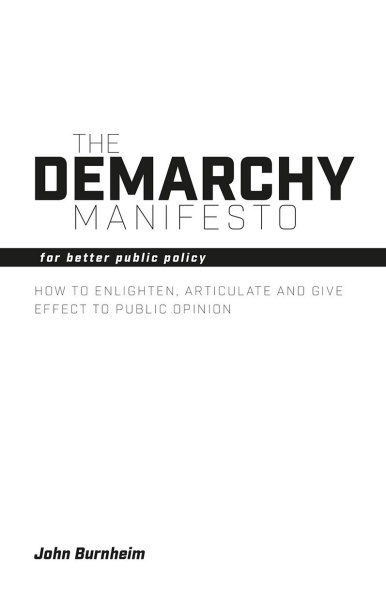
The Demarchy Manifesto

71157100257740l

Many kleroterians are bound to be disappointed in my new book The Demarchy Manifesto, due to be release from Imprint Academic on March 1, because it makes no proposals for replacing voting in favour of sortition in existing institutions, but only in the new voluntary institutions I propose. I believe it is necessary to start this way, since it is extremely difficult to persuade people to give up their vote, but they are prepared to consider sortition where it gives them access to a chance of participating that they do not at present have. This is just an instance of a general pattern in the way that the presentation of options makes a great difference to the evaluations people make of alternatives. You might like to look at this article in the US edition of The Conversation for February 6.

The book suggests that we can snatch the initiative in discussing and formulating public policy from the political parties and produce proposals that they have to accept on pain of voter backlash. I think that there is just a chance that my proposals would consolidate the middle ground whereas the existing procedures encourage the extremes. More fundamentally I aim to move attention from “who gets what” to the sort of public goods that we all can take pride in.

An excerpt from the Introduction to the book:

What I call ‘demarchy’ is primarily a process of transferring the initiative in formulating policy options from political parties to councils representative of the people most directly affected by those policies. The task of those councils would be to distil from public discussion the most acceptable policy in a particular matter. It would be up to voters to insist that the politicians heed them. There is no question of constitutional change, no new parties or new laws, no call for a mass conversion of opinion, but a suggestion about how to initiate a change in accepted practice, starting with actions that may seem of little significance in the big picture, but are still justified by their specific purposes. My focus is on how policy is produced and adopted. I am not concerned with questions about the philosophical basis of state power, or human rights, or crime and punishment. The precise forms these things take in practice are a matter of conventions, which I do not propose to challenge. There is already much debate about these matters. I am concerned about what I see as a more important, but neglected, question.

I begin by concentrating on how to establish some new practices and initiatives in policy formation, empowering those most affected to take the initiative in formulating what they want. It is no advantage to have a choice of products if none of those on offer meets your requirements. The best situation is to be able to say exactly what you want and commission specialists to supply it. Or is that analogy anachronistic and inappropriate in the era of mass production and distribution? I try to analyse our unique problems. My ultimate aim is to transform our political culture. I intend to show how different practices of policy formation are appropriate to different problems at every level from the local to the global and how they might come to be accepted.
Continue reading

Democratising Deliberation: Parliamentarism, Deliberative Democracy and Lotteries

This article [PDF], by Anthoula Malkopoulou, is a commentary on the work of political theorist Kari Palonen on parliamentarianism. In response to recent scepticism, Palonen’s support for the ‘classical paradigm of elected Members of Parliament looks outdated and insufficiently responsive to the challenge of rising inequalities’:

On one hand, sceptics point to the inherent aristocratic or elitist character of elections, embodied in the perceived superiority of representatives compared to the represented (Manin 1997, 134–149). This is sustained not only by century-long anarchist polemics against bourgeois parliamentary democracy, or populist shaming of political corruption, but also by legitimate i.e. republican concerns about election engineering or illegitimate political lobbying. On the other hand, many scholars are worried by the growing social inequalities enabled by the predominance of economic liberalism since the 1980s (Rosanvallon 2013). These are often exacerbated by corresponding inequalities in political influence that further benefit the wealthy and socially advantaged classes (Hill 2013; Malkopoulou 2014). In this respect, legitimising the current system of parliamentary government and providing its apology sounds far too elitist and self-defeating.
In response to such scepticism, Kari has showed some interest in opening his parliamentary model of deliberation to new modes of inclusion . . . his ideal-typical democratic innovations include the practice of rotation, election of singular representatives who are not linked to political parties, and recently, support for the random choice of representatives (Palonen 2014, 345). This turn is linked to the dissociation of random selection from Habermasian consensus and its support by klerotarians as a device that is independent of the process of deliberation (Stone, Delannoi and Dowlen 2013).

Continue reading

Charlie Douglass: Guaranteeing gender equality

A post by Charlie Douglass.

Democracy we are told is government by the people. What if many of the people aren’t involved? What if some have a much stronger voice than others?

If a government is to act on behalf of people of every colour, gender, age, and wealth status, then we must either rely on politicians ignoring self-interest completely, or find a way in which a house of parliament can have its members chosen very differently to today. Bias matters because today our parliaments under-represent many groups. Women are under-represented and although some change is happening, the change is slow. Why should the men who are already there be the ones who decide how fast the change is? Why is there so little effort to represent people from below the poverty line?

If you could draw equal representation from across society into a house of parliament, then self-interest matters much less. If a parliament was half female, half male, and contained people from every type of wealth status, then many really important issues would see quick and effective change. Poverty has the attention of many of us, but without power not much is changing. When there is a vote which gives voice to all, then the bias of media barons and political donations can be put in the trash-can where it belongs.

In many countries politics has two houses of government, and the proposal here is to replace the one is which the nation’s leader does not stand. In the USA, France and Australia this is the Senate. In the UK this is the House of Lords, and in Germany it is The Bundesrat. After two terms perhaps this new senate could replace both houses, or the second house could be replaced by sortition also – forming two houses.
Continue reading

#LordsReform – Let the People Decide

From the Sortition Foundation blog: http://www.sortitionfoundation.org/lords_reform_let_the_people_decide

Sortition certainly sounds good to us – but how do we get from here to there?

#LordsReform Let the People Decide

The Sortition Foundation has released a Draft Strategy Document outlining some ideas. The first campaign proposal is a call for a Citizens’ Parliament on House of Lords Reform (http://www.citizensparliament.uk/). The campaign, to be officially launched later this year, will call on the UK government to constitute and empower a 650-member, random though representative sample of ordinary citizens to consider, research, deliberate on, and then make a House of Lords Reform proposal, to then be put to a national referendum. You can already sign the open letter calling for a Citizens’ Parliament on Lords Reform.

Continue reading

Democratic Innovation on Postwaves

postwaves

Adam Cronkright writes:

This is Adam Cronkright, cofounder of Democracy In Practice, an organization that has been experimenting with random selection of representatives in student governments in Bolivia for the past two years. Independently from Democracy In Practice, I’m putting out a call for contributors and readers of Equality by Lot to participate in and help beta test a new online platform that randomly distributes decision-making/moderating power and responsibility among its users.

I’ve been doing some beta testing for a website called Postwaves. The site is inspired by the Wisdom of Crowds (popularized by James Surowiechi) and uses sortition to share moderator responsibilities evenly among all the members of a forum. That is, each post gets randomly and anonymously sent out to a small portion of forum users who vote independently and anonymously on whether the post is relevant to the large group (NOT on whether or not they agree with the post). If it receives a certain threshold (say 50% of those randomly asked to assess it find that it is relevant) it get’s made public on the forum. So in essence, they are testing a sortition-based, scalable way for online groups to moderate themselves horizontally. The idea is to more effectively filter out noise (i.e. irrelevant content) and allow the best content to be most visible regardless of who posted it (celebrity vs. normal person) or whether the first person(s) that read it gave it a thumbs up or a thumbs down (which can have a disproportionate effect on the opinions of those that follow).
Continue reading

The Paradox of Democratic Selection: Is Sortition Better than Voting?

A draft book chapter by Anthoula Malkopoulou:

Sortition, or the selection of political officers by lot, has its antecedent in the direct democratic tradition of ancient Athens. Its transfer into a modern context of representative democracy poses rightful scepticism not only about the practical difficulties, but more so about the theoretical inconsistencies that arise. Modern systems of political representation are based on the aristocratic idea of ‘government by the best’, who are to be selected through a competitive call for candidates (Manin 1997). Sortition, on the other hand, replaces this aristocratic criterion of competition and evaluative election with the democratic mechanics of direct and equal distribution of political office by chance. Hence, the very expression ‘democratic (s)election’ includes a paradoxical contradiction in terms, between the democratic concept of equal access to public office and the aristocratic idea of government by the (s)elected best.

My aim in this chapter is to shed some light into this contradiction by critically discussing the benefits and pitfalls of using sortition today, comparing it throughout the chapter with voting and the general effects of electoral representation. More specifically, my arguments are divided in four sections. I begin by addressing the reasons that drive klerotarians away from electoral representation (1). Next, I consider alternative modes of political ‘outsourcing’, such as the inclusion of civil society actors or the use of quotas (2). I continue by discussing the democratic legitimacy of sortition by dividing the subject in two questions: (a) political equality and (b) political participation (3). Last, I focus on the type of political representation that the lot produces, viewed from the perspectives of descriptiveness, authorization and accountability (4). In conclusion, I suggest that lotteries may offer valuable improvement to current practices of democratic selection, but only if special measures are taken to compensate for the limitations they entail.

Full text (uncorrected draft: not for citation).