Choosing by lot and the politics without titles

Yavor Tarinski

The man who wears the shoe knows best that it pinches and where it pinches. ~John Dewey [1]

One of the main pillars of contemporary oligarchies worldwide is the institution of elections. Every leader and government, regardless of how liberal or authoritarian, claims its ascendance to power through some kind of electoral process. Elections are considered as “the democratic means” per se – if a system is based on elections, then it supposedly is a “democracy”.

The supporters of this view see in electoral processes a means of sustaining popular sovereignty, while avoiding what they see as a danger of popular self-rule – i.e., rule by the incompetent. But as philosopher Jacques Rancière underlines, there is an “evil at once much more serious and much more probable than a government full of incompetents: government comprised of a certain competence, that of individuals skilled at taking power through cunning.”[2]

Electoral processes tend to nurture antagonism and competitiveness, rather than cooperation and dialogue. They give way to a certain anthropological type – the power-hungry political demagogue. Rather than concerned with resolving public issues and problems, it focuses on “winning” elections. The very essence of politics is radically altered in elections-based systems – with their content being emptied of any substantial deliberatory essence and replaced with a lifestylish approach that focuses on candidates – their ways of life, the tricks they pull on each other, etc.

Ultimately, the main agenda that drives the action of the electoral anthropological type is that of opinion polls. Candidates must learn what and when to say things that will be liked by the largest amount of people, so that they can get ahead in the race. The result is a type of craft where electoral competitors outbid each other, play dirty, and resort to all sort of tricks in order to win. This becomes the main occupation of people involved in electoral competitions for office. Because of this political scientist James S. Fishkin suggests:

Candidates do not wish to win the argument on the merits as much as they wish to win the election. If they can do so by distorting or manipulating the argument successfully, many of them are likely to do so. Representatives elected through such processes are looking ahead to the next election while in office.[3]

Continue reading

How to answer the problem of accountability in sortition?

One of the most common criticisms against sortition is that there is no accountability, whereas election allegedly does have an accountability mechanism. What is the appropriate rebuttal to this criticism? I have tried to answer this poorly in a blog post here. I make up a matrix of hypothetical, idealized scenarios and assess elections vs sortition. I find that elections only achieve accountability contingent on high voter competence. When voter incompetence is assumed, I find that sortition will lead to better outcomes.

In other words, I find that sortition only makes sense in worlds where we do not have competent voters. Moreover, I find that sortition fails in worlds populated by solely Machiavellian personalities (maybe you could call these people homo economicus).

Voter incompetence is manifested as the inability of voters to control and create representative political parties. And their inability to wrest electoral power away from elites. Or their incompetence in participating in the right political primaries or the right elections. Or their inability to effectively compete against wealthy special interests. The public lacks the capacity to win the electoral contests.

Lafont Proposes Institutionalized, Advisory Mini-publics

Yoram published some anti-lottocracy paragraphs from Christina Lafont recently. It spurred me to read her book and compose a rebuttal, which I’m in the midst of. In the meantime, here are paragraphs from the book in which she urges the integration of advisory mini-publics in current mass democracies, from pages 148-159.

5.2. Deliberative Activism: Some Participatory Uses of Minipublics

Contestatory Uses of Minipublics

[The] considered majority opinion [of a mini-public] differs from current [mass] majority opinion [and] could give minorities a powerful tool to challenge consolidated majorities […].

[A] distinctive and very valuable feature of minipublics is their superior ability to secure effective inclusion of marginalized voices. […] This could lead to more nuanced positions on polarizing issues or it could prompt a general reconsideration of popular but unjust views […].

[I]n order to maintain their legitimacy, all such uses of minipublics would need to ensure the independence of the institutions in charge of organizing them.
Continue reading

Trends in Theorizing Sortition

Delighted to see my new review essay (co-authored with Audrey Plan, one of our department’s former Ph.D. students) appear in print. The essay deals with recent theoretical work on sortition. You can check it out here: https://journals.sagepub.com/doi/10.1177/00208345241247492.

I should add that Yanina Welp, a friend of mine, is publishing shortly a similar paper in the same journal focused more on the empirical literature on sortition. Not sure when that will appear.

Demiocracy, Chapter 1b: The (Mass-Electoral) System Is the Problem

It’s been famously said that the general will cannot be represented—only a factionalizing “will of all.” And it’s been found, after man tore free, that Rousseau’s warning was correct.

Rousseau’s fears about representative institutions are everywhere confirmed within the politics of power: Leaders, players or actors become isolated from an audience. —Robert J. Pranger, The Eclipse of Citizenship, 1968, p. 27.

However, the general will can be incarnated in the State—“virtually” incarnated—by inserting a small, or “demitasse,” sample from the whole population. “Demiocracy” is the name I’ve adopted for this Demi-incarnated democracy.

It is rational to use a sample when using the whole would be impossible, awkward, or undesirable. We use a sample as juries for those reasons. Likewise, we use samples in focus groups, in surveys of TV viewership, and in opinion polling.

Demiocracy’s behavior will be revolutionary, though probably not (fortunately) as revolutionary as Rousseau hoped.

To make a revolution is a measure which, prima fronte, requires an apology. —Edmund Burke.

Fundamental progress has to do with the reinterpretation of basic ideas. —Alfred North Whitehead.

The state begins by being absolutely a work of the imagination. Imagination is the liberating power possessed by man. —Ortega y Gasset.

All great truths begin as blasphemies. —George Bernard Shaw.

A man with a new idea is a Crank, until the idea succeeds. —Mark Twain.

A really new idea affronts current agreement. —White’s Observation.

Continue reading

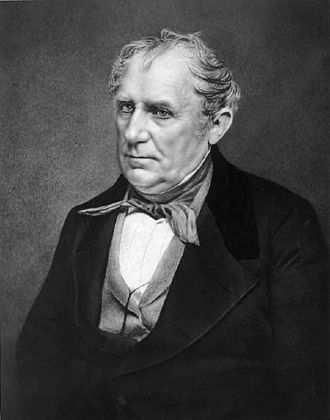
The American Democrat by James Fenimore Cooper

It turns out that the American author James Fenimore Cooper (1789 – 1851), primarily known today for the novel The Last of the Mohicans, wrote in 1835 a book of political theory titled The American Democrat. The book is a rather interesting document of the political views of the “democratic” elite of his time, which are remarkably similar to the views of the “republican”, explicitly anti-democratic, elite of a generation or two before – i.e., of the American founders.

Underneath the similarity, it is clear that there are now new concerns. While the founders expended most of their efforts optimizing and justifying “checks and balances” and considered their sentiment against the rule of the mob as an easy case to make, Cooper is concerned with dispelling any misapprehensions about the equality of men – indicating that democratic ideology is gaining political power in the early 19th century. Cooper explains to his readers that if men were really thought to be equals elections would be replaced with sortition:

The absolute moral and physical equality that are inferred by the maxim, that “one man is as good as another,” would at once do away with the elections, since a lottery would be both simpler, easier and cheaper than the present mode of selecting representatives. Men, in such a case, would draw lots for office, as they are now drawn for juries. Choice supposes a preference, and preference inequality of merit, or of fitness. (p. 79)

Sortition can do it all

This post is a rebuttal to the conclusion of Keith Sutherland’s 2013 paper “What sortition can and cannot do”, whereby sortition is deemed inappropriate for the “advocacy role” of representative legislature owing to alleged improper representation.

Since posters here address each other with their first names and especially since I will likely be chatting with him soon, I will refer to Keith Sutherland as Keith despite having never chatted with him yet and despite that going against the convention of referring to scholars one is discussing by their last names.

I have seen that there is a long standing feud of sorts between Keith and Yoram, and I find it appropriate to mention this here given that what seems to be at the origin of the conflict is precisely largely their differing views on the extent to which sortition should pervade the selection of policymakers compounded by a more general disagreement on political ideology according to a fairly standard left-right antagonism. I have no dog in this fight nor a particular affinity to either’s position whether on sortition or on political ideology more generally as far as I can tell, appearing to hold an intermediate position in both respects. As such though I am posting on Yoram’s site against Keith, this should not be construed as an attack by “team Yoram” against “team Keith”, as further evidenced by the fact that I had never communicated with Yoram until a few days ago when a renewed focus on sortition led me to make a few comments on his site. I imagine that Keith has heard all my arguments here before, and that most others have too, but since I couldn’t find a similar post on the topic I figured it would at least be useful to have a post dedicated to it. I am presuming that readers are familiar with the paper and the concepts it discusses and so I am not reintroducing them here.

Continue reading

Rancière: The scandal of sortition

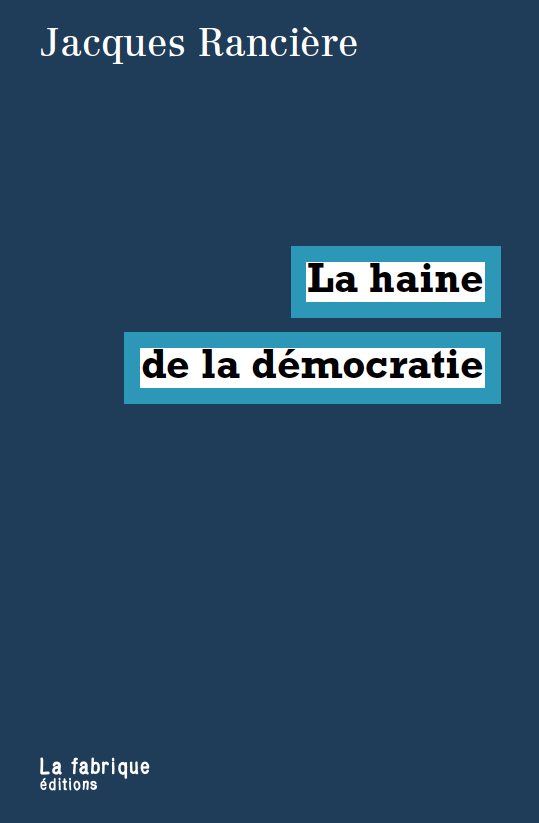
The second chapter of Jacques Rancière’s Hatred of Democracy (2005), “Politics, or the Lost Shepherd”, contains a fairly long discussion of sortition and its relation to democracy. The following paragraph is from page 41 of the English translation:

The scandal [of sortition] is simply the following: among the titles for governing there is one that breaks the chain, a title that refutes itself: the [Plato’s] seventh title is the absence of title. Such is the most profound trouble signified by the word democracy. It’s not a question here of a great howling animal, a proud ass, or an individual pursuing pleasure for his or her own sake. Rather is it clearly apparent that these images are ways of concealing the heart of the problem. Democracy is not the whim of children, slaves, or animals. It is the whim of a god, that of chance, which is of such a nature that it is ruined as a principle of legitimacy. Democratic excess does not have anything to do with a supposed consumptive madness. It is simply the dissolving of any standard by which nature could give its law to communitarian artifice via the relations of authority that structure the social body. The scandal lies in the disjoining of entitlements to govern from any analogy to those that order social relations, from any analogy between human convention and the order of nature. It is the scandal of a superiority based on no other title than the very absence of superiority.

This is somewhat reminiscent of the “blind break” argument for sortition (by eliminating all reasons for selection, bad reasons are eliminated as well). Later on, for example, Rancière emphasizes the fact that when using sortition seeking power is not a prerequisite to attaining it. But the tone here is quite different. The emphasis is on rejecting traditional or “natural” reasons, reasons that dominate social relations throughout, reasons that justify the elevated status of established elites. It is the rejection of those traditional reasons that scandalizes those elites, as well as many among the masses who have internalized the justness or naturalness of those “distinctions”.

Larry Bartels wants democratic theory to focus on elites

Larry Bartels is an American political scientist. In 2016 he published, together with Christopher Achen, the book Democracy for Realists: Why Elections Do Not Produce Responsive Government, in which the authors argued that voters can’t really tell what’s good for themselves. One possible takeaway from this argument could have been that elections are not a democratic mechanism. A recent interview with Bartels, on the occasion of the publication of a new book of his, indicates that he draws a very different conclusion. Bartels gives up on the people altogether (“they are what they are”) and wants to focus democratic theory on the behavior of elites.

I think what we need is a theory of democracy that has some real understanding of, on one hand, the inevitable power and leeway of political elites and, on the other hand, the goals they should strive to achieve when they exercise that power. Much of our thinking about democracy is very focused on ordinary citizens and what they should or shouldn’t be doing in their role in the process.

I’ve come increasingly to think that that’s a futile exercise. Ordinary people are pretty much what they are. We have a pretty good sense of how they behave. There are a lot of commonalities in their behavior across political systems with different cultures and different institutions. In all those places, regardless of the role of citizens, it’s the political leaders who really call the shots. So what we need is a better understanding of what democratic leadership entails, and how institutions can be made not to ensure, but at least to increase the probability that leaders will govern in enlightened ways, and on behalf of the interests of ordinary citizens.

Bartels ends on an overtly aristocratic note, where, perhaps taking a page from the Chinese, he wants to cultivate better elites. But at the same time he is overtly pessimistic and warns his audience that we should not expect too much from democracy.

[W]hat would a better system of democracy look like? I don’t have the answer to that. I do have the sense that we tend to focus too much on trying to avoid every conceivable threat to democracy and to imagine that if only we got the system and the rules right, that the system would operate happily in perpetuity. I think in reality there’s a huge gray area between democracy and autocracy, and lots of different dimensions in which democracies perform better or worse. Maybe the sense that a lot of people in the U.S. and elsewhere have now that we’re in a period of crisis is a belated recognition that democracy in all times and places is partial and risky and chancy.

[W]hat we really have to focus on is how we can socialize leaders to want the right things, and constrain them to avoid the worst excesses of misuse of power in political systems.

Psychologizing the electoralist phenomenon

Steve Taylor, a Senior Lecturer in Psychology at Leeds Beckett University wrote a piece in The Conversation offering his explanation for trouble with the electorlist system. Taylor writes:

The ancient Greeks practised direct democracy. It literally was “people power”. And they took measures specifically to ensure that ruthless, narcissistic people were unable to dominate politics.

Recent political events show that we have a great deal to learn from the Athenians. Arguably, a key problem in modern times is that we aren’t stringent enough about the people we allow to become politicians.

There’s a great deal of research showing that people with negative personality traits, such as narcissism, ruthlessness, amorality or a lack of empathy and conscience, are attracted to high-status roles, including politics.

In a representative democracy, therefore, the people who put themselves forward as representatives include a sizeable proportion of people with disordered personalities – people who crave power because of their malevolent traits.
Continue reading