A response to Cody Hipskind, part 3 of 3

Cody Hispkind’s post is here. The previous parts of my response are here and here.

Political activism under a democratic system

A major tenet of democratic ideology is that people are the best representatives of their own interests: when provided sufficient opportunity, each person and each group of people are best able to understand and express their own values and ideas and the actions that should be taken in order to promote these values and ideas. This tenet is in contrast to “republican” ideology which shares with democratic ideology the idea that everyone’s interests should count equally, but asserts that some people (“a natural aristocracy”) are best qualified to determine what those interests are and how they should be pursued, and therefore those people should be in charge.

Elections are a republican, anti-democratic mechanism: they empower an elite to determine public policy for others (whether this elite may be called a “natural aristocracy” is a matter of taste, I guess). That elite should be able to represent itself, the democratic tenet asserts, but is quite unlikely to represent the majority of the people who are very different from it. Sortition, through the process of statistical sampling, creates a body that by representing itself would represent the public at large.

However, the capacity for self-representation is not a spontaneous, automatic capacity. Getting a group of people (or a single person, for that matter) to the state where it is able to represent its own interests effectively is not a trivial matter. From an institutional standpoint, there are clearly some preconditions that need to be met: there need to be enough resources at the disposal of the group so that reliable information can be gathered. There needs to be enough time to discuss matters, determine an agenda, fashion proposals, debate them, amend them, vote on them, evaluate the effect of the adopted policy, reconsider the matter and repeat the procedure over time.
Continue reading

A response to Cody Hipskind, part 1

Thank you Cody for your post. I believe it can serve as a starting point for a fruitful discussion – a discussion that has already started in the comments thread to the post.

I would like to address various points you made separately. Here are the first 3 points, corresponding to the first 6 paragraphs in your post.

1. Class and political conflict

It is an obvious fact of life that different people have different political ideas. If everybody agreed on everything politics would be very easy – any one of “us” would do what “we” all agree upon. Still, there is a tendency, which used to be the dominant line of elite political thought in pre-modern times but is common today especially among liberals, to argue, or at least to imply, that disagreements are over means rather than ends. That is, that “we” all agree what is the common good (or at least would agree what is the common good if some of us overcame our ignorance) and the main difficulty is finding competent people who would be able to achieve that good. This translates to elitism. The elitism used to be explicit with the pre-moderns, the archetype being Plato, it was slightly less explicit with the early moderns, e.g., the American Founders, and it is much more implicit today. Nevertheless, it is often still just below the surface of the democratic rhetoric.

The notion that “we” all agree on goals can be dismissed. The common-goals ideology and the attendant elitism are of course self-serving notions for those in power. They imply that to the extent policy produces undesirable outcomes – say enrichment of those in power and their associates and the impoverishment of much of the rest of the population – then those in power can at most be blamed for incompetence rather than corruption. (Naturally, they would in fact argue that unfortunate as the outcomes are, they are necessary for the achievement of the commonly agreed goals.)
Continue reading

Representation: An ideological and legal fiction

I’ve spent the last few days at an international workshop on ‘Representation in Historical and Transcultural Perspectives’ organised by the Centre for Political Thought at Exeter University. On the final day it was suggested that representation was an ‘ideological and legal fiction’ and none of the participants disagreed. Yves Sintomer gave the final presentation and suggested that his fieldwork comparing Chinese and French systems of representation showed little difference between the two and that the lack of effective representation was an existential crisis for democracy. I had a question for Yves, but we ran out of time, so will ask it here (and draw it to his attention):

One system of representation that would clearly be non-fictional is delegates with legally-binding instructions but this was rejected at the time of the American and French revolutions. Trustee representation (with free mandate) may have worked for a time but didn’t long survive the extension of the franchise and is now rejected by the populist uprising in Europe and America. Virtual representation in Burke’s sense was always fictional due to the dissimilarity between voters and the political class. This would suggest that the only form of non-fictional democratic representation would be when final decision power is vested in a statistically-representative minipublic. Concerns might be raised both about the accuracy of the descriptive representation and the epistemic consequences, but such a system would be non-fictional so long as the microcosm retained ongoing descriptive representation vis-a-vis the target population. This would require large juries, quasi-mandatory participation, short-term service, balanced (exogenous) information and advocacy, and silent deliberation and secret voting, but the representation would not be fictional if it could be demonstrated that multiple samples of the same population generated closely-matching decision outputs. Might such a system be the only way of establishing genuine political representation?

A Marxist Analysis of Sortition

Welcome to Equality-by-Lot, Cody Hipskind! -Yoram

In this post, I’ll be taking a Marxist approach to the question of sortition. That is to say, I’ll be working from a framework that understands society as being composed of several classes with conflicting material interests, and which understands the state as an instrument by which one class rules over others.

I would also note that though classic Marxists have historically centered location within the system of production as central to the reproduction of class society, for my part I hold with the host of theorists who have shown in the decades since Marx wrote how questions of race, gender, migratory status, etc. are likewise integral to the ways in which the ruling class has reproduced its hegemonic status.

Let me begin by recognizing the benefits which rule by lot has from a Marxist perspective. Within my country of the United States and around the world, it is indisputable that electoral systems produce legislatures which, when taken as a whole, are disproportionately wealthy, white, cis-male, and otherwise more representative of the members of the ruling class than of society as a whole. A lottery system would certainly correct such an imbalance by increasing the likelihood of that members of historically disenfranchised communities would receive an equal voice in the legislature. This would obviously be a desirable outcome.

However, it is my position is that elections provide two social goods which would likely be undercut through a system which chooses officers exclusively through sortition. Specifically:

1. Elections create competition between parties over control of which is to say, over the control of the government.

In this way, elections implicitly recognize the sort of divisions in society I outlined above. If a party does something unpopular–say, decide to lower taxes on the rich, voters can punish that party by throwing them out and choosing a replacement. In practice, this means that the subgroups which compose the working class can play kingmaker between the bourgeoisie parties and, ideally, organize themselves into their own parties in order to take power as a class themselves.

In contrast, under sortition, there’s no way to hold people accountable for their decisions: popular or not, you leave office when your term expires. This has the upswing of producing less competitive and divisive politics. And that’s nice and all, but as a Marxist my goal is not to create a politics without division: its to highlight the material divisions and contradictions under capitalism and to exploit the competition among the bourgeoisie parties in order that the working class can get a foot in the door and eventually seize power.
Continue reading

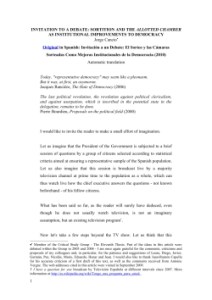
Cancio: Sortition and the Allotted Chamber as Institutional Improvements to Democracy

Here [PDF] is an automated translation (with a few touch-ups) of Jorge Cancio’s 2010 paper “Invitación a un Debate: El Sorteo y las Cámaras Sorteadas Como Mejoras Institucionales de la Democracia”.

Abstract:

I start off inviting my readers to exercise their imagination and then explaining a proposal of creating new “sortition chambers” on all administrative levels – from a chamber at the same level as the present-day Spanish Congress and Senate down to sortition chambers for each municipality. They essentially would be an addition to present-day institutions and would partake in the powers which are held today by elected representatives and officials, although the proposal envisages that in the short run they could be out-voted by the elective institutions. They would exercise their powers according to deliberative procedures.

After that introduction I offer a short account of present-day theoretical and practical proposals and implementations of sortition-based systems in the political field – highlighting the fact (following Manin) that mainstream discussions on democracy tend to ignore sortition altogether (including those made by the political left), but also making the point that since Dahl and others (inter alia, Burnheim, Goodwin, Barber; and the more recent works now appearing in Imprint Academic) there seems to be an increasing renaissance of this subject. I also point to the practical experiences of the Planungszelle and the voters’ and citizens’ juries.

Thereafter I try to explain why sortition is mainly ignored nowadays – here I follow again Bernard Manin – identifiying the contractualist bias of the XVII and XVIII century revolutions (which sought to establish a rule of consent for being governed) as the main reason for opting for elections instead of sortition as mechanism for the selection of political office-holders. Afterwards, the emergence of the political parties as oligopolical forces in the political market (here I refer to the work of C.B. Macpherson) and their growing distance from society and increasing autonomy vis-à-vis societal needs have led to a “party democracy” or “cartel party” system (Katz and Mair). The facade of autonomous decision in electing public officials covers, therefore, a system where political offers are very limited, allowing me to speak about an “election-fetish”. Contrasting to this evolution I then underline the paradox of identifiyng democracy with elections (and political parties) when we consider that democracy was linked in Athens with sortition whereas elections were considered aristocratic.
Continue reading

Politics as a profession

In a recent debate with Etienne Chouard, among quite a few fallacies and hypocritical talking points, Raphaël Enthoven makes an interesting point regarding the role of training in politics (about 23 minutes into the recording) [my transcription and translation, corrections welcome]:

The fact is that, as Plato argues, politics is a profession.

[ Chourad interjects: “Plato was an aristocrat!” ]

Politics is a profession, even if you ask a democratic such as yourself. Even if you ask yourself. How would you explain the place that you accord in [your book] “Notre Cause Commune” [“Our Common Cause”], in your work, in your blog, always, since 2005, to constituent workshops? The fundamental role that you assign to instruction and to training of citizens? Isn’t it in order to give citizens the means to exercise correctly, properly and competently (if you excuse the adverb) the powers they were temporarily entrusted with?

It is obvious that politics is a profession and requires information. This profession, this information, must be open to all. There should be an equality of opportunity, there should be a wealth of opportunities for democratic practice and learning, including through sortition. Saying, however, that the equality of rights, the equality of competence would justify that each and every person would govern successively, as they did in Athens – a very small city – appointed by sortition and as a part time job, ignores the fact that it is the exercise of power that relieves incompetence, unprofessionalism, and lack of skills.

Right-wing support for sortition

A paper has just been uploaded to Academia.edu entitled Instituting a Democratic Sortition in America. The author, Terry Hulsey (who hails from the Abbeville Institute, which lauds the culture of the Confederacy and the “Southern tradition”), offers a libertarian (anarcho-capitalist) critique of social democracy and is no fan of equality (as currently conceived):

A second large group of political scientists writing about sortition are those who, dismayed that over 95% of the elective oligarchy of legislators are white males – and about half of them lawyers – seek equality in the form of proportional representation for women, for minorities currently based on race, and for unspecified protean “disadvantaged” factions. Hugo Bonin, Ernest Callenbach, and Michael Phillips are typical of this group. All of them embrace “diversity” while being curiously blind to the fact that diversity is the opposite of equality. They seek equality for the various factions that are assembled not for their diversity, but for their adherence to a prevailing ideology. What were the unequally represented factions of a century ago? They were the factions of class: Worker, bourgeois, and landlord. Clearly the factions are assembled according to political considerations, and not according to measurable benefits for the society as a whole. For how will those who are half black and half Latino be represented? Would they not be doubly represented? How many legislators will represent the Frisian immigrants? And how many will represent the left-handed Frisians with a limp? All such schemes that embrace sortition from egalitarian motives fail because they are based on arbitrary groupings formed by the fashionable watchwords of the day.

Personally I’m encouraged that sortition is now appealing across the political spectrum, and would encourage posters and commentators to try to keep their partisan views to themselves in order to help enlarge the sortition community.

EPSA

The 2019 Annual Meeting of the European Political Science Association (EPSA) will be held on 20-22 June in Belfast next year. I’m organizing the Political Theory panels for this meeting. I know there are plans afoot to organize one on sortition and related democratic institutions, as well as another democratic theory panel (on epistemology and democracy). Unfortunately, the deadline is a bit tight–17 December. (I meant to post about this earlier, but was distracted by other matters. Apologies.)

If you might be interested in joining one of these panels, please drop me a line ASAP. (Or just go ahead and propose a paper–I can add you to a panel later.) The website for the meeting is at

http://www.epsanet.org/conference-2019/

Thanks!

Venice and Why Sortition is Not Enough

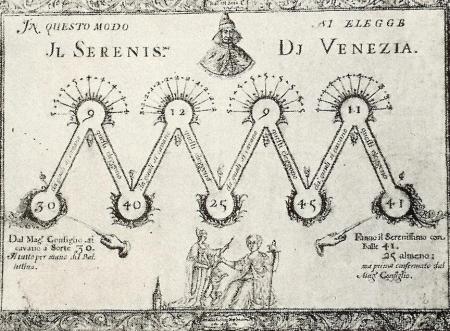
Without much commentary, given the high level of knowledge and debate on this blog, I share an important document about elections in Ancient Venice. As most here will know, I hold it that ‘pure’ sortition is a suitable and necessary tool for democracy. However, it is also an insufficient one, as has been criticised already at the time of sortition’s outset, with the powerful “Socratic Objection” as documented by Xenophon. Today, I describe the missing element specifically for appointments to positions of power.

As most here will know, the Ancient Venetians combined sortition with elections in multiple iterations to determine their leadership, the Doge. Their success with this add-on innovation was superior to the Athenians, as evidenced by the significantly longer duration of their system. Now, there clearly were flaws, room for improvement, as their system ended by reversal to today’s unfortunate party system but that’s for another day.

So far, most scientific papers on this topic have been descriptive. Now Miranda Mowbray, and Dieter Gollmann of the Enterprise Systems and Storage Laboratory at
HP Bristol expand the debate with this paper on the mathematical properties of the Venetian method in avoiding usurpation of power while still finding the best leadership. The authors have their mind on applications in distributed computing security, but for us here, the advantages for a more mundane topic such as democracy may be good enough to give it some thought.

Enjoy.

As an aside, the statutes of G!LT in Austria therefore employ the Venetian model for all executive leadership elections. My rationale is that the party system with its unholy alliance with mass media rewards showmanship and superficiality, as evidenced by the high proportion of TV Actors and Reality Show Stars in top jobs. Instead G!LT’s protocol ensures a reasonably self-experienced, direct, personal knowledge of a candidate’s ability and suitability for an executive position. For those who read German, here to the Statutes of G!LT. For those who don’t there is Google Translate.

Arturo Íñiguez: On the meaning of the word ‘democracy’

Arturo Íñiguez, an occasional contributor to Equality-by-Lot, recently published a rather beautiful essay touching upon sortition which weaves together history, linguistics and political philosophy (English, French, Spanish). Well worth reading in its entirety even for people familiar with the idea of sortition, here is an excerpt from the essay:

[R]epresentative regimes can be either aristocratic, if they rely on election, or democratic if they rely on sortition.

According to my experience, a lot of people, when exposed to these truths, will react in complete denial. But the fact is that this has been completely trivial knowledge for political scientists for most of recorded history: from Plato and Aristotle to Montesquieu and Rousseau, in the mid XVIIIth century, all of them wrote the same: elections are aristocratic and sortition is democratic. How come, then, that we have been so thoroughly indoctrinated as to believe the exact opposite of something that was crystal-clear for the greatest human thinkers?

Well, the change began in the late XVIIIth century, when the rich bourgeois in France and North America decided that they would be better off in the future by breaking free from the existing monarchic regime (which after all had not been so bad with them, or they wouldn’t had got so rich in the first place). Needless to say that sharing any power with the poor masses was always completely out the question. The masses would be used to fight the royal armies and then abused into thinking the the victory was also theirs. Both the Founding Fathers and the French revolutionaries were adamant in opposing democracy. Suffice to read what they said and wrote to understand that democracy was for them a very bad and ugly word.

But calling their elective system aristocracy, which would have been the logical thing to do following the philosophical tradition we have just mentioned, was also a no-go. Was not the aristocracy the despised enemy recently destroyed? And at the end they had to settle for a word like ‘republic’, an empty signifier which can mean anything you want it to mean.

A lively discussion followed the essay in the comments and Arturo exhibited the proper democratic mindset and engaged in conversation with some of the commenters. Here, for exmaple, is one comment by a reader and Arturo’s reply:
Continue reading