 Equality-by-Lot’s traditional yearly review post. For previous editions look up each year’s December posts.
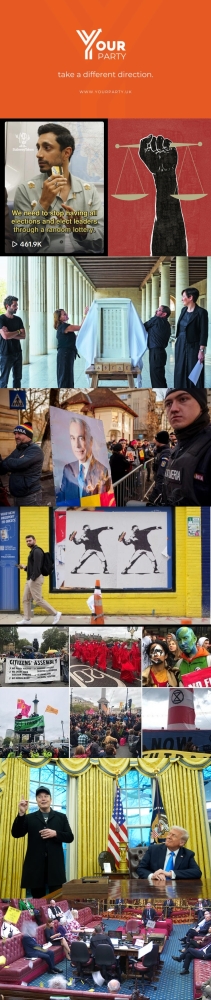
The most important sortition-related development of the year was undoubtedly the decision by YourParty in the UK to allot the delegates to it founding conference. This decision created an intense discussion around sortition, a discussion that was unprecendented certainly in the UK specifically, probably in the entire Anglosphere, and possibly even in the modern world.
Many activists were horrified to find that sortition stripped them of their standard privilege associated with their established organizing and willingness to invest time and resources. The claims that the whole setup was a way for the organizers to control the process were substantiated by the setup’s details: Thousands of allotted delegates gathered into a hall for a two-day event, inevitably forcing them into the position of passive audience, eliminating any possibility of setting the agenda for the conference. Interestingly, one of the decisions adopted was a rather vague commitment to allotting some of the delegates of future YourParty conferences.
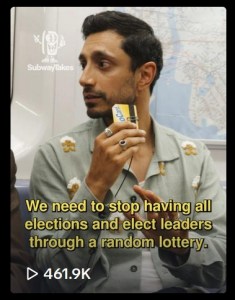
Another notable event was the posting on YouTube and TikTok of a “Subway Take” by the Academy Award winning actor Riz Ahmed in which he proposed to “stop having all elections and elect leaders through a random lottery”. On YouTube the post has now been viewed over 2.5 million times and garnered almost 200,000 likes.
Within the standard academic sortition mud stirring, one proposal stood out: using sortition to create democratic investor assemblies for controlling corporations.
Finally, the electoralist crisis in the West continues to unfold. An opposition candidate who unexpectedly won the first round of presidential elections in Romania was disqualified and the leader of the French Right was barred from participating in upcoming elections after being found guilty of illegal management of party finances.
Filed under: Academia, Applications, Elections, Participation, Press, Sortition, Theory, video | Leave a comment »


 Adam Cronkright
 Ali
Ali Ahmed R. Teleb
 avanderven
 avergne
 Alex Kovner
 azakaras
 Brett Hennig
 campbellwallace
 Simon Threlkeld
 Nick Coccoma
 codyhipskind
 Common Lot Sortitionist
 Conall Boyle
 constitutionalism
 davidschecter
 graytmatter
 gtridimas
 H.J. Hofkirchner
 Hanspeter Rosenlechner
 John Burnheim
 jgarry20151
 Jochen Krattenmacher
 johnedwardtaylor
 johnhuang865
 Jonathan Crock
 keithsutherland
 Jacob Richter
 kkoreilly
 lukewhito
 SimonPek
 Nathan El
 Nicholas Gruen
 Owen Shaffer
 Patrick Chalmers
 Paul Gölz
 peterstone
 Pierre-Etienne Vandamme
 pronfeld
 Emil
Emil rcaze
rcaze richwbrown
 Roger Knights
 roslynfuller
 Pierre-Etienne Vandamme
 shaharavin
 tbouricius
 Ted Wachtel
 Joshua Laferriere
 theodorestathis
 towardsautonomyblog
 Wayne Liebman
 Yoram Gat
 Oliver Milne
 Equality by lot