We are happy to announce the launch of our newest project focused on democratic experimentation and innovation in collaboration with the R.V. High School in Bolivia. Check out our launch video below, and stay tuned for more updates! Happy to hear any of your questions and comments.
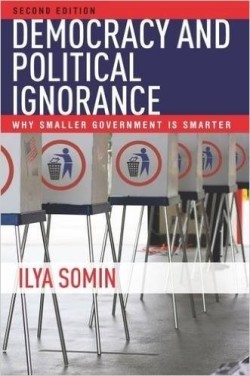
Ilya Somin, Professor of Law at George Mason University, is the author of the book Democracy and Political Ignorance: Why Smaller Government is Smarter. Somin opens an opinion piece in the Washington Post thus:
Widespread political ignorance is a serious problem for modern democracy. In recent years, many scholars have argued that we can overcome it by relying on “sortition”: delegating various political decisions to jury-like bodies selected at random from the general population. In this post, I explain why such proposals are unlikely to succeed.
Before going into the substance of Somin’s arguments about sortition, it is important to realize that ignorance is actually only the second most important problem with the current system, the first being the difficulty of mass scale agenda setting. More details here. The emphasis on ignorance rather than agenda setting is typical of the “rational choice” line of political argument which ignores the complexity of organization largely for ideological reasons. That said, the ability of decision makers to become informed about their subject matters is important and worth discussing. Some of the considerations that are discussed below apply also to the matter of agenda setting.
Simon Threlkeld has a new article in the Canadian National Observer advocating against having electoral reform decided by referendum. An excerpt:
Electoral system should be decided by jury, not politicians or referendum
Politicians should not decide the rules under which they are elected, because fair and democratic decision-making requires that those who decide do not have a conflict of interest. All of Canada’s political parties should accept this.
The Conservatives say that whatever electoral system parliament decides on, it needs to be ratified in a national referendum. Rather transparently, what concerns them is not giving the public a say, but rather preserving the status quo which in the 2011 election gave them a majority of the seats with just under 40 per cent of the popular vote.
Rule by the people needs to be well-informed, because only informed views provide a good basis for a decision.
A referendum is highly unsuitable for ensuring an informed decision about Canada’s electoral system. The public would only learn about the option(s) on the ballot voluntarily in their spare time, and most people are not especially interested in learning about electoral systems. In B.C.’s 2005 referendum on a proposed new electoral system, shortly before voting day 66 per cent of those surveyed by Ipsos-Reid said they knew “nothing” or “very little” about the proposal on the ballot. In another survey, over half of those who voted “no” said they did so because they did not feel “knowledgeable.”
Combining a shrewd business acumen with a philanthropic social conscience, the SA-based start-up – which formally launched last week – aims to work with governments, business, not-for profits and communities to broaden democratic engagement.
[…]
“It’s really nice to be able to set the boundaries of what’s authentic and inclusive, and what’s not … we’re really only interested in those (clients) that are actually sharing decision-making.”
Even before its official launch, the fledgling company has already made a splash; it managed the recent Citizens’ Jury process that reviewed policy prescriptions for the management of unwanted dogs and cats, and is now engaged with the Premier’s Taskforce on Healthy Kids’ Menus.
But both Lawson and Jenke are confident the long-term success of their venture isn’t predicated on political whim. Continue reading →
We have been inspired by the Belgian G1000 and the Dutch G1000 and aim to hold one G1000 in London and one in Cambridge in late 2016 or early 2017, where a truly representative sample of 1000 people gather, deliberate with each other in a respectful environment, and decide together what is best for their communities. It is a way to do democracy differently.
Come along to find out all about a G1000 and how you can help make a G1000 happen in the UK!
To an ancient Greek democrat (of any stripe), all our modern democratic systems would count as “oligarchy”. By that I mean the rule of and by – if not necessarily or expressly for – the few, as opposed to the power or control of the people, or the many (demo-kratia).
That is the case even if – and indeed because – the few happen to be elected to serve by (all) the people. For in ancient Greece elections were considered to be in themselves oligarchic. They systematically favoured the few and, more particularly, the few extremely rich citizens – or “oligarchs”
[…T]here are a number of ancient democratic notions and techniques that do seem highly attractive: the use of sortition, for instance – a random method of polling by lottery that aimed to produce a representative sample of elected officials. Or the practice of ostracism – which allowed the population to nominate a candidate who had to go into exile for 10 years, thus ending their political career.
And comparison, or rather contrast, of our democracies with those of ancient Greece does serve to highlight what’s been called creeping crypto-oligarchy in our own very different (representative, not direct) democratic systems. Continue reading →
In this episode Patrick Chalmers and Yoram Gat talk about Patrick’s inside view of establishment journalism. Patrick presents his analysis of the roots of the problems with journalism and their connection to the problems of our systems of government.
Patrick’s book – Fraudcast News – How Bad Journalism Supports Our Bogus Democracies – can be found online here: http://fraudcastnews.net.
Naomi has just flagged up an interesting article from Village Magazine on the Irish experiments with constitutional conventions in 2011 and 2016 by Eoin O’Malley, one of the participants. The article adds to my concerns that ‘full mandate’ allotted bodies are open to manipulation:
Some research shows that the act of deliberating with others has an impact beyond exposure to arguments or evidence. That is people given the evidence and arguments don’t move as much as those who are asked to discuss that evidence and arguments with others. This sounds like something positive for deliberative mini-publics. But it might not be.
The reason for this is because (as Condorcet demonstrated), independence is the key to getting the ‘right’ answer and this suggests that communication between jurors should not be encouraged — all that is needed is exposure to balanced arguments and evidence (as Goodin and Niemeyer discovered in their study of the Bloomfield Track citizens’ jury). This is distorted by the need to come to collaborative conclusions:
Because they are not independent the same flawed thinking or arguments can be magnified. For instance we could see the citizens in the mini-publics engage in groupthink. Some opinions might be aired, but can be effectively suppressed by the atmosphere in the room. There is significant evidence in social psychology that groups can push opinion to extremes and silence minority opinion. To prevent this great care has to be taken that all views are respected.
I’m wondering whether any readers have insights about books and/or articles which build on/critique John Burheim’s path-breaking and overarching model of demarchy, and/or apply demarchy to non-government organizations such as corporations or unions. I’m conducting some research in this space and haven’t been able to find too much work specifically on demarchy in published work (but have found a lot about specific uses of random selection). Any and all suggestions would be much appreciated. Thanks!


 What is a G1000?
 Adam Cronkright
 Ali
Ali Ahmed R. Teleb
 avanderven
 avergne
 Alex Kovner
 azakaras
 Brett Hennig
 campbellwallace
 Simon Threlkeld
 Nick Coccoma
 codyhipskind
 Common Lot Sortitionist
 Conall Boyle
 constitutionalism
 davidschecter
 Ethan McCutchen
 graytmatter
 gtridimas
 Henry Tuttle
 H.J. Hofkirchner
 HpR
HpR James Kierstead
 John Burnheim
 jgarry20151
 Jochen Krattenmacher
 johnedwardtaylor
 johnhuang865
 Jonathan Crock
 keithsutherland
 Jacob Richter
 kkoreilly
 lukewhito
 SimonPek
 Nathan El
 Nicholas Gruen
 Owen Shaffer
 Patrick Chalmers
 Paul Gölz
 peterstone
 Pierre-Etienne Vandamme
 pronfeld
 Emil
Emil rcaze
rcaze richwbrown
 Roger Knights
 roslynfuller
 Pierre-Etienne Vandamme
 shaharavin
 tbouricius
 Ted Wachtel
 Joshua Laferriere
 theodorestathis
 towardsautonomyblog
 Wayne Liebman
 Yoram Gat
 Oliver Milne
