Posted on December 14, 2011 by Yoram Gat
As we did last year (1, 2), I would like to create a post or two summarizing the sortition- and distribution-by-lot-related developments of 2011 and the activity here on Equality-by-Lot.
Please use the comments to give your input on what you think are the most mention-worthy events or essays of the past year.
Filed under: Distribution by lot, meta, Sortition | 1 Comment »
Posted on December 11, 2011 by Yoram Gat
Tom Hodgkinson, editor of The Idler, invokes Plato on the pages of The Independent:
[I]f Boris [Johnson] knew his Plato, which he ought to, having been to Eton and everything, then he would recognise in the protests, riots and strikes that have marked this year a sign that the people ain’t happy with the situation. He would also recognise himself as being a member of the short-sighted oligarchy – oligarchy meaning “control by a wealthy minority”. Reading Plato’s Republic, I was struck by the parallels with a typical cycle that he describes. In Platonic terms, it would seem that an oligarchy has taken over UK plc, and that this oligarchy has made too many loans, thereby pauperising the people, and now fails to see what is happening right beneath their noses: that the people are talking about revolution. The good news, though, is that a real democracy may be in store:
Plato writes that when the pursuit of riches remains unchecked, resentment breeds:
[…]
This is the situation that will lead to social upheaval: “Democracy originates when the poor win, kill or exile their opponents, and give the rest equal rights and opportunities of office, appointment to office being as a rule by lot.”
This is what the people want: a real democracy, government by the people, and not by a clique comprising top politicians and CEOs. […]
Filed under: Athens, History, Sortition | 46 Comments »
Posted on December 9, 2011 by Yoram Gat
A new paper about lotteries in education mentions some familiar names.
Abstract: It has been over 40 years since Connecticut amended its Constitution to ensure citizens a right to a free public education. Despite the constitutionally prescribed right, dramatic inequities in educational conditions continued to characterize the state’s K-12 educational system, especially between suburban/rural white and urban minority school districts. In the 1970s plaintiffs challenged the prevailing mechanism for allocating education funds with a host of court cases that tackled the thorny question of how much financial responsibility the state should assume to equalize the spending disparities between school districts. Prodded by court decisions, many formulas and approaches have been proposed by the Connecticut General Assembly in response to the various legal challenges yet the state has never fully funded the cost sharing formula nor lived up to the 50-50 cost sharing arrangement envisaged by some policymakers. The situation remains at an impasse with the latest court action, CCJEF v. Rell (2005), to be resolved no sooner than 2014 by most accounts.
Continue reading →
Filed under: Distribution by lot, schools | Leave a comment »
Posted on December 9, 2011 by davidschecter
I’ve been thinking recently that one promising venue for experimenting with sortition might be popular movements such as Occupy here in the US, or the indignados in Spain. These are venues where people are unusually open to learning about, and even trying, new ways to organize society. Also, from what I know of here in San Francisco, the Occupy folks are trying to make most of their decisions in large “general assemblies,” which is very cumbersome, so I suspect that some of them would be very interested in ideas like sortition.
Does anybody here know of examples of sortition being used in popular movements, or have ideas about how it could work?
Also, does anyone know of a contemporary, technologically-assisted, affordable, user-friendly equivalent to the kleroterion that could be used in popular movements? I’m imagining something analogous to big meetings I’ve seen where all the attendees have hand-held devices that enable them to vote and then have the votes instantly tallied on a computer. I imagine that having a technology like that might make an experiment with sortition more desirable and feasible.
Filed under: Sortition | 13 Comments »
Posted on December 8, 2011 by davidschecter
I am new to this forum, and new to the study of sortition. I’m fascinated by the ideas and debates presented here, somewhat overwhelmed, and trying to formulate an organizing framework that can help me – and hopefully others – make sense of it all.
I’ve read with great interest the recent debates about Keith and Terry’s ideas in “Athenian Democracy Reincarnate,” and the recent exchange between Yoram and Alex about election vs. sortition. Rather than plunging into the debates, I’ve been asking myself “what are the basic questions that must be answered in order to design a democratic legislative system; what are the answers that people are presenting here; and what are the main points of agreement and disagreement?”
So far I can think of four highest-level questions for designing a legislative system:
- What criteria should define a “democratic” (and “good”) legislative system?
- What are the essential activities of the legislative process?
- What actors should carry out each activity, playing what roles?
- What processes should be used for each activity?
(Note: this is assuming a given structure of political units, and that’s a huge design issue in itself, but beyond my scope here)
I’m not going to start with criteria, because I’m afraid that the resulting discussion wouldn’t be useful. Instead, in this post I’m going to start with activities, then (hopefully) actors and roles in my next post, then processes, and then criteria.
Filed under: Sortition | 18 Comments »
Posted on December 8, 2011 by keithsutherland
On many occasions I have argued that the representativity of political assemblies constituted ‘descriptively’ (i.e. by statistical sampling) only applies at the collective level, and that this requires members of such an assembly being limited in their function (in contrast to the mandate of elected members). This argument has failed to persuade some participants in this forum, so this post makes the point in a rather stark manner, in the hope that it will challenge my opponents to refute it or else accept it – ‘ to put up or shut up’ – as opposed to merely ignoring it. I’m puzzled as to the continuing necessity to labour this point, as its veracity derives from the meaning of the word ‘statistical’, nevertheless I will seek to hammer the nail in one more time.
Statistical sampling via random selection is widely used for proportionate opinion polling, but the problem with using random selection for relatively complicated issues like political representation (as opposed to preferences over different brands of washing powder) is that such surveys are inevitably of ‘raw’ (unconsidered) opinion. Nevertheless the representativity of the proportional sampling techniques used is hard to deny, hence James Fishkin’s attempt to seek to establish a ‘deliberative’ assembly using random sampling techniques, which combines representativity with informed deliberation in order to represent the ‘considered judgment’ of the whole population. However this requirement leads Fishkin to advocate a very thin form of the deliberative ideal, in which members effectively listen to balanced pro–anti arguments and then decide the outcome via secret ballot, as opposed to the rich active deliberation preferred by Habermasian deliberative theorists. Why should this be?
Continue reading →
Filed under: Sortition | 143 Comments »
Posted on December 6, 2011 by Yoram Gat
The Sydney Morning Herald, which seems to have a certain interest in citizen juries, reports:
O’Farrell dismisses citizens’ jury after Greiner jumps gun
THE chairman of Infrastructure NSW, Nick Greiner, has been spruiking about a citizens’ jury to recommend which projects the government should build – without having the approval of his board.
Sandy Olsen, the spokeswoman for the board of Infrastructure NSW, said yesterday it ”has not discussed adopting the model of using citizens’ juries”.
Continue reading →
Filed under: Press, Proposals, Sortition | 4 Comments »
Posted on December 5, 2011 by Yoram Gat
A 1984 draft paper (that apparently never made it to publication) by Theodore C. Bergstrom and Hal R. Varian is called Government by Jury. Its abstract is as follows:
We consider a simple model of social choice where the voters find it costly to determine their true preferences. Since the influence of an individual voter decreases as the group size increases, each individual finds it optimal to invest less time in contemplating his values in larger groups than in smaller groups. This suggests that a desirable social choice mechanism might be to randomly choose a relatively small group of electors to make social decisions, since they would then have more incentive think carefully about the issues. We investigate this idea of “government by jury” in a simple mathematical model and establish some of its properties.
Unfortunately, the paper makes the rather radical assumption that the interests of all the members of the group are identical, except for the fact that each is trying to minimize the personal effort put into reaching a well informed decision. Thus, according to this model, each person would rather have someone else make all policy decisions for them, provided the decision-maker has somehow been motivated to study the policy problems. This assumption limits the scope of the model drastically and makes any results irrelevant to most political situations.
Nevertheless, the paper is interesting for being perhaps the first formalization of a sortition-based government situation, and provides a possible starting point for richer models.
Filed under: Sortition | 3 Comments »
Posted on November 28, 2011 by Yoram Gat
Daniel Baron of the Institute of Sociology, RWTH Aachen University introduces his article, The Power of the Lot: Are People Obliged to Participate in Political Lotteries? as follows:
While empirical research in the field of aleatoric democracy usually focuses on the deliberative outcomes of these procedures (Fishkin & Luskin 1999; Fishkin et al. 2000), theoretical approaches mainly ask whether political lotteries, compared to traditional ways of recruiting political personnel (esp. elections), are just or not (Stone 2007, 2009). Further discussions broach the subjects of political representation, equality or input- and output-legitimacy (Buchstein 2009a). Down to the present day, a key question to ask when focusing the problem of legitimacy of aleatoric democracy has been most widely ignored: whether laypersons chosen by lot should be compelled to participate in the committee where they have gained a seat, or whether sortition should be founded on the principle of voluntariness.
Continue reading →
Filed under: Juries, Sortition, Theory | 15 Comments »
Posted on November 21, 2011 by Yoram Gat
I have created an advertising campaign on Google with the following ad:
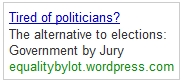
Clicking on the ad currently takes you to the home page of this blog, but it would probably be better if the target was an “introduction to sortition” page. Such a page can be created and added to the tabs at the top of the blog (next to the “Home”, “About the Kleroterians”, “Contributors” and “Literature” tabs).
If anyone is interested in collaborating on creating such a page (possibly something along these lines), please let me know. Comments on the text of the ad are also welcome.
Filed under: Sortition | 5 Comments »


 Adam Cronkright
 Ali
Ali Ahmed R. Teleb
 avanderven
 avergne
 Alex Kovner
 azakaras
 Brett Hennig
 campbellwallace
 Simon Threlkeld
 Nick Coccoma
 codyhipskind
 Common Lot Sortitionist
 Conall Boyle
 constitutionalism
 davidschecter
 Ethan McCutchen
 graytmatter
 gtridimas
 Henry Tuttle
 H.J. Hofkirchner
 HpR
HpR James Kierstead
 John Burnheim
 jgarry20151
 Jochen Krattenmacher
 johnedwardtaylor
 johnhuang865
 Jonathan Crock
 keithsutherland
 Jacob Richter
 kkoreilly
 lukewhito
 SimonPek
 Nathan El
 Nicholas Gruen
 Owen Shaffer
 Patrick Chalmers
 Paul Gölz
 peterstone
 Pierre-Etienne Vandamme
 pronfeld
 Emil
Emil rcaze
rcaze richwbrown
 Roger Knights
 roslynfuller
 Pierre-Etienne Vandamme
 shaharavin
 tbouricius
 Ted Wachtel
 Joshua Laferriere
 theodorestathis
 towardsautonomyblog
 Wayne Liebman
 Yoram Gat
 Oliver Milne
