Listen up, ruling elites: It’s not enough to be for the people, you must be with the people

Clearly, “by the people” is a non-starter, so Nathan Gardels advises those readers of Noema magazine who are members of the benevolent, if a bit misguided, elites that if they wish to stem the rise of the authoritarian strongmen they better be “with” the people.
The rigid polarization that has gripped our societies and eroded trust in each other and in governing institutions feeds the appeal of authoritarian strongmen. Poised as tribunes of the people, they promise to lay down the law (rather than be constrained by it) […]

The embryonic forms of this next step in democratic innovation, such as citizens’ assemblies or virtual platforms for bringing the public together and listening at scale, have so far been mostly advisory to the powers-that-be, with no guarantee that citizen input will have a binding impact on legislation or policy formation. That is beginning to change.

[This takes us] a step closer to government “with” the people instead of just “for” the people […]

Continue reading

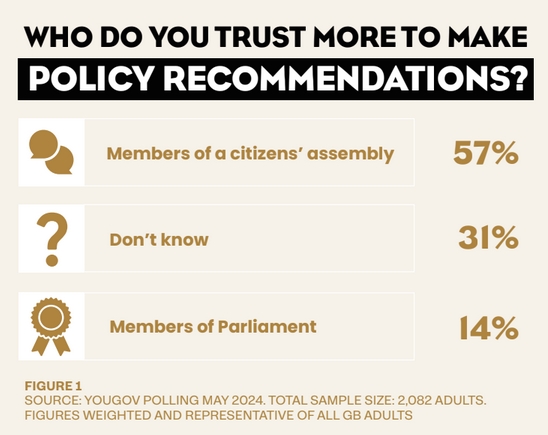
UK citizens trust citizen assemblies 4 times more than MPs

Findings from a 2024 poll appearing in a paper by Sortition Foundation.

Choosing by lot and the politics without titles

Yavor Tarinski

The man who wears the shoe knows best that it pinches and where it pinches. ~John Dewey [1]

One of the main pillars of contemporary oligarchies worldwide is the institution of elections. Every leader and government, regardless of how liberal or authoritarian, claims its ascendance to power through some kind of electoral process. Elections are considered as “the democratic means” per se – if a system is based on elections, then it supposedly is a “democracy”.

The supporters of this view see in electoral processes a means of sustaining popular sovereignty, while avoiding what they see as a danger of popular self-rule – i.e., rule by the incompetent. But as philosopher Jacques Rancière underlines, there is an “evil at once much more serious and much more probable than a government full of incompetents: government comprised of a certain competence, that of individuals skilled at taking power through cunning.”[2]

Electoral processes tend to nurture antagonism and competitiveness, rather than cooperation and dialogue. They give way to a certain anthropological type – the power-hungry political demagogue. Rather than concerned with resolving public issues and problems, it focuses on “winning” elections. The very essence of politics is radically altered in elections-based systems – with their content being emptied of any substantial deliberatory essence and replaced with a lifestylish approach that focuses on candidates – their ways of life, the tricks they pull on each other, etc.

Ultimately, the main agenda that drives the action of the electoral anthropological type is that of opinion polls. Candidates must learn what and when to say things that will be liked by the largest amount of people, so that they can get ahead in the race. The result is a type of craft where electoral competitors outbid each other, play dirty, and resort to all sort of tricks in order to win. This becomes the main occupation of people involved in electoral competitions for office. Because of this political scientist James S. Fishkin suggests:

Candidates do not wish to win the argument on the merits as much as they wish to win the election. If they can do so by distorting or manipulating the argument successfully, many of them are likely to do so. Representatives elected through such processes are looking ahead to the next election while in office.[3]

Continue reading

Just sortition, communitarian deliberation

A new paper by Nicole Curato, Amiltone Luís, Melisa Ross, and Lucas Veloso in Environmental Science & Policy includes field work eliciting comments from people in Zambezia, Mozambique regarding their views on sortition in the context of the allotted Climate Assembly on the Climate and Ecological Emergency.

Just sortition, communitarian deliberation: Two proposals for grounded climate assemblies

Abstract

Sortition or recruiting randomly selected everyday citizens is a core feature of climate assemblies. Sortition, the argument goes, enforces the principle of inclusiveness, as everyone has a fair shot at getting invited to the climate assembly. This form of recruitment, however, faces criticism. It challenges traditional structures of representation and decision-making where elders, religious leaders, elected representatives, and community organisers typically give voice to the ideas and grievances of everyday people. For some, sortition valorises the atomised individual who can speak their mind in a forum, without any mechanism for the individual to reconnect their deliberative experience to the wider community. In this article, we draw on the experience of the province of Zambezia in Mozambique as one randomly selected Assembly Member took part in the world’s first Climate Assembly on the Climate and Ecological Emergency. Based on in-depth interviews, focus group discussions, and feedback sessions with local organisations in Zambezia, we offer practical insight on how sortition can deepen community connection and maximise the impact of climate assemblies in delivering practical outcomes for climate change adaptation. Using grounded normative theory, our study demonstrates how sortition can promote justice by elevating the voices of those most impacted by climate change. We also demonstrate why a communitarian approach to citizen assemblies enhances accountability and shared learning and empowers members to translate global deliberations into local actions.

One useful contribution of this article is a summary of the arguments for and against sortition that the authors drew from the literature.
Continue reading

Dowding, Bosworth and Giuliani: Sortition, Parties and Political Careerism

A new paper in The Political Quarterly:

Sortition, Parties and Political Careerism

Keith Dowding, William Bosworth and Adriano Giuliani

Abstract: One reason for growing distrust of politicians, parties, and governments is the increase in ‘careerism’: politicians who have never worked outside politics and seem to work inside politics for themselves as much as for the common good. Sortition—choosing representatives by lottery—is one solution. However, random selection of representatives breaks the accountability link provided by elections and leaves amateur politicians at the mercy of their civil servants. It would, critics argue, destroy competitive party politics, the foundation of modern democracy.

We suggest that parties select their candidates through sortition of party members, with successful incumbent MPs standing again. This would mitigate the ills of patronage and adverse selection without losing professionalism and political experience. It would encourage deliberation and the proper persuasive and representation function of parties, alongside the accountability that elections provide. It would also, we suggest, lead to better advice to politicians from policy units within and outside the public service.

Keywords: careerism, democracy, political careers, political parties, professional politicians, sortition

Sortition Research – What do we need to learn to make better recommendations on sortition?

“What is the best government?” Can we answer this empirically? What kind of research could be conducted to answer these questions? I ask the readers of this blog to generate some ideas.

Potential Research Areas

Randomly Controlled Trials

Small-scale trials of democracy are indeed possible, and it might be possible to measure outcomes. Randomly Controlled Trials (RCT) are the typical gold standard, where a random selection of participants get a treatment and the rest are assigned as the control group.

For example labor unions or worker owned cooperatives might be persuaded with financial incentives to become test subjects. However, small scale trials might not be able to simulate the incentive structures of large democracies which may be subject to phenomenon such as “rational ignorance” and the reduction of the “expected value” of a participant’s vote.

On the other hand, perhaps small organizations *are* able to simulate these incentives. For example the much reviled American Homeowner’s Association, allegedly run democratically at smaller scales yet also hated by its participants. Because many do not participate, this leads to the self-selection of busy-bodies who annoy the nonparticipants. Could sortition be a solution to HOA hatred?

Continue reading

International Network of Sortition Advocates presents

Sortition in Professional Organisations:

What can we learn from their practice?

In previous presentations, participants have learned the value of integrating sortition into businesses and organisations and some steps to achieve this.

Join Dr. Aaron Gain as he highlights case study examples of organisations that are using sortition—what has worked and what hasn’t.


About the Speaker: Dr. Aaron Gain is a researcher, educator and manager focusing on using mixed research methods to understand organizational and people development, employee and stakeholder engagement and workplace democracy.  Exploring alternative non-managerial forms of organising is central to his work.  He is also a volunteer mentor for young social entrepreneurs.

He has a background in health and care as well as consultancy, having worked for the National Health Service, The Australian Department of Health and Human Services, Deloitte and various charities.


Date: Wednesday, 7 May 2025

[8 May in Asia & Australia]

Time: 18:00-19:00 London

[19:00-20:00 Europe/Copenhagen • 1:00-2:00 PM US Eastern • 10:00 AM US Pacific]

Location: Online – Registration at Eventbrite

FREE – Reserve your spot now!


INSA is a volunteer organisation aimed at connecting pro-sortition academics, advocates, and activists around the world, to share resources & tactics and advance the theoretical understanding and practice of sortition. 

You are invited to join our Discord server at

https://discord.gg/6sgnrphp6w

Handpicking the candidates – a possibility that remains unaddressed

The Kleroterion is a sculpture by Taryn Simon. It was originally presented at the Storm King art center in New York in 2024. It is now on display at Gagosian Gallery in New York. Alfred Mac Adam, Professor of Latin American literature at Barnard College-Columbia University, reviews the work at The Brooklyn Rail, a website billing itself as “Critical perspectives on art, politics and Culture. Independent and Free”.

Adam explains the workings of the sculpture:

The machine randomly picked one from a group thus avoiding any possibility for corruption. Simon’s recreation, which looks something like a classic PEZ dispenser as Donald Judd might have reconfigured it, stands alone in one room of the gallery. The space is curtained in red drapery, with red carpet on the flooring forming a pathway to the kleroterion. To run the device, each of five viable candidates for office would be assigned a colored lozenge. The lozenges would be inserted into a slot and a crank turned until all but one lozenge were ejected from the machine, declaring the winner.

As Adam describes things, and indeed, looking at the device itself which has very few slots, Simon’s device is quite different from the Athenian kleroterion. Continue reading

Mr. Smarty Pants introduces his readers to sortition

It appears that Mr. Smarty Pants Knows is a brief section in The Austin Chronicle which introduces readers to the lesser known words and expressions of the English language. The April 11th, 2025 of edition of this section introduces its readers to the word sortition (among a few other words). The author provides a short rationalization for the mechanism.

Have you ever been selected for jury duty? Sortition is the selection of public officials or jurors at random to get a representative sample. In ancient Athens, they believed sortition was more democratic than holding elections because oligarchs couldn’t buy their way into office.

Representation as Embodiment

‘May you live in interesting times’ is both an ancient Chinese curse and an accurate description of current politics. Despite often being at opposite ends of the policy scale, lottocrats and charismatic populists share the same perspective on ‘representation as embodiment’, as illustrated in this crude mash-up of the frontispiece to Hobbes’s Leviathan (1651 m/s drawing). Both camps (while often disagreeing on policy matters) claim that the Mortall God is an emergent property of popular sovereignty. Lafont and Urbinati (2024) equate lottocracy with populism: populism has an unaccountable leader who is supposed to ‘embody’ the nation; lottocracy has an unaccountable assembly that is supposed to ‘embody’ the nation.
Continue reading