Getting beyond the DEI candidate

I think advocates of sortition should be pointing out the many ways it might be adapted to various different circumstances of our political life. This elides the more fundamental discussion of a preferred constitution, but rather naturalises the idea of sortition as part of the political repertoire. It shows its promise and versatility in helping to detox the current system.

Accordingly here’s something tweeted today —with the full text reproduced below the tweet.
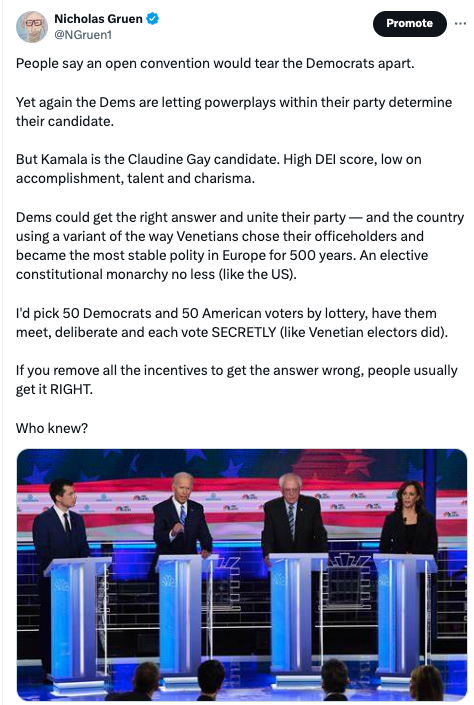
People say an open convention would tear the Democrats apart.Yet again, the Dems are letting powerplays within their party determine their candidate. But Kamala is the Claudine Gay candidate. High DEI score, low on accomplishment, talent and charisma. Dems could get the right answer and unite their party — and the country using a variant of the way Venetians chose their officeholders and became the most stable polity in Europe for 500 years. An elective constitutional monarchy no less (like the US). I’d pick 50 Democrats and 50 American voters by lottery, have them meet, deliberate and each vote SECRETLY (like Venetian electors did). If you remove all the incentives to get the answer wrong, people usually get it RIGHT. Who knew?

https://x.com/NGruen1/status/1815982404542341347

PS: the new interface is so bad, I can’t do better than this I’m afraid.

Dharmawardana and Wilson keep up the good work

The first step toward the application of sortition for the democratization of society is not to convince elites that sortition would be a good tool for them to use, as many academics seem to believe, but to disseminate the idea widely among the population, so that it becomes a live political possibility. For this to happen, the few who are aware of this idea need to tirelessly take advantage of every opportunity to advocate for sortition.

Chandre Dharmawardana and Phil Wilson are advocates for sortition (each in their own country and situation), whose writings have been cited here before. Each of those has recently written again, demonstrating the spirit of consistent dedication to the cause of democracy.

Dharmawardana wrote in the Sri Lankan The Island:

In my opinion, a way around [the practical and theoretical problems with elections] is to abandon electoral methods and return to the method of SORTITION advocated by Aristotle and used in several Hellenic cities during the time of Pericles.
Continue reading

Rory Stewart’s Long History of Ignorance

Followers of this site will be intrigued to know what I think is a really first-rate radio documentary from Rory Stewart, which reframes knowledge in a Socratic or Confucian way, which is to say, starting from our vast ignorance both before and after we learn all we can. There are six episodes with the fourth on politics where Rory bangs the sortition drum pretty loud. You can click through to the whole series on this link or to the sortition episode by clicking the image below or the mp3 file which I’ve also appended below.

Mogens Herman Hansen – prominent classicist with an interest in sortition – dies

The Guardian has an obituary of Mogens Herman Hansen.

Danish historian who transformed our understanding of the way Athenian democracy functioned

The term democracy emerged in the classical city-state of Athens to denote power exercised by common people, at that point men who were not slaves. From around the sixth century BC, officials were chosen by lot and were subordinate to a citizens’ assembly that made decisions. Writers on this process tended to describe it in theoretical terms. But the Danish historian Mogens Herman Hansen, who has died aged 83 after a short illness, transformed understanding of how Athenian democracy functioned by approaching it empirically, through a series of simple questions.

Hansen established the actual practices of the direct democratic assembly, the nature of the leadership exercised by the distinct classes of orators and generals in the absence of any form of partisan political structures, and the importance of mood and rhetoric on the opinions of the mass assembly.

His second insight was based on the fact that previous interpretations of Athenian democracy had ignored how it had changed as a result of Athens’ defeat in the Peloponnesian war with Sparta and the constitutional reforms that began in 403 BC.

The system had moved from the assembly being sovereign to one that was ruled by the distinction between laws (nomoi) that were permanent, and decisions (psephismata) that had to be made in conformity with the laws, and could be challenged in the courts if they were not.
Continue reading

Democracy Perception Index

It turns out that there is a rather interesting yearly report called “Democracy Perception Index” which has been published since 2019. The report is based on opinion surveys conducted in more than 50 countries and in which people are asked about the perceptions of democracy and of the government of the country in which they live.

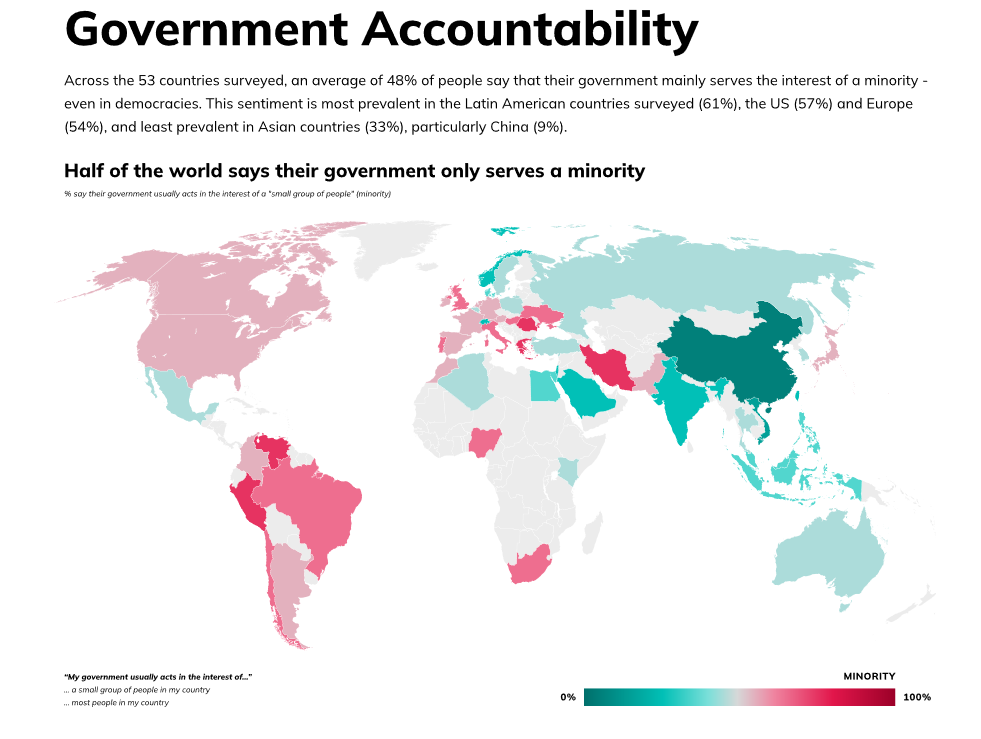
The report is contains various pieces of information of interest. One of the interesting findings in the 2024 edition is that majorities in Japan, in almost all European countries, and in all American countries with the exception of Mexico, see their governments as serving “a small group of people in my country”. In Asia, in contrast, majorities in most countries (with the notable exception of Iran) see their governments as serving “most people in my country”.

Also interestingly, some light is shed on the way people use the under-defined term “democratic”. The criterion people use for stating that their country is democratic is rather more lax than the question of whether the government serves most people. Since majorities in many countries in Europe and America say that their government is democratic, it seems that quite a few Western and South American people are willing to assert both that their government is democratic and that it serves a small group of people at the same time. In China the situation is the opposite: More people assert that the Chinese government serves most of the people in the country than assert that China is democratic, implying that quite a few of the Chinese see China as undemocratic despite asserting that its government serves most people.

Rather bemusingly, the report uses the terms “democratic”, and “free” as factual labels (as opposed to reflecting perceptions) to refer to the Freedom House classification of countries. This follows the convention of referring to [Western] expert opinions as scientific fact, while delegating people’s perceptions of their governments to mere opinion.

Effects of electoralism: Food insecurity

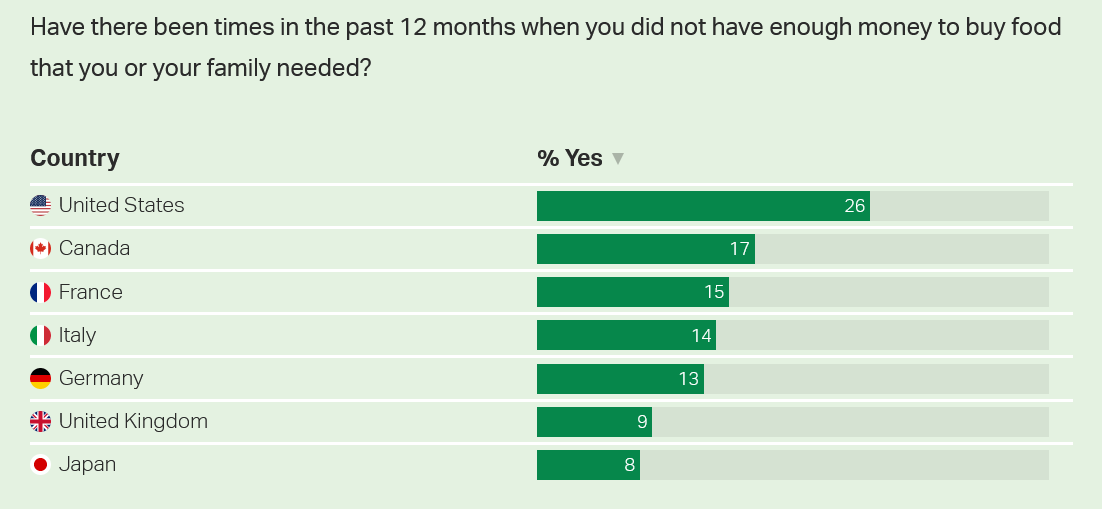
A Gallup poll finds that the inability to afford food is common within Western nations.


Effects of electoralism is a new category of posts is that is devoted to documenting the social and political effects of the elections-based system of government. The aim is to generate a steady stream of up-to-date items that can be easily referred to in order to highlight the fact that the system is inherently anti-democratic. Discussion of the persistent failure of the system to serve those ruled under it is studiously avoided not only by those who overtly promote the status quo but also by many supposed reformers who express concern about people losing confidence in the system, but rarely discuss the underlying causes for this loss of confidence.

Demiocracy, Chapter 21: “Wide” mass electorates attract and empower Propaganda

Already weakened by the vast impersonal forces at work in the modern world, democratic institutions are now being undermined from within by politicians and their propagandists. The methods now being used to merchandise the political candidate as if he were a deodorant positively guarantee the electorate against ever learning the truth about anything. —Aldous Huxley, Brave New World Revisited, 1958, VI.

We vote, indeed we perceive political reality, through the people with whom we are in contact. Most of us are reached by the mass media only in a two-step process, by way of other people’s perceptions and reactions to them. —Hanna F. Pitkin, The Concept of Representation, 1967, p. 223.

… it has also become evident that if one acts ruthlessly …, cleverly organized propaganda can accomplish swift and drastic changes in opinions and attitudes, especially in difficult and critical situations; it can … also instill patently false ideas about actual conditions. — Daniel Boorstin, The Image, 1961.

Regarding one of those Pernicious P’s, Wikipedia says the following [2024-07-01] about the influential author Edward Bernays and his book, Propaganda (1928):

[Bernays] outlined how skilled practitioners could use crowd psychology and psychoanalysis to control them [the masses] in desired ways. Bernays later synthesized many of these ideas in his postwar book, Public Relations (1945), which outlines the science of managing information released to the public by an organization, in a manner most advantageous to the organization.

Continue reading