


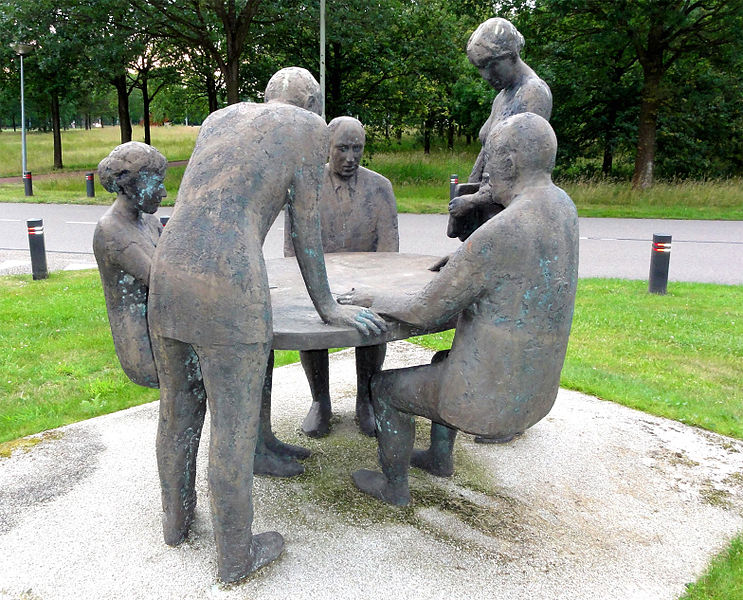
 In a previous post I discussed the “deliberative transformation”, a favorite trope within the theory of “deliberative democracy”. I pointed out that whereas the deliberative democrats see this hypothetical phenomenon as an ideal (maybe the central normative goal of their theory, more important than any policy outcomes), such a phenomenon, if it were really a widespread phenomenon as the deliberative democrats imagine, would be a major obstacle to an allotment-based democratic system (which, it is worth mentioning, is the only theoretically well-motivated schema of a democratic system).
This post considers the ideological structure that is associated with the idea of the deliberative transformation.
It may be claimed that the rather obvious, but of course unadmitted, starting point of the deliberative democracy theory, is that the adherents of the theory are concerned by the fact that the mass of citizens often refuse to support certain ideas that are accepted by the adherents as truth. Classically the reaction to the fact that citizens cannot be depended upon to see things as they are seen by an elite group was to assert that government should be left to those who are enlightened enough to see things as they should be seen. However, in the modern democratic age such crude elitism is unacceptable. Thus, the deliberative democrats seek a cure for the popular disorder. According to this view, deliberation is nothing more than the treatment that the deliberative democrats prescribe to the recalcitrant masses. It is the process which will lead the masses out of the Platonic cave and into the dazzling light of rational thought. If applied correctly, this treatment will inevitably, indeed, by definition of correctness, make the masses accept the objective truths, those that will lead them to support the policy choices preferred by the deliberative democrats.
Deliberative democrats would, however, deny all that. They would solemnly proclaim that they do not seek to promote any specific ideas or policy choices, neither their own nor anyone else’s. Rather they aim to enlighten the entire citizenry, including themselves, through the transformative magic of deliberation. They would assert that they would accept as worthy and democratic any decision that a truly deliberative body would produce, and that a body being truly deliberative depends solely on its procedures rather than on achieving pre-determined outcomes. However, even on this account, the implications of the idea that many citizens can be expected to experience deliberative transformations is contradictory to the basic premise of democracy, which is that citizens are reliable, indeed, the most reliable, judges of their own values and interests.
If citizens’ understanding of the world can only be considered politically valid after they have gone through the transformative experience of deliberation then the typical citizen’s understanding of the world in existing society is invalid. In its pre-deliberation state the citizen is likely to misperceive reality around them. They thus cannot be trusted to represent their own values and interests. Again, this is not a simple matter of being consciously uninformed. According to deliberative democrats, the pre-deliberation state is not a situation in which the citizen reserves judgment or makes a consciously tentative judgment which they are quite willing to change as they seek and obtain new information or as they further contemplate the information they have. It is rather a state where the citizen strongly holds ideas that in their post-deliberation, politically-valid state they come to reject.
In terms of citizens’ values and interests, the transformation can be conceived in two ways. It may be that the citizens keep their interests and values intact through the transformation, but having been mistaken in their judgement before the transformation are now able to perceive their implications correctly and able to apply them correctly in decision making. Alternatively, the transformation causes the citizens to experience a significant change in their values and interests. In either case, the pre-deliberation citizen is unable to effectively represent their post-deliberation values and interests – and according to the deliberative democrats it is those post-deliberation values and interests that count as being the citizens’ true values and interests.
Thus, the adoption of the idea that citizens are transformed by deliberation runs directly against the democratic idea of self-representation, as does any idea that involves the notion that most people in society systematically misperceive reality, or misperceive their own values and interests. Such an idea leads directly to the need for an enlightened elite managing society – either as a permanent ruling class, or at least as an interim vanguard that leads the masses to the light, where finally they will meet the vanguard’s standards and win its approval for graduating to self-rule.
Filed under: Academia, Deliberation, Sortition |
 Adam Cronkright
 Ali
Ali Ahmed R. Teleb
 avanderven
 avergne
 Alex Kovner
 azakaras
 Brett Hennig
 campbellwallace
 Simon Threlkeld
 Nick Coccoma
 codyhipskind
 Common Lot Sortitionist
 Conall Boyle
 constitutionalism
 davidschecter
 Ethan McCutchen
 graytmatter
 gtridimas
 Henry Tuttle
 H.J. Hofkirchner
 HpR
HpR James Kierstead
 John Burnheim
 jgarry20151
 Jochen Krattenmacher
 johnedwardtaylor
 johnhuang865
 Jonathan Crock
 keithsutherland
 Jacob Richter
 kkoreilly
 lukewhito
 SimonPek
 Nathan El
 Nicholas Gruen
 Owen Shaffer
 Patrick Chalmers
 Paul Gölz
 peterstone
 Pierre-Etienne Vandamme
 pronfeld
 Emil
Emil rcaze
rcaze richwbrown
 Roger Knights
 roslynfuller
 Pierre-Etienne Vandamme
 shaharavin
 tbouricius
 Ted Wachtel
 Joshua Laferriere
 theodorestathis
 towardsautonomyblog
 Wayne Liebman
 Yoram Gat
 Oliver Milne
 Equality by lot
Interesting — as Yoram correctly states, deliberative democrats would deny this argument, claiming only to act as facilitators (which brings into play the Quis Custodiet Ipsos Custodes? principle, examined in the recent JoS symposium on governing citizens’ assemblies: https://www.ingentaconnect.com/content/imp/jos/2026/00000002/00000001
Yoram is right to argue that the ultimate goal of deliberative democracy is the deliberative transformation of the full citizen body (the renewal of the Habermasian public sphere), and some critics might view this as a quixotic or antidemocratic project. The symposium on James Fishkin’s new book, Can Deliberation Cure the Ills of Democracy? (which calls for a deliberative transformation), will be published in JoS shortly.
LikeLike
Interesting, Yoram! But the key difference is whether you believe that “most people in society systematically misperceive reality, or misperceive their own values and interests” (a belief you attribute to deliberative democrats), or only that “some people, sometimes, misperceive…” If you believe the former, you’ll be tempted by elitist conclusions, be they technocratic or vanguard party. If you believe the latter, there’s no threat to the democratic ideal. In the end, it’s still individuals making their own call. The question is just whether we want a democratic procedure that has no chance of allowing participants to correct (by themselves!) their false or unjust beliefs, or one that could, perhaps, have this desirable effect. I can see no good reason to prefer the former.
LikeLike
Pierre-Etienne,
It’s one thing claiming that people sometimes misperceive their own values and interests, but the language of “correcting” false and unjust beliefs involves a shift into epistemic and Rawlsian territory. The traditional case for democracy is simply that the beliefs and preferences of the demos should be reflected in public policy. Sure it would be better if the beliefs were well-founded and the preferences just, but there is a danger of throwing out the (democratic) baby with the bathwater.
LikeLike
PS it’s interesting to still hear talk about the role of reason in correcting false beliefs. This is what Helene Landemore described in her 2013 book as the “classical” (Cartesian) model, which has been superceded by the Argumentative Theory of Reasoning. According to the latter theory the role of reasoning is to persuade one’s peers, so it’s a branch of rhetoric.
LikeLike
Let me share an example of citizen incompetence that I am familiar with. In America, the average citizen, even educated, does not understand why the World Trade Centers collapsed on 9/11. The average citizen has not bothered to read the publicly available NIST reports.
The average citizen is not an engineer with an understanding in solid mechanics and the behavior of structural collapse. It just so happens I am.
The knowledge needed to understand collapse just takes, time. You just need to learn some more stuff. With infinite stuff to learn, all people don’t learn everything. Very smart scholars and doctors and whoever will get things wrong in my niche because they’re just not specialized in it.
Obviously, the question of why the World Trade Center collapsed has huge implications on politics. It has implications in building codes. It has implications in foreign policy.
For slender structures, a constant worry is “buckling”. Buckling is a kind of structural instability when, given a constant load, the structure will continue to deform more and more. In the context of both towers, according to the NIST reports, all the towers collapsed because of **thermal expansion** of critical columns. They didn’t collapse because steel was melted or softened. When the critical columnns expanded, they were forced to carry more load over their capacity. Then they buckled. Because many buildings are designed differently, the WTC design just so happened to lead to a cascading “progressive collapse”. Collapses do tend to happen near free fall speeds because of the lack of stiffness following buckling.
To me then a huge part of “deliberation” is just citizens bothering to understand policy they have to approve or disapprove. Citizens are not “unenlightened” for not understanding everything under the sun. The elites don’t understand either!
As for an “enlightened elite” ruling over society, there’s a difference when citizens have power over the specialists. For example, a lot of laws in both Europe and the United States are developed by specialist engineers. Even kings have relied on specialists to give them advice on specialized topics. Yet because the king retains sovereign authority, the realm remains a tyranny.
It’s not different with democracy in my opinion. Citizens can and will choose to delegate specialized tasks to experts. Citizens will hire specialists to draft specialized legislation. Kings and corporations do exactly the same.
As far as “values changing”, the primary value that is typically changed is: “Oh, that white/black/gay/poor/rich/etc/male/female person is a lot less of an asshole I thought they were!” Literal closeness breeds real social cohesion.
Another huge advantage of sortition is that sortition enabled the manpower needed to make collective decisions. Oftentimes we hear about overworked legislators who delegate out the understanding to policy to party leaders.
With sortition, you have an amazing power to draw MORE people by lottery to construct new deliberative assemblies whenever you need them. The size of the legislator can expand and contract as needed to handle the policy need!
LikeLiked by 3 people
Great comment by anonymous above.
And I think it shows up Yoram’s ‘gotcha’ style of argument. The fact is that if you’re thinking about how to improve our democracy there are many things to think about and many trade-offs. If one isn’t trying to ‘steel-man’ those with whom one disagrees, I don’t think you demonstrate much.
LikeLike
Hi Pierre-Etienne,
> “some people, sometimes, misperceive…”
Sure. Everyone is mistaken occasionally. But if most people are able to represent their own interests and values well most of the time then the situation of people correcting themselves becomes a rare enough phenomenon to be of no great importance.
It can surely be expected that occasionally a significant portion of the decision makers will find that they changed their mind during the deliberation process. It can also be expected that sometimes important issues will be affected by these significant changes of minds. But these situations will be the outliers and will not reflect the way the system routinely behaves.
The fact that the notion of people changing their minds is so significant in the theory of “deliberative democracy” is due to the elitist mindset of its proponents.
LikeLike
While technically I support what this article is claiming (as I understand it): power should be with the people and the magic of sortition is people can seek their own good. The techniques of deliberation are not the magic.
The way this article is written feels almost oppositional to deliberation, which is a little frustrating. In my experience, everyone I’ve talked to and every sortition advocate I’ve met, thinks there’s a big role for deliberation. I think it’s just so baked into humans “seeking their own good” to deliberate! Were we to convene a sortition assembly and put them in a big room without any facilitation at all, they would likely derive some kind of facilitation for deliberatrion themselves.
I’ve helped moderate LA’s charter reform assemblies and a few other events and been in lots of meetings about designing the process of deliberation. There is a temptation to think that our process design and our moderation are invaluable invaluable. Like anecdotes I hear about juries, I think assemblies themselves would demand deliberation.
It kinda feels like Yoram here is saying Deliberative Democracy people prioritize “thinking/deliberating about your choice”, while he says the essential value is “having a choice”. I’m on Yoram’s side, but just want to point out that most humans, when given a (real) choice, are going to think/deliberate about that choice.
LikeLiked by 1 person
Anonymous,
> Citizens are not “unenlightened” for not understanding everything under the sun.
Obviously, and thus it is unclear to me what the fact that most people don’t understand structural engineering is aimed to imply.
> Citizens can and will choose to delegate specialized tasks to experts. Citizens will hire specialists to draft specialized legislation.
Again, I consider this obvious. If anyone is going to dispute this it is the deliberative democrats themselves who often imply that unless the “deliberation” process is properly organized by the professionals then the citizens would just make hasty uninformed decisions or would be too clueless to know who to ask for advice.
> As far as “values changing”, the primary value that is typically changed is:
Here is where you finally do stray into defending some aspects of the “deliberative transformation” trope. Although you are not making any assertions regarding the frequency of this transformation or its magnitude, you are asserting that you know the type of transformation that will be happening. And here you are on much thinner ice, both on matters of fact and on matters of the values you are expressing.
Regarding facts: How often do people really change their opinions materially at all (as opposed to filling in some information they did not have, and which they knew they did not have, or as opposed to giving some thought to issues they never gave much thought to before)? Are those changes really of the type that you so confidently assert they are? Would the changes depend on the many details of the deliberative setup? I’d want to see a variety of data before I am willing to accept the rather dogmatic view that people have a natural tendency toward liberalism and universal inclusivity, a tendency that is somehow artificially suppressed in our societies but is unleashed by “deliberation”.
Regarding values: I find the fact that you make your assertions on this matter so confidently to certainly be suspicious and to be an indicator of an unhealthy expectation that under “the right” conditions people will tend to see things as you do.
LikeLiked by 1 person
Hi Max,
I think we are very much in agreement.
> most humans, when given a (real) choice, are going to think/deliberate about that choice.
I agree. I am all for thinking and deliberation.
What I oppose is the notion, implied or explicit in the deliberative democracy theory, that the main problem with the current system is the degraded state of the population (and a whole host of associated anti-democratic ideas).
LikeLiked by 2 people
The JoS review symposium on James Fishkin’s Can Deliberation Cure the Ills of Democracy? is now online. Unfortunately there’s a bug in some of the commentary links, but the claims about “deliberative transformation” that Yoram alludes to are in Jim’s response to the commentaries, see:
https://www.ingentaconnect.com/content/imp/jos/pre-prints/content-impjos8
LikeLike
the Palisades Recovery Coaliation held a community event a few months ago. one of the Coalition leaders had heard of sortition and civic assemblies just a few weeks prior to their community event. he asked my local sortition organization, PDLA, to provide some guidance and moderate the small groups, so that’s how i got involved.
26 people, two days of deliberation. the deliberation was led by the two leaders from the Coalition. they were not profesisional moderators and mixed advocacy with their moderation. i was dying inside the whole 8 hours of the first day, because i felt so strongly that the Coalition leaders were tampering with the purity of the deliberation. we, from PDLA, gave them feedback, and the second day of the event, there was an improvement.
OK! TO BE FAIR, the Coalition did not call this event a “civic assembly” and only last minute had tried to randomize invitations among the pool of people who had signed up online to participate. and last minute, invited PDLA (4 of us) to come help moderate.
in retrospect, other than taking away speaking time from the participants, i don’t think the personal views of the Coalition leaders had an outsized effect. their opinions were treated about like anyone else’s opinions in the group.
however! the Coalition leadership nearly committed what now might be the biggest sin a moderation team can commit in my book!
the report with the assembly’s recommendation was fundamentally inaccurate! the draft report was emailed out and we were like wait, what? one of the three components of the group’s recommendation was missing (indeed, it was the recommendation to include “citizens’ assemblies” going forward in the Palisades). a bunch of emails were sent back and forth, and we were able to get picture evidence of the whiteboard where the recommendation had been written down with all three components from the event.
after that was settled, i felt better, but then we were told (but never saw) that the one of the Coalition leaders had included a lengthy commentary of their own alongside the final report.
so…in some sense, i’ve come to believe event moderation technique isn’t as important as i once thought, but (and i suppose this is obvious) it is tremendously important that the recommendations be faithfully transmitted!!!
i blogged here https://almostinfinite.substack.com/p/the-miracle-in-the-ashes-of-los-angeles but this was before i had seen the flawed report.
LikeLiked by 1 person
Max:> the deliberation was led by the two leaders from the Coalition. they were not profesisional moderators and mixed advocacy with their moderation.
OK, the problem I think is that we all (including professional moderators) have our own preferences and biases, and these may not even be conscious. Yoram referenced the view that “people have a natural tendency toward liberalism and universal inclusivity” — a perspective that might be characteristic of the kind of people who are attracted to deliberative democracy. But are Rawlsian values universal, or just the preferences of liberal arts professors during the last quarter of the twentieth century? In his response to Mark Warren’s observation that participants in America in One Room depolarized by moving from Trump to Biden, James Fishkin remarked that Deliberative Polls may well be of interest to “Post-Trump Republicans” (the implication being that 49.8% of voters in 2024 were simply wrong/deluded/brainwashed etc). https://www.ingentaconnect.com/content/imp/jos/pre-prints/content-impjos8
I wonder if the move towards AI moderation is partly motivated by impartiality concerns, or whether it’s just a question of cost and scaleability?
LikeLiked by 1 person
Hi Yoram,
There is a third way we can envision this.
I am a homeowner, and, as such, I know the various needs my home has. If my window is drafty, I am fully aware that it needs replacing. If my dishwasher breaks down, I’m aware I need a new one. If my lightswitch stops operating, I need to fix the wiring. I value a properly functioning home. However, I personally do not know how to replace my windows, I cannot install a new dishwasher, nor re-wire my home. I bring in various other people into my home to do these things for me. I don’t tell them how to do it, I don’t know the proper way to carry it out. Taking care of my home, therefore, is a callabortive project with many different perspectives involved.
People are generally quite knowledgable regarding what their needs are (like my home), but may not be experts on the best way to achieve their needs, nor of the needs of others.
Bringing an electrcian, a plumber, an architect, a roofer, etc into my home to discuss the best way to make reonnovations as a group will produce better outcomes than just making decisions on my own. Simiarly, bringing in different perspectives, trying to create a solution a group, requires some degree of synthethis of all their ideas and perspectives, which allows for greater nuance. It also leads to exposure of different perspectives, allowing for more people views to be taken into account.
It is not their values or interests that they misperceive, people generally understand the things that benefit them and the hurdles they face in their own lives. What deliberation achieves is to combine their own values and interests with that of others, and seek out solutions to carrying out their varying needs and values in a more whole and complete way.
LikeLike
Jordan’s paper Electoral Lottocracy will be live on JoS shortly.
LikeLike
The new URL for the Fishkin symposium is https://www.ingentaconnect.com/content/imp/jos/2026/00000002/00000002
LikeLike
But the server is down, will report back when it’s available again.
LikeLike
Back to https://www.ingentaconnect.com/content/imp/jos click the fast track option. Apologies for all the chopping and changing.
LikeLike
Hi Jordan,
The homeowner who needs the help of professionals for home maintanance is not being transformed by the experience. As you write – they have a goal in mind and they are quite aware at the outset that they need the help of professionals to achieve this goal. By the end of the project they have their original goal achieved, possibly with some minor unexpected modifications and improvements.
The deliberative transformation notion is about a homeowner who calls in the professionals to fix his electrical switch or his windows and by the end of the project they have become a dedicated naturalist, have had their house razed and the lot turned into a wildlife sanctuary. While this turn of events now makes perfect sense to the former houseowner, their family and friends now see them as unrecognizable and suspect that the professionals have somehow manipulated the houseowner into this new way of thinking for their own nefarious purposes.
LikeLike
Hi Yoram,
It’s possible that deliberation may indeed be a transformative experience for some who participate, but I don’t see why one should assume that to be the case, or even that it’s a necessary assumption.
As a homeowner, I’m not wholly ignorant on maintenence. When calling in an electrician, I may offer some preferences for how I want things to be done, and the electrician may manage to convince me otherwise. Perhaps when I call in a repairman to fix my homes heating, they will convince me that I, in fact, need a whole new heater, and that a heat-pump would be the best choice for me today.
To change my mind about once decision doesn’t require me to become an entirely new person, nor do I change my underlying values. My understanding of how to best achieve them changes.
When engaging in deliberation in a political context, I am, similarly, presented with new information. We join together to attempt to solve a problem, and attempt to work out how to do that. I will bring my own values and experiences to the table, and they will contribute towards the final outcome in some way. However, I will also be exposed to experiences that I lack knowledge of, and those arguments may convince me. Or, alternatively, they may not. The group dynamics may leave the group, more or less, convinced while individuals may not be wholly commited to the outcome.
What deliberation requires of me, though, is to attempt to convince others of my perspective, while others attempt to convince me. What arguments I find convincing will depend on my values, certainly, as will the rest of the group. Still, having to be convincing is, itself, a different way of thinking than most everyday life. It forces the participants to more strongly consider their own views, why they have them, and to consider the views of others and how to take their view into account in order to convince them of yours.
That process doesn’t necessarily transform you, but it does cause you to, for the context in which you are deliberating, take on a more complete picture than you normally would when talking only to yourself or those who generally agree with you.
LikeLike
Jordan:> having to be convincing is, itself, a different way of thinking than most everyday life. It forces the participants to more strongly consider their own views
I’m not so sure — the confirmation bias (necessary to persuade others) may also serve to reinforce one’s own prejudices. In his new book, Terry Bouricius notes that ‘once we have expressed an opinion, we develop a psychological investment in it and feel a prideful compulsion to defend it’ (Bouricius, 2026, p. 147). He also notes that a small minority (20%) of people are open to opinion change. If so then those pursuing the deliberative transformation are facing an uphill battle.
LikeLike
Keith,
This is true, and I’m not suggesting that this process will necessarily change one’s mind. However, it isn’t always necessarily for participants to change their minds for the deliberative process to be successful.
Needing to be convincing to others requires entirely different skills than being convincing to oneself or those who agree with you. To successfully convince others, you first need to attempt to understand their own perspective, why they believe what they do, and then attempt to explain why your own solution addresses their concerns better than their own, or at least, better than they originally thought. In other words, to be convincing others first requires you to understand others.
People who deliberate are also consistently examining the strength of the arguments by others, and people are generally good at evaluating the strength of an argument, particularly from those they disgree with.
What I think will often happen is that people will end up in a position, after deliberating, where they recognize that the strength of the argument from the other side is strong, but, for various psychological reasons that we all experience, are not yet ready to change our mind. We hold onto the belief that while we cannot defeat the argument today, that given enough time we will be able to work out a reason the other side is wrong.
None the less, a person in this state may be more willing to “go along with the group”, as the argument, while not sufficient to convince them that it’s the best option, is sufficient to convince them that they can live with the decision.
What the result is is that the group’s final decision is one that has been scrutinized, and that the group has largely deemed to be the most defensible option, even if not every person truly agrees with it or has changed their mind.
LikeLike
Jordan:> Needing to be convincing to others requires entirely different skills than being convincing to oneself or those who agree with you
You should have been a teacher of rhetoric, an attorney or a politician! Seriously though, having spent some two decades arguing on this forum, I’ve come to the view that once someone has a strong view on a topic (and, particularly, if they’ve expressed that view either verbally, or in writing), it’s very difficult for them to alter their fundamental perspective. Remember that the argumentative theory of reasoning proposes two distinct cognitive modules: persuading and evaluating. Whilst there is no reason why the two approaches cannot co-exist in a single reasoner, confirmation bias is more likely to infect the evaluation faculty. This is why I’m an advocate for jury, rather than deliberative, democracy.
LikeLike
Keith: > Remember that the argumentative theory of reasoning proposes two distinct cognitive modules: persuading and evaluating.
This is true, but it’s true even for those deliberating. People are able to evaluate the arguments of those they are speaking to and determine the strength of their argument. This makes it easier for them to strike down weak arguments, and forces them to produce stronger arguments.
Also, remember, the argumentative theory of reasoning also predicts that the strength of argument production depends upon the need to convince others. Convincing people who agree with you requires no effort, and thus, argument production is weak. Arguing against people who disagree with you requires more effort, and argumentat production is stronger.
But further, context matters. When one debates in a forum, or at the dinner table at thanksgiving with the family, there are no consequences or accountability, beyond perhaps some food on the floor. The need to convince others is still relatively low, as the stakes are low.
When there will be actual action tied to your decisions, the stakes are higher, and therefore, the need to convince others also increases. The argumentative theory of reasoning predicts, as such, the strength of argument production should also increase.
So to see greater arguments, we need both variety of views and stakes that require an attempt to convince one another.
But my claim here is that even under these conditions, people may still not change their minds on what outcome they prefer, but they may change their mind on the merits of the other options. This sort of changed view is one you likely won’t really see play out in contexts where a decision doesn’t actually need to be made. So long as people can keep arguing, indefinitely, without the need to make a choice, people will continue to argue in favour of their preferred outcome.
But if a choice needs to be made, people who have done a better job producing convincing arguments will thus convince others of the merits of their view. This may not change their mind on their preferred outcome, but *can* change their minds on what outcomes they may agree to, *in spite* of their preference.
This change, in my opinion (and something I shall be arguing in future papers, once I have spent some time familiarizing myself with more literature) is democratically valuable.
LikeLike
>So to see greater arguments, we need both variety of views and stakes that require an attempt to convince one another. [This] is democratically valuable.
I think we agree
a) that the variety of views needs (for practical reasons) to be finite and should reflect the preferences of the demos, and that this is best achieved by an electoral procedure.
b) that convincing a large quasi-mandatory jury is effectively the same as convincing everybody.
The question is the optimal way for getting from a) to b). Given your faith in the need for persuasive rhetoric and all the caveats regarding information cascades, confirmation bias etc. I’m not persuaded that intra-group deliberation is reliable. In a law court, nobody cares whether the advocates believe in the guilt or innocence of the defendant — all that matters is their ability to persuade the jury. Or are you suggesting the defence attorney needs to convince the prosecutor that she is wrong?
LikeLike
A legal trial jury also deliberates, beyond the argument production produced by the advocates. And different members of the jury often come in with their own predisposed biases, before that deliberation begins, as to what the verdict should be.
The argumentative theory of reasoning suggests that the deliberation of the jury is a pretty fundamental process. Jury members may agree with one advocate over another based on their own personal biases, and will use confirmation bias even when listening. However, this exists overtop of their ability to evaluate the strength of arguments from others.
However, it isn’t until the jury members need to convince one another do they work on fully understanding the breadth of the arguments being made.
And studies show that a consensus jury produces jurors who are more satisfied with the outcome than non-consensus jurors, even when they initially disgreed with the consensus. The process of going through deliberation and being convinced of the merits of the arguments, makes justifying that outcome easier, even if that outcome doesnt’ align with your own preference.
The argumentative theory of reasoning encourages deliberation amongst the jury, as that is when they are required to construct the strongest arguments to justify their choice.
LikeLike
The remit of small trial juries is to reach a unanimous verdict on the facts of the case, hence the need for jury-room deliberation. Large political juries exist to reflect the informed preferences of the target population. The wisdom of crowds (based on the law of large numbers) suggests that personal “biases” will cancel out. There is no need for individual jurors to justify anything to anybody, all they need to do is listen to the arguments and then register their verdict. The search for unanimity in political decision making is a symptom of epistocracy, or (alternatively) a fascist mindset.
LikeLike
I know my last sentence sounded a tad hyperbolic, but this is a message I received from Nadia Urbinati yesterday:
“I am also very surprised by the vehement hatred of elections. Left and right together against elections. I think this is a dangerous time.”
I think Nadia is referring here to the common ground between lottocrats and populists. The transformation of the populace could deliberative or of a more unsavoury nature, but the search for political consensus is a dangerous one.
LikeLike
I see the point you are raising, as well as your concern. I’ll start by noting that I’m not arguing in favour of strict unanimity, though I admit that the consensus I favour is, at times, close enough that that’s unlikely to quell your concern. However, let me be clear that my reasoning is not due to a desire for conformity, either towards elitest experts, nor in a fascistic sense. In fact, it’s entirely the opposite.
I strongly favour democracy, including elections. I do not advocate, as you are aware, of removing elections, and I would actually argue against it. My desire is to make elections *more* democratic, for which I believe the current setup actually interferes with. It’s my belief that a true pluralistic democracy would be one in which all elected representatives are free to pursue the needs of their voters, regardless of whether they are a large or a small party. My issue with current electoral systems is that voters either vote for the majority party, or they end up with a representative unable to actively pursue their inerests.
A true, pluralistic democracy, in my opinion, is one in which the population consider government a shared space in which the needs of all citizens are considered equally valid and worth pursuing.
The job of the jury in this context is not to vote in favour of their preference — that’s what elections are for. The job of the jury is to determine how to apply the shared space. Specifically, to listen to the arguments, to deliberate, and then to determine what decisions they can live with. If a jury member believes they cannot live with a decision, either for or against the legislation, they are encouraged to hold their position. A hung jury is an entirely valid outcome that provides it’s own signals for what should come next. However, if they feel as though the arguments by the group are strong enough that they can live with the outcome, then they don’t need to agree or prefer that outcome to go along with it.
This is inline with perspectives like Philip Pettit’s accouting of non-domination. We are not asking everyoen to agree, but we are asking for a greater level of consent. A jury that does not at least attempt some level of consesus is a jury that is free to ignore the arguments from the minority members, and, as a result, minorities remain dominated.
LikeLike
Thanks for the clarification Jordan. We agree about the need for electoral reform, I just think you are taking the analogy between political and trial juries too far. My preferred model for political juries is the 4th century nomothetai and they have nothing in common with trial juries. In fact, in his new book Terry Bouricius claims that the provenance for the Anglo-American trial jury is the Viking and Norman occupation.
LikeLiked by 1 person
I do understand. However, I do believe there is more in common between a legal trial and a political trial than it at first appears.
I think, for example, there is, indeed, a great deal of fact to review when examining policy. One can look at how successful a policy has been in other jurisdictions, how similar the jurisdicitions of those successes or failures were, how successful a pilot program has been, etc. One can examine the causual chains of a policy and see if they would work out as theorized. One can examine the factual motivation for the proposed policy. For example, if the government wishes to carry out the reduction of rights because of some criminal wave, one can examine how significant the wave is based on historical data, the nature of the crime, etc. Perhaps the government is overclaiming danger.
I would even argue that a lot of differences of values end up becoming differences of fact. People who deny climate change aren’t in favour of forest fires, famine and drought, but do not believe the evidence supports the fears.
These sorts of questions are, in my opinion, a common element of policy, and a perfect usage for juries.
But I think juries and deliberation can do more than just that. Young speaks about situated knowledge; Experiences that different people have access to that others do not, based on being differently situated. These can be expressed through narratives in a trial. It wouldn’t be just the facts presented that would need to accounted for in the deliberation, but these narratives as well. People would need to provide arguments to justify how the legislation does or doesn’t respond to these narratives and experiences, and the deliberative process is powerful for helping people work through these different perspectives.
The problem is that if my examination of beliefs above is correct, and people may refrain from changing their mind, but are willing to suspend their belief in order to accept a policy that they have come to believe has merit, a simple majority vote robs them of this opportunity to truly express it. If you ask people their preference, they will share it, and if you believe that people in general are unlikely to change their views, then why bother holding the trial at all? The views beforehand are likely to mirror those after. While you point out that people are better at evaluating the strength of the arguments of others, do note that this does not mean they are necessarily convinced by the stronger argument. I once went to a theology debate between an athiest and a Christian, and I believed the Christian produced stronger arguments in that debate, yet I did not leave a Christian. Those who favour one side but feel the other argued better are unlikely to change their mind based on a better performance.
However, if I’m right in believing that despite remaining unconvinced, a person may be willing to set aside their preference if they can be convinced an argument has *merit*, then this allows deeply held convictions from a minority the opportunity to convince weakly held preferences from a majority, something that is lost entirely with a simple majority vote.
LikeLike
To respond to a different point regarding the cancelling of biases with a large N, this only works if we are taking an average of some sort. The law of large numbers tells us that as a sample size gets large enough, it’s average approaches that of the actual value from which it’s a sample of. The wisdom of the crowd tends to show that a lot of people have personal biases that do get cancelled out in the average. When guessing the number of jellybeans in a jar, a lot of people overestimate, a lot underestimate, but the average tends to be extremely close.
However, that does not guarantee us that the *mode* will be close. A majority rules vote does not provide us an average, but simply gives dominating power to the largest answer. If a population has a certain bias to begin with, on average, then a large body will reflect that bias. If the body is large enough, the body will simply reflect the bias accurately.
It also tends to flatten the results. If 50+1% of the population weakly prefers A and the remainder strongly prefers B, the average of their views, in a sense, would lean towards B, but a simple majority vote gives us A.
These sorts of problems do get dealt with more cleanly with a higher level of consensus. We *can* get a greater sense of the actual “average” view, how strongly they hold those views, etc. Otherwise, we simply end up dropping the minority from the discussion altogether.
LikeLike
I agree with all Jordan’s examples regarding the uncovering of facts, rather than preferences. However in both courtroom practice and (proposed) legislative trials the forensic exchange is between the advocates, rather than the jurors. In his new book Terry Bouricius outlines a fascinating example from his time as an elected member of the Vermont House of Representatives:
“On one occasion we had a panel of opposing lobbyists essentially conduct an organised argument in front of a committee for a bill on which none of us had prior stances. The lobbyists would call each other out, since they knew when an opponent was intentionally cherry-picking data or skirting an important issue, which none of us less-informed committee members could detect. . . . We learned more through that one brief deliberative session than we normally ever learned about any bill. (p. 148).”
No doubt the members of the committee deliberated between themselves afterwards, but the uncovering of facts was down to the adversarial debate between opposing teams of lobbyists.
>a person may be willing to set aside their preference if they can be convinced an argument has *merit*
Sure, but what deliberative democrats seem to forget is that it’s reflecting the preferences of the overwhelming majority of citizens who don’t participate in the minipublic that matters. If this is going to mean a “deliberative transformation” of the citizenry that strikes me as (at best) a quixotic project.
LikeLike
For sure, and this is not something I look to change. However, while the evidence is presented during trial, deliberation is a massively important part of it’s synthesis. Different jurors will focus in on evidence that confirms their initial biases (confirmation bias), but during deliberation notes are then compared and a full, more thorough accounting of all the evidence is considered by the group.
Exposure to evidence alone is beginning of the process, and (assuming a adequitely diverse set of participants), the act of deliberation improves outcomes.
So, there are two ways I’d question this. The first is to appeal to the notion of the “will of the people” and the ever expanding scope of what that means. Clearly we would agree that how Athens interpreted “the will of the people” would be wholly inadequate to us today, as not all people with interests, or who had to live with the consequences of policy had a say in that policy. Women and slaves, for example, were not included in their interpretation of “the people”. Something that wasn’t rectified immediately in modern liberal democracies, for which universal suffraged was a hard fought battle.
I argue that a further expanding of the “will of the people” is still required. The will of the people should be the will of *all* people, not just a majority. Minority groups should be capable of achieving their will. If this is not the case, then they are a dominated population, subject to the arbitrary will of the majority. However, when the will of a minority should be given precedence of the majority cannot be arbitrary either.
My stance is that a jury (or, more accurately, a series of parallel independent juries), reaching a high level (but not necessarily unanimous) of consesus achieves exactly this. The majority of these juries are still free to reject the minority arguments, but may also choose, provided they come to understand the merit, to defer to that minority. This provides, in my opinion, a far more complete image of “the will of the people”, which accounts not only preference, but active deference. In a pluralistic society, deference is, in my opinion, foundational to a fully realized democracy.
The second way I’d like to address it is to point out that the majority is a minority. Elections, as they exist today, tend to flatten various groups into a singular “majority”, of which none of their wills are truly represented but are given a “close enough” treatment. Every person, though, is uniquely situation in a way in which they will fall into the majority in many respects, and a minority in others. Every person has interests that will, at some point, put them into a minority view. Providing a mechanism for minority groups to pursue their interests against a majority provides opportunity for all people. Deffering to a minorities interest today will open the doors for your own minority interests to be acknowledged and deferred to tomorrow.
For all this, I believe that limiting democrach to the preferences of the majority is too narrow a scope, and one of the needed reforms is to widen it.
LikeLike
>The will of the people should be the will of *all* people, not just a majority. Minority groups should be capable of achieving their will.
Spoken like a true Rousseauian. Unfortunately J.-J. (who was vehemently opposed to intra-group deliberation in the sovereign assembly) thought that this was unachievable in large modern states (Corsica, c. 1768 was about the top limit). Whether multiple juries reveal the general will or the will of all is a moot question. Speaking as a majoritarian democrat, I’m not too bothered one way or the other — the key question is whether the decision outcome will be accepted by the vast majority of citizens disenfranchised by the aleatory coup. This means eliminating the factors that lead to variance in decision output.
LikeLike
For sure. One of my projects is to demonstrate this, or, at least, provide plausibility to warrent interest for investigation. I already have some analysis done on this that I think lends credibility to the argument, though I’d want to discuss my work with a statistician.
Descriptively, my case depends on separating out positive verdicts, negative verdicts, and hung outcomes (indetermine), the third of which leaves the matter unsettled and represents it’s own signal. I argue that for a given jury, the odds of one jury producing a positive verdict and another negative is far less likely than a positive verdict and a hung verdict, or a negativer verdict and a hung verdict. In other words, once a positive or negative verdict is found, it is highly unlikely to be overturned were it to repeat again.
LikeLike
Perceived legitimacy, imo, is the crucial factor. This means demonstrating in practice that it makes no difference which empirical citizens participate, the outcome would be the same. My jury proposed as an alternative for the Brexit referendum was some 6,000 strong. If this were split into 10 juries of 600 and (given the same advocacy input) recorded the same decision output (subject to an agreed margin of error) then citizens could relax in the knowledge that they were lucky not to be called up for jury duty. The huge cost of the exercise would be justifiable in this case, on account of the consequences of the decision. If the variance between juries was above the agreed threshold, then the losing part(ies) could call for a retrial.
LikeLike
Certainly. How I would address this, I”ll set aside for now, as I feel I’ve already caused a great drift from the original topic already. I greatly appreciate the dialog we had here.
LikeLike
Keith > having spent some two decades arguing on this forum, I’ve come to the view that once someone has a strong view on a topic (and, particularly, if they’ve expressed that view either verbally, or in writing), it’s very difficult for them to alter their fundamental perspective.
Yes, and predictable when little to no deliberation occurs.
LikeLike
> Yes, and predictable when little to no deliberation occurs.
It does not? People are certainly exchanging ideas and offering what they see as reasons for their ideas. What are the conditions for deliberation which do not occur on this forum?
It is easy to suspect that “deliberation” is often used to mean a situation that occurs when, and only when, everybody involved comes to see things the way I do.
LikeLike
My point (reinforced by the Argumentative Theory of Reasoning) is that deliberation between people who have strong views is actually very difficult, especially once they have vocalised their perspective (moderation really doesn’t make much difference). The ATR presupposes that reasoning is about persuading others, rather than changing one’s own mind. That’s why I advocate decision making by large, silent, randomly-selected juries, rather than ‘deliberative democracy’.
LikeLike
Yoram and I have deliberated intensively on this forum for over 10 years, yet have not shifted our positions significantly, as we are both deeply wedded to our respective views. But I would hope that our attempts to persuade have not fallen entirely on deaf ears, as this forum has a large number of silent participants.
LikeLike
>The ATR presupposes that reasoning is about persuading others, rather than changing one’s own mind.
This is not quite what the ATR presupposes. It’s for both. One does not wish to change their mind unless provided adequite reson to do so, which is why we are better at evaluating arguments.
Nonetheless, while discussion on a forum could, potentially, lead people to changing their minds over time, I suspect the deliberation would go very different amongst the members of the forum if a decision were actually needed to be made. People would be unable to continuously delay addressing arguments they strugle to counter for future engagements when a coming deadline for a decision is lurking.
This also is the difference between people arguing over thanksgiving and making a decision in a deliberative setting in which the group must form a decision. A final answer must be made, and the deliberation provides the mechanism to make it. There need to be good reasons provided to choose one over another.
When two people meet up to go out to eat, but want to go to two different restaurants, they don’t end up at two different restaurants. They deliberate and make a decision. However, if they were to argue over which restaurant is best on the forum, they may, indeed, never come to a final conclusion after two decades on online discourse.
LikeLike
Logged in to take ownership of the previous reply
LikeLike
Jordan, this is how Helene Landemore puts it:
“The ATR developed as an evolutionarily-plausible alternative to the classical (Cartesian) model of reasoning as a way of updating and correcting one’s own beliefs.”
>I suspect the deliberation would go very different amongst the members of the forum if a decision were actually needed to be made.
I think that would be true regarding most members of this forum (who tend not to share their views), but I doubt it would make much difference to participants who have deeply entrenched views. That’s the main reason for differentiating between advocates and judges in legislative forums.
LikeLike
> the deliberation would go very different amongst the members of the forum if a decision were actually needed to be made.
So what turns on the magic of deliberation is the need to make a decision? Aren’t elected parliaments and their various committees constantly making decisions? Are they “deliberating”?
LikeLike
>“The ATR developed as an evolutionarily-plausible alternative to the classical (Cartesian) model of reasoning as a way of updating and correcting one’s own beliefs.”
Yes, this is consistent with the ATR. It is contrasting the classical model, which says that reason is used by a lone-reasoner to examine their own views and update them appropriately. ATR suggests that reason does not appear to do a good job doing this, as a person will consistently find reasons to support what they always believe.
However, a lone-reasoner finding reasons to reinforce what they previously believed differs from a deliberater being provided reasons why they should believe otherwise.
In fact, in Mercier and Sperber’s book, the Enigma of Reason (for which I currently only have on audiobook, so direct quotes are challenging), they go out of their way to defend jury deliberation near the end of Chatper 15. In it, he cites a study by Hastie, Pennington and Penrod in which mock juries watch a legal trial regarding a stabbing. Both the original jury and legal experts largely agreed the outcome should be “2nd degree murder”. The most common answer given by mock jurors after having seen the video was “manslaughter”. Only a quarter of the mock jurors favoured 2nd murder. Most mock juries, on the other hand, went with 2nd degree murder.
The outcomes provided by most juries differ from the majority opinion of the individual jurors. This is regarded in the book as an example of the success of deliberation, by the authors of the ATR.
LikeLike
In a word, no. Very little deliberation occurs within parliament itself. From Bouricius’ book, “Democracy without Politicians”, he writes:
Elected officials primary purpose is to be re-elected, and to do so, cannot engage in free-deliberation. They must maintain the positions in which they were elected to uphold. They engage, first and foremost, in motivated reasoning. Any negotiation and compromise is done from a power perspective, in which one party, the one which has a majority, enters from a place of higher power, or, in the case of a filibuster, the minority has the power of delay. None the less, the negotiation is done with elections in mind, first and foremost, not the outcome.
Juries, while they have prejudices, and may even stand to gain from the outcome of a decision in some way, have significantly less external motivations. They come together as equals, rather than positions of power. They are not concerned with re-election, and so negotiations can involve real compromise. Reasons for the outcome need to be provided to one another in order to come to a group decision.
In parliament, outcomes are decided by vote whips, not by deliberation.
If deliberation is the mechanism by which a decision is decided, deliberation produces decisions.
LikeLike
>The outcomes provided by most juries differ from the majority opinion of the individual jurors. This is regarded in the book as an example of the success of deliberation, by the authors of the ATR.
Doesn’t that just reflect the decision threshold, and the pressure towards consensus in trial juries? As you know, I think you draw too close a parallel between trial and legislative juries. In the former case there is a right answer (guilty or innocent), in the latter there are only preferences.
>If deliberation is the mechanism by which a decision is decided, deliberation produces decisions.
What produces the decision is the closure mechanism (simple majority, supermajority, unanimity etc). In other words it always comes down to a vote.
LikeLike
>What produces the decision is the closure mechanism (simple majority, supermajority, unanimity etc). In other words it always comes down to a vote.
This is true. What the ATR predicts, however, is that the closure mechanism which requires greater argument produces better reasoned outcomes. Reasoning, in this model, is lazy, and the quality of reasons are proportional to the *need* in which one must convince others. Once a simple majority is made, no more reasons are needed, so the quality of reasons are reduced.
The higher the bar, the more one needs to actually convince others, and the stronger those reasons become. This is the direct prediction of the ATR.
LikeLike
Yes that’s true, but that’s why lawcourts (where the role of jurors is to ascertain the truth) is different from politics, where a simple majority will suffice. When politicians claim to be also dealing with the truth, we should start counting the spoons.
LikeLike
The argumentative theory only says that the quality of reasons given improves with the need to convince others. The types of reasons is not central to the thesis. The difference between legal and political contexts are the types of reasons involved, not a difference in the need for reasons entirely.
The argumentative theory of reasoning gives is good reason to want deliberation in both contexts.
LikeLike
In the courts the principal exchange of reasons is between the competing attorneys — jury room deliberation is required because the juridical ideal is unanimity. In the legislative case the only historical example we have is 4th century nomothesia (which you, I, Kai and Alex are using as our template), where there was no jury-room deliberation. Whether or not intra-group deliberation serves an epistemic function, and whether it can be implemented without having an adverse impact on the representative fidelity of the minipublic is an open question, which Kai is currently trying to put to the test.
I hope you will also agree that the ATR suggests a distinction between persuaders and deciders, and also note Madison’s view that mixing the two functions in a ‘single body of men’ can lead to corruption.
LikeLike
The problem is that we know, through studies like the one above, that most people pay closer attention to the arguments provided by the competing attorney’s that already confirm their biases. Those that favour a particular verdict listen closer to arguments that support that initial intuition.
I don’t know if we can truly say ATR suggests a distinction between persuaders and deciders, rather, it creates a distinction between argument production and evaluation, but it supposes a direct connection between these two things. Argument production is lazy, while argument evaluation is critical. However, knowing that one is going to be evaluated critically results in the production of higher quality arguments. Being given direct responses, arguments against the reasons provided, forces the persuader to provide stronger reasons. This back and forth is what leads to the strongest reasons.
While the process of sortition may be inspired by the nomothesia, our knowledge on a great deal of things, including human psychology, has developed tremendously since that time, as has our technology. If they were capable of producing transcripts of a deliberative process at the time, it’s possible that may have altered their process. If they were aware of modern research around cognitivie biases and group deliberation, it’s possible that may have altered their process. That the nomothesia did, or didn’t do a certain action doesn’t provide us any information on whether or not it is better to do it.
I’ll have to look into Madison’s view, as my research on the vast array of views over time is still quite young. I’m doing my best with the limited time I have. However, I do question if Madison’s arguments would extent to our particular context, which is fairly unique.
LikeLike
What we definitely can say, though, about persuaders and deciders is that in the circumstances that persuaders have external motivations that lead to motivated reasoning, they should indeed, be separated from the decision process.
LikeLike
The ATR is built on (hypothetical) cognitive modules that, like all other EvoPsych just so stories, perform a blind function that improves survival fitness. Whilst the two modules (persuading and evaluating) do co-exist in the same brain, they are pulling in opposite directions, and the persuader is trying to convert her audience, not herself. The classical theory of reasoning, by contrast, is seeking to uncover “the truth”, the goal being to convince oneself.
>in the circumstances that persuaders have external motivations that lead to motivated reasoning, they should indeed, be separated from the decision process.
Yes, that’s clearly true. But motives come in a variety of shapes and forms (other than socio-economic). Very often it’s a desire for status, or just proving yourself to be right. Once you’ve nailed your colours to the mast (or your 95 theses to the church door) then the ATR suggests you will do everything to defend them. The dispute between Luther and Pope Leo X required a jury that had no skin in the game.
LikeLike
Yes, those are two module, but if the outcome of those modules guaranteed people never changed their minds, or never conceded, groups would fail to come to a consensus and form decisions. Even majority rules decisions requires consensus to respect the outcome of a majority rules decision. Such group paralysis is not what we generally observe in small groups.
These modules are hypothesised to be efficiency algorithms, for which people individually produce the strongest arguments for their position, to them deliberate as a group. The efficiency is lost if the group is unable to bring these individual perspectives together as a group.
It’s vital that the deciders do not have external motivations, but it can be acceptable for persuaders to. The separation is motivated by that distinction. The argumentative theory of reasoning supports deliberation amongst the deciders, as they are the ones in need of the greatest reasons.
LikeLike
Sure, the social contract means that we have to accept the rules of the game (generally some form of majoritarianism), but EvoPsych would suggest this is because it’s cheaper to count the strong right arms than it is to clear up the bodies after the swords have been drawn. I don’t think this can be dignified with the word “consensus”.
>It’s vital that the deciders do not have external motivations
In political decision making we all have external motivations (interests, preferences, beliefs etc). What is vital is that the motivations of the minipublic accurately reflect the motivations of the target population. Kai’s current research programme is to see if this is adversely affected by intra-group deliberation. If it is, then both the ATR and 4th century Athens would suggest it has to go.
One thing that continues to puzzle me is where ‘deliberative democrats’ can look for provenance for their project. It can’t be Athens or Rome or Rousseau or EvoPsych. If there is no historical or theoretical provenance then it’s just a set of procedural norms for “the ideal speech situation”. Like Jeremy Waldron, I prefer political political theory rather than 57 varieties of luck egalitarianism or whatever.
LikeLike
Perhaps we need to define what it is we mean by external motivations in this context. Yes, political decisions can cause each person benefit or harm, but those are benefits and harms caused by the decisions themselves.
If, through the act of deliberation, one discovers a decision benefits or harms them more than initially thought, they are free to re evaluate. Perhaps they didn’t realize the extent it may benefit or harm others, and whatever social connection they feel encourages a changed view. Nonetheless, the benefits or harms they experience or include in their analysis comes from the decision itself.
On the other hand, external motivations are ones that have nothing to do with those outcomes. If I’m paid to take on a particular stance, or my job relies on me making progress on in the pursuit of an outcome, it doesn’t really matter what the outcome is. If campaign donations rely on a particular political outcome, the benefit I receive is unrelated to the merits of that outcome, to myself or others. I can be convinced to chase a political outcome that harms me if someone pays me enough to overcome the harm that decision would cause.
In this way, external motivations prevent deliberation, as the reasons themselves are irrelevant. I’m not against people with skin in the game partaking, on the contrary, I’m against people who don’t have skin in the game beyond securing a particular outcome.
LikeLike
Agreed. And that form of corruption can be addressed by large juries that vote in secret.
LikeLike
It could. But I don’t see the basis in the ATR to recommend that outcome.
The ATR says the reasons from the jury will improve upon deliberation. My point is that the ATR doesn’t advocate for separating persuading from evaluating, it says that reason works best when these are done together. There’s no argument, that I am understanding, that the ATR suggests any benefit from a separation of these practices, and several that suggests the opposite.
There is a basis to separate external motivations, those that are independent of the consequences of the decision itself, from the decision making process. Beyond that, I cannot see one can square the ATR with a reduction of actual argumentation, upon which the theory rests.
LikeLike
>My point is that the ATR doesn’t advocate for separating persuading from evaluating, it says that reason works best when these are done together.
Sure, together in time and space. But there is a theoretical risk (that Kai is trying to operationalise) that combining the persuasion and evaluation functions in the same brains can corrupt the outcome, in the sense that different juries will arrive at different decisions, and we won’t know which one best reflects the informed preferences of the target population. Optimising the quality of the reasons is the priority for epistocrats and Habermasian deliberationists, whereas democratic theorists prioritise representative fidelity. ‘Deliberative democracy’ is a set of procedural norms for the internal workings of a group, but such groups are small in size and require ‘impartial’ moderation, and this would be ruled out if the body has a statutory, rather than advisory role. Terry Bouricius’s book provides a delightful example of the ATR in practice, from his time serving on a committee in the Vermont House of Representatives:
“On one occasion we had a panel of opposing lobbyists essentially conduct an organised argument in front of a committee for a bill on which none of us had prior stances. The lobbyists would call each other out, since they knew when an opponent was intentionally cherry-picking data or skirting an important issue, which none of us less-informed committee members could detect. . . . We learned more through that one brief deliberative session than we normally ever learned about any bill. (p. 148).”
In this example, the committee (whose members “had no prior stances”) were the evaluators. The ATR wouldn’t have worked if they did, that’s why it’s better to separate persuaders and evaluators. As for the “quality” of the reasons provided, the determining factor is whether they are persuasive to that audience, not whether they converge towards “the truth”.
LikeLike
I would also note that Terry argues for decision making by large, silent randomly-selected juries, for reasons derived from the ATR. Where he disagrees with you, me, Kai and Alex is that he sees no role for elected politicians in policy proposal and advocacy.
LikeLike
Yorum>It does not? People are certainly exchanging ideas and offering what they see as reasons for their ideas. What are the conditions for deliberation which do not occur on this forum?
Deliberation is to be distinguished from argumentation. Deliberation is collaborative, the intention of the participants to reach a joint decision, ideally one that everyone agrees upon. This forum like most (all?) is characterized by argumentation, people presenting their views and giving reasons to persuade others to their viewpoint. It also lacks a crucial ingredient, that all forums lack, the establishment of trust between the participants. I don’t believe that is possible to achieve merely by, “exchanging ideas.” Time and again it has been found that arguments, reasons and facts alone do not change peoples opinions.
LikeLike
Jordan, you are right to point out that deliberation is a normative project. That makes it even more puzzling that you seek to adopt it for a political system, relying on the ATR, posited as “thereby allowing communication to proceed even when trust is limited” (Landemore, 2013, p. 126). According to you trust between participants is a prerequisite and this is utopian as ‘rational discourses have an improbable character and are like islands in the ocean of everyday practice’ (Habermas, 1996, p. 323).
>Time and again it has been found that arguments, reasons and facts alone do not change peoples opinions.
That’s true where views have become deeply ingrained, hence the need to separate the persuaders (who are not going to change their views) from those performing an evaluative role.
LikeLike
Keith> Yoram and I have deliberated intensively on this forum for over 10 years, yet have not shifted our positions significantly, as we are both deeply wedded to our respective views.
You have argued intensively for over 10 years, not deliberated.
LikeLike
Jordan, I think the distinction you are making is that deliberators should be motivated by a desire to change their views (under the guidance of trained and impartial moderators). That’s fine as a normative project but underplays the agonism that is a characteristic of politics (jaw-jaw being derived from war-war). You also ignore the fact that the authors who developed the argumentative theory of reasoning view the confirmation bias as a positive cognitive attribute for persuaders. If this is the case then Yoram and I are simply playing by the rules.
LikeLike
Keith, just FYI, the last few anonymous replies have not been me.
nonetheless, I think the evidence suggests that the conditions which produce effective deliberation can be manufactured.
LikeLike
I will note that it feels to me like you are looking to dissect the ATR and use its components, rather than take the theory as a whole, and I feel that act compromises the validity of its use.
The argumentative theory of reasoning is that reasoning is meant to be used socially, and, as a consequence, reasons are strongest when used in argumentative contexts.
Statements like “this takes confirmation bias as a positive” and “people are better at evaluating the arguments of others than their own” are true, but using them in isolation, taken away for the theory itself, is no longer utilizing the theory. Both of those are simply parts of the overall synthesis.
Confirmation bias is an advantage, so long as it’s used in a deliberative settings so that the different perspectives are included and used towards a decision, as confirmation bias used in this way is a more efficient use of cognitive skills.
All these statements serve the larger thesis that argumentative improves reasons. Taken to it’s logical conclusion, we should want contexts in which the need to convince others is stronger, not weaker. Any component of the theory used to argue the opposite invalidates it’s use, like taking my eyeball out it’s socket and taking it with you to Europe so that I can see the world. Plucking pieces out of the whole seems like a futile practice to me.
LikeLike
I wonder who our anonymous contributor is. I’m sure it’s possible to manufacture conditions which produce effective small-group deliberation. The problem is the need for the small group to reliably reflect the informed preferences of the population it is intended to describe. This is far more challenging, and I’m keen to see Kai’s attempt to operationalising these demanding constraints.
I think (s)he should also acknowledge that Bernard Manin, whose groundbreaking 1987 paper helped kickstart the deliberative democracy movement, later in his life advocated an (agonistic) debate format, following CIceronic perspectives on the type of rhetoric that was appropriate for politics.
LikeLike
Jordan, we agree that the ATR is a social process, both of our models involving the public exchange of reasons. Our only difference is that I stress the need to make a formal separation between persuaders and evaluators in order to preserve the descriptive representativity of the minipublic. If Kai can demonstrate empirically that evaluators exchanging reasons in small groups will not adversely affect representative fidelity then that’s fine with me.
LikeLike
That’s certainly fair enough.
LikeLike
Keith> Agreed. And that form of corruption can be addressed by large juries that vote in secret.
Secret ballots no doubt help to ameliorate the harmful effects of corruption. Those willing to bribe would change their tactics to attaching the reward to the voting outcome desired. More expensive, and less certain, but would it be totally ineffective? I could see tremendous sums gathered for “rewards” over tax policy.
LikeLike
The juries that we are proposing are some 500 strong. Presupposing a legal regime that prohibits jurors from accepting financial inducements it’s hard to see how lobbyists could swing a secret vote on such a scale.
PS would you like to share your identity with us? I (mistakenly) thought you were Jordan.
LikeLike
Yeah, I’m not particularly concerned about the bribery of jury members. Since they are in place for only one issue, and there are laws against such bribery, any attempt to approach a jury member to suggest a form of quid pro quo has a very high risk, and it would need to be done multiple times to have a significant enough effect on the overall outcome. The high risk and low chance of success (all it takes is a single jury to report the action to protect themselves) makes it tougher point of attack.
My concern is entirely based around whether or not deliveration occurs. Evidence shows that jurors who watch the arguments will listen most carefully to the arguments that support their intuititions, affirming what they already believe. Only through deliberation, when the jurors must provide reasons, are they actually need to examine those beliefs and we get the full benefit of having a jury at all. The goal of having the “considered opinions” is only achieved if they are actually considered, and I think deliberation is pretty vital to that.
Just to distinguish myself from anonymous, not to re-litigate.
LikeLike
Jordan, what is the context for the evidence — small trial juries? The general point of course is true, the LLN suggesting that the biases you refer to will (largely) cancel out. And it’s important to remember that the wisdom of crowds is predicated on a lack of communication between participants. The other point is that the population that the minipublic is charged with describing will not have the benefit of exchanging reasons, so is likely to reject the considered opinions of the jurors (unless it can be demonstrated that the outcome would be the same, irrespective of which citizens were selected to participate).
LikeLike
> You have argued intensively for over 10 years, not deliberated.
Clearly, because had we been deliberating we would have come to an agreed position. (And that position would have been the one that you hold.)
How could we have been so blind to keep arguing for so many years instead of deliberating! But then again, the vast majority of humanity is blind just like we are and it is only a select minority that can understand the occult secrets of deliberation. How lucky we are to have this select minority to lead us out of the cave and into the dazzling light of day!
LikeLike
In part, yes. We can see that in these studies, it isn’t being presented with information that changes ones mind, but the deliberative process once you have the information.
Well, not quite. The LLN simply says that a randomly selected sample, when taken large enough, the average of that sample along some measurement will approach the expected value of the larger group it’s sampled from. So, if you take a random sampling of a population and measure their height, the average of a small group might deviate significantly from the broader population, but the larger the group, the closer the sample’s average will approach the general population. That is, assuming there is no bias in the selection method itself.
However, this only suggests that the biases of our sample will match the biases of the larger population, not that they will cancel out. If the entire population all have the same bias, so, too, will the sample. If our goal is to re-create the views of the general population, which, obviously, is *a* goal for a mini-public, then, so long as our sampling method is unbiased, we should be able to achieve that goal.
But if we want a *considered* population, the argumentative theory of reasoning suggests we achieve that through arguing. Simply listening to arguments, passively, will allow each participant to focus in on the arguments that support their beliefs ahead of time. It is only when they need to produce reasons themselves, and have those reasons evaluated by others, in a context in which a decision must be made, we have have all the ingredients for true consideration of reasons.
In regards to the wisdom of the crowds, this works best, far as I can tell, when making a guess in which some amount of error will be present. Such as guessing how many jelly beans are in a jar. It requires actual independence from one person to another, which isn’t really plausible in a society in which media exists. The presecence of media, which discusses political issues, causes people’s views to be statistically dependent. Guessing how many jellybeans in a jar (presuming the media has not reported on this jar and described the number of beans themselves) is independent. Cultural values will also remove the independence of people.
LikeLike
Jordan >But if we want a *considered* population, the argumentative theory of reasoning suggests we achieve that through arguing. Simply listening to arguments, passively, will allow each participant to focus in on the arguments that support their beliefs ahead of time.
I think we need some specific evidence. You couldn’t obtain that from a British trial jury, as what goes on in the jury room stays in the jury room. Fishkin claims to have evidence to support this view, but this in fact compares DPs with a control group that only receives “balanced” information. I’m not aware of any modern attempts to recreate 4th century Athenian nomothesia. So please let us have citations (with extracts) to support this view.
LikeLike
The one study I cited above would be one such piece of evidence, in which, after watching a trial, only a small minority of participants selected 2nd degree murder, while the majority picked more extreme options that matched their original view, and they presented only the reasons from the trial that confirmed those views. It was only once they deliberated did the majority of juries fall to 2nd degree murder, despite only a minority of them holding that view in the first place.
This was cited in the Enigma of Reason as an expected outcome. Confirmation bias does not simply end when argumentation occurs in front of us. It’s challenged when we engage in the deliberation process ourselves.
Doing a search on this, here are some studies I’ve come accross.
Charles S. Taber, Milton Lodge Motivated Skepticism in the Evaluation of Political Beliefs, found participants countered arguments contrary to their view, and accepted uncritically those that supported theirs.
From scientific american, I can find the following quote:
But I can’t seem to find a published version of it. Whether these extend to the exact conditions of the nomothesia, obviously I cannot say, but I’m not exactly certain any argument as to why we would expect confirmation bias to operate differently.
I think there are certainly contexts in which providing sufficient information would likley be enough to change the minds of people, but that’ll depend on how strongly they held the belief prior. The stronger the belief they had prior, the harder it’ll be to change that view through a direct presentation of information.
LikeLike
It’s certainly true that people will moderate their views as a result of social pressure (aka exchanging reasons), and that the movement tends to be in a liberal direction. Mark Warren observed that participants in America in One Room (2019) depolarized, but they did so almost entirely by moving from Trump to Biden. There is a real danger that deliberative democracy will be perceived as the last attempt of liberal elites to keep power away from the basket of deplorables.
The advantage of the nomothetai approach is that it’s very similar to existing political arrangements. The only difference is that jurors are obliged to listen to all sides of the argument and know that their vote will actually count for something. I’m a big fan of Andrew Dobson’s “Listening for Democracy” (OUP, 2012)
“people taking it in turns to listen have a better chance of developing the required ‘we’ community than people taking it in turns to speak. . . It might appear ironic that discursive democracy could be improved by having less discussion, but it only appears to because we have got so used to thinking of discursive democracy in terms of speaking.”
LikeLike
Keith>The juries that we are proposing are some 500 strong. Presupposing a legal regime that prohibits jurors from accepting financial inducements it’s hard to see how lobbyists could swing a secret vote on such a scale.
The combined net worth of Jeff Bezos and Elon Musk is about $1.25 trillion. They could offer the jury one million dollars each if the result is attained. That would be .00008% of their net worth. That would be like me offering less that a penny each, something I’d be more than willing to do to achieve a non self-interested outcome. The staggering wealth accumulation is hard to fathom, and the ways it could be used to influence policy unforseeable. The jury might have to be anonymous, but that has attendant issues.
This is Lane Hilt
LikeLike
Then the penalties for giving and accepting bribes would need to be draconian. Bear in mind these oligarchs would have many enemies amongst the jurors, who would take great delight in shopping them to the authorities. The Greeks had many ways of attacking power accumulation — perhaps we would need to reinstate ostracism as a punishment for trying to corrupt a jury.
LikeLike
Lance Hilt, not Lane. I saw no way to edit, perhaps I need to be signed in to access that feature.
Jordon> Yeah, I’m not particularly concerned about the bribery of jury members. Since they are in place for only one issue, and there are laws against such bribery, any attempt to approach a jury member to suggest a form of quid pro quo has a very high risk, and it would need to be done multiple times to have a significant enough effect on the overall outcome. The high risk and low chance of success (all it takes is a single jury to report the action to protect themselves) makes it tougher point of attack.
Single-issue assemblies are preferable for sure, but I think you underestimate the power of vast wealth. Who will make the laws against bribing the jurors and will they be immune to bribery, or will the existing ones for public officials remain in place? Clever methods have been devised to circumvent those existing laws, such as employment rewards, hidden deposits, etc. A mere fine would not do, there would need to be incarceration and the uber-wealthy have shown themselves to be quite adept at avoiding prison. Even laws would need enforcement and here in the US we have seen that part of the process break down with players openly defying the laws with impunity. It seems too much to hope that those with vast wealth will simply give up on using that wealth to influence outcomes because they see it as too difficult. They will find proxies to shield themselves, perhaps threats, or methods yet to be conceived. The bribes themselves would likely be presented in language that creates plausible denial, and leaves little to no record.
LikeLike
keith> hen the penalties for giving and accepting bribes would need to be draconian. Bear in mind these oligarchs would have many enemies amongst the jurors, who would take great delight in shopping them to the authorities. The Greeks had many ways of attacking power accumulation — perhaps we would need to reinstate ostracism as a punishment for trying to corrupt a jury.
Yes, things work better on a smaller scale where all the actors are known. I agree that the penalties would need to be draconian, but even the death penalty has not prevented crimes.
A single-issue assembly has the advantage that it could remain anonymous, as is the case with the grand jury members. Putting most the effort into preventing identity discovery would probably reap better results than threats of punishment.
LikeLike
That’s true Lance, but there does need to be some way of identifying the jurors as a representative sample. As the selection algorithms will inevitably be opaque, I think the jury has to be seen to be believed. That’s why I think it’s more viable to protect the integrity of the jury by a) enormous numbers b) silent deliberation c) secret voting and d) draconian punishments for jury nobbling. The ‘trial’ of new legislation needs to be as public as any other courtroom.
LikeLike
That would not be needed to satisfy me. I would only want to know the demographic makeup, and more importantly, transcripts of the deliberations. Names and/or addresses of 500 members would be irrelevant information for me, probably forgotten as soon as read, if even read. I don’t see how it would be useful in understanding the decisions reached.
LikeLike
I didn’t mean providing names and addresses, only that courts are public bodies — juries are only sequestered in exceptional circumstances, as justice has to be seen to be done. And there is no need to understand why the jury has decided as it did, it’s only necessary for the advocative exchange to be public and for jurors to have made up their minds independently. Needless to say, I am not a deliberative democrat.
LikeLike
I see, I think. You believe the jury members should be seen by the public? That provides reassurance of legitimacy? I suppose it has some reassuring effect to see that there are ordinary in-the-flesh people making the decision. Still, my same opinion applies to that as to knowing their names. I don’t really care what they look like, other than a mild curiosity. I DO care about how they, were chosen, if the deliberative process was carried out in a way that all voices were adequately heard, the process and discussions that took place to arrive at their conclusions, so for me their is a need to understand why the jury decided as it did to determine if I am in agreement. Maybe they had reasons I had not considered. Being a deliberative democrat, I do not agree that the jurors should arrive at their decisions through independent reasoning (we have discussed this before, not meaning to go down that rabbit hole again). I agree with Habermas that the Kantian model of the independent rational mind is a myth, that all reasoning is socially interactive. So called, “independent reasoning is simply reasoning from a reduced, but not solo, perspective, with less likelihood of bias amelioration.
LikeLiked by 1 person
My concern is that the decisions should be made by a truly representative sample of the target population. This presupposes large juries with quasi-mandatory participation (and other exacting constraints). I guess my lack of interest in why they decided as they did demonstrates the (unbridgeable?) gap between sortitionists and deliberative democrats. Notwithstanding the efforts of Fishkin, Landemore etc towards a nationwide deliberative transformation, I don’t see any way to close the gap (noting, especially, that there is no robust historical or theoretical foundation for what is, essentially, a normative project).
>independent reasoning is simply reasoning from a reduced, but not solo, perspective, with less likelihood of bias amelioration.
Bias is ameliorated by well-balanced advocacy and the aggregation of 500 independent judgments.
LikeLike
And this is decision making in a social context, it’s just that the rhetorical style is agonistic debate format (as Manin advocated later in his life). Argument, rather than deliberation.
LikeLike
I would argue, in order for a population to accept the outcomes of a government body, they are going to need to see the reasons for that decision. At the end of the day, it’s never those who are on the winning side that will question the legitimacy of a practice, but those on the losing. The winnin side understands the reasons for an outcome (or at least, they have their own reasons for wanting it). Those on the losing, however, in order to be able to accept why they lost, they are going to want a good reason for it. If the sortitional body is the one making the decision, they need to be the one providing the reasons for that decision. I do not think the losers of a decision will be able to accept that outcome without the reasons given.
I think there are going to be a great deal of elements needed for a society to accept the outcomes of any government body, whether it be representative or sortitional. So I’m not arguing that this would be suficient, only that it’s necessary.
LikeLike
And yet the losing party in an election accepts the outcome, so long as the rules of the game were followed. This strikes me as basic social contract stuff, nothing to do with the exchange of reasons.
LikeLike
Well, yes and no. Recently in Canada, a number of MPs have crossed the floor, which is an entirely valid thing to do. The consequences of this were that a minority government became a majority, which, again, follows the rules of the game.
However, while, people, on the whole, did not seem very accepting of that outcome. It was condemned by a great deal. While it still happened anyway and democracy didn’t end, it was taken as a fairly illigitmate move, despite breaing zero rules.
There is also the question of whether the outcomes being accepted by the losers, simply based on social contract, is not the very problem we are looking to solve right now. Democracy, around the world, is becoming increasingly unpopular. It is my undestanding that this is the problem we are all attempting to solve, and try to make a system that most people can feel content with. While each decision may be accepted, individually, if the decisions continue to go the wrong way, that will build up resentment.
Providing reasons may not solve this, but it is one step in the process to mitigate it.
I also argue there is a difference between the election of a representative, and the process of a decision itself. To understand why a representative is elected, you’d need to get the reasons from every citizen in the country, of which there might be many.
But once they are elected, that candidate is making decisions on behalf of everyone. Providing reasons is one way in which we hold them accountable. When they make decisions on our behalf, we expect those decisions to have good reasons.
LikeLike
In the electoral lottocracy hybrid (which we both advocate) legitimacy is two-fold. In the first element persons standing for election make a representative claim, and this will be founded in reasons (why we should vote for them). In the second stage reasons will be exchanged by elected advocates on the bill under consideration and the jury will decide which of them are the most persuasive. Jurors exchanging reasons between themselves would add little to the legitimising of the process (and could possibly damage it).
LikeLike
I mean, there are two different types of reasons. In the trial, both the prosecution and the defence provide reasons. So we have access to the reasons from both sides.
What is missing, though, is the reasons about reasons. In making a decision, the final decision, the people need to decide which of the presented reasons are good, and which are bad, and those evaluations are backed up by reasons. Which side had the stronger reasons, in the end, and why, are, themselves, a new layer of reasons that people need access to in order to get full insight into the outcome.
LikeLike
We appear to be entering a recursive discursive loop.
LikeLike
I would describe it as “refining iterative loop”. I believe my last post drew out a new distinction I haven’t made previously.
LikeLike
>My concern is that the decisions should be made by a truly representative sample of the target population.
I certainly want that as well, but as you well know, defining what a representative sample is is not straightforward. For example, I am a white, male, over 70, but I don’t think my political views match that demographic well, so I don’t agree that an over 70 white male necessarily represents me at all, and probably does not. Perhaps you are relying upon a large enough sample size to take care of outliers such as I. I can’t recall your views on stratification. Having 11% of the jurors over 70 would, unfortunately, make it less likely that my views were being represented.
>Bias is ameliorated by well-balanced advocacy and the aggregation of 500 independent judgments.
500 solo reasoners will simply reflect the biases of the population. When they evaluate alone they do not benefit from the correctives of misunderstanding and misinterpretation that group deliberation provides. They will ignore and/or counter evidence that advocates present contradicts their views, and champion the evidence and reasoning that agrees with them. This is so well documented that I apologize for stating the obvious.
> I guess my lack of interest in why they decided as they did demonstrates the (unbridgeable?) gap between sortitionists and deliberative democrats.
Since I am both, as are many, I don’t believe that gap exists. I believe the gap is among sortitionists who are concerned with how the decision was made. I recall your concern is that group reasoning leads to group think. How concerned are you that facilitated discussion will reflect the views of the facilitator? The deliberative wing of the sortitionist camp, where I land, is not as concerned about group think, but about overcoming confirmation bias.
Would it be too time consuming to allow for a period of solo reasoning followed by a deliberative discussion (so that faulty confirmation-bias counter-reasoning could be unearthed, before bill passage?
LikeLike
Lance
Large, quasi-manadatory juries ensure that citizens’ perspectives are reflected proportionately without the need for stratification. If everyone participates then we have 100% representation (direct democracy); this reduces in line with the sample size, but 500 is still pretty accurate and is below the rational ignorance threshold. Note that this was also the size of the Athenian council.
I think it’s unhelpful to describe the ideological diversity of the citizen body in terms of “bias”. The ATR would suggest that evaluators who don’t have strong views are likely to moderate their perspective as a result of the exchanges between advocates. It may or may not be the case that this would be enhanced further by intra-group deliberation but the downside is that additional confirmation bias will be introduced by the speech acts involved, along with the inevitable variation between groups (which would reduce the representative legitimacy of the process). Deliberation and democracy can be antithetical.
>How concerned are you that facilitated discussion will reflect the views of the facilitator?
100%, that’s why I keep quoting Juvenal. And groupthink is a major concern. Confirmation bias can be ameliorated by the exchange between advocates, as revealed by Terry’s experience on the Vermont committee (cited above). In his example the advocates were paid lobbyists, in my proposal they are elected by the citizens who share their perspectives.
My proposal is a direct reflection of 4th century nomothesia (which would have to truck with the notion of “faulty” reasoning), whereas yours is a product of the Rawlsian/ Habermasian search for consensus via a republic of reasons. Note that these normative theorists were dealing primarily with deliberation in elite bodies, Habermas disparaging Dahl’s interest in sociological representation.
Jordan:> I would describe it as “refining iterative loop”.
I’m sure that’s true for data scientists like yourself. My background is sociology.
LikeLike
Keith, Ideology is not a form of bias. The bias occurs when arguments are accepted or rejected based on their alignment with an ideology. People are reluctant to veer from their ideological beliefs, or as you point out, any strongly held view, on the basis of reason alone. Your elected officials that are advocating for bills would presumably be members of political parties with ideological stances. If so, many of the jurors would also be ideologically aligned with parties They would vote in line with their party affiliation with a few exceptions. I take it you are fine with that, the advocacy being directed at the independents, who would be persuadable and often be the deciding votes. In the US this most often results in a little less than 50% of the people being unhappy with the outcome.
I am not familiar with the effect deliberation has on those with lightly-held views as the interest has been directed at those with extreme views. There is copious evidence that holders of extreme views modify them. I would guess lightly held views are held even more lightly. There is little danger that adding a deliberative step would create confirmation biases all the independents as they, by definition, do not hold the firm views that trigger confirmation bias. Adding a deliberative step would indicate a likelihood of further agreement.
I gather that you believe this agreement is an indication of peer and facilitator pressure toward group conformity, rather than a modification produced by increased understanding. That might be so, but it contradicts the self-reporting of participants.
“Confirmation bias can be ameliorated by the exchange between advocates, as revealed by Terry’s experience on the Vermont committee (cited above). In his example the advocates were paid lobbyists, in my proposal they are elected by the citizens who share their perspectives.” If that were so, confirmation bias would be so innocuous as to likely have never been identified or named. The example you cite is one in which none of legislators had prior stances. It is not an example of confirmation bias being ameliorated through listening to advocates argue.
There is an interesting moment in a recent documentary that follows a citizen assembly created to discuss the Covid-19 situation in Michigan. A conservative Republican is first to speak, and he announces confidently that the seriousness of Covid is greatly exaggerated. Then a black man speaks up and relates how many of his friends and relatives have died from Covid. He has a difficult time getting through his tale, having to take several pauses. Later they interview the Republican and he is less strident in his dismissal of the problem, agreeing that it is worthy of consideration.
I do not believe any amount of arguing, fact-citing, and certainly not sarcasm and ridicule , as so often encountered in forums, would have produced such a result. Where you see group conformity, I see shared humanity, a recognition of shared core values, and the creation of empathy as responsible for the change.
It is good to remember that a key tenet of deliberative democrats is that anyone affected by a decision should have a voice of consequence in it. This is antithetical to the elitism you are claiming about them. The tried and true method for installing elites is via the election of a professional political class.
LikeLike
If I had to choose between deliberation and democracy, I side with the latter, and accept Dahl’s dictum that the demos must have control of both the agenda and the outcome. I don’t see any alternative to the political party for the former role.
The nature of the political party under superminority would be very different, as each issue will stand and fall on its own merits. The current spate of party bashing reflects the polarization into two extreme tribes. I remember the postwar consensus when the majority of electors would be of a centrist persuasion. As for the forums, advocates will choose the form of rhetoric that is most persuasive and this might well include the sort of personal testimonials that you rightly valorise.
>It is good to remember that a key tenet of deliberative democrats is that anyone affected by a decision should have a voice of consequence in it
That’s a great slogan, but meaningless in huge modern states. At the end of the day the priority is to reflect the informed preferences of the vast majority of citizens who don’t get to deliberate (i.e. everyone, rather than anyone), and this will likely involve a divergence from Habermasian ideal norms.
LikeLike
Lance:> Where you see group conformity, I see shared humanity, a recognition of shared core values, and the creation of empathy as responsible for the change.
Maybe (I certainly hope so), but the issue at hand is how to align this with the preferences and views of those who don’t take part. In his response to the commentators on his new book, Jim Fishkin aims for a deliberative transformation of whole polities: https://doi.org/10.53765/3050-0672.2.2.248
I think this is quixotic — the public sphere disintegrated for structural reasons, so we need a variant of democratic practice that aligns with existing realities.
LikeLike
Keith: I agree with you. Deliberation cannot come at the cost of democracy. If the deliberation strays too far from the desires of the people broadly, this will cause real issues in the populace, as they will lose the ability to steer the direction of the country.
This is the concern that Lafont has with sortition broadly.
This is something I am working to address in my next paper, and I believe this concern is compatible with deliberation. I think superminorities changes the game more than you are even giving credit for, and, taken as a whole, deliberation will work with the broader population, rather than against it.
I hope when I’m able to present the arguments in full, you will find them at least somewhat satisfying. I believe there is a connective path towards what we advocate, and what deliberative democratcs advocate. I’m working to make that connection explicit, but it will take me some time.
LikeLike
Looking forward to reading it Jordan.
LikeLike
> I think superminorities changes the game more than you are even giving credit for, and, taken as a whole, deliberation will work with the broader population, rather than against it.
Interesting conversation with Terry Bouricius on this theme on the sortition agora (Terry claiming that elections cannot generate win-win solutions)
https://sortition-agora.co.uk/post/on-poachers-and-gamekeepers-response-to-review-article
LikeLike
Luckily, we do not have to choose between democracy and deliberation. Each enhances the other.
I don’t understand why you feel political parties are needed for bill proposals. I see no logical connection between the two. Don’t they have independent candidates in the UK like in the US?
I also fail to understand how the superminorty system would eliminate inter-party rivalry. It is my turn to reference windmills. The post WWII period you mention was a brief respite from devisiveness, brought about by the unification of fighting against fascism. It immediately began to erode in the US, the first shot fired being the replacement of Henry Wallace, the most popular politician of his time, with Harry Truman by conservative Democrats wishing to roll back New Deal policies and promote the Cold War. Not long after, Joe McCarthy entered the fray and the divisiveness resumed. I know of no better way to encourage grandstanding and sophistry than to institute party politics. Plato would nod his head in amazement at how thoroughly he had predicted the problems with “democracy.”
The form of “rhetoric” I was pointing out is not merely verbal testimony. It cannot take place on a forum.
I agree that
the priority is to reflect the informed preferences of the vast majority of citizens who don’t get to deliberate, I don’t agree that that makes it likely that Habermasian norms would be violated. I don’t believe it is possible to accomplish that result without abiding by those norms.
LikeLike
Our argument is purely in favour of election, not parties per se, but in practice, electoral democracy will lead to political parties as the best way to represent the multiple discourses of large modern poleis. Alex and my model is more party-based, whereas Kai and Jordan focus more on individual legislators, but we are united in the view that election is the only democratic option for policy proposals.
Our models valorize inter-party rivalry, but on the basis of a broader range of alternatives. There are good reasons to believe that the policy jury is the best judge of grandstanding and sophistry.
As for the rhetorical style that is appropriate for deliberation, Habermasian norms are all well and good for moderated discussion among small groups of volunteers — the difficult question is how to ensure confluence between mini- and maxi-public.
LikeLike
>I don’t understand why you feel political parties are needed for bill proposals. I see no logical connection between the two. Don’t they have independent candidates in the UK like in the US?
The major political parties (apart from Farage’s Reform) are boycotting the Clacton by-election, leaving 34 (primarily) independent candidates.
LikeLike