


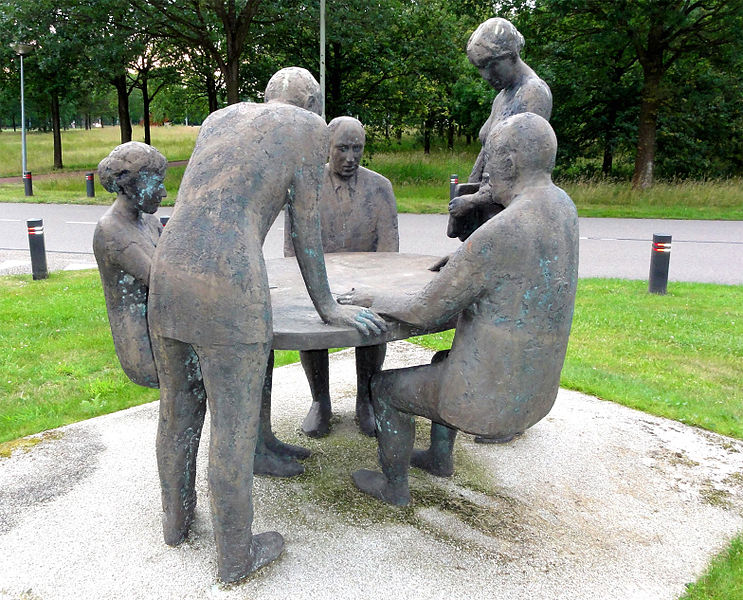
 In a previous post I discussed the “deliberative transformation”, a favorite trope within the theory of “deliberative democracy”. I pointed out that whereas the deliberative democrats see this hypothetical phenomenon as an ideal (maybe the central normative goal of their theory, more important than any policy outcomes), such a phenomenon, if it were really a widespread phenomenon as the deliberative democrats imagine, would be a major obstacle to an allotment-based democratic system (which, it is worth mentioning, is the only theoretically well-motivated schema of a democratic system).
This post considers the ideological structure that is associated with the idea of the deliberative transformation.
It may be claimed that the rather obvious, but of course unadmitted, starting point of the deliberative democracy theory, is that the adherents of the theory are concerned by the fact that the mass of citizens often refuse to support certain ideas that are accepted by the adherents as truth. Classically the reaction to the fact that citizens cannot be depended upon to see things as they are seen by an elite group was to assert that government should be left to those who are enlightened enough to see things as they should be seen. However, in the modern democratic age such crude elitism is unacceptable. Thus, the deliberative democrats seek a cure for the popular disorder. According to this view, deliberation is nothing more than the treatment that the deliberative democrats prescribe to the recalcitrant masses. It is the process which will lead the masses out of the Platonic cave and into the dazzling light of rational thought. If applied correctly, this treatment will inevitably, indeed, by definition of correctness, make the masses accept the objective truths, those that will lead them to support the policy choices preferred by the deliberative democrats.
Continue reading
Filed under: Academia, Deliberation, Sortition | 109 Comments »
 Adam Cronkright
 Ali
Ali Ahmed R. Teleb
 avanderven
 avergne
 Alex Kovner
 azakaras
 Brett Hennig
 campbellwallace
 Simon Threlkeld
 Nick Coccoma
 codyhipskind
 Common Lot Sortitionist
 Conall Boyle
 constitutionalism
 davidschecter
 Ethan McCutchen
 graytmatter
 gtridimas
 Henry Tuttle
 H.J. Hofkirchner
 HpR
HpR James Kierstead
 John Burnheim
 jgarry20151
 Jochen Krattenmacher
 johnedwardtaylor
 johnhuang865
 Jonathan Crock
 keithsutherland
 Jacob Richter
 kkoreilly
 lukewhito
 SimonPek
 Nathan El
 Nicholas Gruen
 Owen Shaffer
 Patrick Chalmers
 Paul Gölz
 peterstone
 Pierre-Etienne Vandamme
 pronfeld
 Emil
Emil rcaze
rcaze richwbrown
 Roger Knights
 roslynfuller
 Pierre-Etienne Vandamme
 shaharavin
 tbouricius
 Ted Wachtel
 Joshua Laferriere
 theodorestathis
 towardsautonomyblog
 Wayne Liebman
 Yoram Gat
 Oliver Milne
