Public Support for Citizens’ Assemblies Selected through Sortition

A new paper explores public opinion in the EU regarding sortition based decision-making bodies. The paper was written by Jean Benoit Pilet, Damien Bol, Emilien Paulis, Davide Vittori and Sophie Panel.

Title: Public Support for Citizens’ Assemblies Selected through Sortition: Survey and Experimental Evidence from 15 Countries

Abstract:
As representative democracies are increasingly criticized, a new institution is becoming popular in academic circles and real-life politics: asking a group of citizens selected by lot to deliberate and formulate policy recommendations on some contentious issues. Although there is much research on the functioning of such citizens’ assemblies, there are only few about how the population perceives them. We explore the sources of citizens’ attitudes towards this institution using a unique representative survey from 15 European countries. We find that those who are less educated, as well as those with a low sense of political competence and an anti-elite sentiment, are more supportive of it. Support thus comes from the ‘enraged’, rather than the ‘engaged’. Further, we use a survey experiment to show that support for citizens’ assemblies increases when respondents know that their fellow citizens share the same opinion as them on some issues.

Trust in government and corona virus deaths

The scatterplot above shows the association between trust in government in EU countries as measured by the Eurobarometer 92 back in November 2019 and the publicly available count of corona deaths per 1M inhabitants as of March 6th, 2021 in those countries (data).

A standard regression (solid line) shows a negative relationship with each percentage point of trust being associated with a decrease of about 15 deaths per 1M inhabitants. (A more robust regression procedure – dotted line – shows even steeper association.) The share of this association is about 15% of the total inter-country variance in corona deaths prevalence in the EU, and about 25% of the variance when the outlying data point of Cyprus is removed.

There are at least two possible mechanisms that could be offered to explain the association. The first is that both trust and corona deaths are affected by government competence. Lower competence is associated with lower trust and with higher pandemic death prevalence. Continue reading →

Sortition in the Harvard CS department

Prof. Ariel Procaccia is giving a course at the Harvard Computer Science department titled “Optimized Democracy”. Procaccia has been writing about sortition for a while and sortition plays an important part in this course’s syllabus:

Students in the course explore the mathematical bedrock of democracy itself, and then build upon those foundations by applying computer science theory to some of the most vexing problems facing modern policymakers.

For instance, one topic covered in Procaccia’s course, sortition, dates back to the very first democracy in ancient Athens. Citizens seeking a position on the Athenian governing committee would self-select into a pool of candidates, intended to be generally representative of the city population, and then magistrates would be chosen by lot.

Fast forward 2,500 years and this method is still being used to form citizens’ assemblies. These assemblies have been used most prominently in Ireland to discuss constitutional reform and in France and the U.K. to debate environmental issues.

But there’s a problem.

“There is this tension between giving everyone a fair chance to participate in the citizens’ assembly, and this idea that we want to represent the population at large. The people who volunteer have a large self-selection bias,” he said. “That leads to very compelling algorithmic questions of how to balance these issues.”

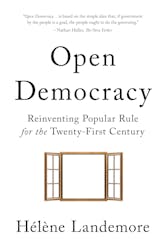
Landemore: Open Democracy, part 5

Rejecting “realism”

One of the strengths of Open Democracy is its normative ambition. Rather than lecturing readers about the need to be realistic and to accept elitism in various ways, Landemore insists that the democratic ideal of political equality should be taken literally. Calls for various forms of compromise are the norm throughout the scholarly literature of democracy. Often such calls are to some extent implicit (e.g., Dunn, see part 2 of this post series). Occasionally they are unabashedly explicit. In this genre Landemore focuses her wrath on Achen and Bartels.

Achen and Bartels take the Lippmann-Schumpeter-Dunn line of argument one step farther by explaining to their readers that while their impression that government does not in any way reflect public opinion is wholly justified by the facts, their frustration with this situation is wholly due to unrealistic expectations. Democracy implies elections, elections imply elite control, and elite control implies unresponsivity. It’s time to be realistic and readjust our expectations.
Continue reading →

Landemore: Open Democracy, part 4

Landemore describes (p. 34) Bernard Manin’s analysis of the electoralist regime as a mixed regime whose oligarchical element is the use of elections which favor those who have a chance to be elected and whose democratic elements are the periodic renewal of the mandate and – to a lesser extent – from the principle of the freedom of opinion and from public debate of ideas. She then discusses how this regime is defended by two normative political scientists: Nadia Urbinati and Jurgen Habermas.

For Urbinati this regime is democratic because representation is “a mode of participation that can activate a variety of forms of control and oversight”. The representatives supposedly give voice to their voters and create an alignment between voters’ wishes and actual policy outcomes. Landemore rejects this “metaphorical” participation as being unconvincing.

Landemore describes Habermas’s model as resting on deliberation in two tracks – the mass track and the decision-making track. Landemore sees the model as lacking an explanation of how the mass track influences the decision-making track in a meaningful way. Even if it did, she asks, how is the unregulated mass discussion a proper way to set the decision-making agenda? In particular, mass deliberation inevitably leads, Landemore says, to the formation of parties and thus to partisanship which is antithetical to deliberation.

In short, Landemore points out, what seems like a fairly straightforward point, that “deliberative democracy” is some combination of naive wishful thinking and apologia for the status quo. What is less straightforward is why, given that Landemore recognizes that this is the case, she continues to “embrace” this theory of democracy.

The road not taken

In the second section of chapter 2 Landemore asks why the new regimes of the end of the 18th century represented an ideology of competence of virtue of the leadership rather than an ideology of mirroring of the people or a leadership which is “the people in miniature” – when both ideologies were available and discussed at the time. One possible answer, which Landemore attributes to Yves Sintomer, is that the missing ingredient was a grasp of statistical sampling. Another answer is Manin’s claim that the notion of consent of governed, expressed through voting, was dominant.
Continue reading →

Landemore: Open Democracy, part 3

The crisis of representative democracy

Landemore again goes to the heart of matters when she states at the beginning of chapter 2:

My main point in this chapter will be to trace a certain understanding of the “crisis” of contemporary democracy not so much to contingent external factors (though they obviously play a role) but, rather, to the more fundamental democratic flaws in representative democracy’s original design. The main problem, I will argue, is that representative democracy was designed on the basis of electoral premises that prevent even its best, most democratized contemporary versions from reaching the full potential of genuine “popular rule”, that is, a rule that empowers all equally.

Due to these democratic flaws

the cognitive dissonance between the reality of the regimes we live in and the democratic expectations people attach to them can only grow over time.

Too often the crisis of confidence in electoralist regimes is attributed to a plethora of circumstances that are supposedly incidental, non-inherent to the regime itself: everything from globalization to technological change to polarization to Putin. In contrast, Landemore’s agenda is refreshingly clear and principled. While accepting that at least some of those phenomena have their effects, she does not see these are being root causes but, to they extent they are influential factors, as being symptoms of the root causes that are inherent to the electoralist system (p. 32).

It is unfortunate that this clarity is attenuated again by the mandatory gesturing toward propriety. First, why would Landemore write about a design that “fails to empower all equally” because it is based upon “mistaken premises” if by her own account the electoralist design had explicit anti-democratic objectives? Implying that the founders were incompetent democratically minded law-givers is somehow more acceptable, it seems, than maintaining consistency with the previous analysis and inferring that the founders quite competently designed an impressively successful anti-democratic system.
Continue reading →

Landemore: Open Democracy, part 2

“Open”

Revisiting briefly the matter of the title of the book: In Part 1 I objected to Landemore’s choice of the term “open democracy” to describe her ideal for government. In short, I find that the word “open” is essentially meaningless and I suspect that the reason for using it as a modifier is that doing so allows to apply the word “democracy” (as in “closed democracy”) to the existing Western eletions-based regimes. On page 15 of the book, Landemore herself notes that the term is already used and abused in politics – as when it refers to transparency. Landemore also makes the connotation of open-source software explicit and claims that there is a likeness between “open democracy” and open source software because “in a democracy the law should be something to which all have access and on which all can make an impact. Everyone should be able to write and claim authorship over the law”. Again, this is too vague to be useful. It is certainly not true at all that open-source software is democratic in any meaningful sense. For one thing, open source is often financed and controlled de-facto by powerful interests. In fact, if anything an analogy may be drawn between open-source software and the “closed” electoral system where a superficial, formal equality is a mask for inherent systemic inequality.

Technology, direct democracy

Too often political reform advocates have a laissez faire “it’s all good” attitude and they embrace any proposal that is making the rounds. Having an “open mind” may sound like a good idea, but in fact not examining proposals critically is recipe for dissipating energy and missing rare opportunities for change. Landemore does not make this mistake. Despite the invocation of the open-source connotation, Landemore explains that her book is not about democracy through technology. This is good. The barriers to democracy are not technological and focusing on technological solutions is therefore a distraction. Another thing Landemore is explicitly not offering is the “antiquated and largely impractical ideal of direct democracy” (p. 17) – a system where mass participation is a central feature. Her reasoning will be laid out in chapter 3 of the book, so it remains to be seen how convincingly it is argued that this is not the right way forward. But argumentation aside, the conclusion is the right one in my opinion. Rejecting mass participation is therefore an important step in clearing the ground for better ideas.

What is an elite?

On page 18 Landemore has an important clarification of the term “elites”. She writes:
Continue reading →

Landemore: Open Democracy, part 1

I have recently started reading Hélène Landemore’s book Open Democracy (2020, Princeton University Press). Having gone through the first two chapters, I find the book very useful and I highly recommend it. Despite its somewhat clichéd title, and despite the occasional bow toward the self-serving traditional Western theory of democracy, Landemore is in fact offering (it seems so far, I should say) a rather radical critique of the status quo and does not shy away from throwing some heavy punches at theorists who in one way or another defend oligarchical ideologies. In fact, Landemore presents – even if intermittently and obliquely – a thoroughgoing critique of the elections-based system that is not only better argued than, say, that of Van Reybrouck, but also more radical than his. I can’t think of a comparable book from a mainstream US political scientist. (Maybe Dahl’s A Preface to Political Theory?) The fact that Landemore, now at Yale, is originally French, may be playing a significant role.

Here is a first installment of my comments. I hope to have quite a few more posts discussing Open Demcoracy.

“Open Democracy”

To start: the title, “Open Democracy”. This does not bode well. Is there such a thing as a “closed democracy”? Is this making an implied assertion that our current system is a closed democracy, while we should be aiming at an open democracy? The term “open” has the odor of a buzzword (as in “open source”) – a feel good term which like “democracy” itself, or “people power”, could really mean anything.

On page 2 (I am reading the electronic version, so page numbers are approximate), when discussing what are supposedly historical examples of democracies, Landemore gives what seems like a definition of “open democracy”: a situation where “in theory”, any member of the political community “could access the center of power and participate in the various stages of decision-making. Citizens could literally walk into the public space to be given a chance to speak and be heard”. This is contrasted with the modern situation where “many have the feeling” of being “left out of the most important centers of political power, while the political personnel form an elite that is separate from them”.
Continue reading →

Chevallier: The chic populism of participative democracy

A column by Arthur Chevallier in Le Point is yet another condemnation of the allotted committee monitoring the French vaccination campaign. The author sees the creation of the committee as a sign of weakness and hesitation. The government, he asserts, must act resolutely and dispose of attempts to over-communicate.

Chevallier is an editor at Passés composés and the author of the book “Napoléon et le Bonapartisme” published by Que sais-je ?.

The chic populism of participative democracy

Jan. 5, 2021

The allotment of 35 citizens to follow the vaccination campaign was aimed to be the perfect exercise in communication. It turned out to be the opposite.

Democracy is not about weakness. It is not about the promotion of amateurism. The creation of a committee of 35 allotted citizens which is supposed to follow the vaccination against Covid-19 invited mockery. What should have been proof of transparency turned into evidence of failure. If criticising the management of the crisis is less a matter of courage than of cynicism, since the matter is not as easy as it may seems, it is still necessary to denounce the unhealthy attempt to compensate for lack of efficacy by populism. Horizotalization of power is an illusion. Democracy did not gain its prominence by getting amateurs to run complex matters, but rather by its successes.

Without being aware of it, progressivism gives way to a stereotype of recationism. Since the 19th century, an ideology which may be called counter-revolutionary mocks democracy for being “feminie”, attaching to it labels such as the well-known “prostitute”, and hurling insults claiming that it is incapable of creating a powerful and harmonious state. History proves the opposite. Democracy is in fact quite often a radicalization of politics. In antiquity, Athens was at its height of power and imperialism at the 5th century BC, being its age where its democracy attained its most sophisticated form.
Continue reading →

Sortition has progressed, it seems, into the ridicule phase

As Mahatma Gandhi didn’t say:

First they ignore you. Then they ridicule you. And then they attack you and want to burn you. And then they build monuments to you.

The fondness of the Macron administration for allotted bodies has prompted the following piece by the satirical site Francheinfo. Marlène Schiappa is Macron’s assistant minister in charge of citizenship.

Marlène Schiappa is going to allot 15 citizens for a free Brazilian hair straightening

Democracy above all else, like in ancient Greece, Marlène Schiappa has chosen to use sortition in order to select 15 citizens of all origins, religions and hair types as winners of Brazilian hair straightening at the Ans Brazil salon.

“Under current conditions, we must allow the French people to enjoy soft and silky hair, such as mine, all for a reasonable price as offered at Ans Brasil. This is first of all a matter of social justice. Whether one lives at Aulnay or at Poissy sur Brie, we must allow French people’s hair to be nourished from its tips to its roots, with a sufficient dose of keratin so that it does not become brittle,” explained the minister for citizenship and for the hair-growing areas of the skin.