Southall: A proposal for using sortition in South Africa

A 2017 paper by Roger Southall in Politikon, the South African Journal of Political Studies, proposes applying sortition in South Africa.

The Case for Sortition: Tackling the Limitations of Democracy in South Africa

Roger Southall, University of Witwatersrand, Johannesburg, South Africa and the Department of Political Studies, University of Cape Town, Cape Town, South Africa

Abstract

This article considers how the erosion of democracy in South Africa since 1994 might be addressed through sortition, the random selection of citizens to perform public tasks. Drawing upon the recent essay outlining the case Against Elections by David Van Reybrouck [(2016). Against Elections: The Case for Democracy. London: Bodley Head], which paints liberal democracy as facilitating rule by elites, it argues for the appointment of sortition panels to consider reform of the electoral system. Sortition in South Africa could draw upon streams of participatory democracy experienced during the struggle against apartheid, and lead towards a more deliberative democracy.

Dan Hind: The Cooperative State

Dan Hind proposes using sortition to achieve a “cooperative state”.

Rather refreshingly Hind rejects the “modernization” argument:

I do not propose far-reaching constitutional change in Britain or the United States because the current arrangements are irrational or anachronistic. On the contrary, these arrangements are, for the most part, rational and frighteningly up-to-date.

Hind’s proposal is an elections-sortition hybrid:

The idea is not to do away with elections. Some offices require technical abilities or experience and election does not seem like a terrible way of filling them, even if at times it is hard to imagine a worse person for an elected office than the person holding it. But it does not follow that public office should be monopolised by those who, for whatever reason, manage to win an election. Indeed, if representation is to retain its authority, it will have to be supplemented by more properly democratic institutional forms.

Hind seems to fall into an obvious fallacy: the simple point that not every position should be filled by lot does very little to advance the argument that some positions should be filled by election.

That said, Hind does propose to invest allotted bodies with some real powers of oversight:
Continue reading

Upcoming event: Selina Thompson in conversation about sortition with Maddy Costa

An upcoming event in the Arnolfini arts house in Bristol.

Sortition: Selina Thompson in conversation with Maddy Costa
Saturday 03 November 2018, 18:30 to 20:00

Following a year of research and exploration, this is your chance to hear from artist Selina Thompson about the thoughts and ideas behind the development of the project Sortition.

The research included the hosting of a week-long Sortition boot camp with twelve young people from across the country here at Arnolfini, and an investigation into what Sortition might look like in both a gallery and theatrical context.

At this new event which is part of 14-18 NOW and its series Represent reflecting on the centenary of the first women gaining the right to vote, Selina Thompson takes some time with critical thinker Maddy Costa to reflect together on the future of democracy, and what the role of artists and the participatory contexts that they create might play in this.

Hannah Arendt Center’s Bard Institute for the Revival of Democracy Through Sortition

The Hannah Arendt Center for Politics and Humanities at Bard College is introducing the Bard Institute for the Revival of Democracy through Sortition:

Introducing the Bard Institute for the Revival of Democracy through Sortition

True Democracy as Practiced by the Ancient Greeks

“The appointment of magistrates by lot is thought to be democratic and the election of them oligarchic.” —Aristotle, Ancient

Sortition (noun) – The action of selecting or determining something by the casting or drawing of lots.

The Bard Institute for the Revival of Democracy through Sortition is conceived as a critical platform to assemble the diverse research and resources that are emerging around deliberative democracy and sortition. We are a project of the Hannah Arendt Center at Bard College, and place much importance in the association with her legacy of thought. We believe sortition satisfies Hannah Arendt’s ideal of political freedom and that it would have figured in her writing, had it not been buried in the history books. As investigators of the practical possibilities of this ancient and reviving model of democratic decision-making, we are based in Germany, the United States, and wherever else our research may take us.

The Institute was cofounded by recent Bard College graduates Jonas Kunz and Hans Kern. Check back with us soon for updated content, links to sortition in the news, and much more. Sign up by email to receive updates on the Institute’s activities.

Tim Dunlop: It’s time to replace voting with sortition

In 2014 Tim Dunlop had just been introduced to the idea of sortition by David Van Reybrouck. He was “not completely convinced by his [Van Reybrouck’s] argument, but [was] sufficiently incensed by our current parliamentary democracy and its many failures to at least consider what he suggests.”

Four years later, Dunlop has written a book advocating sortition, and has an article in the Guardian that opens with an unambiguous statement:

If we want to fix the way our governments work, the first thing we should do is replace voting with sortition in at least some of our governing bodies.

Like many feel-good reformists, Dunlop puts much emphasis on the potential for fostering deliberation, trust and respect amongst the members of the allotted chamber and by extension, in the population at large. However, bucking the norm among such reformists (including Van Reybrouck), Dunlop’s message is very clearly democratic in the most fundamental sense (i.e., making power representative) and his rejection of elections and its elitist implications is uncompromising.

If we are really serious about bottom-up reform of our democratic institutions, then reforming the seat of government itself in this way, a way that installs ordinary people at the heart of power, is essential. Our neoliberal economy and the representative form of government that dominates our societies do everything they can to divide us from and pit us against each other. A People’s House transcends these divisions and brings us together. The basic concept of sortition is pretty straight-forward, and introducing it as a replacement for voting in, say, the Australian Senate, while leaving that body’s other powers intact, represents, at least administratively, fairly minimalist change. But on every other level, the potential effect is explosive. In one fell swoop, you diminish the power of the parties and that of many of the lobbyists who exist to influence their decisions. You transform the way in which the media covers politics. You hand control of at least part of the legislative process to a genuinely representative sample of the population as whole, rather than vesting it in a bunch of elites and their representatives. You empower people in a way that the current system could never hope to do, and you reconnect our chief democratic institution with the life in common.

Nothing is going to change until the main source of power in our society, our seat of government, is populated by people who are genuinely representative of the society at large. We have been taught forever that the way to do that is by voting, but that is simply wrong, and the quicker we unlearn it the better, no matter how counterintuitive it might seem at first. If you want a truly representative government of, by and for the people, then you need to choose it not by voting, but by sortition.

1768: Scheme of a Political Lottery, for the Peace of the Kingdom

The following letter to the Political Register and Impartial Review of New Books, printed in London in 1768, offers sortition of parliament as a way to remedy the corruption of elections. Thanks to Terry Bouricius for drawing attention to this historical piece.

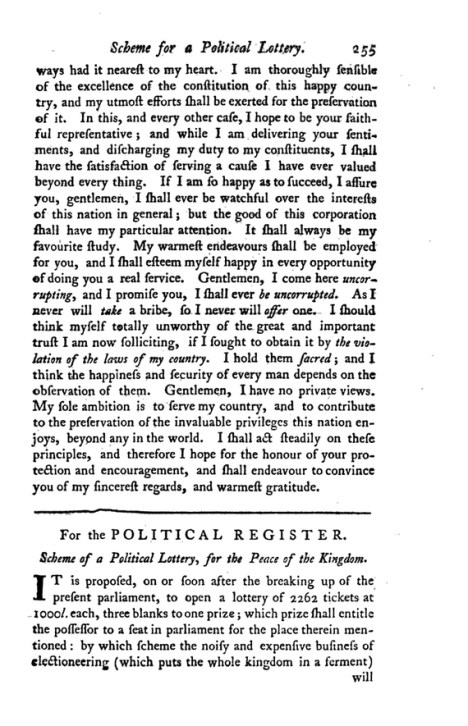
Scheme of a Political Lottery, for the Peace of the Kingdom

It is proposed, on or soon after the breaking up of the present parliament, to open a lottery of 2262 tickets at 1000l. each, three blanks to one prize; which prize shall entitle the possessor to a seat in parliament for the place therein mentioned: by which scheme the noisy and expensive business of electioneering (which puts the whole kingdom in ferment) will be over in two hours, many people have an opportunity of serving their country cheap, and much bribary and corruption be prevented.

The the produce (deducting five per cent. to be set apart for guzzle, and to be equally distributed in every borough) be applied towards paying the national debt. That the lottery be drawn in the court of requests, on the day appointed for the meeting of p——t, and that the members so elected do immediately adjourn to the house of commons, appoint a speaker, &c. and then proceed to business. This will effectually prevent all designs of bad ministers, and more especially if their tools should draw blanks, as no person can have more than one ticket, and that not transferable; lest the courtiers, nabobs, or adventurers, should engrose the whole and buy and sell the nation.

Sortition advocate arrested for allegedly planning to blow himself up on election day

On October 10th, various news outlets have reported that the FBI has arrested Paul Rosenfeld in NY, USA for allegedly planning to blow himself up with the goal of drawing public attention to the idea of sortition. The New York Daily News writes:

Rockland County man arrested for building 200-pound bomb, plotting to detonate it in DC on election day

A Rockland County man who cops say built a 200-pound bomb he was planning to explode in Washington, D.C., in an Election Day suicide attack was arrested Wednesday.

Paul Rosenfeld, 56, of Tappan, was busted on federal charges of manufacturing an explosive device.

“As alleged, Paul M. Rosenfeld concocted a twisted plan to draw attention to his political ideology by killing himself on the National Mall in Washington, D.C. — risking harm to many others in the process,” U.S. Attorney Geoffrey S. Berman said.

“Rosenfeld’s alleged plan for an Election Day detonation cut against our democratic principles.”

NBC News write:

New York man wanted to blow himself up on the National Mall on Election Day

Paul Rosenfeld was arrested on charges that he built a bomb and planned to kill himself with it to draw attention to beliefs in ancient election system.

The FBI has arrested an upstate New York man accused of building a bomb that he intended to use to blow himself up on the National Mall in Washington, D.C. on Election Day, authorities said Wednesday.

Court documents say Paul Rosenfeld, 56, of Tappan, wanted to draw attention to his belief in “sortition,” the ancient practice of randomly selecting legislators out of a pool of eligible voters.

The press release by the U.S. Department of Justice is here.

In 2015 Paul Rosenfeld has published an essay on Equality by Lot titled “The Extinction of Politics“. The article has been linked to by some of the reports of the arrest.

Mencken: A Purge for Legislatures

The book A Mencken Chrestomathy contains a reprint of an article by H.L. Mencken called “A Purge for Legislatures”. The article, originally published in 1926, may be the first modern piece of advocacy for sortition. Thanks to Roger Knights for writing to draw attention to this article.

A MOOD of constructive criticism being upon me, I propose forthwith that the method of choosing legislators now prevailing in the United States be abandoned and that the method used in choosing juries be substituted. That is to say, I propose that the men who make our laws be chosen by chance and against their will, instead of by fraud and against the will of all the rest of us, as now. But isn’t the jury system itself imperfect? Isn’t it occasionally disgraced by gross abuse and scandal? Then so is the system of justice devised and ordained by the Lord God Himself. Didn’t He assume that the Noachian Deluge would be a lasting lesson to sinful humanity — that it would put an end to all manner of crime and wickedness, and convert mankind into a race of Presbyterians? And wasn’t Noah himself, its chief beneficiary, lying drunk, naked and uproarious within a year after the ark landed on Ararat? All I argue for the jury system, invented by man, is that it is measurably better than the scheme invented by God. It has its failures and its absurdities, its abuses and its corruptions, but taking one day with another it manifestly works. It is not the fault of juries that so many murderers go unwhipped of justice, and it is not the fault of juries that so many honest men are harassed by preposterous laws. The juries find the gunmen guilty: it is functionaries higher up, all politicians, who deliver them from the noose, and turn them out to resume their butcheries.
Continue reading

Hugo Bonin: Democracy by lottery

The newspaper Le Journal de Montréal has an article by Jacques Lanctôt about Hugo Bonin’s book, La Democratie Hasardeuse [Original in French, my translation].

Games of chance in politics

“With luck, things will turn out well.” Who has not heard this saying at some point? A chance encounter, a decision taken offhandedly, a delay that turned out for the best, any of those may change our life.

Hugo Bonin believes that luck may be beneficial in politics as well even if it is not a magical solution to all our problems of representation. In a well structured essay, well supported by numerous concrete examples stretching as far back as antiquity (Athens and Rome) and where a future that is almost within our reach is imagined, Bonin aims to show that sortition is a hundred-fold better than the so-called representative elections.

Sortition has its limits but its great merit is that it takes no account of distinctions between races, genders, ages or social classes. John and Jane Doe are worth just as much as the elitist clique of doctors, lawyers and businessmen who have been governing us for too long a time.

More “egalitarian”
In an electoral regime such as the one know here and elsewhere in the West, the voters vote to elect the supposedly better candidate. While in an allotment system, the notion of “better” does not exist because everybody are equally politically qualified. Thus, this is “an egalitarian and a democratic procedure” where all external considerations are excluded.

Random selection is already practiced here in Québec and elsewhere. We need only consider jury selection in a criminal trial. Made of lay people rather than experts, following the British law, this jury is called upon to analyze the evidence and render a decision after deliberation.
Continue reading

Wafawarova on sortition

Reason Wafawarova, columnist in The Herald of Zimbabwe, concludes a column in which he decries the disfunction of the the electoral system in Zimbabwe with the following:

Imagine having to develop a system today that would express the will of the people. Would it really be a good idea to have them all queue up at polling stations every five years with a bit of card in their hands and go into a dark booth to put a mark next to names on a list, names of people about whom restless reporting had been going on for months in a commercial environment that profits from restlessness?

We care deeply about our community, and we as people want to be heard. Maybe we can return to the central principle of Athenian democracy; drafting by lot, or sortition. In that era the majority of public functions were assigned by lot.

Renaissance states such as Venice and Florence worked on the same basis and experienced centuries of political stability. With sortition, you do not ask everyone to vote on an issue few people really understand, but you draft a random sample of the population and make sure they come to grips with the subject matter in order to take a sensible decision.

A cross-section of society that is informed can act more coherently than an entire society that is uninformed.

This perhaps brought about the idea of representative democracy or parliamentary democracy, but do our parliamentarians always act in our best interest?