News Limited sings the praises of sortition

Vikki Campion writes in news.com.au about the wonders sortition can do for those communities looking for ways to save money:

Consulting the people – radical approach to democracy

THEY sacked sister cities, slashed mowing services and cut spending on glossy council brochures.

A pilot panel of 36 randomly selected mums, dads, students, retirees and pensioners have taken hold of Canada Bay Council’s budget for the next four years, slashing and burning inefficiencies and finding new revenue to address its mounting infrastructure backlog.

The pioneers were guinea pigs in an Australian-first method of community consultation which could be the future for cash-strapped councils which need to cut waste instead of raising rates.

Continue reading

Beyond the principle of distinction

The primary negative effect of the electoral system is the obverse of its ostensible function. This effect is what Bernard Manin called “the principle of distinction” – the delegation of political power to people whose situation and outlook is significantly different from those of the population at large. As a result of this difference, the political elite serves interests that are different from, and often antithetical to, those of the average voter.

However, the electoral system is often presented by academic advocates and by electoral activists and politicians as providing a value to society above and beyond its function for selecting government officials. It supposedly encourages meaningful popular participation in government through voting, informed discussion, organized activism in electoral campaigns and awareness of the importance of compromise and coalition building. In fact, the electoral system encourages none of those patterns – on the contrary: it is antithetical to them. This is due to several characteristics of the electoral system that do not follow from the principle of distinction.

1. Politics as competition The electoral system is a mechanism in which groups compete for power. Allocation of power through competition has several related effects:
Continue reading

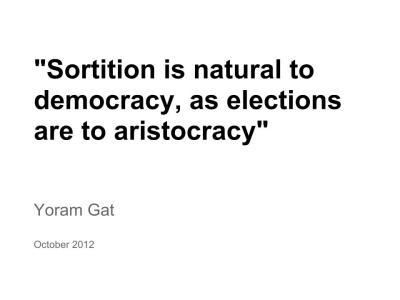
Sortition is natural to democracy, as elections are to aristocracy

An introductory presentation about sortition for a talk I’ll be giving to a general audience. Comments are welcome.

“Why Occupy Fizzled?”

September 17 was marked as the anniversary of the Occupy Wall Street movement. While the dismissal of the movement as a spent force by its opponents including corporate mass media is only to be expected, it seems that the feeling that this movement has reached the limits of what can be achieved with its past tactics is shared by sympathetic observers.

Matt Taylor at The Daily Beast offers an analysis that is to a large extent an establishment point-of-view, but makes some valid points as well:

As Occupy Wall Street protesters geared up to mark their first anniversary in Manhattan on Monday, they found themselves operating almost alone, without much of the outside support from celebritieslabor unions, and other progressive groups and leaders that had helped to create a palpable sense of momentum last fall.

[…]

But it would appear that, some tepid local union supporters in the city notwithstanding, the broader progressive coalition—including organized labor—is sitting this one [the anniversary] out, having seen the Occupy movement descend into internal squabbling in recent months over how, and whether, to engage the political system directly.

Continue reading

Chouard: No democracy without sortition

An interview with Etienne Chouard in Ragemag magazine (translation by Google Translate, with my touch-ups):

Is sortition the future of democracy?

Sortition is not the future of democracy, it is inseparable from democracy; it is a much stronger link than a chronological phase: there is no democracy without sortition.

Chouard also considers the popular initiative mechanism as a major democratic component (mistakenly, in my opinion):

What is a popular initiative referendum?

PIR (or CIR: Citizen-initiated referenda) is the institution that guarantees the people that it is possible, on the people’s initiative at any time, to regain control of the legislative process and components. It is central. The popular initiative referendum exists in a few countries in the world: in Italy, half of the United States, Venezuela and Austria, for example. In France, in 2008, the parliament, by government orders, revised the constitution to establish what they fraudulently called (I weigh my words) a “popular initiative referendum.” Just read Article 11 to find that this is a referendum on parliamentary initiative. Our so-called “representatives” so openly mock us. We do not have a democracy: we have a plutocracy.

Thomas Fleming: Down With Democracy!

Thomas Fleming, editor of the American monthly Chronicles: a Magazine of American Culture, author of several books on ethics (The Morality of Everyday Life) and politics (Socialism, The Politics of Human Nature), contributor to newspapers, magazines, and academic journals on both sides of the Atlantic, and formerly a professor of Greek and Latin at several universities, is again proposing following the Athenian example.

It turns out that the American political system had been in reasonably good shape until Martin Van Buren copied the party system from the UK, and in doing so put the US government on the path of corruption. The final nail in the coffin, Fleming asserts, was the institution of primaries, replacing the corrupt but still useful party leaders as the determinants of party candidates.

Taking a break in dispensing dubious historical synopses, Fleming moves to the present:

If this is democracy, I am ready to try an alternative.  Whenever anyone dares to criticize democracy, he is inevitably slapped down with Churchill’s witticism that democracy is the worst form of government except for all those others that have been tried.  What neither Churchill nor his millions of quoting admirers have ever explained is what they mean by democracy. Indeed, after decades of studying political theory–and discussing such matters with the learned and the wise–I still have no clue as to what people mean when they use the word, other than their opinion that democracy is decidedly a good thing.

Cheerleaders for democracy, the American way of life, and my sweet old etcetera tell us that the principles of one man/one vote and representative government are the essence of our democratic liberty. Interestingly, the people who are credited with inventing the institution and certainly gave us the word–I mean of course the Greeks–did not regard elections as particularly democratic.

Continue reading

Nicholas Wood has been reading Andrew Dobson

A letter to the Kenyan Sunday Nation:

Let’s do away with elections altogether

Saturday, September 1, 2012

I agree with columnist Murithi Mutiga’s argument last Sunday about elections. Do away with elections and go for selection by lot.

In a stroke, party/tribal politics loses all meaning. Campaigning becomes obsolete.

A body of people representing all walks of life without vested interests sits in the House.

The process is simple, cheap and fair. It is not on the Western liberal model either.

As Prof Dobson of Keele University (UK) wrote in The Guardian recently [see here], if this was good enough for the ancient Greeks, who invented democracy, why not for us?

Nicholas Wood, Mombasa.

Lanni and Vermeule: Precautionary Constitutionalism in Ancient Athens

Harvard Law school professors Adriaan Lanni and Adrian Vermeule discuss sortition among other Athenian political mechanisms. They write:

In the ancient Greek world, selection of magistrates by lot was nearly synonymous with democracy. One of the most important functions of the lot in the Athenian democratic structure was to prevent any individual magistrate from amassing too much power and thereby threatening the sovereignty of the popular Assembly. We argue that the lot, taken together with the principles of rotation and collegiality, operated as precautionary measures against individuals gaining too much influence. Continue reading

Gary Gutting: Should We Cancel the Election?

Gary Gutting is a professor of philosophy at the University of Notre Dame, and an editor of Notre Dame Philosophical Reviews. Mark Fredrickson found a post of his on the New York Times online opinion pages. The post is set up as a dialog between the author and Socrates. It is a typical mix of valid points and elitist dogma.

SOCRATES: I’m against it.

GUTTING: I see what you mean. It’s going to be nasty, brutish, and long — not to say immensely expensive — but of course if we want a democracy, there’s no alternative.

S: I disagree. You shouldn’t hold the election at all. You should flip a coin instead.

G: You don’t see any difference between Obama and Romney?

S: Oh, I do. I’m very impressed with Obama, no question. He’s intelligent, courageous, self-controlled and has a good sense of justice. Just the sort of person I had in mind for my philosopher-rulers. But none of that’s going to make a difference to the American voters. The election’s likely to be close, and in any case the outcome will turn on the October unemployment report, the price of gas, an Israeli attack on Iran, who has the most money for attack ads in the last two weeks or some other rationally irrelevant factor that you don’t yet have any hint about.

G: But surely you’d prefer to let Obama make his case to the American people rather than let blind chance decide the outcome?

S: I think letting the American people decide is no different from leaving it to chance. The vast majority of you don’t know enough about the issues or the candidates to make anything like a reliable decision. (It was the same in Athens in my day.)
Continue reading

Online discussion of lottery voting

Jon Roland writes:

I will be on along with Eric Liu, former Clinton speechwriter and adviser, and others.

Here’s the link to the topic we’ll be discussing:

http://digitalcommons.law.yale.edu/cgi/viewcontent.cgi?article=1963&context=fss_papers

Other sites for this topic:
http://sortition.net
http://constitution.org/cs_elect.htm

Watch us on @HuffPostLive tonight, 8/13/12, 8:00pm CT live.huffingtonpost.com